
Kekionga Ball Grounds (Fort Wayne, IN)
This article was written by Bill Griggs - Jim Nitz
Fort Wayne, Indiana, has hosted only 12 major-league games in its long association with professional baseball, including the final game of a ten-game postseason series between Chicago and Providence of the National League in 1882. However, one of those 12 contests was the very first major-league game, played in 1871 at the Kekionga Ball Grounds.1 Only eight other professional games were played at this site.
The games were played north of the former Fair Grounds, which had been converted to a Civil War staging area originally christened Camp Bayless2 and renamed Camp Allen in August 1861 to tie the area to Allen County, of which Fort Wayne was a part.3 The entire area, including the ball grounds, became commonly known as Camp Allen. The ball field was usually referred to by variants of “Camp Allen grounds,” “old Camp Allen,” or even “the old camp grounds west of the St. Marys” until the Grand Duchess, a wooden grandstand, was built in May 1870.
Most sources indicate that the Kekionga team played at Hamilton Field, in downtown Fort Wayne. The confusion stems from 1862, when a prominent banker, Allen Hamilton, allowed the Summit City Base Ball Club, of which his son Allen was a member, to use the property behind his homestead for its Monday afternoon intrasquad games.4 There is no newspaper record of games being played there after 1863. The elder Allen Hamilton died in 1864 still holding title to the property. It was platted by his heirs on June 24, 1865, as part of Hamilton’s Third Addition and used thereafter for commercial purposes. After the war the family allowed games to be played on their holdings south of the railroad which became the original Kekionga grounds.
Hamilton originally owned the west quarter of section 11-30-13 in Allen County, an area approximately one mile by a quarter-mile. His homestead lay in the northeast corner, the Summit City grounds in the northwest corner. The area south of Hamilton’s homestead was an open field consisting of well over 100 acres, which became known as “the Hamilton field.” (The term “field” was generic and had no relationship to baseball.) Hamilton’s heirs also owned property north of the city also referred to as “the Hamilton field,” which became the city’s first golf links in 1900.5
The Kekionga team was founded on June 28, 1866,6 and played its first game, between its first and second nines, on July 4 at 7 A.M. on grounds described as south of the Pittsburgh, Fort Wayne, and Chicago railroad depot.7 Within the month, the team received permission from the Hamilton family to utilize and improve as their home grounds a 400-foot-square tract8 south of the railroad depot between present-day Williams, Barr, Wallace, and Calhoun streets.9 At that time, the south 90 acres of the Hamilton field had yet to be developed. The proposed grounds lay within the northwest corner of the remainder. Combining all sources, we find that the Kekionga Grounds lay within the north 660 feet (the distance between Wallace and Williams) of the west 400 feet of the property south of present-day Wallace Street, approximately 700 feet south of the railroad. These original Kekionga Grounds were usually referred to as “their grounds, south of the railroad”10 or simply “the Railroad Grounds”11 by the local newspaper.
Historians later confused the original 1862 Summit City grounds with the Kekionga Grounds and created a fictional ballpark named Hamilton Field that many sources still cite as the site of the first major-league baseball game. No such baseball park ever existed. There is no known written record of the area being known as the Hamilton field until well after Kekionga vacated the area. The expression “Hamilton Field” without “the” as a preceding definite article and with a capitalized “F” is not found in the written record until well into the 20th century. In any case, Kekionga permanently vacated these grounds after the 1868 season.
The amateur Kekionga team played games at several other sites, including the former State Fairgrounds, now known as Lawton Park.12 On July 4, 1867, the team’s first and second nines played their first known game at Camp Allen.13 They used the site for several more games, then moved there permanently in 1869, but it is impossible to discern whether the choice of the Camp Allen grounds was Kekionga’s or their opponents’.
The Camp Allen grounds were located in the peninsula formed by the Ox Bow of the St. Marys River, one street south of Front Street, also known as the Cemetery Road, now West Main Street, bordered by Elm Street on the north, Cherry Street on the east, Bluff Street, now vacated Camp Allen Drive, on the southeast, Fair Street on the south, and Mechanics Street on the west. The property was legally described in a petition to close off adjoining streets by the erection of a new fence, as lots 51 -91 in the plat of Rockhills Second Addition,14 shown below, which had been platted on July 14, 1854.
The plat stretched on the north to Front Street, later renamed Main Street after its annexation, which provided easy access via the Bluff Street Bridge, which lay immediately southeast of the present Carole Lombard Bridge over the St. Marys River. There was no access south of Main Street until well after the demise of the team and then only by a walking bridge over the St. Marys River to Swinney Park. The entire neighborhood was nicknamed “Nebraska,” according to local legend, because it was thought to be so far away and cut off by the river from the city proper that it might as well have been in Nebraska.
The 1871 Fort Wayne Guide Map clearly shows the location of the Ball Grounds, but offers no clue as to its orientation, dimensions, or features. No other pictures, maps, or drawings are known to exist of America’s first league ballpark. It is not clear whether the area between Mechanics Street and the river was part of the grounds or additional property leased by the team, or whether lots 64-69 should have been excepted from the legal description cited above.
On May 22, 1869, Camp Allen hosted the renowned Cincinnati Red Stockings, who won 41-7. Temporary seating was provided to augment Mother Nature’s bare ground.15 Twelve days earlier, Kekionga had visited Cincinnati’s Union Grounds and lost 86-8, becoming the Red Stockings’ second victim (excluding two earlier games against picked nines) of its eventual 57-0 season. Union Grounds featured a central grandstand for ladies nicknamed The Grand Duchess,16 which Kekionga used as the model for its own grandstand.
In 1870 Kekionga wished to host many of the major professional teams including the Red Stockings, White Stockings, Philadelphia Athletic, Rockford Forest City, and the Baltimore Marylands. After nearly signing a lease to move to the Summit City Skating Park,17 just north of present day Main Street, they settled upon returning to Camp Allen. Interestingly enough, many members of the team had participated in baseball games on ice skates at the Skating Park during the winter of 1868.18
The team sold 100 season tickets, which raised $500 to help finance its own central grandstand. The grandstand was christened the Grand Duchess after its Cincinnati counterpart.19 The Fort Wayne Daily Gazette of March 23, 1871, noted that a season ticket allowed both a “gentleman and a lady” to all games for $5, which assured a disparity between the number of attendees and tickets sold.
The May 21, 1870, Fort Wayne Daily Gazette, describing the Grand Duchess, reported:
“The Kekiongas have a splendid ground for playing upon this year. They have six acres enclosed with a high, tight board fence, measuring 1,900 feet lineal, and seats for the convenience of spectators, with canopy overhead.
“They expect every club of note in the country to visit them. They will introduce all athletic sports upon their grounds besides base ball, and hope the young ladies of our city will perfect themselves in croquet and invite parties from our neighboring cities to contest in the game. The Kekiongas will arrange croquet grounds in the enclosure and make all convenient for their pleasure.”
The June 2, 1870, Fort Wayne Daily Democrat added the following:
I… A club house has been created over which elevated seats are now constructed, the whole covered with a roof that will protect from sun and rain. The ‘Grand Duchess’ as it is called, is immediately in the rear of the catcher and commands a very excellent view of the game. There are also a large number of seats on both sides of the Club House, and if the Club meets with the right encouragement from those who can assist them, it is expected to have all the seats under cover. …”
The June 16 Gazette listed the rules for the Ball Grounds:
Base Ball – The Kekionga base ball club have adopted the following
RULES AND REGULATIONS:
1st Betting on the results of games is prohibited.
2nd No person will be allowed to use profane or obscene language on the grounds.
3rd No person will be allowed to make loud or boisterous remarks while the game is in progress.
4th None but members of this club and visiting members of other clubs will be allowed in the club house.
5th The sale of intoxicating liquors is positively prohibited within or around these enclosures.
6th No playing of any kind will be permitted on these grounds on the Sabbath day.
7th No intoxicated person will be permitted to enter the grounds.
8th Each member is empowered to act as a policeman, and arrest all persons that do not act with decorum and propriety.
After the construction of the Grand Duchess, the Ball Grounds became commonly known by variants of the “Kekionga ball grounds,” “Kekionga grounds,” or simply the “ball grounds.” Current historians have confused the Grand Duchess grandstand with the Ball Grounds. The Grounds were never known as the Grand Duchess, nor has there ever been a ballpark named the Grand Duchess in Fort Wayne.
The Grounds were improved even further for the 1871 National Association campaign as the ground was leveled and holes and ruts from the frequent intrusion of horses and carriages were filled. Fences were repaired and railings installed to keep carriages and crowd away from the field and the players. “Two beautiful new flags” were erected as foul markers.20 The Kekionga Grounds were superior in all ways to its predecessors.
The Grounds apparently had a policy that seems strange and counterproductive by current thinking. Only ladies and their companions were allowed in the Grand Duchess grandstand as evidenced by the May 22, 1871, Fort Wayne Daily Gazette and Fort Wayne Daily Sentinel, respectively.
“Ladies visiting the ball grounds will always find seats reserved for them in the grand stand.”
“The grand stand will be strictly reserved for ladies. Buy your tickets before going to the grounds, as there will be an immense rush at the office.”
The August 28, 1871, Gazette, previewing what no one knew at the time would be the final Kekionga game, added:
“The grand stand is positively reserved for ladies and gentlemen accompanying them.”
Because the playing field was close to the riverbank,21 there are several reports of balls being hit into the St. Marys River. In the September 30, 1870, game with the Chicago White Stockings, Jimmy Woods “made eleven foul strikes, knocking the ball into the river several times.”22 The grounds were so damp during the game of August 11, 1871, against Cleveland that “pitching was impossible, especially as the ball went into the river several times.”23 The Cleveland Herald version as quoted by the Gazette was that “The ground was slippery from rain and the ball was four or five times fished out of the creek at the rear of the backstop.”24 In the final game with Troy, “King hit safely for first, the ball was sent into that supreme nuisance, the St. Marys river, came out all wet.”25
The Kekionga Base Ball Club of Fort Wayne was a charter member of the National Association of Professional Base Ball Players, America’s earliest professional baseball league. But 1871 proved to be Fort Wayne’s first and only year as a major-league town. Named after the original Miami Indian village immediately east of the city, the Kekionga team ended its season on September 5 with a 6-13 record in championship games and an overall 21-15 record excluding a scheduled game with a local college for which there are no known results. The records were later improved to 7-12 and 22-14 by the awarding of a forfeit of the May 23 Rockford game, because Rockford had used an ineligible player.26
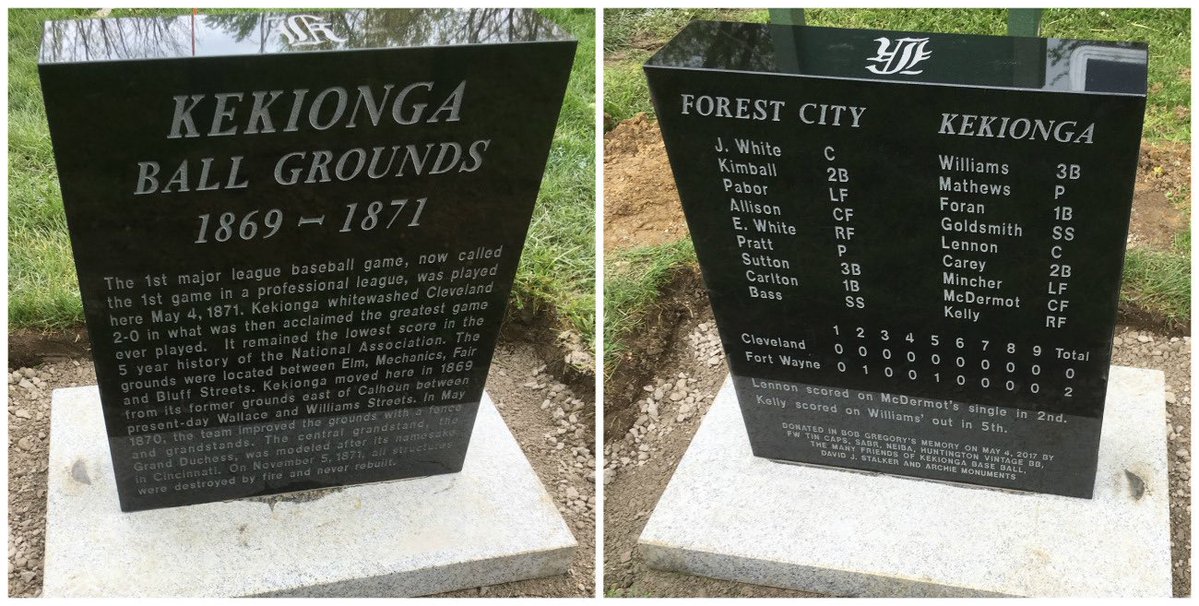
The Grounds did enjoy the distinction of hosting the National Association’s inaugural contest, with Fort Wayne playing the Forest City Base Ball Club of Cleveland on Thursday, May 4, 1871. This initial professional league game was a 2-0 shutout pitched by the Kekiongas’ Bobby Mathews, an astoundingly low run count in an era of elevated scores. The whitewash was the lowest score in the National Association’s first four years of existence.
That May 4 game drew a disappointing crowd estimated at between 20027 and 50028 because of threatening weather. Unknown to the attendees, the game in Washington between the Boston Red Stockings and the Olympics of Washington, which had been scheduled to be played the same day, was rained out, making the Kekiongas’ contest the first major-league game in the minds of many historians and the first professional league game in the minds of the rest.
Their second game, on Saturday, May 13, against the Chicago White Stockings, drew a season-high crowd estimated at between 1,50029 and 2,000.30 The last of the Kekiongas’ nine home games was played on Tuesday, August 29, before 500 fans. The game featured the anomaly of the Kekionga captain, Harry Deane, serving as umpire because the Troy Haymakers did not bring the umpire they had chosen.31
The first outs in the Kekionga season were recorded when second baseman Tom Carey turned a fly ball into an unassisted double play by doubling Deacon White off second. The final outs in Kekionga history were also the result of a double play involving Carey, this time when Jimmy Hallinan was caught trying to advance from second to third after Carey fouled out to shortstop Mike McGeary.32
When Bobby Mathews and Tom Carey left the team for disputed reasons after the final game with Troy, the team disbanded on September 5.33 On September 23 the Daily Sentinel announced, “The Kekionga base ball grounds and improvements are for sale.” The Daily Democrat on September 27 wrote, “The fence and lumber at the Kekionga ball grounds are now offered for sale at very reasonable rates.” It is not known if there were any takers.
The lifespan of the Grand Duchess was almost exactly 1½ years. It burned to the ground almost exactly 48 hours after the year-end meeting on November 3 of the National Association in Philadelphia, which Kekionga representatives attended.34 The Gazette account of the fire no longer exists, but the November 6 Sentinel recorded the following which has been reprinted in numerous local histories:
“The alarm of fire about 8 o’clock last evening, was occasioned by the burning of La-Grand-Duchess at the Kekionga Base Ball grounds. The Fire department turned out in force, but its services was not required, as the flames had gained too much head-way. Ere long all souveniers [sic] of that once grand organization will have passed away.”
The paper also noted the following:
“Who says Tom Mays, the talented editor of the Auburn Courier, is not a careful, considerate fellow, full of good judgment and foresight. While Secretary of the Kekionga Base Ball Club, he took out a policyof insurance on the ‘Grand Duchess.’ If the company has anything left after paying Chicago losses, the damage will in part be repaired.
“Mr. Mays will at once proceed to Hartford, Connecticut, and have an interview, with the President of Putnam, informing that gentleman, if at any time he wishes to establish the rising fame of his company, so that it can insure like wooden structures, he should come down with the stamps immediately.”
Whether the Kekiongas ever received payment is not known, but despite having representatives at the November 3 National Association meeting,35 the team disappeared forever, though it never made a formal announcement of its permanent demise. The December 20 Sentinel quoted the Philadelphia Post as listing the Kekionga ballclub as an active participant in the coming 1872 National Association season.
There are scattered reports of games being played at the Kekionga Ball Grounds as late as 1881,36 but it is not known if they played in the identical location or on other parts of the grounds. The area became gradually residential and remains so in the 21st century, except for the southeastern portion of the property, which in 1912 became part of Camp Allen Park.
Sources
Allen County Public Library, Fort Wayne Parks File.
Fort Wayne Guide Map (Fort Wayne: Harvey C. Lowrie, 1871).
Fort Wayne Daily Gazette, April 18, 19, and 26, May 1, 4, 5, and 15, August 30, and September 1, 1871.
Fort Wayne Daily Sentinel, April 15 and 17, 1871.
Fort Wayne Journal Gazette, February, 26, 1950, and May 1, 1966.
Fort Wayne News-Sentinel, April 28, 1984.
Indianapolis Star, April 23, 1967.
Griswold, B. J., Guide to Fort Wayne (n. p., 1914).
Griswold, B. J., The Pictorial History of Fort Wayne Indiana (Chicago: Robert O. Law Co., 1917; rpt. Evansville, Indiana: Unigraphic, Inc., 1971).
Insurance Map of Fort Wayne, Indiana (New York: Sanborn Map & Publishing Co., 1902).
Map of the City of Fort Wayne, Indiana (Fort Wayne: John de La Camp, C.E., 1874).
Panoramic View of the City of Fort Wayne, Allen County, Indiana, 1880.
Ryczek, William J., Blackguards and Red Stockings: A History of Baseball’s National Association, 1871-1875 (Jefferson, North Carolina: McFarland and Co., 1992).
Smith, James D. III, “Robert T. Mathews.” In Tiemann, Robert L., and Mark Ruckereds., Nineteenth Century Stars (Kansas City, Missouri: SABR, 1989).
Thorn, John, and Pete Palmer, eds. Total Baseball, Third ed. (New York: HarperCollins, 1993.)
Williams’ Fort Wayne Directory for 1870-71. Sixth Issue (Fort Wayne: Williams and Co., 1870).
Notes
1 Baseball researchers disagree on whether the National Association (1871-1875) was a major league. The disagreement is not because of the caliber of the Association’s players; many of them joined the National League when it began in 1876. It is principally over the Association’s lack of a central governing body, failure to keep to a standard schedule, and the absence of other “business” principles that characterize its successor leagues. Still, the concept of “major leagues” and “minor leagues” was unknown when the Association was formed, so perhaps the question is moot.
2 Dawson’s Fort Wayne Daily Times, April 26, 1861.
3 Dawson’s Fort Wayne Daily Times, August 28,1861.
4 Dawson’s Daily Times and Union, April 24,1862.
5 Fort Wayne News, June 30, 1900.
6 Fort Wayne Daily Gazette, July 29, 1866.
7 Fort Wayne Daily Gazette, July 3, 1866.
8 Fort Wayne Daily Gazette, July 29, 1866.
9 Fort Wayne Daily News, April 1,1908.
10 Fort Wayne Daily Gazette, May 11, 1868.
11 Fort Wayne Daily Gazette, September 12, 1868.
12 Fort Wayne Daily Gazette, October 20, 1866.
13 Fort Wayne Daily Gazette, July 6, 1867.
14 Fort Wayne Daily Gazette, April 12, 1871.
15 Fort Wayne Daily Gazette, May 19, 1869.
16 Fort Wayne Daily Gazette, May 12, 1869.
17 Fort Wayne Daily Democrat, April 26, 1870.
# Fort Wayne Daily Gazette, April 27, 1870.
18 Fort Wayne Daily Gazette, January 28, 1868.
19 Fort Wayne Daily Democrat, June 2, 1870.
20 Fort Wayne Daily Gazette, May 1, 1871.
21 Fort Wayne Morning Journal Gazette, August 27, 1901.
22 Fort Wayne Daily Gazette, October 1, 1870.
23 Fort Wayne Daily Gazette, August 12, 1871.
24 Fort Wayne Daily Gazette, August 15, 1871.
25 Fort Wayne Daily Gazette, August 30, 1871.
26 Brooklyn Daily Eagle, November 7, 1871.
27 Fort Wayne Daily Gazette, May 5, 1871.
28 New York Times, May 8, 1871.
29 Fort Wayne Daily Gazette, May 15, 1871.
30 Fort Wayne Daily Sentinel, May 15, 1871.
31 Fort Wayne Daily Gazette, August 30, 1871.
32 Ibid.
33 Fort Wayne Daily Sentinel, September 6, 1871.
34 Brooklyn Daily Eagle, November 7, 1871..
35 Ibid.
36 Fort Wayne Weekly Sentinel, August 9, 1881.