

1919 White Sox batboys went on to lives of civil service
This article was published in the SABR Black Sox Scandal Research Committee’s December 2025 newsletter.

A 1919 Chicago White Sox team photo includes three young boys without baseball uniforms: two batboys at the far left and a clubhouse boy called “Sharkey” sitting on the ground with Eddie Collins’s hands on his shoulders. The two batboys, Clyde Winn and Billy Downes, went on to live distinguished lives in Chicago. (1920 Reach Baseball Guide)
Of the five known team photos taken of the 1919 Chicago White Sox, only one features non-uniformed personnel. White Sox players and manager Kid Gleason are shown wearing their white home uniforms in front of a grandstand full of people. Two unidentified young boys in short-sleeved shirts and White Sox caps are flanking them to the left. Another man, identified as “Sharkey, clubhouse boy,” is sitting on the ground in front of Eddie Collins, who places his hands on the young man’s shoulders.1
This team picture was the same one used for the 1919 World Series program — with the two kids at the far left cropped out — and in the 1920 Reach Baseball Guide. In neither publication are the two boys identified and the mysterious “clubhouse boy” is always just identified as “Sharkey.”
In a two-part series, I will identify these long-forgotten members of the 1919 White Sox for the first time in over 100 years and shed new light on their life stories. This article will focus on the two young boys in short-sleeved shirts.
Eddie Bennett’s Origin Story
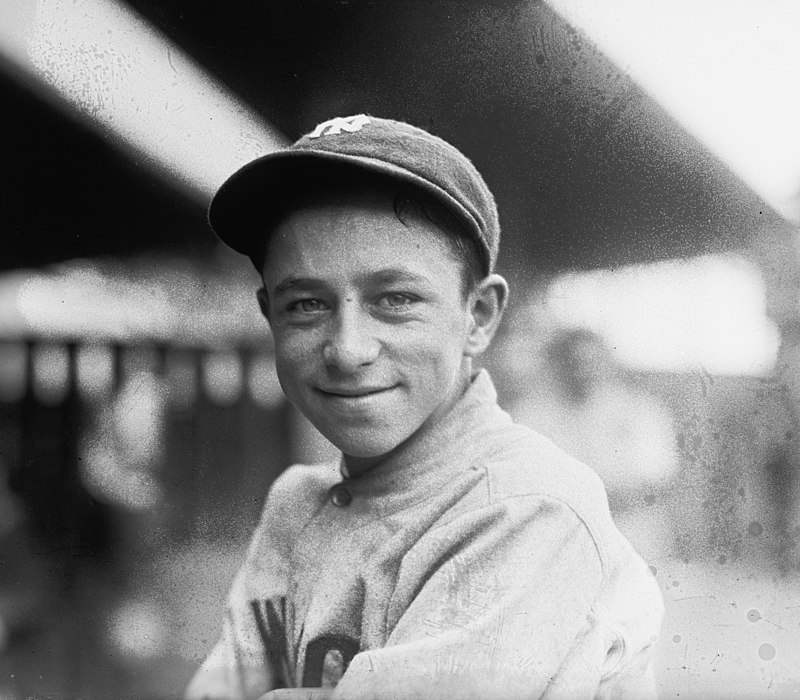 First, a word on Eddie Bennett. In the mid-1920s, Eddie Bennett rose to fame as a “mascot” and good-luck charm for the New York Yankees championship teams with Babe Ruth and Lou Gehrig. Bennett reportedly got his start in baseball back in 1919 after he was discovered by White Sox outfielder Happy Felsch on a trip to New York. No definite photo of Bennett with the White Sox has turned up, leading some writers to question if he ever was with the team in 1919.2
To date, the earliest mention of Bennett’s association with the 1919 White Sox comes from articles published about Bennett late in the 1920 season when he was a mascot with the Brooklyn Dodgers. Bennett also appeared in a widely circulated Dodgers team photo that was published in many American newspapers in late September, just weeks before Brooklyn’s first World Series appearance.
A September 29, 1920 article in an Indiana newspaper describes the teenage Eddie Bennett as “a little orphan” who was friends with the son of Dodgers outfielder Hi Myers. Bennett reportedly told “big tales about how he made the White Sox a winner in 1919.”3 The article ended with the claim that Bennett “brought the White Sox over in 1919 and the Dodgers this season. Shucks! Why, Eddie’s worth more than Babe Ruth to any man’s ball club any way you figure.”4
A Brooklyn Times Union article on October 5 described the two Dodgers mascots as follows:
“The Dodgers’ two mascots were Richard Claude, 15, a local product, and Eddie Bennett, 16, a White Sox cast-off, who came to Brooklyn this year by the waiver route. … Bennett, who mascoted the White Sox into a pennant last year, is a protégé of Hi Myers.”5
Brooklyn Eagle sportswriter James J. Murphy added a little more detail to Bennett’s White Sox tenure in his World Series column that appeared on October 9. Murphy reported that Bennett served as the White Sox mascot “last season” and “he received a slice of the World Series spoils from the Sox players and returned to New York.”6
Writing about Bennett a few years later, syndicated columnist Westbrook Pegler claimed:
“In 1919 without previous experience, he adopted the White Sox when they were in depth of an August slump, traveled the league over with them, and became the star bat boy of the world series which was lost only because the Sox were determined not to win.
“The next spring, he refused to report to the White Sox. He had no squawk to make concerning the wages for they had given him $18 a week and a $200 pool at the end of the series, but he was convinced that the Sox hadn’t shown him the proper support in the world series, which he was sure he deserved to win.”7
In a 1928 interview with Lank Leonard of the Brooklyn Citizen, Bennett gave his own version of the White Sox story. After being fired from his job as a runner for a Wall Street brokerage firm, Bennett decided to cheer himself up by taking in a doubleheader at the Polo Grounds between the Yankees and the White Sox. The details Bennett provided line up with the White Sox-Yankees doubleheader on July 30, 1919.
After the Yankees won the first game, Bennett went to get a drink of water under the bleachers — “the luckiest drink of water I ever took!” At this moment, White Sox center fielder Happy Felsch was on his way to the clubhouse and spotted Bennett. Felsch walked over to Bennett and asked, “Say, kid are you lucky?” Bennett smartly replied, “Well, of course” despite being fired from his job just a few hours earlier.
According to Bennett, Felsch took him to the dressing room and then on the field as a “jinx chaser.” The White Sox went on to win the second game. The Sox insisted Bennett return for the game the next day, which they won. That win sealed his fate, as he told Leonard. After that win, “then they were convinced I was a lucky charm and insisted I go with them on the road. It seemed too good to be true, but they really meant it, and I remained with the club right through the world series with Cincinnati.”8
Given these sources, it appears Bennett did serve as a mascot or batboy for the 1919 White Sox, at least for one series in New York and it is reasonable to assume probably for the conclusion of the road trip in early August through Boston, Philadelphia, and Washington.
Whether Bennett remained with the team as a good-luck charm for the rest of the season and for the World Series is unclear.
As I will show below, the White Sox already employed two mascot/batboys for their home games in 1919. So it seems unlikely they would employ a third, especially one who lived so far away in New York. However, ball players can be a superstitious lot, so the idea can’t be dismissed entirely.9
Tracking Down the 1919 Batboys
So who were the two White Sox batboys in 1919?
Reporting on and interviewing team mascots prior to a World Series was a typical newspaper feature during the early twentieth century. However, there seems to be little mention in the press of the White Sox’s two mascots in the leadup to the 1919 World Series.
In an October 4 article in the Cincinnati Post, an article describes the pregame festivities before Game Four: “Bud Bancroft, mascot of the Reds, was the first representative of either team to appear on the field in uniform this afternoon. The two White Sox mascots followed him shortly after.”10
Yet another article, circulated in various newspapers across the country, mentions the two White Sox bat boys meeting with the Reds’ mascot prior to Game Four:
“That pride usually goeth before a fall was demonstrated when two White Sox bat boys visited the Reds’ mascot. They were received with warmth. These same two White Sox boys visited the same Red mascot yesterday and at that time met with a superior manner, the visiting youngster having nothing to do with them.”11
It is also worth pointing out the two articles mention two mascots, not three. One of these bat boys was finally named in a United Press article that ran in the Cincinnati Post on October 6, lamenting Eddie Cicotte’s loss in Game Four:
“ ‘Hard luck’ said young Clyde Winn, White Sox bat boy, mourning over Eddie Cicotte’s second lambasting by the Reds. ‘And I know what I’m talking about, because in my job a fellow’s got to know the game. I been bat boy for the Sox all season and I’ve seen ’em play many a worse game and win it.’ ”12
The 13-year-old Winn is further quoted as saying:
“Cicotte shoulda win that game, but everybody has bad luck now and then, and it was just his turn. He was cussin’ to beat the band when he came back to the dugout after the fifth inning. The Reds got the breaks, thassal; they coulda won this game with a pair of dice, thassal. Thassal.”13
In addition to these articles, newsreel footage of the 1919 World Series clearly shows at least one mascot, possibly two, sitting around with the White Sox players before their first home game of the series, Game Three.14
A little more digging was needed to help identify the second batboy. A 1920 department store advertisement article helped clear up this mystery.

Billy Downes and Clyde Winn were pictured in the Chicago Daily News on July 15, 1920, before their public appearance at Marshall Field and Company store. (Public Domain)
In July 1920, the Marshall Field and Company department store hosted a meet-and-greet with the two White Sox mascots on their “juvenile floor.” The full-page ad featured a grainy photo of the two boys, Clyde Winn and Billy Downes, in uniform and a brief interview about a mascot’s gameday duties and their favorite players were:
“A Mascot gets the foul balls and gives them back to the umpire. When the players run out of balls, he goes up into the office after new ones. He gets the bats, keeps the catcher’s stuff out of the way, and helps the players warm up when they come on the field early to practice.”15
Winn named Buck Weaver and Eddie Collins as his favorites, while Downes (“who used to be Bat Boy to the Visiting Teams”) picked Ty Cobb and George Sisler.16
A 1975 obituary for William Downes Jr. confirmed that he “was a batboy for the Chicago White Sox for several years, including 1919—the year of the infamous Black Sox scandal in which some players sold out the team in the World Series.”17
After identifying the two batboys by name, I was able to contact family members for Winn and Downes, and confirm they both worked for the White Sox in 1919. Clyde Winn’s grandson, Mike Adams, even had a clear photograph that appears to be from the same photoshoot for the 1920 department store ad. The photo leaves no doubt that these are the two boys present in the official White Sox team photograph that appeared in the 1919 World Series program (cropped) and 1920 Reach Guide, as well as in film footage and newspaper reports from the Series.18
Clyde Winn and Billy Downes
With the real 1919 White Sox mascots identified, we can now fill in the gaps and learn more about their lives.
Clyde Edward Winn was born on July 4, 1906, in Chicago. On the 1920 US Census, Clyde’s family lived on Normal Avenue, just a couple blocks away from Comiskey Park. The son of a police officer, Clyde would also go on to serve the city of Chicago as a police officer and detective. He worked at the police department from 1932 until his retirement in 1969.
The life of a policeman and detective in Chicago yielded some interesting encounters. In 1955, Winn was shot in the right thumb during an armed robbery of a South Side tavern.19 Detective Winn along with three other officers, all in plainclothes, were eating when five gunmen entered to rob the place. Winn heard one of the men shout “Stickup!” Winn drew his gun but he was shot in the thumb first. He heard one shout, “They’re policemen, kill them!”20
Instead, the gunmen forced everyone to lay on the floor while they took $400 from the register and the officers’ guns and badges. A bartender handed guns to an officer and a customer, and they fired a barrage of bullets at the thieves, disabling their car and wounding one. The gunmen were forced to abandon their getaway car and flee on foot, enabling some of them to be arrested.21
According to grandson Mike Adams, Clyde Winn took issue with the fact that Judge Kenesaw Mountain Landis suspended the eight White Sox players after they were acquitted at trial. Winn said Babe Ruth was one of his favorite players and that Ruth would often send the batboys, including Winn, out to get him food or drinks during ballgames.
Adams also shared a story about Clyde’s mother, who was at their house doing chores one day when she heard a loud cheer from Comiskey Park down the street. When Clyde came home, she asked what the roar was about. Clyde told her that the team let him take batting practice, he hit a home run, and all the White Sox players burst out in a loud ovation cheering his home run.22 Clyde Winn passed away in September 1976 at the age of 70.23
A photo promoting the Chicago White Sox batboys’ scheduled meet-and-greet at Marshall Field’s in July 1920 shows Billy Downes and Clyde Winn in uniform next to “Pat Moran’s Baseball Board Game,” which was on sale at the store in downtown Chicago. (Courtesy of Mike Adams)
William Edward “Billy” Downes Jr. was born on October 22, 1904, in Chicago. In 1920, the Downes family was living at 3245 S. Wells St., directly across the street from Comiskey Park. Downes served as a mascot and batboy for the White Sox for four seasons, usually in the visiting team’s clubhouse and dugout.24 Downes was always active in sports, first as a star player for his high school basketball and baseball teams, and then as a referee.
In 1941, Downes began working for the National Football League as a professional football referee. He spent more than 25 years as an NFL official — blowing a whistle for many noteworthy games including the New York Giants’ 1956 championship clincher at Yankee Stadium25 — before moving into a supervisory role. At the time of his death in 1975, Downes was said to have refereed more NFL championship and all-star games than any other referee.26
One interesting anecdote from Downes’s time as a referee involved a near-death experience. In 1952, Downes was calling games for a traveling basketball team called the Abe Saperstein Globe Trotter-College All-Stars.27 The team had an engagement in South America and Downes was asked to join as a referee. He declined due to family obligations. The Pan-American flight he would have taken crashed into the Brazilian jungle, killing everyone on board, including his replacement official.28
In his life outside of sports, William Downes worked his way up through civil service in Chicago. In 1956, he was appointed as the director of O’Hare and Midway airports. A few years later, he was named the city’s commissioner of aviation, a post he held until his death in 1975.29 Upon hearing the news, Chicago Mayor Richard J. Daley said, “Our city has lost a devoted public official and I have lost a very dear friend.”30 In 1978, the Airports Council International of North America created the William E. Downes Jr. Memorial Award, a prestigious award given annually for important accomplishments that had a significant and positive impact on airports or aviation in airport management in the United States and Canada.31
Both of the men who served as White Sox batboys in 1919 went on to lead interesting lives in Chicago. Mayor Daley attended both of their funerals — Downes because of his decades of service as a high-ranking city official and prominent NFL referee, and Winn for his long career as a police officer and detective whose duties sometimes included driving the mayor around Chicago.
In part two of this series, I will explore more about “Sharkey,” the mysterious clubhouse boy also pictured with the 1919 White Sox.
Acknowledgments
I would like to thank members of the Downes and Winn families who helped by giving information on their baseball relatives. Special thanks to Mike Adams, grandson of Clyde Winn, who sent a 1920 photograph of Clyde and Billy in White Sox uniforms.
Notes
1 Reach Official American League Guide, 1920: 42.
2 Peter Morris, “Eddie Bennett.” Scandal on the South Side: The 1919 Chicago White Sox. (Phoenix, Arizona: SABR, 2015): 265-68.
3 Dean Snyder, “Mascot Second Team To Flag,” Logansport (Indiana) Pharos Tribune, September 29, 1920.
4 Snyder.
5 Brooklyn Times Union, October 5, 1920.
6 James J. Murphy, “Robins Get Line on Indians’ Field at Practice Session,” Brooklyn Eagle, October 9, 1920.
7 Westbrook Pegler, “The Sporting Goods,” Chicago Tribune, January 10, 1926.
8 Lank Leonard, “Loss of Wall Street Job Made Eddie Bennett Baseball Mascot,” Brooklyn Citizen, December 1, 1928.
9 Peter Morris, in his SABR biography of Eddie Bennett, echoes the skepticism that Bennett served as the White Sox mascot for the remainder of the 1919 season. He cites authors Jack Kavanagh and Norman Macht who suggested that “Bennett probably remained with the club for only a couple of 1919 regular-season games.”
10 Tom Swope, “Fun Is Promised On Field,” Cincinnati Post, October 4, 1919: 1. Bud Bancroft was the son of veteran Reds business manager Frank Bancroft.
11 “World’s Series Sidelights,” Baltimore Sun, October 5, 1919.
12 “Reds In Luck, Thassal, Says Sox Bat Boy,” Cincinnati Post, October 6, 1919.
13 “Reds In Luck, Thassal, Says Sox Bat Boy.”
14 “British Canadian Pathe News, 81A: 1919 World Series excerpt,” Library and Archives Canada. https://www.youtube.com/watch?v=0mPHqbJXDQI; “The Faith of Fifty Million People: Inning Three,” Baseball. Ken Burns (PBS, 1994). https://www.youtube.com/watch?v=9iaGyUba6DY. The Smithsonian Institute colorized parts of the 1919 World Series film footage and used it in 2018 Season 2, Episode 3 of their television series America In Color: Organized Crime. https://www.youtube.com/watch?v=pZ5HoZK6ogc.
15 “Boy Mascots of White Sox To Be On Fourth Floor, Friday, July 16,” Chicago Daily News, July 15, 1920: 16.
16 Kitty Spry, “Just What Exactly Does a Mascot Do?” Chicago Daily News, July 15, 1920: 16.
17 “William Downes dies; aviation chief, referee,” Chicago Tribune, July 10, 1975.
18 Mike Adams interview with author, January 3, 2023. In a photograph provided by Adams, the boys are posed with Pat Moran’s baseball board game, which also appeared in the July 1920 ad for their appearance at the Marshall Field and Company department store.
19 “Seize 3 Bandits Who Disarmed Cops In Tavern,” Chicago Tribune, November 24, 1955.
20 “Gunmen and Police Battle In Chicago,” Rock Island (Illinois) Argus, November 23, 1955.
21 “Gunmen and Police Battle In Chicago.”
22 Mike Adams interview, January 3, 2023.
23 “Winn, Clyde E.” Chicago Tribune, September 28, 1976. Accessed via Ancestry.com.
24 “William Downes dies; aviation chief, referee”; “Boy Mascots of White Sox To Be On Fourth Floor, Friday, July 16.”
25 Hal Higdon, “‘The Referee: ‘If it were not for the rules, they’d break bones on every play,” Chicago Tribune Sunday Magazine, August 27, 1967: 155.
26 “William Downes dies; aviation chief, referee.”
27 While Saperstein was also the founder of the Harlem Globetrotters, this was not the same team.
28 Arch Ward, “In the Wake of the News,” Chicago Tribune, July 29, 1952.
29 “William Downes dies; aviation chief, referee.”
30 “William Downes dies; aviation chief, referee.”
31 https://aci-na.secure-platform.com/a/page/awards/downes-award.