

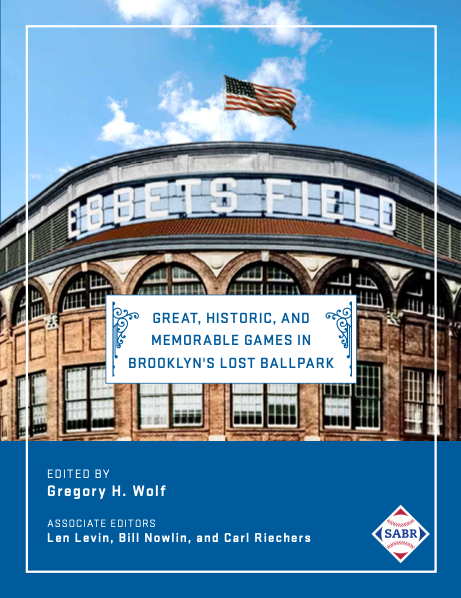
Introduction: Ebbets Field: Great, Historic, and Memorable Games in Brooklyn’s Lost Ballpark
This article was written by Gregory H. Wolf
This article was published in Ebbets Field book essays (2023)
Ebbets Field: Great, Historic, and Memorable Games in Brooklyn’s Lost Ballpark evokes memories and the exciting history of the celebrated ballpark through stories of about 100 games played there and several feature essays. Named after Charles Ebbets, majority owner of the Brooklyn baseball club from 1902 until his death in 1925, Ebbets was the home of the Dodgers from 1913 until their relocation to Los Angeles after the 1957 season. Whether they were called the Superbas, the Robins, after skipper Wilbert Robinson, or the Dodgers, the club played in excess of 3,400 games at Ebbets Field, as well as 28 World Series games in nine different postseasons. The games included in this volume reflect every decade in the ballpark’s history, from the inaugural regular-season game, against the Philadelphia Phillies on April 9, 1913, to the last one, against the Pittsburgh Pirates, in front of just 6,702 spectators on September 24, 1957.
Unlike its contemporaries, such as Forbes Field in Pittsburgh and Griffith Stadium in Washington, Ebbets Field was never the permanent, primary home of a Negro League team. The one exception was the Eagles, owned by Abe and Effa Manley, who played at Ebbets Field in 1935 before their relocation to Newark the following season. In addition to an insightful feature essay exploring the Manleys’ club in Flatbush in 1935, we’ve included a story about the team’s inaugural game at the ballpark on May 18, against the Homestead Grays, as well the first night game in the ballpark. The Cincinnati Reds’ Johnny Vander Meer no-hit the Dodgers on June 15, 1938, in what is often considered the first night game at Ebbets Field; however, the first night game at Ebbets Field actually took place almost three years earlier, on September 11, 1935, under portable lights as the Negro League Dodgers played the House of David.
Ebbets Field hosted 28 World Series games and you can read about each one of them in this volume. Uncle Robbie’s pitching-dominant teams from 1916 and 1920 captured Brooklyn’s first NL pennants since 1899-1900, though no World Series took place after those seasons. After almost two decades, often floundering in the second division, skipper Leo Durocher led the Dodgers back to prominence and the pennant in 1941, losing to the Yankees. The Dodgers and Yankees: What sounds more like a World Series than those words? The two teams squared off in the fall classic six times in a 10-year stretch (1947, 1949, 1952, 1953, 1955, and 1956), with the Dodgers capturing their elusive World Series title in 1955. Read about the heroes, like pinch-hitter Cookie Lavagetto and his walk-off double, the Dodgers’ only hit of the game, to win Game Four in 1947; Carl Erskine’s then World Series record 14 punchouts in Game Three in 1953, as well as what might be the most important game in Ebbets Field history: Johnny Podres’ shutout in Game Seven to lead Dem Bums to the promised land in 1955.
There was plenty of heartache, too. Catcher Mickey Owen’s dropped third strike with two outs in the ninth inning cost the Dodgers a series-tying victory in Game Four in 1941. The Dodgers returned to Flatbush with two chances to capture the title in 1952, yet lost Game Six, 3-2, and Game Seven, 4-2, as 20-year-old Mickey Mantle spanked a pivotal home run in each game. After Clem Labine hurled a classic 10-inning complete game to beat the Yankees, 1-0, in Game Six in 1956, the Dodgers were on the cusp of back-to-back titles. In Game Seven, 27-game winner, NL MVP, and major-league Cy Young Award winner Don Newcombe was bombed for five runs in three innings as Johnny Kucks went the distance in a soul-crushing 9-0 victory, in what proved to be the last World Series game at Ebbets Field.
Some of the games of this volume have historical significance, like Jackie Robinson’s debut as a Dodger on April 15, 1947; the first and only All-Star Game at Ebbets Field, in 1949, as well as the first game played in the ballpark, an exhibition with the New York Yankees, on April 5, 1913, four days before the first regular-season game. Other games recall memorable or milestone feats, including Gil Hodges hitting four home runs on August 31, 1950, and the Milwaukee Braves’ Joe Adcock smashing four on July 31, 1954. Babe Herman became the first Brooklyn player to hit for the cycle at Ebbets, on May 18, 1931, and Dem Bums won the pennant on the final day of the 1956 season. We also present some improbable comebacks and some high-scoring slugfests, such as the Dodgers’ 22-run outburst on September 6, 1930; a 23-run eruption on July 10, 1943, when the Dodgers twice scored 10 runs in an inning; and the club’s 15-run first-inning explosion on May 21, 1952.
For those who want pitching, Ebbets Field: Great, Historic, and Memorable Games in Brooklyn’s Lost Ballpark contains some of the greatest mound feats at the ballpark’s history. We’ve included no-hitters by Dodgers Dazzy Vance (1925), Ed Head (1946), and a pair by Carl Erskine (1952 and 1956); and by opponents Paul Dean of the Cardinals (1934) and Johnny Vander Meer’s historic no-no, his second straight, in the first Dodgers night game at Ebbets Field, in 1938. Fred Frankhouse’s abbreviated seven-inning no-hitter from 1937 is included, too. Additional games recount marathon pitching or dominant performances by hurlers, such as Jeff Pfeffer’s 18-inning complete game in 1919, Karl Spooner’s 15-strikeout gem in his big-league debut in 1954, and 19-year-old Sandy Koufax’s two-hit shutout with 14 punchouts for his first big-league win, in 1955.
Ebbets Field: Great, Historic, and Memorable Games in Brooklyn’s Lost Ballpark is the result of the tireless work of dozens of members of the Society for American Baseball Research. SABR members researched and wrote all of the essays in this volume. These uncompensated volunteers are united by their shared interest in baseball history and a resolute commitment to preserving that history. Without their unwavering dedication, this volume would not have been possible.
I am indebted to the associate editors and extend to them my sincerest appreciation. Bill Nowlin, the second reader, fact-checker Carl Riechers, and copy editor Len Levin read all the essays and made numerous corrections to language, style, and content. Their attention to detail has been invaluable. It has been a pleasure to once again work on a book project with such professionals. What a team we have!
I thank all of the authors for their contributions, meticulous research, cooperation through the revising and editing process, and finally their patience. It was a long journey from the day the book was launched to its completion, and we’ve finally reached our destination. We did it! Please refer to the list of contributors at the end of the book for more information.
This book would not have been possible without the generous support of the staff and Board of Directors of SABR, SABR Publications Director Cecilia Tan, and designer David Peng. We express our thanks and gratitude to SABR and its photo archives, especially the Rucker Archives for the majority of the photos in the volume.
And finally, I wish to thank my wife, Margaret, and daughter, Gabriela, for their support of and endless patience with my baseball pursuits.
We invite you to sit back, relax for a few minutes, and enjoy reading about the great games and the exciting history of Ebbets Field.
GREGORY H. WOLF was born in Pittsburgh, but now resides in the Chicagoland area with his wife, Margaret, and daughter, Gabriela. A professor of German studies and holder of the Dennis and Jean Bauman Endowed Chair in the Humanities at North Central College in Naperville, Illinois, he has edited more than a dozen books for SABR. Since January 2017 he has been co-director of SABR’s BioProject, which you can follow on Facebook and Twitter.