

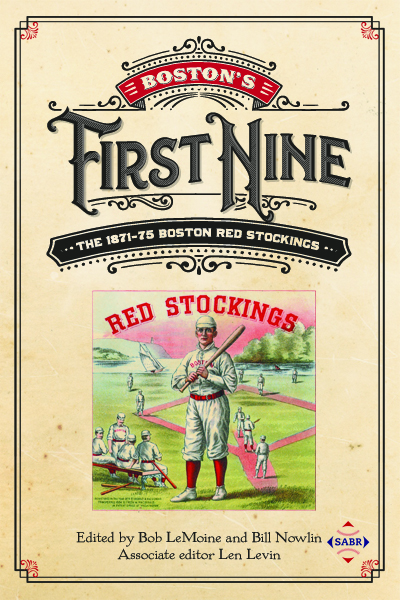
Introduction: Boston’s First Nine: The 1871-75 Boston Red Stockings
This article was written by Bob LeMoine
This article was published in 1870s Boston Red Stockings essays
“It was a league of people: people with human foibles, people with no road maps to guide them as they tried desperately to further the growth of their beloved game.” — William Ryczek1
Remembering the 1870s
He had just returned from a world cruise, and must have shivered on his way to Braves Field on May 8, 1925. The weather was described as “none too soft or kind” by Burton Whitman of the Boston Herald.2 Now 78 years old, George Wright was again stepping out onto a Boston baseball field. He was joined by old teammate Jack Manning and about 50 others who played, managed, or umpired from the 1870s or later. The occasion was the Golden Jubilee Game, celebrating the 50th season of the National League, founded in 1876. Wright and Manning played for Boston in 1876. This “was a day of reminiscence,” wrote the Associated Press. “Grayed and stooped by the passing years, they came to the game despite the chill wind and the clouds that alternated with sunshine.”3
Wright and Manning, as well as the contingent of old-timers and dignitaries, strode to the center-field flag pole with the modern Boston and Chicago teams and the 101st Regiment Band. The American Flag and Jubilee pennant were raised, and the band played the National Anthem. On the way back to the dugout, the old timers had a moment to acknowledge the cheers from the fans as the band played “Auld Lang Syne.” They made their way to their reserved box seats, and as old-timers are known to do, they commented on the present game and contemplated the past.
“By gory,” Manning blurted to Wright, “they say these fellows are faster than we were, George, but they make as many mistakes. See that, now, he’s pitching outside to him, when it’s a cinch he could not hit a ball in close.”4 Wright, however, was more interested in the number of foul balls becoming souvenirs for the fans. “We didn’t have so many balls in those days,” he recalled, “and when a ball went over a fence or into the crowd we would often halt the game for a few minutes until the ball was returned, then the ball would be put back into the game.”5 Noting that Jimmy Welsh had been purchased by the Braves for $50,000 the previous December, Wright joked, “One could buy a whole club for $50,000 in the ’70s.”6
“We hobnobbed with royalty out at Braves Field yesterday afternoon, meeting the grand old baseball veterans, now silvery haired and rapidly ageing … old in years, but young in spirit,” wrote Ford Sawyer of the Boston Globe.7 The assemblage of stars was indeed impressive, but just as impressive was the longevity of the game, which arose from a time Sawyer called “the days when baseball playing was a rather precarious undertaking and one didn’t know whether or not financial adversity would cause the league to toss up the sponge.”8
The National League has survived even to our day, but Wright and Manning remembered a prior league which was never the subject of pageantry. Yet of the 22 players who played for the Boston Red Stockings over five seasons in that league, five are in the National Baseball Hall of Fame. This league and this time are worth remembering, in the opinions of those who have written, fact-checked, edited, and designed this book in front of you.
The NAPBBP: A Noble Experiment
The National Association of Professional Base Ball Players was baseball’s first attempt to organize as a professional business and break away from its long amateur heritage. There had been professional players for a while; often they would get paid under the table or be listed as city laborers as a cover for being paid to play. But then the first openly professional team, the Cincinnati Red Stockings of 1869, took the baseball world by storm. They dominated whatever teams came into their path, and then traveled west on the newly-built Transcontinental Railroad. They went undefeated throughout 1869 and then finally met defeat at the hands of the Brooklyn Atlantics on an East Coast trip in 1870. They lost more games as the season concluded, as the world of professional baseball was changing. Other professional teams were catching up and proving stiff competition. The fans in Cincinnati lost interest in their now vulnerable team, and the owners decided that if the team was going to lose, they didn’t need to pay them for the effort. The legendary team disbanded, and a Boston dynasty was on the horizon.
Boston businessman Ivers W. Adams had seen the Red Stockings play local Boston teams and imagined Cincinnati stars George and Harry Wright playing for a Boston professional team. Adams had the connections with some of the most prominent Boston business leaders of the day, with the cash to make a Boston team a possibility. They had the money and resources, and the Wrights had the baseball connections, bringing with them some of the greatest players of the day. The league and the new Boston team were set to begin in 1871.
Like any new startup company, it made a lot of mistakes along the way. There was no set schedule, so games had to be negotiated, sometimes at the last minute. The standings were always a mystery, with one newspaper sometimes showing a different leader board than a paper in the next town. Who won the championship at the end of the season was often a matter for discussion, with an unequal number of games played, and some teams that folded before the season ended. Boston, winner of the pennant from 1872 through 1875, arguably also won the 1871 pennant but for two games credited to Philadelphia over an illegal player playing for Rockford. The Rockford club signed Scott Hastings, who had started the season with a New Orleans club. Teams protested when he suddenly appeared playing for Rockford, a violation of league rules against raiding players during the season. Hastings was not eligible to play for Rockford until June 16. At the end of the season, all Rockford victories before June 16 were wiped out, including two wins over Philadelphia. Boston finished two wins behind first-place Philadelphia.9
These and many other irregularities make modern baseball researchers scratch their heads. But these were the 1870s, and for the game of baseball to evolve to where we are today, it had to emerge from a period in which the game was in a sort of adolescent identity crisis. The rules were changing, and who was going to umpire a particular game was anybody’s guess. Players ran the teams and some teams were co-ops that depended on gate receipts to distribute payment after the game. Teams filled their schedules with exhibitions, hoping an extra game here or there would get them some extra cash on-hand. Other teams were desperate just to get train fare home.
Despite all of these obstacles, baseball survived and thrived, even though the survival of the fittest meant some teams disappeared off the map. But our focus is of course Boston, and the story of professional baseball from 1871-1875. The fans made sure the team had people to play in front of. Newspapers, even though some of the copies are either very brief or incredibly hard to read today, gave coverage to local Bostonians. Despite this entire era taking place almost 150 years ago, fans read the amazing stories of their home team in its journeys from Chicago to Canada and even the UK.
Harry Wright’s Leadership
What should not be lost on the modern reader is the prominent place Harry Wright holds in professional baseball history. On April 13, 1896, baseball celebrated “Harry Wright Day” around the country to raise money for the late legend’s memorial fund. Wright, hailed as the “Father of Professional Base Ball” by Sporting Life 10 and other publications, had died the previous October.
One such celebration was in Rockford, Illinois, where the old Forest City club once played. “Two thousand persons huddled together under the leaky roof of the grandstand at Riverside Park and withstood the torrent for half an hour,” wrote the Boston Globe. The weather was terrible, but fans got to get a glimpse of some of the stars of the past. Businesses were closed and “blocks and residences were handsomely decorated and nearly everybody in town wore one or more of Harry Wright memorial badges.” Carriages carried these legends through the streets to mass applause. Included in the carriages were George Wright, “millionaire” Al Spalding, and Fred Cone, with Spalding wearing his old Forest City uniform, Wright his old Cincinnati threads. Only one inning was completed, however, as a pouring rain settled in, ruining what could have been a most memorable day.11
Back in Boston, John Morrill, who played all but one of his seasons in Boston from 1876-1890, put together a Picked Nine to face the Harvard team. Tommy Bond and Candy Cummings were part of the nine, and Harry Schaefer, now a hotel manager, enjoyed some old chats with Cummings.12 In Cincinnati Charlie Gould, who “played pretty fair ball, everything considered,” and Deacon White, who heard “quite a bit of applause,” played in an old-timer’s game.13
Harry Wright’s genius is what can be credited for the NAPBBP’s moderate success. Baseball historian David Quentin Voigt’s chapter on the NAPBBP is titled “Harry Wright’s League.”14 Christopher Devine’s biography of Wright notes how Wright was always the driving force behind the scenes even while on the field. “While he was known as the Cincinnati captain, manager, and center fielder, he operated in 1869 as General Manager, Traveling Secretary, and Public Relations Department. He arranged all the games and gate receipts percentages, set up the travel schedule, negotiated hotel and railroad bills, negotiated player salaries, bought equipment, directed the groundskeeping, handled the media, and promoted Red Stockings games.”15 It was this ingenuity on and off the field that he brought to Boston, bringing the city a championship-caliber professional team.
The Red Stockings were without a doubt Harry Wright’s team, but the NAPBBP was also his league. It was a league that included teams in places that would never again have a major-league team: Troy, Fort Wayne, Rockford, Middletown, Elizabeth, New Haven, and Keokuk. Competition was a matter of the haves and have-nots, and the strong teams feasted on the weak ones, which often didn’t last the season. The league saw teams bat under .200 for a season, and also pitchers who were 50-game winners. There were ridiculous statistics in which Boston players dominated the league. Spalding pitched 2,346⅔ innings, an average of 469⅔ per season, and had a winning percentage of .794 with a 204-53 record. Ross Barnes had a five-year batting average of .391, George Wright .350, Cal McVey .362, and Deacon White .352. The Red Stockings won 19 in a row in 1872, then 26 in a row to start the 1875 season.
It was Harry Wright’s leadership that made this early professional league possible, as “he approached the game in a far more businesslike manner than did most of the other men associated with the pro game,” wrote Benjamin Rader. “Wright not only carefully managed such details as club scheduling and finances, but above all, he firmly established his authority over the players. Acting as a paternalistic patriarch, he even dictated their living arrangements in Boston.”16
“From its creation in 1871 to its crash five years later,” wrote baseball historian John Thorn, “the National Association had a rocky time as America’s first professional league. Franchises came and went with dizzying speed, often folding in midseason. Schedules were not played out if a club slated to go on the road saw little prospect of gain. Drinking and gambling and game-fixing were rife. … But from the ashes of the National Association emerged the Red Stockings’ model of success and the entrepreneurial genius of Chicago’s William Hulbert.”17
This league and this era are not often recalled despite baseball’s current emphasis on nostalgia, but without this great experiment of a league, the game may not have evolved as a professional sport at the time that it did. But baseball did grow as a professional sport, in large measure to Harry Wright and others who “got the ball rolling.” “The National Association had its warts,” writes Ryczek, “was poorly run, and generated only one worthwhile pennant race in five years. But it was the first major league, a noble experiment that served a necessary function in baseball’s awkward transition from an amateur to professional sport.”18
Part of Boston’s Past
I was writing articles for SABR’s Games Project describing the very first professional baseball games in Boston’s history. I was curious as to why I had heard so little about these Boston Red Stockings or how all of this history came together. I mentioned this to Bill Nowlin, who amazingly, despite all of his Boston baseball writing and research over the years, admitted he too knew almost nothing about this era. He suggested we co-edit a SABR book on this team, gathering player biographies, articles on some of the most significant games, and other interesting things we would find. We definitely accomplished all of this, as we found a team of writers and researchers equally fascinated with this story.
On a frigid day in January of 2016, I was in Boston for a SABR meeting. I had never seen the site of the old South End Grounds, which is essentially seeing what hasn’t been there for over 100 years. The Boston Globe on February 11, 1929, noted that the park, which even then was still referred to by its former name, the Walpole Street Grounds, was becoming a freight yard. “The old Walpole St. ball grounds,” wrote the Globe, “of blessed memory to old Boston fans, is passing into oblivion.” The Globe recounted the old names you will see in this book as well as the history of the park beyond the realm of these years. The park burned down in 1894, was rebuilt, then later was replaced by Braves Field in 1914. “Now it is all past and gone,” the Globe lamented. “Where once the horsehide went whistling on its way over [the] left field fence the shifting engines will pant about playing their endless game over a network of rails.”19
Today, the Ruggles Station subway trains also rumble through here, and the nearby Northeastern University keeps the area a continual high-traffic area. Besides a small plaque most would never notice, it is doubtful anyone today pauses to imagine what went on there. I tried to imagine Spalding on the mound and Harry Wright patrolling center field. I tried to imagine the fans crowding in to see their champion Red Stockings. But it was too cold, and too long ago.
We hope this book helps you to learn about Boston baseball in the 1870s, perhaps for the first time. Thanks to co-editor Bill Nowlin and a great team for putting this together, the stories of Boston’s first nine.
BOB LeMOINE came up with the idea for this book while researching the beginnings of professional baseball in Boston, wondering “How did all of that come together?” He often daydreams about time traveling to the 19th Century too see early baseball games, horse and buggies, and meet the legendary stars. Actually, he’d just like to see a game for 25 cents. Bob works as a high school librarian and lives in Barrington, New Hampshire.
Notes
1 William J. Ryczek, Blackguards and Red Stockings: A History of the National Association, 1871-1875 (Wallingford, Connecticut: Colebrook Press, 1992), xi-xii.
2 Burton Whitman, “Young Braves Defeat Cubs, 5 to 2, in First Golden Jubilee Game,” Boston Herald, May 9, 1925: 6.
3 Associated Press, “Old Timers Present. Players of Half Century Ago See Braves Defeat the Cubs,” in the St. Albans [Vermont] Daily Messenger, May 9, 1925: 5.
4 “Little Change in Fifty Years, Old Brave and Ump Opine,” Boston Herald, May 9, 1925: 6.
5 Ford Sawyer, “Veterans of Boston Teams of 70’s At Golden Jubilee Celebration,” Boston Globe, May 9, 1925: 8.
6 Ibid.
7 Ibid.
8 Ibid.
9 David Nemec, The Great Encyclopedia of 19th Century Major League Baseball (New York: David Fine Books, 1997), 10.
10 “Wright Is Dead. The Father of Professional Base Ball Called Out,” Sporting Life, October 5, 1895: 3.
11 “Honor Wright. Memorial Fund Games in Many Cities,” Boston Globe, April 14, 1896: 1.
12 “Memorial Sport. Games Played for the Wright Fund,” Boston Herald, April 14, 1896: 3.
13 “Old ’Uns Played Pretty Good Ball,” Cincinnati Enquirer, April 14, 1896: 2.
14 David Quentin Voigt, American Baseball: From Gentleman’s Sport to the Commissioner System (Norman, Oklahoma: University of Oklahoma Press, 1966), 35-59.
15 Christopher Devine, Harry Wright: The Father of Professional Base Ball (Jefferson, North Carolina: McFarland & Co., 2003 [ebook edition]), 2.
16 Benjamin G. Rader, Baseball: A History of America’s Game (Chicago: University of Illinois Press, 1994), 38-39.
17 John Thorn, “Our Game,” in Total Baseball, 6th ed. (New York: Total Sports, 1999), 5.
18 Ryczek, 227.
19 “Walpole Street Grounds Passes,” Boston Globe, February 11, 1929: 18.