
Fast Day: Boston’s Original Opening Day
This article was written by Joanne Hulbert
This article was published in 1870s Boston Red Stockings essays
The New York Times heralded the approaching start of the base-ball season in March 1871 by announcing that “the ball-fields of the metropolis will again become the scene of interesting contests—unless the weather should prove unusually inauspicious.”1 In Cleveland and Chicago, base-ball clubs and their fans also kept an impatient eye on the weather and waited for the ground to thaw and conditions to become favorable, as that all too important first game was a highly anticipated event. As reports from New York also noted, during 1863 the first game played occurred as early as March 14, and if the weather in 1871 cooperated, Brooklyn announced, a game would be played there on March 11.
But not so in Boston, where traditions ran deep and if Bostonians were to wait for the weather to cooperate, the delay could be longer than tolerated. Therefore, the first game of the season, for as long as base ball had been an essential part of life in New England, was celebrated with great fanfare on the first Thursday of April, despite what the season offered, whether in the form of rain, sleet, or even snow.
Before the calendar accumulated the holidays we celebrate today, there were only a few days during the year when Boston, along with the rest of New England, was afforded a day off from work to celebrate, commemorate a historical event, or let off some of the daily tension of simply living. One of those days was Thanksgiving, a day of celebration and commemoration, as well as a nod of respect to our forefathers, with lavish feasts and a joyful noise before Christmas joined the the calendar. In order to temper the urge toward too much celebrating and good tidings of joy, that Puritan streak in Boston’s heritage produced Fast Day, traditionally held on the first Thursday in April, a day for “fasting, humiliation and prayer”—words that appeared on the formal proclamations published annually by the governor of Massachusetts. The first recorded Fast Day in New England was 1623 at Plymouth, and the last proclamation for such a day in Massachusetts would be 1893.
Last Thursday was observed as a Fast Day, and also as a Day of Humiliation and Prayer, in Massachusetts. As evidence of public repentance, there were afternoon and evening performances in all the Boston theaters, mainly for the benefit of the suburban population. As further evidence, if any were needed, there were many base-ball matches. In order to get themselves into a serious frame of mind, many members of the General Court [the state legislature] made an excursion to Plymouth Rock. Of course, they ate no dinner, but strictly meditated upon the fasts (voluntary and involuntary) kept by the Pilgrim Fathers. There was a pleasant holiday, but no “humiliation” to speak of.2
At first in the early years, there was not much of a reason to do otherwise. Most citizens were used to occasional routine moments of fasting, humiliation, and prayer, but having a day devoted to just those virtues might have been easy to swallow back then. Or not. Times change, albeit gradually. Henry David Thoreau remembered Fast Day 1830 in an April 10,1856, diary entry: “Fast day—Some fields are dried sufficiently for games of ball—with which this season is commonly ushered in. I associate this day, when I can remember it, with games of base-ball played over behind the hills in the russet fields toward Sleepy Hollow where the snow was just melted and dried up.”
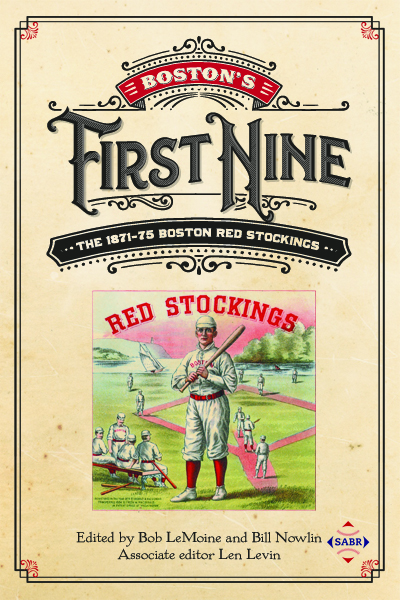
Already there was a hint of where Fast Day was heading. As Thanksgiving heralded the approaching winter, Fast Day waited with hope on the arrival of spring, despite lingering climatic evidence otherwise. Today, baseball fans eagerly await the first game of the season, and our ancestors were no different. Base ball in 1870s Massachusetts held the same thrill of anticipation, and despite unreliable weather, players and fans throughout New England were ready to get outside on Fast Day, April 6, 1871, to witness amateur games and for the first time the debut of a professional base-ball club in Boston. The team included immortals George and Harry Wright, Albert Goodwill Spalding, Calvin McVey, Harry Schafer, Sam Jackson, and Ross Barnes in a game played with a picked nine in the cold wind and on a soggy field with basepaths still slippery with ice and mud. George Wright introduced the trap ball with hints of the future infield fly rule brewing. With men on first and second, the batter hit a fly ball that Wright let pass through his hands, then picked it up and threw it to third in time for it to then be passed to second, to complete a double play. The runners, it was reported, were so mystified that they hardly knew what had happened, and the crowd perceived it as a trick on the part of Wright. Thrilling!
The Red Stockings’ debut wasn’t the only game on Fast Day 1871. Harvard met the Lowell Club on Jarvis Field, across the river in Cambridge, and the Unas Club of Charlestown played its opening game with the Tufts College nine at College Hill. The venerable old Excelsior Club of Boston visited Waltham’s Young America Club and defeated them. The score in six innings was 50-18. Games were played in Hartford, Providence, and in small towns in Vermont and Maine. Any village or town that could organize a game did so with enthusiasm, as if it were a ritual that could encourage the arrival of warmer weather.
Thursday, April 4, 1872, Fast Day, according to the governor’s proclamation, instilled hope in the hearts of the devotees of outdoor sports. The extreme cold weather of the previous month had left the still frozen ground less favorable for a base-ball game, but games were played nonetheless. Due to the uncertainty of the conditions and weather that might have discouraged even the most hardy New Yorker, the invitation extended to the New York players was canceled, and a picked nine made up of home-grown talent thought to be better able to withstand the less than optimum climate and field conditions was organized. The Lowell Club was again invited along with several players from Harvard and the Beacon Club of Boston, and their lineup also borrowed Birdsall and Cone of the Red Stockings. About 30 loads of gravel, sand, and sawdust were used in an attempt to put the field in at least passable order. Nevertheless, the field conditions were a challenge for the players. Annan of the Picked Nine, a shortstop from Harvard, “hit a ball to the right field close to the fence, which rightfielder Ryan went for and muffed, which was quite excusable, as he slipped in a mud patch, and when he arose the purity of his nether garments had departed.”3 The stalwart crowd of about 3,000 spectators in the grandstand was “graced by the presence of a considerable number of ladies.”4 The score: Red Stockings 32, Picked Nine 0. Fasting, humiliation, and prayer went on around Boston, but just as sure as it was Fast Day, games of base ball were played everywhere.
Fast Day 1873, “in accordance with annual custom, was observed as the opening day of the base-ball season and the Boston nine made their first appearance in public since they were rewarded for their last year’s exertions with the champion flag and streamer.”5 The first Thursday of April was never presumed to be auspicious for outdoor activities and watching a base-ball game was not expected to provide a comfortable atmosphere so early in the spring. The day before brought a drenching rain making the field damp and heavy with mud, though much better, reporters wrote, than the field of Fast Day 1872. Cloudy skies and a raw wind prevailed, but the conditions were not enough to discourage Boston cranks and nearly 2,500 of them turned out to watch the game and celebrate as the championship flag was hoisted over the grandstand. The picked nine of strong amateur players was captained by Cheever Goodwin, formerly of the Harvard College team. Those college boys from Cambridge had been fielding a team since 1863, and enjoyed baseball celebrity before the professionals had organized. Harvard College and the Lowell Club provided reasonably capable players who served the Boston Club well as worthy opponents on Fast Day.
A week before Fast Day 1875, the Boston Club inspected the field to see what repairs needed to be done. The game was set for Thursday, April 2, and a picked nine with players from the Beacon and Somerset amateur clubs provided the opposition. The ground was damp, the cold wind tested the fortitude of the cranks and players, and yet the crowd turned out despite the hardship, as if driven by deep-seated tradition or an inherent need to see a base-ball game, a harbinger of spring that was yet to arrive. Weather conditions did not affect the playing of the game that would naturally be played that day, but the first professional club to travel to Boston, the Philadelphias, would arrive on Saturday, April 25. The Bostons meanwhile would spend time as far south as Baltimore while waiting for warmer weather to arrive ahead of them on the home field.
Fast Day morning was pleasant and sunny, snow and rain at mid-day and the afternoon was leaden, cold and cheerless. The cold of the afternoon seriously interfered with the game of base ball and the aquatic sports, but the in-door amusements in the evening were well patronized.6
And yet they played on Thursday, April 8, 1875, a week later than traditional, as Easter was observed on March 28, just a few days before April 1, the first Thursday in April. Having two holidays in one week was too much to endure. The grounds were in poor condition and only 500 cranks braved the cold, but they were pleased with the outcome—a shutout by Albert Spalding, Boston 8, Picked Nine 0. The game featured the debut of Arthur Latham, who played “excellently well.”7 The picked-nine lineup was filled with future stars and local favorites. George Bradley of the Graftons would join the Boston National League team in 1876 and be nicknamed “Foghorn.” Tyng and Thatcher from Harvard and Briggs of the Beacon Club along with Apollonio, an outfielder from the Excelsiors, appeared on the field, adding interest to the opening game.
The appearance of “Apollonio” in the lineup of the picked-nine players adds a note of intrigue. Nicholas A. Apollonio, city registrar of Boston, had three sons—Nicholas T., Samuel, and Spencer—who were apparently smitten by the game of base ball. Which one was the player for the Excelsiors? Nicholas Taylor Apollonio is unlikely to be the candidate; he was president of the Red Stockings, and as such would likely have been recognized as a player-president—an unlikely though sporting gesture as the team’s executive. Samuel achieved prominence as a stationary engineer and was not known to be connected to any base-ball business. And then there was Spencer, the youngest of the three. A newspaper article in 1908 introduced Helen Apollonio as the daughter of Spencer Apollonio “who played with the Boston Nationals 30 years ago and is well-known in baseball circles.”8 Indeed, the headline on Helen’s impending nuptials heralded: “Newspaper Man Marries. James H. Holt Takes Daughter of Old Time Ball Player for Bride.” There was no mention of Helen’s prominence in Boston’s musical circles.
Beyond 1875, Fast Day continued to herald the opening of the base-ball season in Boston. Several Fast Day games were nearly impossible to play on account of snow—not just a dusting, but knee-deep. In 1877 snow covered the field and the air was uncomfortably damp. The 1880 game was a cold, uncomfortable affair, as was the game in 1882, and yet more than a thousand cranks turned out for the game. Snow canceled the game in 1884, but what finally put an end to the ancient day of fasting, humiliation, and prayer was the encroachment of modern times and the reality that a decreasing number of citizens were attending the church services and instead celebrated the harbingers of spring—light, warmth, and base ball.
At Easter, London gets almost a week of rest or pleasure. Now, in America we have not more holidays in a year than the Londoner gets in a week. At a pinch, if we put in Fast Day which the unregenerate will call “Farce Day,” we can lay claim to seven days in the year. Washington’s Birthday, Fast day, Memorial day, the Fourth of July, Labor day, Thanksgiving day and Christmas day. At least two of these are not general, so that they have only five days that are national property, or six at the outside, and those are distributed over the 52 weeks.But your Briton is more generous to himself. His springtime is earlier than ours, and just after the great change has set in the stalwart Englisher takes a week of it, as who should say: “I have labored in the darkness of winter; now let me take for the sunny fields, and the sparkling river.9
Debate over the abolishment of Fast Day began in earnest in 1893 when only a shadow of the original intent of the holiday remained. The governor “for years had been in effect the umpire in the national game, and when he set the date of Fast Day he said in effect: ‘Play ball!’”10 Debate in the Great and General Court began in 1893 with abolitionists battling the defenders of the old tradition. Neither side won that year and the battle continued into 1894, when the faction calling for abolishment won out. But this posed a problem: As the legislature soon found out, no one wanted to lose a holiday once that day had become a welcome day off from work. A replacement needed to be found and a new, practical reason for that day was required. Massachusetts was rid of Fast Day at last, but some other formal means of proclaiming the base-ball season had to be found. April 19, a day closer (cranks and players hoped) toward warmer weather, was a perfect replacement and fulfilled the proper requirement for historic value. The day commemorated the Battles of Lexington and Concord. The day also marked the shedding of first blood by the soldiers of Massachusetts as they changed trains in Baltimore on their way to defend Washington in 1861, and for good measure was also the day Governor Andros was overthrown and placed under house arrest by the Boston militia in 1689.
The newly proclaimed Patriots Day immediately adopted the activities held most dear by the adherents of Fast Day: field sports and, in particular, baseball. Patriots Day is still a popular holiday in Massachusetts for the dramatic re-enactment of the Battles of Lexington and Concord and the running of the Boston Marathon. The first game at Fenway Park in 1912 would have been played on April 19, if rain hadn’t forced postponement of that game to the next day. One constant still on the Red Sox schedule at that green cathedral, Fenway Park, is Patriots Day, with a game that starts at 11 o’clock in the morning, the hour, perhaps just coincidentally, when church services were held on Fast Day.
is co-chair of the Boston chapter, co-chair of SABR’s Baseball Arts committee, and is a collector of baseball poetry. She resides in Holliston, Massachusetts, and its venerable neighborhood, Mudville, where the early history of baseball bloomed and produced ball players of minor repute. Lest we forget, let us continue to dig deep into baseball’s glorious past.
Notes
1 “Base-Ball. Approaching Inauguration of the Season,” New York Times, March 1, 1871: 6.
2 New York Tribune, April 8, 1871: 4.
3 “Base Ball,” Boston Journal, April 5, 1872: 2.
4 “Base Ball,” Boston Journal, April 5, 1872: 2.
5 “Inauguration of the New Season,” Boston Herald, April 4, 1873: 4.
6 “Base Ball,” Boston Journal, April 9, 1875: 2.
7 “The Sporting Season Opened,” Boston Daily Advertiser, April 10, 1875: 1.
8 “Newspaper Man Marries,” Boston Herald, January 19, 1909:3.
9 “The Easy English,” Boston Herald, April 14, 1893: 3.
10 “The Unfortunate Career of a Small Petition,” Boston Journal, February 8, 1893: 9.