

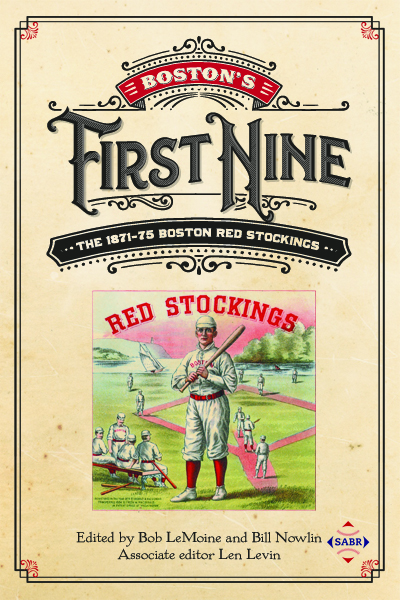
Following the Boston Red Stockings in the Early 1870s
This article was written by Donna L. Halper
This article was published in 1870s Boston Red Stockings essays
Being a member of Red Sox nation in our modern era is easy: if you can’t attend the games, you can watch them on TV, listen to them on the radio, read about them in magazines or newspapers, or do all of the above on the Internet, as well as participate in fan sites. But in 1871, when the Boston Red Stockings came into existence, none of those options was possible. At that time, there was only print journalism—which meant newspapers and magazines; and unfortunately for anyone trying to find out who won yesterday’s game, not all of these publications covered baseball (or reported on any sports at all). And even in the ones that did report on how the Red Stockings were doing, it was usually necessary to look through the entire paper to find the results. There was no such thing as a sports section (or “sporting section,” as it was then called), and the game summary might be anywhere.
But a small number of publications did make time for baseball, and they provided information the fans were eager to read. One of the most popular was the New York Clipper. Founded in 1853, it soon made a name for itself as a reliable resource for news from the world of sports—and not just the games that took place in New York. The Clipper looked like a typical weekly newspaper, but it was unique for its era: Within its eight pages, readers could find extensive coverage of sporting events, and the baseball news was generally located on one or two specific pages, making it easier for readers to locate. Long before the debut of such publications as Sporting Life (1883) or The Sporting News (1886),1 the Clipper filled an important niche. While it also covered other kinds of entertainment, such as stage plays, the majority of its stories were about the athletic competitions from the previous week, including national news about baseball, horse racing, aquatics (swim meets, yacht races), prize-fighting, chess, cricket, and other sports and games of the era.
By April 1859, the banner and logo at the top of the front page identified the Clipper as a “sporting and theatrical journal,” and by April 1868, the banner said it was the “Oldest American Sporting and Theatrical Journal.” Only a few other publications of the 1860s and early 1870s, including the Brooklyn Daily Eagle, New York Times, and Chicago Tribune, devoted as much time and energy to covering baseball as the Clipper did. It is not surprising that fans all over the United States made sure to subscribe: Not only was the reporting thorough, but the Clipper also published letters to the editor, making it one of the few publications that allowed the readers to express their opinions.2
The years immediately after the Civil War saw so much interest in baseball that newspapers began remarking on how “base ball fever” was sweeping the country, as amateur and semipro teams sprang up in cities of all sizes.3 Some newspaper reports predicted that interest would soon die out, as with any other fad. But the love of baseball endured, and large crowds continued to attend the games, proving it wasn’t a fad after all.4 However, this turned out to be a mixed blessing for the press. Although interest in both amateur and professional baseball continued to grow, most newspapers still did not place much emphasis on regular coverage of the games. In fact, compared to the in-depth reporting and analysis from today’s baseball writers, the newspapers of the early 1870s offered very little information: a typical write-up ranged from a couple of sentences to a couple of paragraphs.
There were several reasons why the accounts were so brief. For one, there was no system of “beat reporters” yet, and some newspapers had no writers with expertise in baseball. This meant sending a writer who could offer little more than the basic facts. Also, as baseball continued to grow in popularity through the 1860s and into the early 1870s, there weren’t enough reporters to cover all the teams and all the games in the region.5 Sometimes, newspapers would call upon someone from the club’s management to report on what happened. The editor also might ask a local fan who had attended a recent game to give a quick write-up; or a young reporter might get some experience by going to a game and providing a few sentences about it.6
Another factor in keeping the stories brief was that reporters still had to rely on the telegraph to transmit the scores and game summaries back to their newspaper. (The telephone would not come along till the late 1870s, and the Boston Globe is said to be the first newspaper that used it for receiving news, a report of a lecture by Alexander Graham Bell telephoned to the Globe newsroom in 1877.)7 While the telegraph had certainly become more efficient since its inception in the mid-1840s, well into the 1860s many smaller cities still did not have enough telegraph lines,8 and sending messages from these distant locations could be expensive.9 As a result, stories had to be kept short, in order to stay within budget. (Some reporters, especially with the weeklies, mailed their stories to their newspaper, which saved money and allowed them to write a longer article.)
If you lived in greater Boston in 1871, you probably got your information about baseball by reading the Boston Journal, the Daily Advertiser, the Post, or the Herald. Many of the newspapers in smaller cities like Quincy or Lowell were mainly following the local amateur teams,10 but some newspapers outside Boston also covered the professional clubs, including the Red Stockings, among them Worcester’s Aegis and Gazette in central Massachusetts and the Springfield Republican farther west. But when the Red Stockings made their official debut in May, you couldn’t read about it in the Boston Globe, since that newspaper wouldn’t publish its first issue until early March 1872.
And no matter which newspaper you were reading, including the New York Clipper, you did not know who wrote the stories of the games, since reporter bylines were not yet in common use. (The lack of bylines meant that even the most famous journalists of that era received little credit for their stories. This applied even to one of the most respected sports reporters of that time, Henry Chadwick. He wrote many of the baseball articles for the Clipper and was its baseball editor for more than 20 years.11 A prolific writer, Chadwick was also the editor of a widely used reference book, Beadle’s Dime Base-Ball Player, which contained summaries of the previous season, including the accomplishments of the best teams and players.)
In the early 1870s the language of sportswriting was quite different from what we are accustomed to seeing today. The publications that covered sports in the early 1870s referred to what the Red Stockings played as “base ball” or “base-ball.” The word “team” was seldom used—the Red Stockings were called a “club” or referred to as a “nine.” And reporters didn’t always call them the Red Stockings: often they were just referred to as the “Bostons.” There were few if any slang terms to describe the loyal followers of the game: the word “fan” wasn’t seen at all, and wouldn’t be used until the late 1880s, around the same time that another word, “crank,” became popular with reporters.12 The same was true for the word “rooter,” which was also not in common use until the late 1880s.13 In 1871 people who attended the games were generally described by journalists as “spectators,” or there was mention of the size of “the gathering” or “the crowd”—and given that most of the ballparks were much smaller than today, a good day’s attendance was between 2,000 and 3,000,14 although at certain important games, the newspapers reported more than 5,000 in the stands, and the new ballpark in Chicago was built to seat 7,000 White Stockings fans.15 And speaking of ballparks, this word too was not commonly used yet: The places where the games took place were often referred to as either the “grounds” or the “ball grounds.”
In downtown Boston, the part of Washington Street that would come to be known as Newspaper Row was still a work in progress in 1871. By the late 1880s, it had become a center of publishing. Of Boston’s nine daily newspapers, six were clustered on Washington Street, close to one another as well as a number of weekly and monthly publications.16 (This part of Boston would become very important for the fans: They could gather on Newspaper Row and await the reporters coming back from the games, get the scores from chalkboards set up outside each newspaper, and talk baseball with each other.) But in 1871 the Boston newspapers were not yet concentrated in one central location.
This left fans with only limited options. Sometimes those who couldn’t get into the game might gather outside the park—the Union Base Ball Grounds, at Milford Place in the South End,17 and try to find out what was happening inside. Or sometimes they might try going to the nearest Western Union telegraph office in hopes that a reporter might stop by to receive information from a distant city where a game had been played. In some cities, a local team might host a get-together at a hotel,18 or fans could gather at their favorite local establishment to have a few drinks and talk sports. (It should be noted that only men were expected to engage in this activity; while women could, and often did, attend the games, they were not supposed to spend time in taverns or saloons if they wanted to preserve a good reputation.) However, given that fans of the early 1870s had no expectation of instant information the way we do today, they were undoubtedly accustomed to waiting for their favorite newspaper to come out so they could find out how the Red Stockings and other clubs were doing.
Several of the Boston newspapers wrote extensively about the Red Stockings’ May 2, 1871, opener against the Washington Olympics, although the news didn’t get published until several days later. The Herald and the Journal were especially thorough. The Herald provided an inning-by-inning description of every play, as well as the box score. (Boston won, 20-18.) One interesting fact about the reporting of the game might seem remarkably modern: the unnamed correspondent took the umpire to task, saying he had done a terrible job of calling balls and strikes.19 (That much-maligned umpire was Henry A. Dobson, a veteran baseball writer for the New York Clipper, and a Civil War veteran who had lost a leg during that conflict, but refused to let it stop him.) As a reporter for the Boston Journal noted in a story that was reprinted by the Aegis and Gazette of Worcester, Dobson “moves about nimbly on crutches.” But while admiring the umpire’s determination, the reporter also had harsh criticism for his work, noting that he clearly favored the Olympics and always gave them better calls than he did the Boston club.20
After the Boston Globe made its debut in 1872, local fans had one more place to read about the Red Stockings. In addition to covering some of the games, the Globe was soon providing news and commentary about the players, information about the activities of the club’s executives, and schedules of where and when the Red Stockings would be playing next. And like several other local newspapers, the Globe published advertisements announcing when a game at the Union Base Ball Grounds was due to take place; admission was 50 cents.21
A particularly lengthy road trip in August 1873 kept the Red Stockings away from Boston for three weeks, as they traveled by train to games in the East and Midwest, and then played in Ontario, Canada.22 Many Americans of that time were surprised to learn that baseball was already quite popular in parts of Canada, and had been as far back as the 1860s.23 Thus, when the Red Stockings played against the Dauntless club of Toronto, Canadian newspaper reporters were excited to cover the game. By 1873 the Red Stockings had a reputation for winning, and Toronto fans turned out in great numbers, according to the Toronto Globe (today the Globe and Mail), including “a large number of ladies.” And while the Toronto fans hoped their team could hold its own against what they recognized was a far superior Boston club, the attendees “showed their appreciation of the scientific display made by the Red Stockings.” There was also lots of scoring, and in this case, no controversies about the umpire. The final score was 45-10, with the Red Stockings winning decisively.24
Another trip, this one by boat, did not go nearly as well. In July 1874, the Red Stockings, along with the Athletics of Philadelphia, arrived in Liverpool, England, in hopes of introducing British fans to baseball and perhaps winning them over. (Harry Wright, the manager of the Red Stockings, had been born in England and was still very skilled at the game of cricket. His hope was that the exhibitions by two of the best American baseball teams would create some new fans and help the sport to spread overseas.)25 But while reporters from both countries covered the matches (as the British press called them), attendance was poor, and British spectators seemed puzzled by baseball. They were polite in praising the skills of the players, but couldn’t seem to figure out the rules, even when British journalists tried to explain them. Said one British reporter, “The game is so entirely unknown in this country that it will doubtless be some time before the various points are fairly understood and appreciated.”26 That was an understatement. The trip not only did not win over many fans, but it was also a financial disappointment, as the New York Clipper acknowledged.27 And as Athletics player (and later baseball writer for the Boston Globe) Tim Murnane recalled, the trip also interrupted the season, and deprived the league of its two best teams for about six weeks.28
But other than the frustrations of the trip overseas, the Boston Red Stockings provided the fans with plenty of positive news. In fact, from 1871 to 1875, there were many occasions when the club gave its followers something to talk about. Led by Harry Wright, and the pitching wizardry of Albert Spalding, the club nearly won the pennant in 1871. And from 1872 to 1875 no team in the National Association of Professional Base Ball Players29 was more dominant. The Red Stocking won the championship four years in a row.30 And even without the convenience of radio, television, or social media, the fans of the early 1870s still found many ways to support the team, thanks in large part to the newspapers and magazines that kept everyone informed.
DONNA L. HALPER is an Associate Professor of Communication at Lesley University, Cambridge, Massachusetts. A media historian who specializes in the history of broadcasting, Dr. Halper is the author of six books and many articles. She is also a former broadcaster and print journalist.
Sources
In addition to the sources cited in the notes, the author also consulted:
“A Model Game of Base-Ball,” New York Times, May 28, 1871: 8.
“The Boston Base Ball Club,” Boston Journal, January 21, 1871: 1.
“The Boston Base Ball Club: Interesting Details, the Grounds, Uniform, &c.,” Boston Journal, February 20, 1871: 2.
“The Bostonians Defeat the Nationals,” Fort Wayne Daily Gazette, May 4, 1871: 1.
Notes
1 John Rickards Betts, “Sporting Journalism in Nineteenth-Century America,” American Quarterly, Spring 1953: 49.
2 Harold Seymour and Dorothy Seymour Mills, Baseball: The Early Years (New York: Oxford University Press, 1960), 41.
3 “City News: Base Ball,” Cleveland Daily Leader, April 12, 1866: 4.
4 “The National Game,” New York Herald, June 29, 1869: 1.
5 R. Terry Furst, Early Professional Baseball and the Sporting Press (Jefferson, North Carolina: McFarland Press, 2014), 20-21.
6 Betts, “Sporting Journalism in Nineteenth-Century America”: 52.
7 Marianne Salcetti, “The Emergence of the Reporter,” in Newsworkers: Toward a History of the Rank and File (Minneapolis: University of Minnesota Press, 1995), 50.
8 “Telegraph Lines from Jackson to Lansing City Improvements,” Detroit Free Press, August 3, 1866: 2.
9 John Rickards Betts, “The Technological Revolution and the Rise of Sport, 1850-1900,” Mississippi Valley Historical Review, September 1953: 238.
10 For example, throughout the early 1870s, the Quincy Patriot published game accounts of the Actives, as well as other amateur teams from the Quincy and Braintree area.
11 “Fiftieth Year of Journalism,” Brooklyn Daily Eagle, December 23, 1900: 5.
12 David Shulman, “On the Early Use of Fan in Baseball,” American Speech, Autumn 1996: 330.
13 “Psychic Force,” Brooklyn Daily Eagle, July 25, 1889: 6.
14 “The Most Brilliant Contest on Record,” Brooklyn Daily Eagle, May 29, 1871: 9.
15 David Quentin Voigt, “The Boston Red Stockings: The Birth of Major League Baseball,” New England Quarterly, Vol. 43, No. 4 (December 1970): 537.
16 Herbert A. Kenney. Newspaper Row: Journalism in the Pre-Television Era (Chester, Connecticut: Globe Pequot Press, 1987), 6.
17 “Grand Opening of the Union Base Ball Grounds,” Boston Herald, June 18, 1869: 3.
18 “Town and Country,” Harrisburg (Pennsylvania) Daily Telegraph, March 14, 1871: 3.
19 “Base Ball: Boston vs. Olympic,” Boston Herald, May 8, 1871: 2.
20 “Interesting Game—Boston Red Stockings vs. Olympics of Washington,” Aegis and Gazette (Worcester, Massachusetts), May 13, 1871:6.
21 See, for example, the advertisement for the Thursday, June 6, 1872, game, Baltimore vs. Boston in the Boston Globe, June 6, 1872: 1.
22 “The Beacons Beat the Mutuals,” Boston Globe, August 11, 1873: 5.
23 William Humber, Diamonds of the North (New York: Oxford University Press, 1995), 4.
24 “Baseball Match: Interesting Game Between the Torontonians and Bostonians,” Toronto Globe, August 25, 1873: 4.
25 John W. Bauer, “New Game in the Old Country,” in Inventing Baseball: The 100 Greatest Games that Shaped the 19th Century (Phoenix: Society for American Baseball Research, 2013), 84.
26 “The American Base-Ball Players,” The Week’s News, London August 1, 1874: 974.
27 “Baseball in England,” New York Clipper, August 15, 1874: 154.
28 Tim Murnane, “Murnane’s Baseball Stories,” Boston Globe, January 10, 1915: 39.
29 Voigt, 532.
30 Henry Chadwick, “On the Death of Harry Wright,” in Spalding’s Base Ball Guide and Official League Book for 1896 (American Sports Publishing Company, 1896), 163.