

SABR 54: ‘An unlikely journey’ — Baseball America founder Allan Simpson honored with Henry Chadwick Award
On July 29, 2026, Allan Simpson was honored at SABR 54 at the Hilton Cleveland Downtown in Cleveland, Ohio, with the Henry Chadwick Award, which recognizes baseball’s great researchers — historians, statisticians, annalists, and archivists — for their invaluable contributions to the game. Simpson is the founder of Baseball America, which reintroduced minor league baseball coverage to thousands of fans in the early 1980s and initiated meaningful widespread reporting on college baseball. He largely created the field of baseball draft analysis and prospect tracking and evaluation, forging a new, deeper connection between ardent fans and the future of the sport. He was introduced by SABR Board President Dan Levitt. Listen to audio highlights or read a transcript of Simpson’s remarks below.

- Listen: Click here to listen to Allan Simpson’s remarks during the Henry Chadwick Award presentation at SABR 54 (MP3; 9:58)
There are a lot of twists and turns in my baseball story, and I’ll try and reflect on some of the more noteworthy developments in the allotted time that I’ve been given. I can’t help but harken back to the start of my very unlikely baseball journey. Growing up in British Columbia, Canada, at the age of 11, my parents conveniently took me on a trip to California, and I happened to see my first big league game on TV.
I got to listen to Vin Scully describing Dodger games from spring training. Obviously, when I got back from California, I was hooked on baseball. But upon returning from California, I soon recognized the challenge it would be just to become a baseball fan — to say nothing of the challenge it was going to be later in life, when I decided to make baseball a career.
You’ve got to recognize we’re talking about the 1960s. There was no Internet. There were no Expos. There were no Blue Jays. The closest big league team I had to where I grew up was 1,000 miles away. The closest minor league teams were Spokane and Vancouver, 300 miles away. If I was lucky, I might get to listen to a couple of big-league games on radio, if the (San Francisco) Giants were at home and playing at night. We never had cable, so I rarely got to see the baseball game of the week.
I also went to an English private school, with a strong curriculum in … English. I played cricket, not baseball.
I mean, who would have ever thought, from my very primitive exposure to the game, that I might one day have the inclination and wherewithal to start a publication like Baseball America that eventually may have rivaled The Sporting News for its impact on the game? Or who would have ever thought I might be standing here tonight accepting this very humbling honor ?
The Sporting News turned things around for me. I just happened to stumble upon it a year or two after I got interested in baseball. And I read The Sporting News weekly, cover to cover. I devoured two-week-old box scores which I’d never been exposed to. I soon discovered by reading The Sporting News that there was a big baseball world out there, like the minor leagues. I took a particular interest in all developments leading up to the very first draft in 1965. From there I began thinking about a career in the game. And I learned that the hard way.
I took a job during the summer of my college days with the national semipro champion Alaska Goldpanners, only to go to Alaska and have my work visa rescinded within the first three weeks. I had to stoop to some creative ways to sneak across borders to go back up to Alaska for a couple years thereafter, just to pursue that interest.
As luck would have it, the Montreal Expos created a farm club in Lethbridge, Alberta, in 1975. I was able to land a position as the general manager of the team. I thought that might have been my first career break. But when you’re making $700 a month for seven months of the year, that’s not much of a career and no real way to make a living.
With the realization there were no other pro teams in Canada west of Montreal, and immigration regulations as they were restricting me from ever taking a job in the U.S., my dream of a career in baseball basically ended. And I stood with that decision for the better part of five years. I finished school and took a job in public accounting. But the baseball itch never subsided.
Along the way I continued to read The Sporting News. This was 1980 and it was no longer the publication that it was in in the 1960s when it was a magnificent baseball magazine. It got to the point where I said, “Nobody else is replacing this coverage that used to be there,” covering the minor leagues and some of the grassroots levels of the game. So I thought, “Well, if nobody else is going to do it, maybe I’ll take a chance.”
I was seriously under-capitalized. I had no publishing experience. Everywhere imaginable, I was in over my head. And perhaps most daunting, I had to create Baseball America as a one-man operation out of my unheated garage in Canada and pass it off as an American product. I would have never gotten to first base if anybody south of the border ever had a suspicion this was a Canadian product or the product of some crazy Canadian.
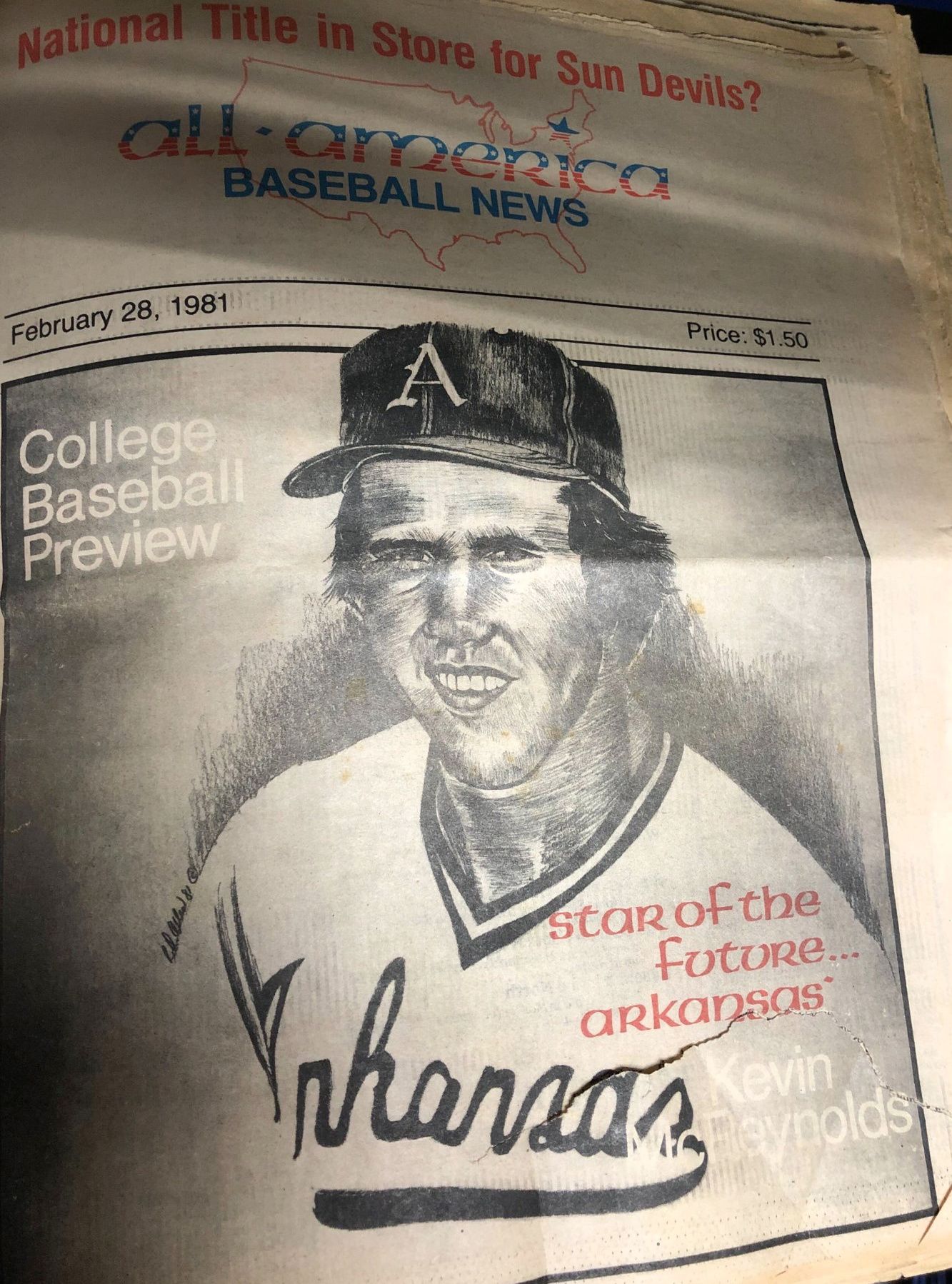 The first issue of Baseball America was published in February of 1981. It was not a masterpiece, and not surprisingly, the magazine struggled in its first year. But through my own perseverance and some incredible timing, it survived that first year mainly by covering the minor leagues, colleges, prospects, and the draft — some of the core coverage that still exists today.
If you remember 1981, that was the year of the major league strike. Unusual attention was showered on the minor leagues at the time, and that played right into our hands. The magazine continued to struggle the following year, but as luck would have it, to my good fortune, I managed to join forces with Durham Bulls owner Miles Wolff. We know the Bulls five years later as being the linchpin for the movie (Bull Durham). That enabled me to go along with the magazine to its rightful place in the US specifically, and into North Carolina.
At the time it was relocated, Baseball America‘s circulation was a modest 6,000. But over the next decade, the magazine’s readership grew to 10 times that, and its influence in the game soon rivaled that of The Sporting News.
Some 45 years after its humble beginnings, the magazine still impacts the baseball industry in substantial ways. I don’t think it’s any coincidence as Baseball America came of age, the interest in some of the grassroots areas of the game grew right along with it.
If you can think back to where minor league baseball was 40 years ago, or the draft, or college baseball, it’s changed substantially. With my deep-rooted interest in the draft, it naturally became a substantial component of Baseball America‘s coverage. Now in something of a full-circle moment, I am currently in the process of putting the finishing touches on a comprehensive historical database on the draft and its rich, often obscure history. To me, it’s been the ultimate baseball research project, and the work that has gone into it has come to the attention of Scott (Bush) and the SABR board.
I believe that’s no small reason why I am standing here today as a proud recipient of SABR’s prestigious Henry Chadwick Award. Thank you.

Originally published: August 25, 2026. Last Updated: August 27, 2026.