


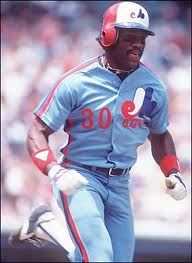
July 14, 1987: Tim Raines is the hero after 13-inning All-Star affair in Oakland
 In its 20th season of hosting major-league baseball, the Oakland-Alameda County Coliseum received its first turn at hosting the All-Star Game. The 1987 season had already acquired a reputation as the year of the “lively ball” or “rabbit ball,” with batters hitting home runs at unprecedented historic rates. The state of the baseball, and how it would play at the All-Star Game, provided one of the key discussion points in the build-up to the game.
First pitch was scheduled for 5:40 PM local time to accommodate the East Coast prime time audience. The twilight conditions promised to make life difficult for hitters, potentially spoiling the lively ball theories. Tigers pitcher Jack Morris relayed that Catfish Hunter told him the All-Star Game time was the same time of day as Hunter’s 1968 perfect game.1 In discussing the conditions, Phillies slugger Mike Schmidt said, “When I go up there, I am going to be looking for the ball and trying to put it in play. I’ll be damned if I am going to try and hit a home run.”2
Another pregame topic concerned Reggie Jackson. For what proved to be the final season of his career, Jackson returned to the Athletics. By the All-Star break, Jackson was batting .201 with only smattering of homers as Oakland’s designated hitter. In the present era, Jackson would likely be honored with a commissioner’s selection to the All-Star Game. AL and Red Sox manager John McNamara claimed to have lobbied for Jackson’s inclusion, but league president Bobby Brown nixed the idea. About the 14-time All-Star, Brown said, “[Jackson] has been great for baseball and great for the Oakland A’s. We just felt the All-Star Game should be the All-Star Game.”3
Bret Saberhagen earned the AL starting spot with a stellar first half for the Kansas City Royals, going 15–3 with a 2.47 ERA. He earned two quick outs through grounders from Eric Davis and Ryne Sandberg. Andre Dawson doubled down the left-field line, bringing up Schmidt. Schmidt indeed made contact as he planned, but his grounder to third baseman Wade Boggs ended the top of the first.
Houston’s Mike Scott (10–5, 2.76 ERA) took the mound for the NL; his one-out error allowed Don Mattingly to reach base, the AL’s only baserunner in the first. Boggs’ ground ball forced Mattingly at second and George Bell’s pop fly ended the inning. The fact that the first inning ended scoreless was not surprising. The surprise unfolded as the game remained scoreless for hours.
Saberhagen and Scott each faced the minimum in the second. Dave Winfield’s leadoff double in the bottom of the inning was erased by Cal Ripken Jr.’s liner to Jack Clark, who caught Winfield off the bag for the double play. Chicago Cubs ace Rick Sutcliffe replaced Scott for the third, and the AL staged a brief rally. With one out, Alan Trammell pinch-hit for the departing Saberhagen and reached first on Ozzie Smith’s error. After Rickey Henderson’s fly out to Dawson in center field, Sutcliffe walked Mattingly and moved Trammell into scoring position. Dawson played 153 games for the 1987 Cubs, none of them in center field, but another catch in that spot, off Boggs’ bat, ended the third.
The NL fared little better in the top of the fourth, as Schmidt snuffed out his own rally, following up his single by getting thrown out attempting to steal second. (Schmidt stole a grand total of two bases that season.) In the bottom of the fifth, Henderson singled and Mattingly walked with two outs, but Boggs’ ground ball forced Henderson to end the inning.
Neither team achieved another baserunner until Dwight Evans singled off Rick Reuschel to lead off the bottom of the seventh. Harold Reynolds bunted Evans to second, but Kirby Puckett struck out for the second out. Oakland’s Mark McGwire strode to the plate to frenzied cheers from the hometown crowd. The moment seemed tailor-made for the AL home run leader and eventual Rookie of the Year to become the hero in his home ballpark. McGwire lofted the ball into the right-field corner as Dale Murphy battled the sun to make the catch in front of the 330-foot marker.
After an uneventful eighth inning, each side created scoring opportunities in the ninth. With one out, Tim Raines hit a bullet off Dave Righetti into center field for a single. Righetti attempted a pickoff move to first baseman McGwire as Raines darted for second base. Raines made it to third when McGwire’s throw sailed into left field. Tom Henke replaced Righetti, and Juan Samuel flied out to Evans in short right field for the second out. Raines elected not to challenge Evans’ throwing arm. This appeared to create another opportunity for a Bay Area ballplayer to become the hero of the Bay Area All-Star Game. In this case, the opportunity fell to San Francisco’s Jeffrey Leonard. His at-bat lasted one pitch, however, with Leonard popping up behind the plate to catcher Matt Nokes. Leonard said, “I wanted a long at-bat but my aggressiveness took over. I realized we had a chance to win it right there, so I wanted to be up there hacking.”4
To lead off the bottom of ninth, Phillies closer Steve Bedrosian walked Winfield. Tony Fernández’s bunt advanced Winfield to second before Bedrosian allowed a second walk to Evans. With the game on the line, Reynolds grounded to first baseman Keith Hernandez, who flipped the ball to Hubie Brooks for the force at second. Brooks threw to Bedrosian, who was attempting to cover first, for the double play. Bedrosian stumbled, however, but caught the throw; he did not make the play at first but recovered to fire the ball to catcher Ozzie Virgil, who applied the game-saving tag on a charging Winfield for the final out. Bedrosian described the play, “I was conscious of Winfield the whole time. … You have to bounce the throw. That’s what I did. I threw a sinker to Ozzie and he made a great play to hold on.”5 Virgil said, “Winfield’s a big man. He ran into me hard—there was a lot of beef hitting me.”6
Hernandez’s one-out single against Henke in the NL 10th came to nothing, and Lee Smith retired the AL in the bottom half. In the 11th, Raines singled with two outs, but the top half ended with Samuel staring at strike three. Smith allowed a Larry Parrish single to open the bottom of the inning, and Parrish made it to third before Fernández struck out looking to end the frame. In the top of the 12th, Oakland’s Jay Howell, with 15 saves to his name but in the process of losing his closer role to Dennis Eckersley, got Leonard to ground out before striking out Tim Wallach and Hernandez. Smith, working his third inning of the night, allowed a leadoff single to Evans but put down the AL in order after that to send the game to the 13th inning.
Howell returned to the mound for the AL, facing Virgil. The Braves catcher drilled the ball into center field for a single. With the NL bench exhausted of options, Smith assumed his spot in the batting order and came to the plate wearing a borrowed Expos batting helmet. His attempts to bunt Virgil to second proved unsuccessful and the first-base umpire called strike three when Smith missed at his final attempt. Then, Brooks hit a laser that found the gap on the right side of the infield for a single, advancing Virgil to second. Willie McGee flied out to Winfield, now playing in left field, and it appeared another rally was about to fall short. Raines’s bat, however, provided the runs so far lacking in the game. After taking two breaking balls inside, he caught the next pitch off the end of his bat, driving it between Winfield and Puckett, who raced after the ball as it rolled to the wall. Howell said, “I’d just thrown him two cruddy breaking balls. I was trying to throw him a strike. He hit the ball right where I threw it—drove it into the gap.”7 Raines claimed a triple, with Virgil and Brooks scoring easily for a 2–0 NL lead. Reynolds kept the NL from expanding its lead with his leaping snare of Samuel’s line drive.
To protect the newly found advantage, NL and Mets manager Davey Johnson called upon his own starter Sid Fernandez. In his 15-season major-league career, Fernandez tallied exactly one save, in 1986. He achieved his unofficial second career save through a scoreless 13th inning. Fernandez walked Kevin Seitzer to open the inning, but Pat Tabler’s strikeout and Nokes’ foul popup left the AL’s fate in Winfield’s hands. Winfield’s grounder to third baseman Wallach allowed for an easy force at second at seal the NL victory.
For Raines, his three hits were the sum total for his All-Star career to date. He said, “This is my seventh All-Star Game and I hadn’t had a hit until tonight… . [Howell] threw me a fastball out over the plate. I didn’t really think about it, I was just looking for a hole.”8 For Howell, misfortune bookended his day. That morning, his garage door came down on the roof of his car,9 and his evening ended with taking the loss in the All-Star Game. In a season in which so many swings sent balls flying out of ballparks, the All-Star Game was decided by a singular swing between two unlikely protagonists. With the win, the NL avenged a defeat from the prior year and claimed its 14th win out of 16 games dating to 1972, which had been the last time an All-Star Game took more than nine innings to resolve.

American League All-Stars, featuring Mark McGwire, on the line at the 1987 All-Star Game at the Coliseum. (Courtesy of the Athletics.)
Sources
In addition to the sources cited below, the author also used the following sources:
1987 All-Star Game NBC broadcast footage, accessed at: https://www.youtube.com/watch?v=9JM0YA1V2tc
San Francisco Chronicle
https://www.baseball-reference.com/allstar/1987-allstar-game.shtml
https://www.retrosheet.org/boxesetc/1987/B07140ALS1987.htm
Notes
1 Dave Nightingale, “A Relapse by the Rabbit?”, The Sporting News, July 27, 1987: 12.
2 Kit Stier, “Pitchers have big edge in All-Star twilight,” Oakland Tribune, July 14, 1987: D1.
3 Kit Stier, “McNamara tried to get Reggie on All-Star team, Oakland Tribune, July 14, 1987: D6.
4 Nick Peters, “Leonard’s chance to be a star in 9th ends in foul out,” Oakland Tribune, July 15, 1987: F3.
5 Stier, “N.L. finally gets to Howell in 13th,” Oakland Tribune, July 15, 1987: F1.
6 Stier, “N.L. finally gets to Howell in 13th.”
7 Stier, “N.L. finally gets to Howell in 13th.”
8 Stier, “N.L. finally gets to Howell in 13th.”
9 Ron Bergman, “Howell ruins his car, but he gives one to Raines,” Oakland Tribune, July 15, 1987: F8.
Additional Stats
National League 2
American League 0
13 innings
Oakland-Alameda County Coliseum
Oakland, CA
Box Score + PBP:
Corrections? Additions?
If you can help us improve this game story, contact us.