Bob Feller: The Johnny Appleseed of Home Run Derbies
This article was written by Larry DeFillipo
This article was published in The National Pastime: Baseball on Lake Erie (2026)
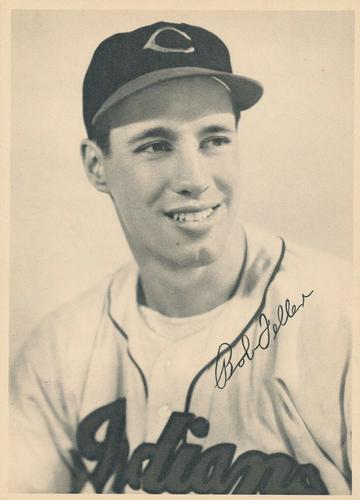
Orchardist John Chapman, otherwise known as Johnny Appleseed, spent the early 1800s sowing apple seeds throughout Ohio and beyond, expecting them to grow into bountiful trees. Bob Feller, the winningest and to many the most beloved pitcher in Cleveland Indians history, embarked on a similarly ambitious crusade after his Hall of Fame career. He spent decades touring North America to promote the growth of baseball, particularly the minor leagues. For Feller, it was both a calling and an escape.
During baseball season, Feller made it his business to visit dozens of minor-league ballparks, spending time at some for what were variously called “pitching demonstrations,” “home run hitting contests” or “pitching exhibitions” (see Figure 1 below). Just as Appleseed wore a trademark tin hat when spreading seeds (or so the urban legend says), so too was Feller garbed in familiar togs during those events, which can collectively be called home run derbies. With few exceptions, Feller wore an Indians uniform bearing the number 19 that he wore throughout his storied career.1
Unlike All-Star Game home run derbies that 21st-century fans are familiar with, Feller’s minor-league derbies took place before regular season games, in front of crowds that often numbered in the hundreds. Batters have been the featured attraction at home run derbies since the term first came into use, but Feller turned that convention on its head. He was the draw for most of the home run derbies that he pitched in.2 Indeed, many of his derbies were the centerpiece of “Bob Feller Night” promotions.3
Home run derbies were just one of Feller’s many on-field activities after his playing days were over. He pitched batting practice for Cleveland in the late 1950s, conducted hundreds of youth pitching clinics, pitched for amateur teams in fund raisers, and was a regular at Old-Timers Games well into his 70s.4
At the height of his barnstorming, Feller spent 200 days or more on the road, in what the Louisville Courier-Journal called “a perpetual road trip.”5 Some years during that period, 1969 to 1988, he visited upwards of 100 minor-league ballparks, and claimed to pitch in 40 to 55 derbies.6
Scouring various online newspaper archives, I’ve found accounts of 320 derbies in which Feller pitched and as many as 80 others in which he probably did. For the latter, I was unable to find confirmation that a planned derby happened. Others surely escaped my detection or have been lost to history. Nonetheless, those I did find are worthy of closer inspection.
Figure 1. (L to R) Advertisements for Feller derbies from the April 18, 1976 issue of the Charlotte (North Carolina) Observer, July 14, 1969 issue of the Albuquerque Journal, and July 16, 1972 issue of the Newport News (Virginia) Press.

A SELF-APPOINTED GOODWILL AMBASSADOR
A 17-year-old Iowa schoolboy when he first put on a Cleveland uniform, Feller relied on a knee-buckling curveball and overpowering fastball, authored three no-hitters, earned eight All-Star selections, and played on two World Series teams. He retired as the franchise leader in wins (266) and was third on the all-time major-league strikeout list behind Walter Johnson and Cy Young.7 Impressive as his numbers were, they could have been even greater. Feller enlisted in the Navy the day after the Japanese bombing of Pearl Harbor, and missed nearly four full seasons while still in his prime.
In announcing his retirement, Feller told reporters in December 1956 that he was “giv[ing] up baseball in favor of business;” specifically, running a fire and casualty insurance company that he had invested in and representing electronics manufacturer Motorola as a “consultant on youth activities.”8, 9 Over the next year, he toured the country, speaking with community groups, giving away autographed baseballs, throwing out ceremonial first balls and conducting pitching clinics.10 Between many of those engagements he traveled in his own single-engine Beechcraft Bonanza airplane.11
After conducting an afternoon clinic at Mission Stadium in San Antonio, Texas, on August 26, 1957, Feller volunteered to pitch a home-run hitting contest before that night’s Texas League game. Three batters each from the hometown Missions and visiting Houston Buffaloes took turns hitting, with Feller serving six pitches to each. Asked why he stayed to hold the competition, Feller said “Minor league clubs need all the help they can get. I’ll be happy to do what little I can to give the fans a little extra for their money.”12 Feller’s relationship with Motorola soon ended, but he never stopped promoting the sport of baseball.
Feller firmly believed that ballplayers should engage with youngsters to keep the sport vibrant and encouraged Major League Baseball to have former major-league stars serve as roving instructors.13 He even went so far as to say that “baseball will not die as long as there is hero worship.”14
Between 1957 and 1968, Feller pitched in a few home run derbies each year, facing almost exclusively minor-leaguers. Like his first derby in San Antonio, he normally served up a handful of pitches to three or four ballplayers from each team playing that day. One team or the other generally included someone who was a client of Feller’s insurance business.15
Feller’s appearances were typically sponsored by minor-league clubs, local businesses or community organizations, who paid him a fee that in 1979 was $500.16 When he was done pitching, Feller often climbed into the stands while still in his uniform, signing autographs and chatting with fans as the subsequent game unfolded. While he mingled with fans, Feller spent little time watching games, but paid attention if a no-hitter seemed in the offing.17 He saw at least one, by Yankee prospect Brad Arnsberg of the Greensboro Hornets against the Savannah Cardinals after a 1984 derby at Savannah’s Grayson Stadium.18
At first, Feller was none too pleased when a batter hit a ball out. During a surprise-filled May 1961 derby at Houston’s Busch Stadium, he walked off the mound when the Buffaloes’ Hank Mitchell went yard on the first pitch he saw. “Even retired, Rapid Robert doesn’t like to lose.”19 Feller himself once claimed that after allowing four homers to a batter in late-1960s Oklahoma City derby, he put the next one under his chin.20
Fiercely competitive, Feller came around to understanding that fans wanted to see some home runs during his derbies. As shoulder issues caused his arm slot and velocity to drop, he warmed up to the idea of grooving pitches. By 1976, Feller admitted “Frankly, I’m glad to get a few balls out of here and please the fans.”21
Feller brought joy to the Land of Cleves by pitching in three Cleveland Stadium derbies. He faced a group of local “disc jockeys” before an Indians exhibition game with the Cincinnati Reds in June 1960, pitched to 49 media celebrities along with former rotationmates Herb Score and Mike Garcia in June 1970, and a month later tossed balls to mayor Carl Stokes, Score, former AL MVP Al Rosen and former Yankees Phil Rizzuto, Elston Howard and Dick Howser before a regular season game with New York.22
After reaching 50, Feller dramatically ramped up his barnstorming. From May through August in 1969 he was almost constantly on the road, and appeared in as many home run derbies as the previous dozen years combined. Money was the reason why. His insurance business had fallen off and psychiatric care for his wife Virginia and middle son Martin had drained the family’s bank accounts.23 In his 1990 autobiography Now Pitching, Bob Feller, Feller revealed that Virginia had developed addictions to barbiturates and amphetamines during his playing days, turning Feller’s family life into what he called “a living nightmare.”24 Barnstorming provided Feller both with income and an escape.
Divorced in 1971, three years later Feller married divorcee Anne Thorpe, with whom he’d maintained a somewhat scandalous relationship.25 In the ensuing years, Anne accompanied Feller to many of his appearances, often encouraging him to challenge batters in derbies. “I just try to throw it over the plate,” Feller shared in a 1986 interview, “My wife always says throw them everything I got—curves, sliders, sidearm. I say no. I want to be invited back.”26
Beginning in 1970, many of Feller’s derbies involved non-ballplayers: fans, local sports media in print, radio and television, local celebrities and politicians, including a few governors.27 Some were competitive, with whoever hit the longest ball winning if nobody homered, or using a points system where would-be extra-base hits earned batters more points that wouldbe singles.28 Others were akin to batting practice, with no winner named. Each batter was allowed either a fixed number of pitches or swings, with Feller sometimes allowing batters a few extra swings. As the years went by, more and more of Feller’s derbies were devoted to those who watched baseball rather than played it.
Fans who faced Feller were usually chosen at random, but some sponsors allowed fans to sign-up for free and others charged a fee.29 The Peoria Chiefs invited 19 fans who gave $100 each to Easter Seals to face Feller in a 1985 derby at Meinen Field.30
A few clubs tried prize money as a way to entice fans to take part in Feller derbies. The Tri-City (Washington) Ports promised $10 to any fan who homered off him in a 1974 derby but nobody did.31 One club, the Anderson (South Carolina) Braves, offered $500, in May 19 84.32 Life insurance salesman Lonnie Hawkins earned a three-day, two-night trip to Las Vegas from a hotel chain sponsor after launching a homer off Feller during a 1972 Provo, Utah derby.33 Beginning in the late-1970s, many who faced Feller came away with “I Batted Against Bob Feller certificates.”34
During many of his barnstorming visits, Feller held a one-on-one interview with a local sportswriter. Most interviewers lauded Feller’s devotion to the sport and his longevity, but in later years some called Feller’s act tired and sad.35 Yet Feller never seemed to tire of touring. He told one reporter in 1977, “I go out there, throw a few pitches to the local heroes, sign my name and talk to the fans. They like it, I like it and I guess that’s all you need.”36
A successful at-bat against Feller brought joy to most, regardless of how far, or how fast, the ball traveled. After winning a 1973 derby in which he topped a cousin of Hank Aaron, Columbus Astros infielder Donnie McLaughlin said “I can always tell my grandchildren that I hit a home run off Bob Feller and beat Aaron.”37 When NFL punter Dave Jennings took Feller deep during a 1978 derby at West Haven, Connecticut’s Quigley Stadium, he circled the bases like he’d hit a walk-off bomb.38 After hitting a fair ball in a 1976 Feller derby, Linda Young of the Quad-City Times wrote “I hit it. I really HIT it.”39 Tim Kurkijian considered facing Feller in a late-1970s derby one of the highlights of his time as a Washington Star reporter, in part because Feller apologized for not throwing the ball any harder.40
A Feller derby in the summer of 1986 was anything but idyllic for pair of Louisville Redbirds—or Feller himself. In his “Bullet Bob” Comes to Louisville, John Morris describes how he and teammate Steve Braun were dismayed when an out-of-sorts Feller seemed to enjoy throwing unhittable breaking balls to a group of disc jockeys. Braun changed into his street clothes and, posing as a DJ, took a turn at bat. The 15-year, major-league veteran lined Feller’s first three pitches over the right field fence, then turned the next six into screaming line drives – the last one finding Feller’s right shin and ending the derby.41
Figure 2. Number of Bob Feller derbies in which minor-leaguers, media or fans participated, by year (1969-88)

A CLOSER LOOK AT THE NUMBERS
The 320 derbies that Feller pitched in between 1957 and 1995 took place in 138 cities, across 37 states and four Canadian provinces. Of those, 305 were in minor-league ballparks, six in major-league stadiums and one in a football stadium, the Hoosier Dome.
Figure 3 shows the number of Feller derbies between Feller’s peak barnstorming years. I’ve found accounts of as many as 27 in his busiest year, 1978, but only two in 1981; one in Indianapolis limited to employees of Massey-Ferguson, a farm-equipment maker for which Feller did promotional work, and another in Evansville for Massey-Ferguson dealers.42
Feller faced minor-leaguers in roughly 40% of his derbies (130), local radio, print and television media members in about 30% (95) and fans in nearly one-quarter (76). Other categories, from local celebrities to members of the military, each took part in under 5% of his derbies. Many derbies included multiple types of batters (e.g. fans and media), so the total exceeds 320.
Table 1. Type of batters faced by Feller in HR derbies, list by number of derbies in which they participated. Retired major-leaguer category does not include those who may have participated as minor-league managers or coaches.

Table 2. Feller HR derbies held at minor-league venues

Figure 3. Annual number of Bob Feller home run derbies verified by the author (1969-88)

Feller held more minor-league derbies at Class-A ballparks (100) than any other level, with the Double-A Eastern League hosting more Feller derbies than any other circuit (36). Florida was the site of more Feller derbies than any other state (50), with events held in 15 different cities.
Ten Feller derbies took place at Denver’s Mile High Stadium, more than any other ballpark. The last was on August 10, 1982, with local media members taking their cuts before a Bears-Omaha Royals game attended by 40,320—likely the largest crowd to see a Feller derby.43
The median crowd size for minor-league games following Feller derbies was 1,457, based on the 276 dates for which attendance figures are available. The smallest turnout was 220 for a 1975 derby in Pittsfield, Massachusetts’ Wahconah Park, won by Dane Iorg of the visiting Reading Phillies.44 Iorg also won a Feller derby two years earlier at the same ballpark, making him one of three minor-leaguers to win two Feller derbies outright.45 Jim Gurzynski of the 1969 Daytona Beach Dodgers and Moe Hill of the 1976 Wisconsin Rapids Twins were the others.46
Figure 4. Feller pitching to Jacksonville Suns manager Billy Gardner in a June 1972 home run derby

(Source: Jacksonville (Florida) Journal, June 13, 1972.)
RAMPING DOWN
Heading into the 1988 season, Feller told reporters the upcoming summer would his last spent at minor-league ballparks. “I’ll be 70 in September and I’ve had enough of catching planes.”47 A few months later he said he’d continue to visit western ballparks. “I’ll do the Coast League, California State League, and the Northwest League. Maybe the Pioneer.”48 On August 9, 1988, Feller appeared in Durham, North Carolina for what appears to be the last derby in which he faced minor-leaguers. Held in Durham Athletic Park, where the recently released movie Bull Durham was filmed, Feller allowed just one home run, to Bulls outfielder Theron Todd.49
Over the next few years, Feller pitched to Indians fantasy campers, threw ceremonial first pitches at the closing of Cleveland Stadium and opening of Jacobs Field and found time to participate in an occasional derby.50 Feller’s last derby appears to have taken place on August 3, 1995, for local media personalities at Yale Field in West Haven, Connecticut.51
Figure 3. Certificate given to fan who batted against Feller on June 9, 1980, at Hi Corbett Field in Tucson, Arizona.

(Source: Smithsonian Institution, National Museum of American History)
THE LISTS
In all, 58 individual past or future major-leaguers came out on top in Feller home run derbies held at minor-league ballparks, not including Hank Aaron and Greg Luzinski, who had one-on-one matchups at minor-league plants with Feller, in 1979 and 1988, respectively.52
A few compelling story lines from these, and other minor-league Feller derbies, include:
- June 28, 1966, West Palm Beach, Florida. High schooler Walter Wiszowaty tops 10 other competitors, including former major-leaguer Johnny Groth and a host of minor-leaguers. Said Feller afterwards “here’s a youngster who never even heard of me.”53
- August 6, 1969, Omaha, Nebraska. After winning a derby that featured five other future major-leaguers, John Mayberry Sr. was the first of three Oklahoma City 89er participants to hit consecutive homers in the closing frame of the ensuing American Association tilt.54
- June 18, 1974, Albuquerque, New Mexico. Albuquerque Duke Charlie Manuel decimates Mickey Mantle in a head-to-head clash, 21 to 2. Feller and Dukes player-coach Tom Tischinski served up 165 pitches.55
- August 21, 1980, Glens Falls, New York. Pitcher Jackie Smith of the Double-A Glens Falls White Sox takes derby crown by out-homering his team’s hitting coach, Orlando Cepeda.56
LARRY DeFILLIPO is a retired aerospace engineer and former Division III college pitcher who lives in Kennewick, Washington, with his wife Kelly. His work has been published in The National Pastime, Baseball Research Journal, and several SABR special publications. He’s authored dozens of game stories for SABR’s Games Project, several of which star Cleveland greats of yore, plus a score of biographies for SABR’s Biography Project, including former local favorites Mike Naymick and Al Luplow. He also serves as a fact-checker for both of those projects.
Table 3. List of Feller derbies won by former or future major-leaguers (names in CAPS) and prominent also-rans.

Notes
1. The Indians authorized Feller in 1958 to wear one anytime he liked. Hal Lebovitz, “Feller Will Get New Uniform From Tribe With Old No. 19,” The Sporting News, February 26, 1958: 19.
2. The earliest surviving newspaper account to use the term “home run derby” described a 1920 competition in which Babe Ruth fell in a head-to-head battle with retired minor-leaguer slugger Perry Werden. “Babe Needs Two More,” Nashville Banner, September 1, 1920: 10.
3. See, for example R.B. Fallstrom, “Decatur Blanks Clinton,” Decatur Herald, June 27, 1974: 19.
4. “He insists on pitching the first inning,” retired closer Tug McGraw told the St. Petersburg Times after the 76-year-old Feller hurled the opening frame a February 1995 Legends of Baseball Game played at Al Lang Stadium. “He’s going to get a line drive off his forehead one of these days, going to be lying on the ground looking like a unicorn, and all the guys are going to stand around saying: ‘That’s the way he would’ve wanted it’.” Bruce Lowitt, “Big-leaguers out; Legends to take field,” St. Petersburg Times, February 22, 1995: 4C.
5. “Inside Sports,” Louisville Courier-Journal, April 20, 186: C1.
6. Furman Bisher, “Feller Legend Lives On,” The Sporting News, August 23, 1975: 2. “Feller Keeps Arm Limber,” Omaha World-Herald, July 31, 1970: 19; Mike Edgley, “Bob Feller: super-pitcher—and not a bad salesman,” Berkshire Eagle (Pittsfield, MA), September 3, 1972: 15; Don Doxsie, “Feller hasn’t lost his spark,” Quad City Times (Davenport, IA), July 29, 1987: 11.
7. Feller also retired as the major-league career leader in walks, with 1764, and, according to Baseball Reference, second to Rube Waddell in double-digit strikeout games, with 51. In tracking Sandy Koufax’s 1964 assault on the major-league double-digit strikeout record, various newspapers credited both Waddell and Feller with 54. See, for example “Koufax Is Back—And How; Hiller Heroics Pace Giants,” Minneapolis Star, May 5, 1964: 1D.
8. Frank Gibbons, “Feller Retires From Baseball,” Cleveland Press, December 28, 1956: 1.
9. Feller had been named president of the George H. Olmsted and Company in January 1956. Cleveland quarterback legend Otto Graham had represented Motorola in a similar capacity after his retirement from the gridiron in 1955. “Feller Will Head Insurance Agency,” Cedar Rapids (Iowa) Gazette, January 4, 1956: 1; Hal Lebovitz, “Hall of Fame to Be Feller’s Next Stop in Game,” The Sporting News, January 9, 1957: 3.
10. A Columbus, Ohio clinic that Feller conducted with former batterymate Rollie Hemsley drew 10,000 ballplayers, parents and coaches. Phil Reichmann, “Feller, Hemsley Team Up Again at Columbus Clinic,” The Sporting News, May 22, 1957: 13
11. See, for example, Phil Reichmann, “Bob Feller Attracts Large Turnouts in Jacksonville and Savannah Clinics,” The Sporting News, April 10, 1957: 15 and Phil Reichmann, “Bob Feller Flies 2,500 Miles for Five Clinics in Five Days,” The Sporting News, June 5, 1957: 36; Ted Battles, “Bob Feller Visits Midland,” Midland (Texas) Reporter-Telegram, June 16, 1974: 4D.
12. The competition ended in a four-way tie, with Houston’s Benny Valenzuela and Ray Dabek joining San Antonio’s Mike Lutz and Hank Moreno in hitting a single home run. Gayle Hayes, “Big Crowds Seen for Feller Clinic Monday,” San Antonio Express and News, August 25, 1957: 1-D.
13. Bob Feller as told to Harry Grayson (NEA), “Baseball Losing Its Grip on Youth, Says Bob Feller,” Riverside (California) Press-Enterprise, March 23, 1958: D-4.
14. “Feller Contends Baseball Will Live On Hero Worship,” Canton (Ohio) Repository, April 19, 1962: 27.
15. One customer, former Indians teammate Luke Easter, finished in a three-way tie during a September 1962 derby that Feller pitched in Rochester, New York. As of December 1961, Feller reportedly had more than 300 former ballplayers as clients, with “bonus babies” his specialty. Shelley Rolfe, “Crackers Turn Back Virginians By 7 to 2,” Richmond (Virginia) Times-Dispatch, May 27, 1962: C1; Hal Lebovitz, “Feller Will Get New Uniform from Tribe with Old No. 19,” The Sporting News, February 26, 1958: 19; Leonard Lyons, “The Lyons Den,” New York Post, December 24, 1961: Magazine-7; Bill Vanderschmidt, “Wings Clinch Tie for Fourth by Splitting with Syracuse,” Rochester Democrat and Chronicle, September 8, 1962: 20; Robert Sangeorge, “Friends Recall Easter in the Wake of Slaying,” Ashland (Ohio) Times-Gazette, March 30, 1979: 18.
16. “Cardinal Notebook,” Erie (Pennsylvania) Times, August 14, 1986: 4C; Jerry Lindquist, “We Don’t Have Too Many Heroes,” Richmond Times-Dispatch, June 24, 1979: B-1.
17. John Hillburg, “Feller: out there promoting,” Peoria (Illinois) Star, July 2, 1983: B1.
18. Earl Jenkins, “SavCards Held Without a Hit,” Savannah (Georgia) Evening Press, May 25, 1984: 23. Feller may have also noticed 19-year-old, first-year pro John Smoltz of the Lakeland (Florida) Tigers retire the first 10 batters that he faced after an August 1986 derby in Daytona Beach. Randy Rorrer, “Islanders Suffer Shutout Setback,” Daytona Beach News Journal, August 7, 1986: 5B.
19. Feller held five batters homerless before Mitchell stepped to the plate: Johnny Edwards, Cliff Cook and Don Pavletich of the visiting Indianapolis Indians and Bud Zipfel and Don McKnight of the Houston Buffaloes. Earlier during the contest, a midget dressed like an astronaut was delivered to center field by a helicopter. “For a few moments…Feller thought he was back in Cleveland’s Municipal Stadium, pitching for Bill Veeck and the Indians,” wrote the Houston Chronicle. Clark Nealon, “Buffs Belt Injuns With A Murdock,” Houston Post, May 16, 1961: 4-1; Dick Peebles, “Feller’s Same, Fast One’s Not,” Houston Chronicle, May 16, 1961: 2-3; Jim Easterwood, “Sports Slivers,” Pampa (Texas) News, May 19, 1961: 14.
20. The author has yet to verify an exact date for this confrontation. “Bullet Bob Feller thinks guys like Pepitone and Bouton bad for game,” Houston Post, August 16, 1970: 4D.
21. “Whitt Solves Feller,” The Sporting News, August 28, 1976: 37.
22. Broadcaster Bob Forster, then with radio station WERE, won the 1960 derby. Nobody cleared the fences in the July 1970 competition and Feller held the former major-leaguers homerless in the latter contest. Onetime Cleveland hurler Wynn Hawkins also pitched in the August 1970 derby. John Henahan, “Indians Hike Stadium String Over Reds to 5,” Cleveland Plain Dealer, June 14, 1960: 29; Russell Schneider, “Batting Around,” Cleveland Plain Dealer, June 19, 1970: 2-D; Russell Schneider, “Tribe Tidbits,” The Sporting News, July 4, 1970: 6; “Indian Notes,” Toledo Blade, August 6, 1970: 39; Russell Schneider, “Batting Around,” Cleveland Plain Dealer, August 6, 1970: 2-F.
23. James Flansburg, “Bob Feller’s Financial and Family Crisis,” Des Moines Register, December 28, 1969: 1.
24. Bob Feller with Bill Gilbert, Now Pitching, Bob Feller (Sports Publishing, 2014 reprint), 206.
25. In November 1972, Thorpe’s then-husband Donald Thorpe, sued Feller for alienating his wife’s affection “through his renowned baseball fame.” “Ex-Indian pitching great to wed,” Cincinnati Post, September 27, 1974: 45; “Suit Against Bob Feller Is Dropped,” Cleveland Plain Dealer, May 18, 1973: 12-D.
26. David Gibson, “Fans forget future for fun of watching Hall of Fame player,” Fort Lauderdale Sentinel, July 2, 1986: 4B.
27. Arkansas Governor Dale Bumpers faced Feller in a July 1973 derby in Little Rock as did several city mayors. Governor Terry Branstad belted a home run not from an overhand but rather an underhand Feller toss in a Des Moines benefit softball event held in July 1984. “Brandt winner; Governor quits,” Arkansas Gazette (Little Rock), July 26, 1973: 2B; “Branstad belts homer off Feller,” Council Bluffs (Iowa) Nonpareil, July 24, 1984: 9. See, for example Jimmy Smith, “Cougars,” New Orleans Times-Picayune, June 27, 1976: 6-6.
28. See, for example Roger Gilmore, “Bob Feller Due at City Island,” DeLand (Florida) Sun News, July 14, 1972: 7.
29. Fans who paid $15 got five Feller offerings during a Westlake, Ohio derby in June 1987. Norm Weber, “Rapid Robert showers Westlake,” Lorain (Ohio) Journal, June 22, 1987: 12.
30. Phil Theobald, “Storm stops Chiefs,” Peoria Journal Star, June 30, 1985: C1.
31. Aubrey Adams, “Feller tired of traveling,” Tri-City Herald (Pasco, Washington), August 28, 1974: 16.
32. Both the Anderson derby and the Sally League game scheduled to follow were rained out. Anderson (South Carolina) Independent-Mail, May 28, 1984: 7A.
33. Scott Candland, “Feller Thrills Little Leaguers,” Provo Herald, July 7, 1972: 8. Four years and hundreds of personal appearances later, Feller had clearly forgotten about Hawkins when he told reporters that he had yet to touched up by fan in a home run derby. Larry Pope, “Bob Feller’s Show Outshines Tourists,” Asheville Citizen-Times, July 21, 1976: 28.
34. See, for example Brad Willson, “Astros Seal Fate With Miscues,” Daytona Beach Evening News, June 27, 1979: 9A and Steve Emerine, “Optimist wins out in battle with Feller,” Arizona Star (Tucson), July 11, 1985: 1E. “Bob Feller Batting Certificate,” National Museum of American History, https://americanhistory.si.edu/collections/object/nmah_1415382, accessed February 27, 2026.
35. One Huntsville, Alabama sportswriter wrote “[A] man who once routinely brought the likes of Ted Williams, Joe DiMaggio and Mickey Mantle to their knees…[is] standing on a minor league pitcher’s mound throwing creampuffs.” Bob Mayes, “Memories: Feller Still Big Hit,” Huntsville (Alabama) Times, May 31, 1985: B1.
36. Mike Bogen, “He’s still a jolly good Feller,” Springfield Morning Union, July 6, 1977: 33.
37. The cousin was Wil Aaron of the Asheville Orioles. Alan Truex, “Roznovsky, Markl Give Astros 2-1 Victory,” Columbus (Georgia) Enquirer, July 12, 1973: 29.
38. Jennings got his at-bat underway by punting a baseball to Feller. “Feller limits media to 6 his in exhibition,” Danbury (Connecticut) News-Times, June 26, 1978: 21.
39. Linda Young, “Now They Hit Feller Pitches,” Quad-City Times (Davenport, Iowa), July 4, 1976: 1B.
40. Kurkjian’s article sharing his perspective came in the newspaper’s final edition. Tim Kurkjian, “The Day-to-Day Routine Was Anything but Ordinary,” Washington Star, August 7, 1981: C-4.
41. Morris described this episode as taking place before a July contest with the Nashville Sounders, but a search through issue of the Louisville Courier-Journal published that season mentions Feller appearing only on June 27, before a Redbirds game with the Indianapolis Indians. John Morris, “Bullet Bob” Comes to Louisville (Diamond Communications, 1999), 48.
42. Kim Rogers, “18-Hit Attack Rips Iowa,” Indianapolis News, August 7, 1981: 28; Bill Fluty, “Chamberlain mows down Triplets, 4-1,” Evansville Courier, August 5, 1981: 30.
43. Bob Eger, “Giants, Bears Split Twin Bill Slugfest,” Arizona Republic (Phoenix), May 8, 1967: 20; “Fans Turn Out Early To See Feller Throw,” Denver Post, August 10, 1982: 4F.
44. “Ranger rips,” Berkshire Eagle, August 18, 1975: 24.
45. Roger O’Gara, “Two games set for tonight after Ranger win, rainout,” Berkshire Eagle, August 11, 1973: 18.
46. Gurzynski’s first derby win came in his first week as a professional ballplayer. Brad Willson, “Memorable Debut,” Daytona Beach Morning Journal, July 30, 1969: 14; Brad Willson, “Baseball’s Good Feller,” Daytona Beach Morning Journal, August 17, 1969: 1B; “Cipot’s 10th-inning homer earns Mets a 5-4 triumph,” Wausau (Wisconsin) Herald, July 3, 1976: 11; John L. Paustian, “Foxes triumph,” Appleton (Wisconsin) Post-Crescent, August 26, 1976: 11.
47. Hal Lebovitz, “Easing up,” Lorain (Ohio) Journal, March 27, 1988: 36.
48. Paul Borden, “Feller story strikes out against barn,” Arkansas Gazette, July 26, 1988: 1D.
49. Kip Coons, “Bulls Overcome Miscues To Win,” Durham Herald-Sun, August 10, 1988: 18.
50. “Famed Fastballer,” Midland Reporter-Telegram, February 25, 1989: 3B.
51. New Haven Pirates public address announcer Glen Dimenstein, who slashed a pair of line drives off the 76-year-old Feller in the event, was “still beaming” the next day. Bob Birge, “Farmer’s In,” Connecticut Post (Bridgeport), August 4, 1995: D3.
52. Aaron hit a single home run off Feller in what proved to be a tedious exhibition held in Savannah, Georgia. Not happy with how it went, Aaron said the following week that he was still waiting for Feller to throw him a strike. Feller told a reporter that he had to throw Aaron 100 pitches “before he finally connected. Said Feller, ‘The fans were yelling ‘Get those old guys off the field.’ I agreed.” The Luzinski derby was part of a celebration honoring the former Phillies’ slugger’s induction into the Reading Phillies Hall of Fame. Billy Rauers, “Columbus Bombs SavBraces, 10-3,” Savannah Morning News, May 21, 1979: 2B. Kenny Hand, “Aaron thinks Astros can finish first in NL West,” Houston Post, May 25, 1979: 6C; “Cubs Notes,” Chicago Sun-Times, June 16, 1979: 90. Richard Soles, “Raleigh-Durham Rips Peninsula In 9-4 Tilt,” Durham Herald, August 21, 1969: 17; Greg Grasa, “Big Fella Takes Great Feller Downtown,” Lancaster (Pennsylvania) New Era, July 7, 1988: 33.
53. Bob Balfe, “Bob Feller To Pitch in HR Test,” Palm Beach (Florida) Post, June 28, 1966: 13; Bob Balfe, “Braves Triumph 5-4 In 2nd Half Opener,” Palm Beach Post, June 29, 1966: 19.
54. “Mayberry Wins Homer Contest,” Omaha World-Herald, August 7, 1969: 25; Robert Williams, “Brandt Contributes To 89er HR Derby As Royals Beaten,” Omaha World-Herald, August 7, 1969: 25.
55. Eight weeks later, Mantle was inducted into the Hall of Fame. “Mantle, Feller Here Tuesday,” Albuquerque Journal, June 8, 1974: C-5; Bart Ripp, “6178 See Nitz Snap Skid,” Albuquerque Journal, June 19, 1974: C-1.
56. Bill Scheft, “Sox fans see quite a show,” Albany Knickerbocker News, August 22, 1980: 3B.