

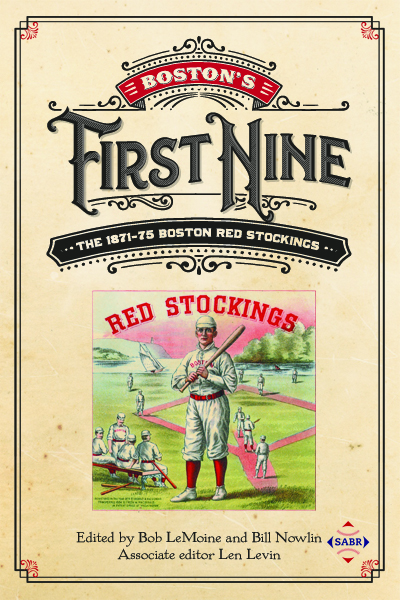
Hub Kids Bid Fans Anew: The Red Stockings in Canada, 1872-1874
This article was written by David McDonald
This article was published in 1870s Boston Red Stockings essays
“The Boston Club were immediately surrounded by an admiring crowd, as the ‘professionals’ were decidedly the finest and most athletic lot of players that have ever visited this city. Their loose dress uniform of light brown flannel, with red stockings and red belts, appeared to be admirably adapted for the active play of the sinews and muscles. On their arrival at the grounds, the Club at once proceeded to practice with their ball, pitching and catching with an expertness that opened the eyes of the spectators. The sinewy arms of the players sent the ball almost with the velocity of a musket shot, without describing a curve, but straight and true to the hands of the catcher. … The ‘Red Stockings’ are all heavy men, very strong and active, in fact, picked men. They are paid regular salaries of from $1,800 to $2,500 per annum each, by the Boston club, to do nothing else but to play base ball, and they go from one city to another through the United States and Canada, playing matches for the gate money and for large stakes.” — Ottawa Free Press, August 28, 1872.1
On August 19, 1872, before 300 fans in Cleveland, the powerhouse Boston Red Stockings beat the Forest Citys 12-7 to push their National Association-leading record to 30-3. Afterward, facing a two-week hiatus in championship play, Harry Wright’s elite band of mercenaries headed north to pick up some extra cash in the baseball boondocks.
It was as if their successors, the Atlanta Braves, showed up to play your slow-pitch team. In Michigan, the Red Stockings cruised through their first two matches, crushing Ypsilanti 40-3 and Empires of Detroit 35-2.
From Detroit, Wright’s boys crossed the border at Windsor, into the crucible of Canadian baseball, Southwestern Ontario, where the game had been played informally even before Abner Doubleday mythically invented it in 1839. The first organized teams there had popped up in the mid-1850s and had soon adopted the New York rules over an earlier, distinctively Canadian version of the game. Ontario teams had been playing exhibition games against American competition since as early as 1860.
Their first stop was London, where, on August 22, 1872, the Red Stockings played their first-ever match on foreign turf, against the Tecumsehs, a club that had been formed four years previously. The result was unequivocal, a 52-3 pasting. The next morning, the Bostons traveled to Guelph to take on the then-perennial Canadian champion Maple Leafs in an afternoon game.
Battle of the champions
The “amateur” (“semiprofessional” would probably be a more apt designation) Maple Leafs were no strangers to big-time competition. Earlier that summer, in fact, they had hosted the Baltimore Canaries of the National Association and beaten them, 10-9.
In mid-August, the Maple Leafs had embarked hopefully on an ambitious road trip to further test their mettle against Association clubs. The results were sobering. They dropped all three of their matches on the East Coast, 25-5 to the Canaries in Baltimore, 35-8 to the Athletics in Philadelphia, and 9-4 to the Mutuals in New York. This final game, at the Union Grounds, drew only 300 fans, which the Brooklyn Eagle blamed on “a threatening storm”2 and a premium 50-cent ticket price.
The Maple Leafs had been exposed for what they were, namely, an excellent amateur club, one of the best on the continent perhaps, but still a notch below the American professionals.
Still, the Eagle was impressed with their showing. “The Maple Leafs have a nine that can get away with anything outside the professional arena,” said its correspondent. “[They] are nearly all Scotchmen, and a fine athletic and active set of players; they are, too, excellent catchers and good throwers, and they play a game that makes the best men work to beat them. … They play the Reds next week at Guelph, and if this Boston nine play no better than they did here this week the Canadians will stand a good chance to win. …”3
Now, a week later in Guelph, while some among the 2,500 in attendance no doubt clung to hopes of a David-Goliath upset, most were simply satisfied to see the legendary Red Stockings in the flesh. Before they had even completed their Globetrotteresque warm-up, the visitors had won over the crowd. “[A]ttractive and amusing were the many pranks they indulged in in the handling of the base ball,” said the Guelph Mercury, “… the tricks of the Wright brothers being particularly amusing.”4
The game started at 2:45. The Maple Leafs showed some pop at the plate, touching Al Spalding for 17 hits, only four fewer than the Red Stockings managed. But the amateurs couldn’t hold a candle to the Bostons in the field. The pros took advantage of numerous errors, scoring in every inning en route to a 29-7 win.
Scratched and daunted
The next afternoon, August 24, in Toronto, Wright’s team took the field at the Cricket Ground for a match against the three-year-old Dauntless club. The Toronto boys were facing their first professional opposition. It was awe at first sight.
“When the Red Stockings went into the field, their build stood out in marked contrast to the men of the Dauntless Club,” said the Toronto Mail. “They were large brawny fellows, their arms tanned up to the elbows, and stood, with very few exceptions, half a foot at least over their opponents.”5
Said the rival Toronto Globe: “These circumstances seemed to have impressed themselves so deeply on their opponents, that they went to work resigning themselves to their fate without, almost, an effort to avert it.”6
The Mail correspondent had this analysis of the fundamental differences between the amateur and the professional defensive games: “At the start it looked as if the Dauntless stood a chance of making at least a respectable show, but before long the great disparity of the two clubs was easily discernible. The Canadians were not up to their work in hardly any particular, and at times when a man should be on a base, he was found to be several yards away from it. On the other hand, the Red Stockings were always in the right place at the right time and worked together like clock work. …
“The style of throwing adopted by the clubs was entirely different. The Americans sent the ball in a straight line to the man it was intended for, but the Canadians threw it high in the air thus frequently losing an opportunity of putting a man out.
“The pitching of Spaulding [sic] of the Red Sox [sic] was very swift and very true. It seemed to be his desire that the batter should send the ball into the field, for as sure as he did he was a gone man.”7 Indeed, Charlie Gould made 16 putouts at first base in support of Spalding’s one-hitter.
The line score conveys the gulf between the clubs.
| R | H | E | ||||||||||
| BOS | 3 | 4 | 5 | 17 | 1 | 3 | 17 | 7 | 11 | 68 | 59 | 4 |
| TOR | 0 | 0 | 0 | 0 | 0 | 0 | 0 | 0 | 0 | 0 | 1 | 20 |
Boston accumulated 94 total bases in 105 at-bats. The Wright brothers scored 10 runs apiece, with George Wright and Roscoe Barnes each going 9-for-12 at the plate.
Independents day
After an off-day Sunday, the Red Stockings returned to the Toronto Cricket Ground. Their opponents this day were the Independents, a team from Dundas, a town 45 miles west of Toronto (and now part of the city of Hamilton). The game, starting at 10:30 A.M., kicked off a day of sporting events marking a civic holiday.
Boston jumped to a quick 12-0 lead, but the Independents plated four in the bottom half of the third, largely due to an uncharacteristic cluster of miscues by shortstop George Wright, first baseman Gould, and third baseman Harry Schafer. Overall, though, said the Globe, “(T)he wonderful catching of the Red Stockings, and the remarkable judgment with which their men played, was a marvel to the numerous spectators present.”8
Schafer also “smote a ball so sorely as to drive it through the windows of a house to the eastern side of the ground, causing much and natural excitement among the occupants of the house to which the window appertained. Somebody, we opine, will have to make good the damage done. …”9
Overall, the Mail judged “the playing of the Americans … by no means as good as it was on Saturday last [vs. Dauntless].”10 Not that it made much difference. Every member of the Boston team scored at least as many runs as the entire Dundas team. The final total was 52-4.
“The ‘Red Stockings,’ ” said the Globe, “are now on their way making their tour through the Canadas, and if they find no ‘foements’ more worthy of their steel than those they have met in Toronto, they will go home with the idea that they are in reality, as they claim to be, the ‘Champions of the World.’ “11
The Cincinnati kids
After the game, the travelers boarded a train for the 250-mile trip northeast to Ottawa, population 21,545. Even next to the fresh-faced opposition Boston had encountered in Southern Ontario, the Ottawas were a team of neophytes—one with a strong connection to the Boston team.
In the spring of 1870 a 27-year-old Ottawa blacksmith and lacrosse player, Tom Cluff, had gone to Cincinnati for a couple of months to visit his older brother Ned, later a prominent American insurance broker and captain of the New York Lacrosse Club. There, on July 4, Tom Cluff is said to have attended his first baseball game, possibly the holiday match at the Union Base Ball Grounds between Harry Wright’s Cincinnati Red Stockings and the Forest City Club of Rockford, Illinois. If so, Cluff would have seen the Red Stockings beat a 20-year-old right-hander from Byron, Illinois, named Al Spalding, 24-7.
A short time later, Cluff attended a picnic near Norwood, Ohio, and witnessed up-close a demonstration of baseball skills by three members of the Red Stockings. “Mr. Cluff was swept away in the excitement,” the Ottawa Free Press later reported, “and after making acquaintance with the base ballers received some guidance of the manner in which he could learn the sport’s finer points and return with them to his native city.”12
The following year, as Harry Wright reconstituted the Red Stockings in Boston, Tom Cluff took what he’d learned in Cincinnati and organized his hometown’s first baseball club. His collection of novices included a couple of hoteliers, a surveyor, a builder, a post-office clerk, and Tom’s younger brother Harry, a refrigeration dealer. Now, in just his second summer of play, Tom Cluff had the opportunity to go head to head with some of the very players who had first fired his passion for the game.
“The Ottawa Base Ball Club are entering into the cultivation of this strictly national game of America with a zeal and enterprise which is destined to do good service to the ‘cause,’” the Free Press proclaimed.13
Tuesday, August 27, 1872, in the capital might have been the greatest confluence of bat-and-ball talent in Canadian history. Not only were the Red Stockings in town; so, too, were the touring English Gentlemen eleven, featuring Dr. W.G. Grace, the Babe Ruth of cricket. The cricketers were at Rideau Hall, the Governor General’s residence, for a gimmick match against a team of 22 local players.
In honor of the day’s big sporting events, the city declared a civic holiday, one from which the fast, brash American game would emerge ascendant in the capital over its stuffy, class-bound British cousin.
Several unnamed Red Stockings—we can probably guess the identities of some—insisted on taking in some of the morning cricket action.14 “The ‘Reds’ thought the batting very fine, but remarked that the game was ‘darned slow,’ and lost ‘time enough in making overs to grow a nation,’” said one reporter, apparently under the illusion that the Wrights and company, being Americans—and ballplayers—were not already intimately acquainted with the English game.15
In the afternoon, Red Stockings went by carriage to the Ottawa Base Ball Club’s new 10-acre grounds on the edge of the city. The field had just been leveled and enclosed with a seven-foot wooden fence.
“The great international base ball match,”16 as it was billed, got under way at 3 P.M., with about 1,000 spectators (some estimates said up to 3,000) who had arrived “in carriages and on foot.”17 “Ample refreshments” were available, but no “spirituous (sic) liquors.”18 The Garrison Artillery band played throughout the 2½-hour game, which was effectively decided before it started.
“The few minutes play previous to the commencement of the match convinced all who were present that the Ottawa club would have no show against the professionals, and there were very few even of the most sanguine of the Ottawa men who would bet one to ten that our club would obtain a single run,” wrote the cold-eyed correspondent for the Ottawa Citizen.19
The Ottawas actually acquitted themselves respectably at the plate, knocking Spalding for seven hits, including a single and a double by Harry Cluff. But they failed to score any runs. Barnes, meanwhile, hit a pair of two-run homers for the visitors and scored eight runs. “The ‘slaughter of the innocents’ was wholesale,” the Ottawa Times remarked.20 The score was 64-0.
Again, the biggest disparity between the teams was on defense: The Ottawas committed 24 errors, leading to 46 unearned Boston runs, while the visitors made just two muffs. “The extraordinary fielding of ‘the short stop,’ Mr. G. Wright, who, in this position, is excelled by none, was watched with eagerness,” said the Citizen. “The wonderful velocity with which he delivers a ball to the first baseman is marvellous.”21
“Nicely entertained”
The Red Stockings departed Ottawa the following day and crossed the border to Ogdensburg, New York, where they pasted the Pastimes, reputed to be the best amateur club in northern New York state, 66-1.
From there, they hopped back into Canada, capping off a long road trip with a Thursday-afternoon game on August 30 in Montreal. Baseball in the Quebec metropolis had sprung up in the 1865-70 period, introduced not from other parts of Canada, but by Franco-Americans who came to study in Quebec colleges. The Montreal Base Ball Club itself was formed in the early 1870s.
The game, in front of a small crowd at the Lacrosse Grounds, unfolded pretty much as expected. “The second innings,” said the Montreal Herald, “displayed the wonderful expertness of the Red Stockings as batsmen, for not only were their hits splendid, but they took advantage of every flaw in the fielding of the Montrealers, and stole runs that less skillful players would not have been able to obtain.”22
The final score was 63-3. Later, George Wright wrote that he and his teammates “were nicely entertained by the club of that city.”23
In six games against Canadian opponents, the Red Stockings had scored 328 runs, an average of 54.7 a game, and given up 17, or 2.8 a game, for a run differential of 51.9 a game. Clearly, the Canadian clubs had some catching up to do.
Return engagement—1873
By their own standards, the Red Stockings struggled mightily through the first half of the 1873 championship season. On August 19, they fell 9-4 to the Athletics in Philadelphia. The loss dropped them to 19-12 in championship play, 6½ games behind the first-place Athletics.
Harry Wright had arranged a total of 46 in-season exhibition games to supplement the 59 championship games they would play that year, and that included another Northern swing into Michigan and Ontario during the August break. After again rolling over the Empires in Detroit, the Red Stockings took the train to Guelph for a rematch with the Canadian champs. Unfortunately, the Bostons’ baggage got off in Sarnia, Ontario.
The Guelph supporters rallied behind their guests. Members of the local cricket team loaned them shoes, and a local woolen mill outfitted them in their customary red hose. And so the Red Stockings were able to take the field at 2:30 in “comparatively neat costume,”24 to wow the big crowd with their usual pregame legerdemain.
The locals had beefed up in the offseason, adding some American mercenaries to their lineup. They included George Keerl, who would play briefly for the Chicago White Stockings two years later, and Harry Spence, later manager of the National League Indianapolis Hoosiers. The imports did not receive a salary, but rather a share of the club’s financial “surplus” at the end of the season.25
With ace hurler Billy Smith still suffering from a rib injury, the Maple Leafs didn’t fare much better than they had the previous summer, losing 27-8 before 4,000-5,000 civic holiday fans. This contest, one noted baseball historian believes, was the inspiration for Zane Grey’s “The Winning Ball,” one of the entries in his classic collection The Redheaded Outfield and Other Baseball Stories.26
After the game, the victorious Red Stockings were feted with a supper at the Royal Hotel. The next morning, they caught a train to Toronto for a 3:40 P.M. rematch with the Dauntless club, whom they had held to a lone hit the summer before. This time the Toronto team put up a fight.
“Hard hitting … was the order of the day, and the driving of a ball to the utmost limit of the enclosure soon came to be regarded as a matter of course,” the Globe reported.27 Schafer, Barnes, and Andy Leonard hit home runs for Boston, while Adams hit one for Toronto. The Red Stockings were forced to turn at least five double plays to keep the score at 45-10.
“We can’t see how the Toronto club batted ten runs with the superior fielding of the Americans,” the Guelph Mercury sniffed.28
Sky-creepers and coal mines
From Toronto, the Red Stockings took the train to Kingston to take on the St. Lawrence team in an afternoon contest before more than 2,000 fans at the Cricket Ground. The Kingston club was in only its second year, but already baseball, according to one newspaper, had become a “mania”29 in the city of about 13,000, with cricket increasingly losing ground in a struggle for control of local playing fields.
The Bostons more than lived up to their hype. “The champions are lissom, active fellows, strongly inured to the game, and capable of doing almost anything they liked with amateur players,” said the Kingston News.30
The rival British Whig concurred: “The Red Stockings are a fine set of fellows, well set-up, with muscles like smiths, and hands hardened like steel by constant punishment from the ball. Their play was really beautiful to those who understood the niceties of the game, and commanded the applause of even those whose acquaintance with Base-ball is of the slightest. …
“The by-play of the visitors during the intervals of the game was the most attractive part of it—a youngster remarking that ‘he’d rather see them Red fellers coddin’ with the ball nor watch the match.’ Their exhibition catches, running and behind the back, and their beautiful and accurate throwing, elicited great admiration from all who had the pleasure of seeing them. …”31
The Whig correspondent was particularly impressed with the defensive play of the professionals: “The pitcher [Spalding], a fine strapping athlete—showed to what perfection the art of pitching could be brought. … Their catching and fielding was simply perfect, a fly being taken, it seemed into whatever out of the way place it went, as easily and safely as if fell into a coal mine. Only one muff of a catch was made by the Red Stockings, and that, it is more than suspected, was an ‘accident on purpose.’ The fielding could not be surpassed—clean and sure, fielders always being where they were wanted and covering an astonishing deal of ground. Nor was their throwing less admirable, the farthest shies being as straight as arrows. …”32 The “ground fielding” of the St. Lawrence club, meanwhile, was found “painfully deficient.”33
The Whig also had praise for the Boston hitters. “The batting of the Red Stockings was on par with their play on the field, magnificent striking and artful placing of the ball frequently distinguishing it,” the reporter said. “Sky-creepers, sent out beyond the reach of a deep field, and low drives too hot for a comfortable handling ran up their scores rapidly. …”34
Up to 55, in fact. The tally included a 17-run nose-rubbing in the ninth, when, as the News reported, there was “lots of fooling in the parts of the batsmen, who seemed to take everything very easy. …”35
For the Bostons, recently acquired Bob “The Magnet” Addy, from Port Hope, a town 100 miles west of Kingston, played right field and scored six times. Deacon White added eight runs. Utilityman Jack Manning pitched the final three innings in relief of Spalding. Harry Wright, taking the day off from playing, umpired.
“The game could not be properly called a match,” the Whig concluded, “as the local club had not a ghost of a chance of defeating the visitors, and the only speculation as to the result was confined to guesses as to how many runs the Kingston men would secure.”36
They managed 10 runs, which, given “the fearful odds,” was deemed “a very fair make.”37
If the lopsided outcome was a slap in the face, it was, the Whig surmised, a decidedly bracing one. “The visit of the players from the Hub cannot but have a most beneficial effect on local players, giving them an opportunity … of seeing Base-ball played by the ex-champions of the world, and awakening in them an emulative spirit which will improve their love and knowledge of the game.”38
Bucky, Juice, and Dink
From Kingston the Red Stockings headed north for a return match on August 26 with the Ottawas, who were now into their third season. Like the Maple Leafs and some other Ontario clubs, they had added a few imports to their lineup.
The recruits included two buddies from Utica, New York, 20-year-old second baseman George “Juice” Latham and teenage hurler-third baseman William “Dink” Davis, along with catcher Mike “Bucky” Ledwith, who seems to have hailed from Brooklyn, New York. Improbably, two of these men would see big-league action within two years.
Ledwith would play one game with the National Association Brooklyn Atlantics in 1874 (although there is some confusion as to whether it might have been another Mike Ledwith), while Latham would eventually play for five major-league teams and manage two.
Davis, meanwhile, would make headlines across the U.S. in the 1880s and ’90s, not for his baseball prowess, but for his talents with a deck of cards. In the early 1880s he was said to have pocketed $100,000 during a 48-hour Faro binge in New York City.
How the Ottawas enticed these players north is unclear. It’s highly unlikely the club would have been in a financial position to pay them much, if anything. Perhaps it provided them opportunities for employment. Indeed, during his time in Canada, Latham reportedly worked in a factory and as a baggage man on a train.
Even with Bucky, Juice, and Dink in the lineup, the Ottawas, in blue and white, were still no match for their opponents in their “white cricketing flannel shirts and knickerbockers faced with scarlet, and their traditional scarlet stockings.”39
“The Ottawa players are all slim, lithe young men, but they look weak and puny beside the fine brawny fellows against whom they were pitted,” the Ottawa Times commented.40 The final score, under dark and drizzly skies, was 44-4.
Among the locals, Latham stood out, the Citizen calling his play “equal to anything on the side of the Bostons.”41
Fifty-five years later, an elderly former Ottawa resident wrote the Citizen and offered this glimpse into the kind of showmanship Boston brought to the game. “One peculiar incident … recurs to my mind,” he said of the Red Stockings’ 1873 appearance in the capital. “A short but very high fly was knocked towards Harry Wright. He took off his cap and held it as if to catch the falling ball, but dropped it when the sphere seemed about a foot or two away and caught the ball in his efficient hands.”42
“Hurriedly got up”
With a day to fill before heading to Ogdensburg, the restless Wright arranged for a cricket match the next morning against a patchwork eleven “hurriedly got up”43 by the Ottawa Cricket Club.
The day was hot and the pitch lumpy, but, said the Times, “Harry Wright at once showed himself an expert batsman. At times he played rather wildly, but on the whole his batting was brilliant and easy, and his style of putting the ball over the field was somewhat trying to his opponents. The fielding of the [Red Stockings] was, of course, splendid, and much admired, while on the other hand, their handling of the willow was scarcely what lovers of the game delight to witness.”44
Nevertheless, Boston, with the Wright brothers sharing the bowling, came out on top, 110-62, “the large score run up by them … undoubtedly due to the wretched fielding of the Ottawa men.”45
After lunch, the Red Stockings returned to the Base Ball Ground, where, in front of a small weekday crowd, the visitors and their hosts formed two nines, with Harry Wright’s picks taking on Spalding’s. It turned out to be the first remotely competitive match the Bostons had played on Canadian turf. The Wrights scored two in the ninth to win 19-18. The Citizen called it “the finest match ever witnessed in Ottawa.”46
Again, Latham’s play earned praise. Playing first base for the Spaldings, he showed “himself a quick catcher and a steady batter.”47
Canadian sunrise
Due in substantial part to the Canadians having recruited a number of more experienced American players, the Red Stockings faced significantly stronger opposition in 1873 than they had the previous summer. In four games (not counting the split-squad affair in Ottawa—or the cricket match), the Red Stockings scored an average of 42.75 runs, while surrendering 8, for a run differential of 34.75. That marked a 17-run decline in their margin of victory over the previous year. The Canadian clubs were improving, but still far from competitive.
The next morning, August 28, 1873, the Red Stockings grabbed the 7:15 train for Ogdensburg for an afternoon game against a similarly improved Pastimes club. Boston won that one, 37-6. On August 29 they arrived back home, having been on the road for two weeks.
The previously underperforming Red Stockings seemed to right themselves on their 1873 Northern journey. Returning to championship play, they won 24 of their final 28 games, with one tie, to capture their second straight National Association flag.
Dominion Day, 1874
Make it a third straight. The start-to-finish National Association champs in 1874, perhaps with their focus on their overseas expedition in July, played just two games in Canada that year. In late June the Red Stockings, 26-6 in championship play, journeyed from Chicago to Brantford, Ontario, for a game against Guelph. The winner, in this third annual battle of national champions, would take home $150 in gold.
Before 2,000-3,000 fans, the Maple Leafs jumped to a 4-1 lead after 2½ innings. But the Red Stockings bounced back with seven runs in the bottom of the third. They survived the physical collapse of their bench in midgame and went on to win 26-6. They outhit the Canadians 32-14.
The next day, July 1, Dominion Day, the two clubs returned to Guelph for a contest in celebration of Canada’s seventh birthday. (The Maple Leafs themselves were six years older.) Later, the Maple Leafs’ owner, brewing magnate George Sleeman, would boast that 10,000 fans—more than the population of Guelph—flocked to the big game.48
No doubt Sleeman exaggerated, but probably not by much: The Guelph Mercury estimated more than 8,000 in attendance. Unquestionably, it was the biggest crowd yet to see a ballgame in Canada. Even for the well-traveled Red Stockings it was an extraordinary event. Apart from a game earlier that season in Chicago, it was probably the largest crowd they had ever performed for.
“The immense mass of people presented an imposing spectacle,” said the Mercury of the holiday turnout, “and the alteration of the red coats of the soldiers and the ordinary clothing of the civilians was a very pleasing feature.”49
The Red Stockings conducted their usual pregame razzle-dazzle. Play started at 2:42 P.M. After three innings, Boston led only 5-2, but broke the game open with six in the top of fourth.
As the afternoon wore on, the mass of standees around the field began to encroach on fair territory, making the last few innings difficult for the fielders. The final score was 20-4, the Red Stockings having outhit the Maple Leafs 23-5. Deacon White himself matched the home team’s hit total.
The Maple Leafs lost the game, but were winners at the gate. They took their $562 share of the gate and put it toward the costs of entering a tournament billed as the “nonprofessional (read ‘semipro’) world’s championship” the following week in Watertown, New York. There, they beat the Flyaways of New York City, the Chelseas and Nassaus of Brooklyn, the Eastons of Easton, Pennsylvania, and the Ku Klux Klan team from Oneida, New York, to capture the “world” title and a $450 first prize. The Guelph “amateurs” earned $65 apiece for their victory, with star players pocketing a little more.
Takeaways
Four observations one might make from the Red Stockings’ three sorties into Canada, 1872-74:
1. These guys worked up a sweat even when they didn’t have to. The “got up” cricket-baseball doubleheader in Ottawa in 1873, toward the tail end of a long road trip, is indicative of how much the boys from Boston lived to play.
2. The unwritten rule that a clearly superior team shouldn’t go out of its way to run up the score had not been written yet. In 12 games in Canada, the Red Stockings racked up 545 runs and gave up 59. Average score: 45-5.
3. What the Red Stockings lacked in mercy, they made up for in showmanship and branding savvy. Their much anticipated appearances in Canada drew huge numbers of highly appreciative fans and helped stoke the baseball fever that swept Southern and Eastern Ontario in those years.
“One great feature of the Bostons’ playing,” noted the Guelph Mercury in 1873, “is the good humour that they always appear to be in when they come to tackle our boys, which in a great measure no doubt draws such a large amount of spectators, and wins good opinions from all Canadians with whom they come in contact.”50
4. Above all, the Red Stockings set the bar for how well the game could be played. Their appearances north of the border in those years were a major catalyst in the rapid professionalization of the pastime in Canada, mostly through the importation of talent from south of the border.
Postscript
A Boston club would not venture north again until May 1877, when the Red Stockings, now of the National League, came to play the London Tecumsehs, now an all-professional entry in the fledgling International Association. This time, it took Boston 10 innings to eke out a 7-6 win.
Compare this nailbiter to Boston’s 52-3 drubbing of London in 1872, and it shows how far Canadian baseball—due largely to the influx of American professionals—had come in five years. In 1877 that same Tecumsehs club would capture the IA championship, while the Red Stockings would do the same in the NL.
DAVID McDONALD is a writer, filmmaker, and broadcaster, who grew up in Toronto and now lives in Ottawa. His writing about baseball has appeared in the The National Pastime, The Baseball Research Journal, The Globe and Mail, the Ottawa Citizen, and in the Canadian baseball anthologies All I Thought About Was Baseball (University of Toronto Press) and Dominionball: Baseball Above the 49th (SABR). He has been a member of SABR for more than 20 years.
Notes
1 “The Civic Holiday,” Ottawa Citizen, August 28, 1872: 4.
2 “Sports and Pastimes,” Brooklyn Daily Eagle, August 16, 1872: 3.
3 “Sports and Pastimes,” Brooklyn Daily Eagle, August 16, 1872: 3.
4 Guelph Mercury, August 24, 1872: 1.
5 “Base Ball,” Toronto Mail, August 25, 1872: 1.
6 “Base-Ball Match,” Toronto Globe, August 25, 1872: 1.
7 “Base Ball,” Toronto Mail, August 25, 1872: 1.
8 “International Base-Ball Match,” Toronto Globe, August 27, 1872: 1.
9 “International Base-Ball Match,” Toronto Globe, August 27, 1872: 1.
10 “Base Ball & Lacrosse Matches,” Toronto Mail, August 27, 1872: 1.
11 “International Base-Ball Match,” Toronto Globe, August 27, 1872: 1.
12 Ottawa Free Press, undated clipping.
13 “Base Ball,” Ottawa Free Press, August 23, 1872: 3.
14 For Harry and George Wright, the cricket match in Ottawa afforded an opportunity to scout an English eleven they would face that September in New York as members of a 22-man team fielded by the St. George’s Cricket Club. Despite solid performances from both Wrights on that occasion, the Englishmen would win handily.
15 “The Civic Holiday,” Ottawa Citizen, August 28, 1872: 4.
16 “International Match,” Ottawa Free Press, August 28, 1872: 3.
17 “International Match,” Ottawa Free Press, August 28, 1872: 3.
18 “Base Ball,” Ottawa Free Press, August 23, 1872: 3.
19 “The Civic Holiday,” Ottawa Citizen, August 28, 1872: 4.
20 “Base Ball,” Ottawa Times, August 29, 1872: 3.
21 “The Civic Holiday,” Ottawa Citizen, August 28, 1872: 4.
22 “International Base Ball Match,” Montreal Herald and Daily Commercial Gazette, August 31, 1872.
23 George Wright, Record of the Boston Base Ball Club, Since Its Organization, With a Sketch of All Its players For 1871, ’72, ’73 and ’74, and Other Items of Interest (Boston: Rockwell & Churchill, 1874), 52.
24 Guelph Mercury, August 23, 1873: 3.
25 Alan Parker, “Rewind: The 1874 World Baseball Champion Guelph Maple Leafs,” https://blogs.canoe.com/parker/news/rewind-the-1874-world-baseball-champion-guelph-maple-leafs/, August 1, 2012.
26 Zane Grey, The Redheaded Outfield and Other Baseball Stories (New York: Grosset & Dunlap, 1920).
27 “Base Ball Match,” Toronto Globe, August 25, 1873: 4.
28 Guelph Mercury, August 25, 1873: 3.
29 “Base Ball,” Kingston British Whig, June 23, 1873: 2.
30 “Grand Base Ball Match,” Kingston Daily News, August 26, 1873:1.
31 “Base Ball Red Stockings v. St. Lawrence,” Kingston British Whig, August 26, 1873: 2.
32 “Base Ball Red Stockings v. St. Lawrence,” Kingston British Whig, August 26, 1873: 2.
33 “Base Ball Red Stockings v. St. Lawrence,” Kingston British Whig, August 26, 1873: 2.
34 “Base Ball Red Stockings v. St. Lawrence,” Kingston British Whig, August 26, 1873: 2.
35 “Grand Base Ball Match,” Kingston Daily News, August 26, 1873: 1.
36 “Base Ball Red Stockings v. St. Lawrence,” Kingston British Whig, August 26, 1873: 2.
37 “Base Ball Red Stockings v. St. Lawrence,” Kingston British Whig, August 26, 1873: 2.
38 “Base Ball Red Stockings v. St. Lawrence,” Kingston British Whig, August 26, 1873: 2.
39 “Base Ball Match,” Ottawa Times, August 27, 1873: 2.
40 “Base Ball Match,” Ottawa Times, August 27, 1873: 2.
41 “The Base Ball Match,” Ottawa Citizen, August 27, 1873: 4.
42 “Another Version of Famous Red Stockings-Ottawa Match,” Ottawa Citizen, Aug. 11, 1928: 1.
43 “Cricket,” Ottawa Times, August 28, 1873: 2.
44 “Cricket,” Ottawa Times, August 28, 1873: 2.
45 “Cricket,” Ottawa Times, August 28, 1873: 2.
46 “Base Ball,” Ottawa Citizen, August 28, 1873: 4.
47 “Base Ball Match,” Ottawa Times, August 28, 1873: 2.
48 Brian Martin, The Tecumsehs of the International Association: Canada’s First Major League Baseball Champions (Jefferson, North Carolina: McFarland & Company Inc., 2015).
49 Guelph Mercury, July 2, 1874.
50 Guelph Mercury, August 23, 1873.