

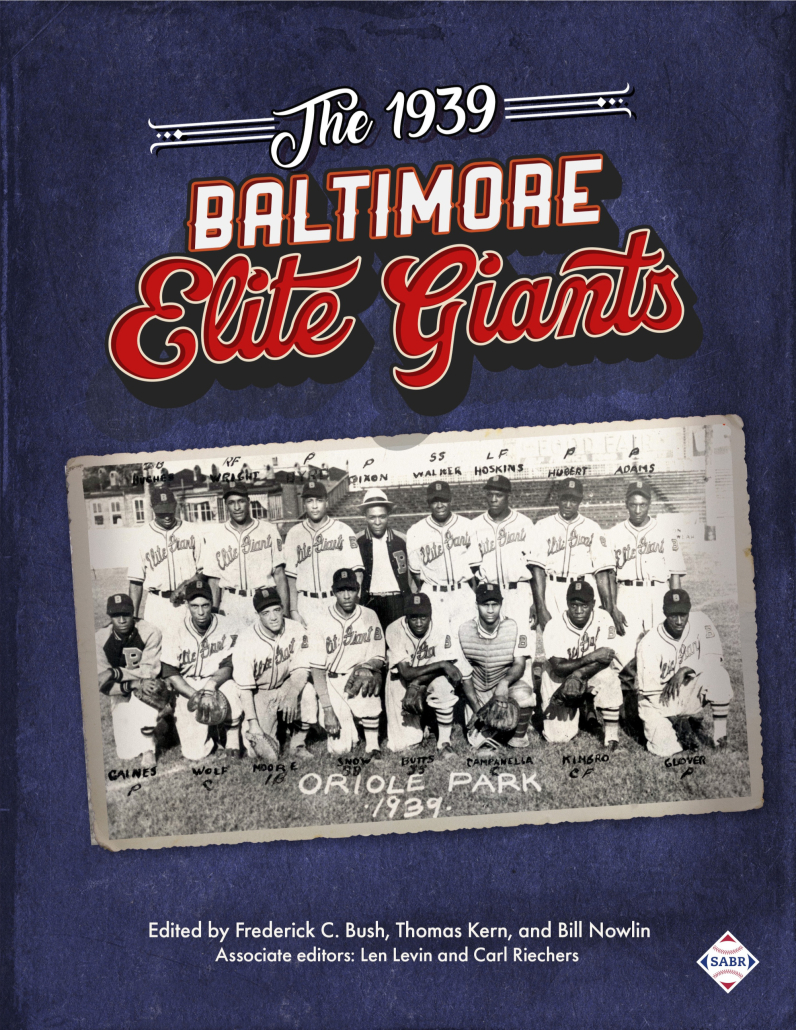
Introduction: The 1939 Baltimore Elite Giants
This article was written by Thomas Kern
This article was published in The 1939 Baltimore Elite Giants
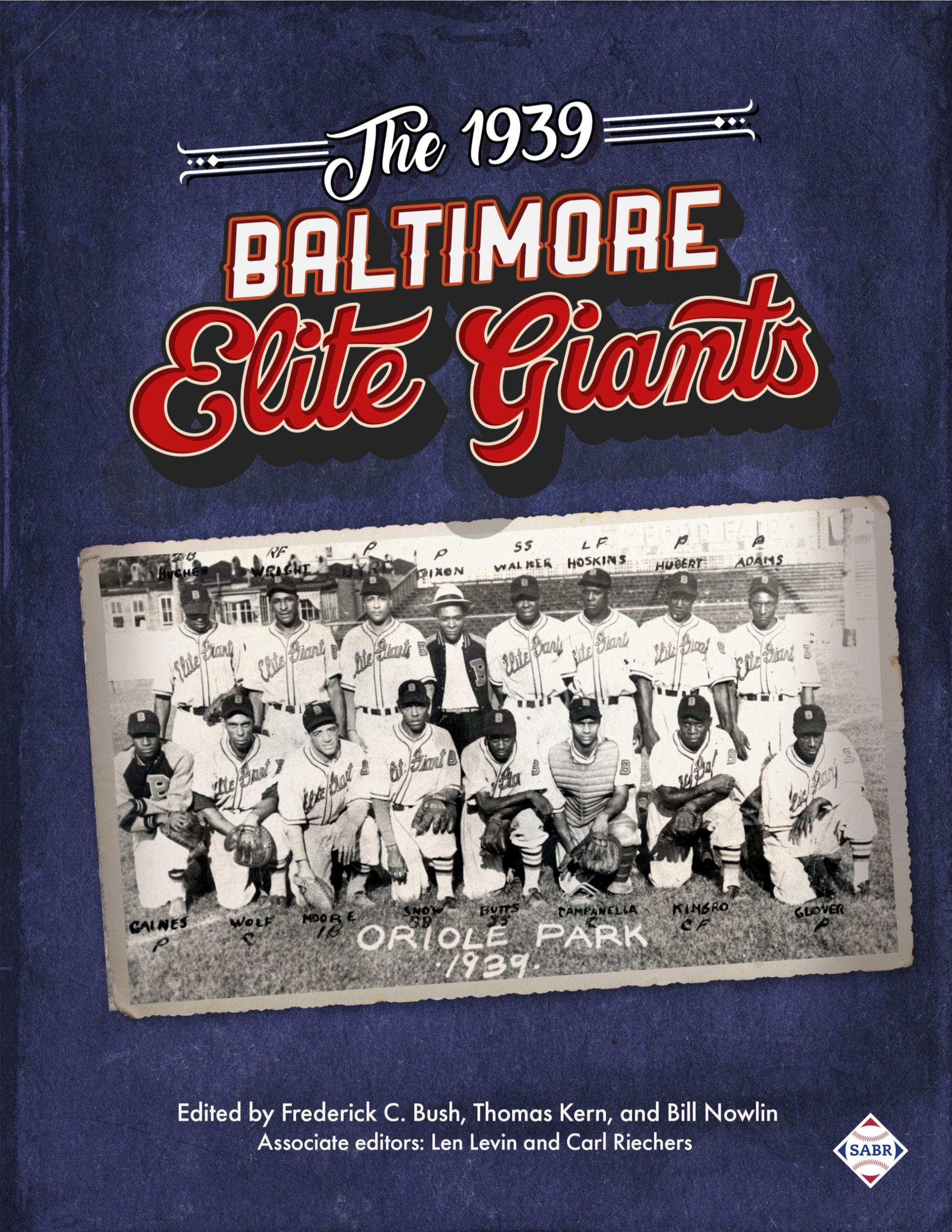 This history of the 1939 Baltimore Elite Giants is the seventh in a series of SABR Digital Library books about the great Negro League teams of the first half of the twentieth century.
The story begins with Tom Wilson, who established the team in Nashville in 1921. They had been previously known as the Nashville Standard Giants, a semipro team that Wilson founded in 1918. Wilson was a local businessman, transplanted from Atlanta, with a love for baseball. The idea of a competitive Black team in the South around the time that the Negro National League was forming farther north under the aegis of Rube Foster appealed to Wilson. But as much as he was loyal to Nashville, his entrepreneurial instincts and wish for financial success led him to relocate the franchise from time to time in search of greener pastures.
Columbus and Washington, DC, became way stations for Wilson as he moved the team in search of a sizable and stable fan base that Nashville’s Black population did not offer. Eventually, in 1938, after a poor showing in Washington, he found what he was looking for – a receptive environment for his Elites – and moved the team one more time, to Baltimore, less than 50 miles up the road. The following year, 1939, the Baltimore Elite Giants struck pay dirt and won the Negro National League championship in a four-team playoff, besting first the Newark Eagles and then the juggernaut Homestead Grays. They remained in Baltimore for the duration of their existence, until the team folded in 1950.
This book provides a detailed account of the Elite Giants and an array of essays about the players and team officials behind them that resulted in Baltimore’s 1939 crown. A complete season timeline, the story of Oriole Park, where the Elites often played, the historical context of the time, and articles about some of standout games are also included. They offer a backdrop for Tom Wilson’s bio and player narratives ranging from the young Roy Campanella and the likes of Biz Mackey, Burnis “Wild Bill” Wright, Henry Kimbro, and player-manager Felton Snow to those serving as the supporting cast.
In addition to the players with bios published in this book, over a dozen additional players were identified in The Negro Leagues Book, published in 1994 edited by Dick Clark and Larry Lester, as well as in James A. Riley’s extensive work, The Biographical Encyclopedia of The Negro Baseball Leagues, as having appeared at some point with the Elite Giants in 1939. Seamheads has captured few if any details on these players in a 1939 Elite Giants uniform; the transient nature of players led to their ephemeral appearances on the roster or even just the occasional bench warming at best in any given year. To quote the late Rick Bush, “[I]t has been inevitable that we find one or more players who cannot be identified or about whom we can find no evidence of their participation in the year on which the book is focused. The following individuals have been omitted from this book for such reasons.” But while the surmised place of these players in Baltimore in 1939 remains uncertain, they merit brief attention and the hope that a future researcher will unearth more details about their lives and baseball careers.
- V. (“Vet” or “Ed”) Barnes. Seamheads lists Vet (nicknamed Schoolboy or Ed) Barnes as having played for the Kansas City Monarchs in 1937 and 1938. There are no records (yet) for any time with the Elite Giants in 1939. He was born on December 23, 1911, in Silver Creek, Mississippi, and died on May 13, 1974, in Vallejo, California. Alternatively, Ed Barnes is listed by Riley as having played for the Monarchs in 1937-1938 and then for Baltimore in 1939-1940.1
- Charles Green “Wooger” Beverly (a.k.a. Beverie). Beverly ostensibly played some third base for the Elite Giants in 1939.2 His career, ranging from 1925 to 1939, otherwise had him as a left-handed pitcher primarily for the Kansas City Monarchs, but also for the Birmingham Black Barons, Cleveland Stars, Pittsburgh Crawfords, Philadelphia Stars, and Newark Eagles. A so-so record of 17-21 and a career batting average of .179 framed his itinerant career, of which portions of eight seasons are documented. Barnes was born in Walker County, Texas, on May 6, 1900, and died in Sealy, Texas, on March 20, 1981.
- George Britt. Britt had an extensive career in the Negro Leagues, dating from 1917 and lasting into the early 1940s. He played for 10 teams, including the precursor to the Elite Giants in Baltimore, the Baltimore Black Sox, from 1923 to 1926. A pitcher who also caught and served as a utility player, Britt was a serviceable right-hander with a decent curve. According to Riley, he was nicknamed “Chippy” because that is what he called everyone else.3 His longest tenure was with the Homestead Grays; sandwiched on either side of his supposed time with the Elite Giants in 1939, he played for the Washington Black Senators and Grays. He was born in Lexington, Kentucky, on July 6, 1895, and died in Erie, Pennsylvania, in January 1981 at the age of 85.
- Jimmy Direaux. Pitcher, third baseman, outfielder. Records show Direaux having pitched for Baltimore in 1938, but no carryover is immediately documented for the 1939 season. Luke suggests that Direaux, along with Andy Porter and Schoolboy Griffith, jumped to the Mexican Leagues that season for better pay.4 In fact, Direaux spent most of his career in Mexico, playing stateside only for the Elite Giants both in Washington and Baltimore. Direaux was born in Pasadena, California in 1916, and a record of his death has not yet been found.
- Al Johnson. A brief career for the Washington Black Senators and the Elite Giants in 1939 and 1940,5 with an earlier appearance with the Washington Elite Giants in 1936, Johnson was a pitcher, but nothing else is known about him.
- Francis Matthews. Seamheads identifies first baseman-outfielder Fran Matthews as a Newark Eagles lifer in the late 1930s and early 1940s with time off for military service, but Riley suggests he played for Baltimore, even sparingly, in 1939. Matthews was born in Cambridge, Massachusetts, on November 2, 1916, attended Boston University before his baseball career began, and died in Los Angeles on August 24, 1999, at the age of 82. He was deemed a promising player in his early years, but his career might have been affected by being hit by Monte Irvin with a throw from third base.6
- John “Lefty” Phillips. Born in Nashville in 1918, death date unknown. Information on Phillips is scarce, although Seamheads shows him appearing in five games over the 1939 and 1940 seasons with Baltimore for a total of 5⅔ innings pitched and an ERA of 12.71.
- Andrew Porter. Andy “Pullman” Porter was considered one of the big three with Baltimore in 1938 alongside Jonas Gaines and Bill Byrd. However, according to Luke, in 1939 he opted to take his talents to Mexico with teammates Jimmy Direaux and Schoolboy Griffith.7 The tall right-hander had a 15-year career split between the Negro Leagues and Mexico, playing in the latter for at least four seasons. He returned to Baltimore in the early 1940s and finished his career with the Indianapolis Clowns. Porter lived to be 100; he was born in Sweet Home, Arkansas, on March 7, 1910, and died in Los Angeles on July 1, 2010.
- Sarah “Mutt” Roberts. Riley lists Roberts as a pitcher for the Philadelphia Stars in 1937-1938 before appearing with the Elite Giants in 1939. No records otherwise have been found.8
- Clarence Williams. Records for Clarence Williams, a pitcher and outfielder, are scarce. Riley suggests he played three seasons, first for the Washington Black Senators in 1938 and in 1939 and 1940 for Baltimore.9 Seamheads found him in one Elite Giants box score in 1939, going 0-for-2. No other information on him is readily available.
- Williams. Shown as a utility player for Baltimore in 1939 by Riley; no other details are readily available.10
- Williams. Not much is known about this right-handed pitcher who ostensibly played for Baltimore briefly in 1939 and then for the Newark Eagles during the World War II years.11
- Woodrow Wilson “Willie” Williams. Seamheads lists a contemporary as “Lilly” but no Willie Williams. Riley’s records show Willie or “Woody,” a left-handed pitcher, as having played from 1933 to 1941 including time with the Elite Giants, in Washington in 1937 and then with the Baltimore club in 1938-1940 before ending his career with the Birmingham Black Barons in 1941.12
- Jim Willis. With the monikers “Cannonball” and “Bullet Jim” to underscore his lethal fastball, Willis played for four iterations of the Elite Giants from Nashville to Columbus to Washington and Baltimore. Seamheads shows him with a career 32-49 record and at least two appearances for Baltimore in 1939. He was born in Sewanee, Tennessee, on February 28, 1908, but had no date of death listed.13
- Zollie Wright. Born on September 17, 1909, in Milford, Texas, Wright, a right-handed-batting right fielder, played for nearly a decade in the 1930s for a handful of teams, including the Elite Giants franchise beginning with the Columbus version and then Washington (where he earned a 1936 selection to the East-West All-Star Game) and Baltimore. He ended his career with stints with the New York Black Yankees (in 1939 and 1940) and the Philadelphia Stars (1941). The Black Yankees and Elite Giants exchanged players from time to time in the late 1930s; perhaps Wright surfaced for a time in Baltimore in 1939. He died in Philadelphia on April 12, 1976.14
This book and those in the series that have preceded it has been made possible by the 30 SABR members who have collaboratively and diligently researched and written each article. A difficult task in compiling a book like this continues to be the collection of photos of as many as possible of those portrayed in it. Some of the more obscure players pose challenges and we are grateful for the efforts of those who have been able to help in finding visual representations.
It is important to take a moment and note the passing of Frederick C. “Rick” Bush, editor of so many of SABR’s baseball compilations. He died in 2023, having already invested much time and effort in planning and organizing this book. He set an example and tone for all who have contributed to books like these, for which we are thankful. He will be missed.
We express our thanks to the tireless efforts of our fact-checker Carl Riechers and copy editor Len Levin. They have served in these capacities in earlier books in the series and are consummate professionals at what they do. Finally, it is fitting to paraphrase how Rick Bush might have concluded this Preface and Acknowledgments, noting that another book in this series is already in the works – the 1945 Cleveland Buckeyes. For now, enjoy yet another window on Black Baseball’s past – the 1939 Baltimore Elite Giants.
THOMAS KERN was born and raised in Southwest Pennsylvania. Listening to the mellifluous voices of Bob Prince and Jim Woods in his youth, how could one not become a lifelong Pirates fan? He now lives in Silver Spring, Maryland, and sees the Pirates, Nationals, and Orioles as often as possible. He is a SABR member dating back to the mid-1980s. With a love and appreciation for Negro League baseball in addition to the Pirates, he has written SABR bios for the 1979 Pirates and Clemente books and has completed bios for Leon Day, John Henry Lloyd, Willie Foster, Judy Johnson, Turkey Stearnes, Hilton Smith, Louis Santop, Andy Cooper, Double Duty Radcliffe, and others.
Notes
1 James A. Riley, Biographical Encyclopedia of the Negro Baseball Leagues (New York: Carroll & Graf Publishers, Inc., 1994), 58.
2 Riley, 82.
3 Riley, 109-110.
4 Bob Luke, The Baltimore Elite Giants (Baltimore: The Johns Hopkins University Press, 2009), 43.
5 Riley, 429.
6 Riley, 521-522.
7 Luke, 43.
8 Riley, 669.
9 Riley, 848.
10 Riley, 849.
11 Riley, 858.
12 Riley, 864.
13 Riley, 865.
14 Riley, 884.