
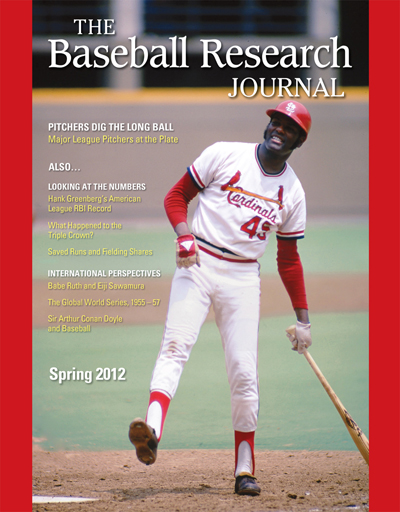
Spring 2012
Volume 41, Issue 1
-
The Bible and the Apocrypha
There can be little doubt that compared to pitching and hitting, fielding is the most vastly under-analyzed part of the game. There is very good reason to hope that the greatest advances in our understanding of the game through statistics will come in the area of fielding measures.
-
Pitchers Dig the Long Ball (At Least When They Are Hitting)
There have been many pitchers who also excelled with the bat, hurlers who could help their team with the stick as well as with their arm. This article will look at some of the most proficient home run-hitting pitchers in the major leagues and some of their accomplishments.
-
Hank Greenberg's American League RBI Record
Hall of Fame slugger Hank Greenberg wrote, “My goal in baseball was always RBIs, to break (Lou) Gehrig’s record of 184 RBIs.” Did he come closer than he thought to doing so?
-
Breaking Balls with a Runner on Third: A Game Theoretical Analysis of Optimal Behavior
With a runner on third base, the pitcher faces a dilemma. Throwing breaking balls is risky because the ball may go past the catcher, thereby allowing the runner to score without a hit. But if the pitcher avoids throwing breaking balls altogether, the batter can anticipate fastballs exclusively, increasing his ability to record a hit, which scores the runner anyway. Using a game theoretical framework, this article shows how each player optimally solves the dilemma.
-
Are Baseball Players Superior to Umpires in Discriminating Balls to Strikes?
Missed, bad or wrong calls are part of nearly every game and can have an influence on the run of the play as well as the final score. Emotions can run particularly high when a player perceives a pitched ball is out of the strike zone but the umpire calls “strike.” Is it possible that a batter is better at judging whether a ball is in the strike zone than an umpire? If so, what can this be attributed to?
-
Johnny Vander Meer's Third No-Hitter
During his major league career, Johnny Vander Meer possessed a lively fast ball, an effective sinker and a reputation for wildness. At 37, with his double no-hitter for the Cincinnati Reds long behind him, the Dutch Master rose on one last occasion to capture the imagination of the baseball world.
-
"Sparky"
The passion of a baseball player at Dorsey High School in Los Angeles led to a career that included managing the Cincinnati Reds and Detroit Tigers and to enshrinement in the National Baseball Hall of Fame. Speaking with some of George Lee Anderson’s earliest friends in baseball, one learns of the fondness inspired by the man known as “Sparky.”
-
Pop Kelchner, Gentleman Jake, The Giant-Killer, and the Kane Mountaineers
In the damp and chilly spring of 1907, at the height of the great glass era, an erudite professor of languages, a polite young first baseman and an eccentric left-handed pitcher came to the Hilltop in Kane, Pennsylvania to play professional baseball. While their time together as teammates would end before the summer was over, each of these storied baseball characters would leave an indelible mark on the National Pastime.
-
American Women Play Hardball in Venezuela: Team USA battles invisibility at home, is celebrated abroad, and faces gunfire at the Women’s World Cup
Of the major American sports, baseball is the only one that continues to enforce a segregation so complete that girls are directed to an “equivalent” sport. Yet generation after generation of women, from the late eighteenth century when baseball first arrived in the United States, to the USA Baseball National Team today, have refused to relinquish the nation’s diamonds.
-
Global World Series: 1955-57
Half a century before there was a World Baseball Classic, there was the Global World Series. The scars of World War II had not yet fully healed, but teams representing four continents and three island nations chose to set aside their political differences and do battle with a bat and ball between the white lines.
-
Sir Arthur Conan Doyle and Baseball
A sometime-participant, an avid fan, and a zealous promoter of baseball in Britain, Sir Arthur Conan Doyle’s analysis of the its qualities and strategies as compared to cricket provides insights into the way baseball was perceived and promoted by a distinguished English man of letters.
-
Babe Ruth and Eiji Sawamura
A 17-year-old high school pitcher named Eiji Sawamura became a Japanese baseball legend with his performance against one of the greatest squads of major leaguer talent ever assembled.
-
Expos Get First Franchise No-Hitter Right Out of the Gate
The San Diego Padres have been around since 1969 and are awaiting their first. The New York Mets have been around since way back in 1962 and, amazingly, still do not have one. Yet the Montreal Expos, who started play in the same year as the Padres, set a record for the fewest games needed to have one of its pitchers pitch a no-hitter, when Bill Stoneman whitewashed the Philadelphia Phillies 7–0 in only the franchise’s ninth game.
-
One Trade, Three Teams, and Reversal of Fortune
The 1946 season had been a deep disappointment for the New York Yankees and the Cleveland Indians. Immediately after season's end, trade discussions began. A deal was made on October 11 that changed the fortunes of both teams: Joe Gordon for Allie Reynolds.
-
1906 Cleveland Naps: Deadball Era Underachiever
Baseball history is littered with heroic performances by great teams that ran rampshod over their competition, as well as teams that overachieved. Less remembered are the underachievers— teams that, at least on paper, appeared great, but failed to achieve their full potential.
-
Whatever Happened to the Triple Crown?
An excerpt from "The Runmakers: A New Way to Rate Baseball Players"
-
The Most Famous Woman in Baseball
A review of "The Most Famous Woman in Baseball: Effa Manley and the Negro Leagues," by Bob Luke
-
Download the PDF
Read the Spring 2012 BRJ on your computer or e-reader!
-
Appendix 1: Tigers games for which the exact details for the runs scored and runs batted in are not yet complete
Appendix 1 in Herm Krabbenhoft's research on Hank Greenberg.
-
Appendix 2: Supporting Documentation for the Corrections of the RBI Errors in Hank Greenberg’s Official DBD Record
Appendix 2 in Herm Krabbenhoft's research on Hank Greenberg.
-
Appendix 3: Retrosheet box scores for Tigers-Athletics games on 20 June 1937
Appendix 3 in Herm Krabbenhoft's research on Hank Greenberg.
-
Appendix 4: RBIs given in newspaper box scores for games played between the Tigers and Athletics in Philadelphia during the 1937 season
Appendix 4 in Herm Krabbenhoft's research on Hank Greenberg.
-
Appendix 5: Analysis of newspaper box scores for the second game of the double header between the Tigers and Athletics on June 20, 1937
Appendix 5 in Herm Krabbenhoft's research on Hank Greenberg.
-
Appendix 6: Retrosheet Box score for Tigers-Athletics Second Game on 20 June 1937
Appendix 6 in Herm Krabbenhoft's research on Hank Greenberg.
-
Editor's Note
A note from the editor of the Baseball Research Journal.