

The Fans of the 1995 Cleveland Indians
This article was written by John McMurray
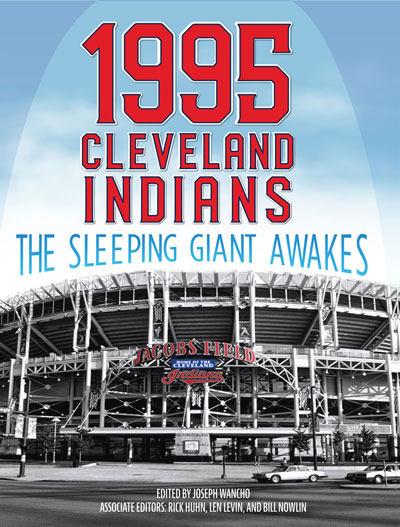
This article was published in 1995 Cleveland Indians: The Sleeping Giant Awakes
That the Cleveland Indians established a single-season team attendance record in 1995 is no surprise, given the Indians’ dominance over other American League teams.1 Yet it was the fervor and passion of those fans and their deep connection to the 1995 team that anyone who was in Cleveland at the time recalls more than two decades later.
Cleveland has had a long history of supporting its local teams, especially when their fortunes turn for the better. Fans routinely filled the Richfield Coliseum to see the Cleveland Cavaliers during the 1976 “Miracle of Richfield,” the first season the Cavaliers won the division title. In 1980, after more than a decade of lackluster finishes, the “Kardiac Kids” Cleveland Browns sold out Municipal Stadium week after week. The resurgent Indians, who did not finish above fourth place between 1968 and 1993, certainly fit the mold of a team that Clevelanders would show up to support, as they had just turned a significant corner. At the same time, Cleveland’s diehard baseball fans were guaranteed to be in attendance, regardless.
Still, the 1995 Indians offered something more. Fans could see from early in that season that this team was a championship-caliber club. Yet, by playing winning baseball in a new ballpark in a new location during the middle of the city’s renaissance, the 1995 Indians experience was something that no Cleveland team had offered before or since. The 2,842,745 fans who came to Jacobs Field that season – the second-best attendance in the American League – saw young and fearless team in a ballpark that was a marked departure from drab Municipal Stadium. The entire experience was new. With the Indians seemingly capable of winning every game, a sense of electricity flowed through the stadium stands from the game’s start to finish. The Indians were a phenomenon, and the fans served as a driving source of energy.
Starting in 1994, when the Indians consistently played competitive baseball in their first season in Jacobs Field, the vibe surrounding Cleveland baseball appeared to change dramatically. As of Opening Day in 1994, the Indians had already sold as many tickets for that season as they had for all of 1993, and, as Richard Justice wrote after the first game, fans in attendance at the 1994 home opener “had seen what they’d come for: the rebirth of baseball in Cleveland and in a sense, the rebirth of Cleveland.”2
Fans’ attachment to the new-look Cleveland Indians began to build throughout 1994. An Associated Press article from June of that year spoke of how fans “are pouring out in record numbers” to see the team and that “merchandise sales have risen considerably.” David Nolan, president of the Cleveland Convention and Visitors Bureau, attributed a surge in hotel occupancy to the team’s strong performance, claiming that “it’s 6 to 8 percent higher than projected for occupied rooms. That’s also how it is for food and beverage sales all across downtown.”3 That Cleveland might have made the World Series in 1994 had it not been for the players strike scrubbing that year’s postseason only whetted local fans’ appetites for 1995. If other cities’ interest in baseball waned after the strike, Cleveland’s surged.
The fan experience at Jacobs Field also made an extraordinary difference. Gone were the obstructed views and seats that felt miles from the action, replaced by a setting that brought fans close to the field and part of a collective experience. For the first time, “charm” was a word used to describe Cleveland’s ballpark, and, as Ed Sherman said, “[c]hanging addresses from Cleveland Stadium – depressing redefined – to Jacobs Field is like moving from Siberia to Maui.”4 No longer were fans sitting widely apart from one another, as they often did across the cavernous old stadium; to the contrary, they sat clustered together – and were hopping to buy seats for games in July when they went on sale before Christmas.
But it was the way the team won that kept fans’ rapt attention. For decades, Indians teams seldom had more than one legitimate power hitter. Suddenly they had a roster where anyone in the starting lineup was capable of hitting home runs, and lofty ones at that. These new players also did it with a swagger befitting the mid-1970s New York Yankees. If Albert Belle was this team’s Reggie Jackson or Jim Thome its George Brett, fans’ perspective on the entire franchise changed, as team followers – almost unfathomably – came to view the Cleveland Indians as the favorites in any game they played. It was winning combined with pageantry and showmanship. Even when Cleveland hitters swung and missed, they swung big. As a result, being at Jacobs Field to see it in person became essential.
Then there were the comeback wins. None in the regular season was more emblematic of this team’s potential in 1995 than the June 4 victory, capped by Paul Sorrento’s two-out ninth-inning home run to win the game, when the team had fallen behind 8-0 against the Toronto Blue Jays. The record 455-game sellout streak that began in Cleveland in 1995 stemmed from this team having a late-inning magic that no other Cleveland baseball team has had before or since. If the boxes behind home plate and adjacent to the dugouts at Jacobs Field did indeed cost $100,000 per season, somehow it was worth it in order to see 40 years of pedestrian baseball turned around so authoritatively and decisively, usually with a home run that seemed to say take that!
In 1995 Cleveland fans wore their team’s apparel proudly. The more of it, it seemed, the better. After noting that the Indians had spent “40 years wandering in baseball’s barren land,” Murray Chass quoted fan Shirley Klein, who said that season: “You can’t go anywhere without seeing Indians shirts and hats. I walk in the morning and people toot their horns because I wear an Indians shirt.”5 By the middle of 1995, one estimate had 27,000 Indians caps and a comparable number of T-shirts sold in the team’s store at the ballpark by early July 1995.6
Indeed, the transition was as complete as it was unexpected: The Cleveland Indians in 1995 had become a point of civic pride. Alan Sudimack, a local marketing vice president, said in September 1995: “I’m so proud of this city right now that if a member of the Indians ran over me in his car, I’d jump up and say, ‘I’m sorry, did I scratch the paint?’”7
Ira Berkow described how Gary Goldwasser, a local attorney, changed from his suit and glasses into his Cleveland gear, “transformed from a mild-mannered lawyer into, well, Superfan!” Goldwasser, Berkow noted, “is not alone and won’t be alone.” Rather “all over town, citizens have been performing similar rituals.” For his part, Goldwasser said: “Everybody in this city hangs on every game. All we do is talk about the Indians. … My wife, Lois, who’s never had much interest in baseball, can now tell you the averages of all the players. It’s like that in family after family here.”8
Fans who couldn’t get tickets to games were connected to the team through the radio broadcasts. Tom Hamilton, a relative newcomer to the team’s broadcasts, with his anticipatory home-run calls, made fans feel like they were at the park. At the same time, announcer Herb Score was a connection both to Cleveland’s winning teams of the mid- to late 1950s, of which he was a member, and to its many losing teams, which he covered for more than 30 years as an announcer. Their complementary styles worked, and fans bonded with Herb and Tom, who connected them with this once-in-a-generation ballclub.
As much as fans flocked to Jacobs Field to see winning baseball for the first time in generations, they came also to see a unique team chemistry. The 1995 Cleveland Indians were a tight-knit baseball team whose confidence and belief it in itself connected the fan base.
Other Cleveland baseball teams have made it to the World Series more recently, but fans of the 1995 team remember this team the most fondly. Beyond the 1995 team making it to the World Series for the first time since 1954, but it was also a team that had an unmistakable je ne sais quoi. And a big part of the experience was sharing it with fans – young and old, longtime and new – who experienced the joy of Cleveland baseball with an enthusiasm and passion that may not be equaled until a Cleveland team one day does win the World Series.
JOHN McMURRAY is Chair of both the Deadball Era Committee and the Oral History Committee for SABR. He is a member of the Editorial Board of Base Ball: New Research on the Early Game.
NOTES
1 With thanks to the Giamatti Research Center at the Baseball Hall of Fame, which provided clippings of articles used in this chapter. See https://baseball-reference.com/teams/CLE/attend.shtml for Indians attendance figures.
2 Richard Justice, “New Stadium, New Day for Cleveland,” Washington Post, April 5, 1994: C3.
3 Associated Press, “Cleveland Rocks as Indians Roll in New Ballpark: Team’s Got AL’s Best Record, Fans Have Reasons to Show Up,” Washington Post, June 25, 1994: D-1A.
4 Ed Sherman, “Is This Heaven? No, It’s Cleveland … Cleveland? Believe It,” Chicago Tribune, April 27, 1994: E10.
5 Murray Chass, “Indians’ Lost Years Took Their Toll on Faithful,” New York Times, September 10, 1995: S9.
6 Ira Berkow, “Indians and Fans Help Revive a Sick Game,” New York Times, July 5, 1995: B7.
7 Iver Peterson, “ ‘Mistake by the Lake’ Wakes Up, Roaring: Cleveland Finds That Winning Feeling,” New York Times, September 10, 1995: 18.
8 Berkow.