

Introduction: Harvey’s Wallbangers: The 1982 Milwaukee Brewers
This article was written by Gregory H. Wolf
This article was published in Harvey’s Wallbangers: The 1982 Milwaukee Brewers
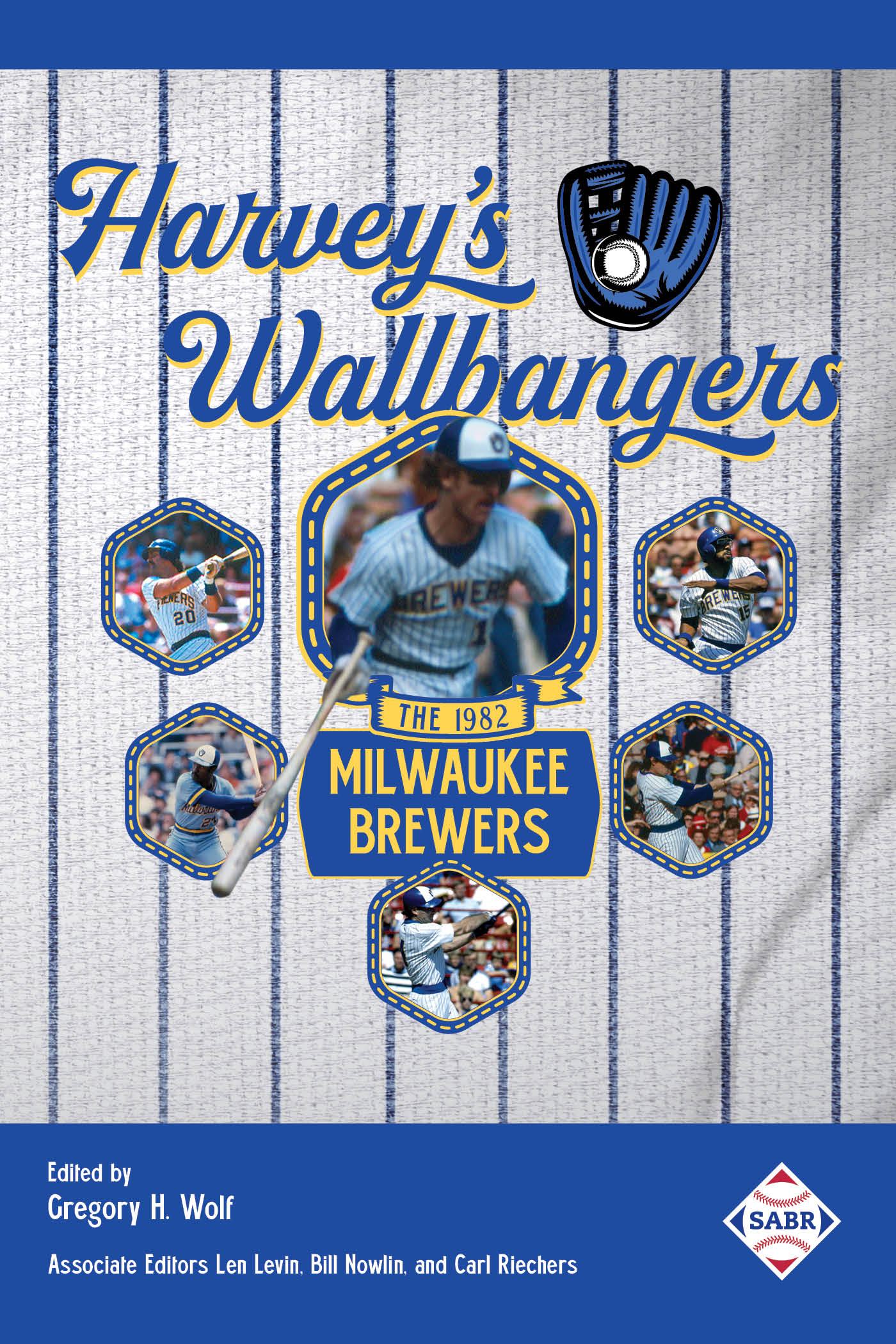 Harvey’s Wallbangers. What a moniker for the 1982 Milwaukee Brewers, who captured the hearts and imagination of baseball fans not just in Wisconsin, but around the country.
Following the strike-shortened 1981 season, big-league baseball needed a feel-good narrative to rekindle fan interest. Harvey’s Wallbangers were one of those stories. The club was filled with a memorable cast of characters, future Hall of Famers, and All-Stars: from Robin Yount, the former Boy Wonder who at age 26 was playing in his ninth full season with the Brewers; the Fu Manchu-wearing and prodigious slugger Gorman Thomas; Ted Simmons, whose shoulder-length mane of hair resulted in the nickname Simba; and Rollie Fingers, with his famous groomed twirling handlebar ’stache, to the criminally underrated, perennial .300 hitter and RBI machine Cecil Cooper; former HR champ Ben Oglivie; and emerging superstar Paul Molitor.
Aiming for the fences, Harvey’s Wallbangers led the majors with 216 home runs, 30 more than any other big-league team. Three of the top five home-run hitters in the AL were Brewers, including Stormin’ Gorman, who tied the California Angels’ Reggie Jackson for the league lead with 39. Harvey’s Wallbangers weren’t just sluggers. They were a close-knit and resilient group that weathered controversies and slumps to capture the AL East crown on the last day of the season, overcome a two-games-to-none deficit to win the best-of-five League Championship Series, and move to within one game of winning the World Series.
The Brewers did not begin the 1982 season as Harvey’s Wallbangers. Their manager was Buck Rodgers, who had guided the club to its first postseason berth in franchise history a year earlier. Many predicted that the Brewers would challenge the Baltimore Orioles, Boston Red Sox, and New York Yankees for the AL East crown. The Brewers, however, started the season sluggishly, losing five straight games in early April, and then slumped in May, losing 14 of 20 games during a woeful stretch. On June 1 the Brewers were languishing with a losing record (23-24), tied with the Baltimore Orioles for fifth place in the seven-team division. Team owner Bud Selig and GM Harry Dalton acted decisively and replaced Rodgers with longtime coach and former 10-time All-Star Harvey Kuenn. Harvey’s Wallbangers were born.
The Brewers immediately responded to the first-time skipper’s laid-back and let’s-have-some-fun attitude. With the offense firing on all cylinders, the Brewers won 21 of their first 29 games under Kuenn’s guidance to move into a tie with the Red Sox on July 3. They began September in first place, 4½ games ahead of the Red Sox and 5 in front of the Orioles. The outlook looked even more promising as the team acquired future Hall of Famer Don Sutton in a trade with the Houston Astros for the final month. However, the situation grew tense. Reigning AL MVP and Cy Young Award winner Rollie Fingers was sidelined with an arm injury and ultimately missed the last month of the regular season and the entire postseason, putting pressure on a pitching staff generally regarded as mediocre.
As well as the Brewers played in September (17-11), the Orioles were even hotter, winning 30 of 40 games, to pull to within one game of the Brewers and set up a dream scenario: a season-concluding four-game, winner-take-all series between the two teams in Baltimore. The Orioles trounced the Brewers in the first three contests, outscoring them 26-7, to pull into a tie. In the season’s final game, the Brewers’ stars led them to victory and the team’s first divisional crown, in a crushing 10-2 victory. Robin Yount slugged two home runs and beat out a triple to cement his MVP season, Cecil Cooper and Ted Simmons bashed round-trippers, and 37-year-old graybeard Don Sutton pitched the most important game of his career to that point, tossing eight strong innings.
The Brewers experienced a roller-coaster postseason. After losing the first two games of the ALCS to the California Angels in Anaheim, Harvey’s Wallbangers returned to County Stadium in Milwaukee and won three straight, led by pitching, to take the pennant. The World Series pitted two philosophies: the Brewers’ prodigious power against the St. Louis Cardinals’ Whitey Ball, so named for manager Whitey Herzog’s emphasis on speed, defense, and pitching. After winning Game Five at County Stadium, 6-4, once again led by Yount’s four hits, including a home run and double, Harvey’s Wallbangers were on the precipice of the title. In agonizing fashion, the Brewers lost Games Six and Seven in St. Louis, their bats quieted by excellent pitching, scoring just four runs.
Despite the loss, the Brewers were still champions, at least in the hearts of their fans. Upon returning to Milwaukee, the team was feted by a grand parade. Four decades later, Harvey’s Wallbangers still hold a special place in Milwaukee sports lore.
This SABR Digital Library book is the result of the tireless work of more than 40 members of the Society for American Baseball Research. SABR members researched and wrote all of the biographies, game accounts, and essays in this volume. These uncompensated volunteers are united by their shared interest in baseball history and a resolute commitment to preserving its history. Without their unwavering dedication, this volume would not have been possible.
I am indebted to the associate editors and extend to them my sincerest appreciation. Bill Nowlin, the second reader; fact-checker Carl Riechers; and copy editor Len Levin each read every word of all the contributions and made numerous corrections to language, style, and content. Their attention to detail has been invaluable. It has been a pleasure to once again work on a book project with such professionals, with whom I corresponded practically every day, and typically more than once. What a team we have!
I thank all of the authors for their contributions, meticulous research, cooperation through the revising and editing process, and finally their patience. It was a long journey from the day the book was launched to its completion, and we’ve finally reached our destination. We did it! Please refer to the list of contributors at the end of the book for more information.
This book would not have been possible without the generous support of the staff and Board of Directors of SABR, SABR Publications Director Cecilia Tan, and designer David Peng.
We express our sincere thanks and heartfelt gratitude to the Milwaukee Brewers Baseball Club and Robbin Barnes, publications assistant, for providing every photo for this book, including those on the cover. The Brewers’ support of SABR’s nonprofit mission is greatly appreciated. Without their generosity, this book would not have been possible.
And finally, I wish to thank my wife, Margaret, and daughter, Gabriela, for their support of and endless patience with my baseball pursuits. They’re accustomed to me working on my “SABR stuff.” We’re looking forward to seeing the Brewers this season and enjoying their wonderful ballpark.
As the Brewers and Major League Baseball celebrate the 50th anniversary of the club in Milwaukee in 2020, we invite you to sit back, relax for a few minutes, and enjoy reading about Harvey’s Wallbangers – the 1982 Milwaukee Brewers!
GREGORY H. WOLF was born in Pittsburgh, but now resides in the Chicagoland area with his wife, Margaret, and daughter, Gabriela. A professor of German studies and holder of the Dennis and Jean Bauman Endowed Chair in the Humanities at North Central College in Naperville, Illinois, he has edited a dozen books for SABR. He is currently working on projects about Shibe Park in Philadelphia and Ebbets Field in Brooklyn. Since January 2017 he has been co-director of SABR’s BioProject, which you can follow on Facebook and Twitter.