

Tampa Bay Rays team ownership history
This article was written by Steve Rennie
This article was published in the Team Ownership History Project
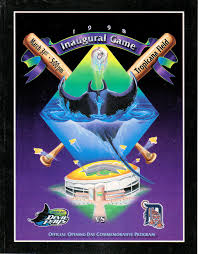
Tampa Bay Devil Rays Opening Day program from March 31, 1998. (Courtesy of the Tampa Bay Rays)
In October 2024, after Hurricane Milton tore through St. Petersburg and shredded the roof of Tropicana Field, rendering it unusable, the Tampa Bay Rays suddenly found themselves without a home—and once again facing the kind of existential crisis that has plagued the franchise from the start.1
The devastation caused by the storm ultimately forced the Rays to play the 2025 season at George M. Steinbrenner Field, a much smaller, open-air ballpark on the Tampa side of the bay that left fans exposed to the heat, humidity, and rain that comes with summertime in Florida.2
Partway through the Rays’ unconventional season in their rental home, though, rumors began to swirl that owner Stuart Sternberg was in talks with prospective buyers to sell the team he had owned since 2005. Those talks heated up in September 2025 and, by the end of the month, a group led by Jacksonville‑based real‑estate developer Patrick Zupski had purchased the Rays for a reported $1.7 billion. The sale ended a long period of uncertainty and instability surrounding the future of the franchise, but it also raised fresh questions about whether the Rays would remain in St. Petersburg for the long term.3
In other words, not much had changed.
Long before the Rays, baseball was already part of life around Tampa Bay. St. Petersburg’s baseball roots date to the mid-nineteenth century, when returning Civil War veterans brought home the game they had played during downtime between battles. By 1892, Tampa had a team in the short‑lived Florida State League. Meanwhile, interest in the game was growing among fans throughout the Tampa Bay area.4
By 1902, this growing interest had produced the semipro St. Petersburg Saints. The club eventually joined the Florida State League as a minor-league team, but the operation folded in 1928. It took nearly twenty years for the Saints name to return to the city. This revived version of the team played in both the Florida International League and the Florida State League, eventually rebranding as the Cardinals and later the Devil Rays following a short-lived affiliation with Major League Baseball’s expansion. The team finally ceased operations after the 2000 season.5
The city soon established itself as a spring training destination. Its climate made it an attractive location for major-league clubs preparing for the season. The St. Louis Browns held spring training there in 1914, and other teams soon followed.6
The presence of these major-league clubs drew visitors each year and bolstered the local economy. Hotels, restaurants, and other businesses benefited from the seasonal influx of tourists and press. Notable players, including Babe Ruth, Lou Gehrig, Joe DiMaggio, and Jackie Robinson, all appeared in St. Petersburg during this period.7
Despite its success as a spring training site, the city struggled to land a full-time major-league franchise. The primary obstacle was the lack of a suitable ballpark. While Al Lang Field hosted spring training games, its 7,227 seats and limited facilities were never going to be enough for a major-league club.8
In the early 1980s, local officials moved to address the ballpark issue. The St. Petersburg City Council offered sixty-six acres of downtown land for one dollar per year to the Pinellas Sports Authority, an entity created by state legislators in 1977 to finance and build a domed stadium. Construction on what would eventually become the Florida Suncoast Dome began in late 1986. The groundbreaking ceremony drew more than 9,000 supporters, many wielding miniature shovels inscribed with the motto “I Dig the Stadium.”9
By 1990, the stadium was finished. All that was missing was a team.
The city came tantalizingly close to landing a team on several occasions. In 1988, the Chicago White Sox seriously considered relocating to St. Petersburg before Illinois approved last-minute funding for a new stadium. Other clubs—including the Minnesota Twins, Seattle Mariners, Texas Rangers, and Oakland Athletics—frequently used the threat of relocation to St. Petersburg as leverage in negotiations for their own facilities. Despite being a top contender for a 1993 expansion team, the city was overlooked when Major League Baseball instead granted franchises to Miami and Denver. Then, in 1992, National League owners rejected Tampa businessman Vince Naimoli’s bid to buy the San Francisco Giants and move them to St. Petersburg. This refusal sparked a flurry of legal actions against both San Francisco’s municipal authorities and Major League Baseball’s antitrust exemption.10 (Click here for the San Francisco side of the story).
In 1994, Major League Baseball again turned its sights toward expansion, announcing plans to add two new teams for the 1998 season. St. Petersburg and Phoenix emerged as the clear favorites among the four finalist groups, beating out bids from Orlando and Northern Virginia. St. Petersburg had one major advantage: a stadium already stood waiting. Originally called the Florida Suncoast Dome, the venue was renamed the ThunderDome before eventually becoming Tropicana Field. While it finally secured a team, “the Trop” would later become a point of contention, frequently ranked among the league’s worst ballparks due to its uninspired, warehouse-like aesthetics and its isolated location along the interstate.11
Naimoli, a New Jersey native who built a fortune by acquiring struggling companies and aggressively cutting costs, reemerged to lead St. Petersburg’s expansion push. His ties to the region dated to the late 1970s, when he served as a vice president for the homebuilder Jim Walter Corp. Naimoli made his presence felt immediately with deep cuts. “He looked in every nook and cranny to try and find savings,” said Richard Dawson, a former corporate counsel of Anchor Glass, in a 1992 interview. “Woe be to someone who was caught Xeroxing something on only one side of the paper.” By 1986, the company had gone public and briefly stood as the only Fortune 500 firm in the Tampa Bay area. But the business was heavily indebted, and in 1989, the Mexican manufacturer Vitro S.A. launched a hostile takeover. Naimoli walked away from the deal with approximately twenty million dollars, eventually turning his attention to several local business ventures before joining the effort to secure a major-league franchise for the region.12
Despite its frontrunner status, St. Petersburg’s expansion bid hit a potential deal-killer when the league abruptly raised the entry fee from one hundred ten million dollars to one hundred thirty million dollars. On top of the price hike, the league demanded that expansion teams forfeit five million dollars annually from the central fund for their first five years. Naimoli was incensed by the eleventh-hour shift in terms, but with the deadline for the expansion announcement looming, he eventually gave in. In the early months of 1995, at long last, St. Petersburg finally got its team.13
The Tampa Bay Devil Rays were born.
Naimoli served as the managing general partner of an ownership group that featured five other primary stakeholders. This core circle included Bob Basham and Chris Sullivan, co-founders of the Outback Steakhouse chain; Mark Bostick, CEO of Comcar Industries; Dan Doyle, president and CEO of Danka Industries; and Bill Griffin, former chair of RISCORP Management Services. Together, these five general partners owned 62.5 percent of the Devil Rays, while Naimoli held a 16 percent stake. The franchise also drew support from several limited partners, including Florida Progress Corp., a utility holding company headquartered in St. Petersburg; Lance Ringhaver, owner and chairman of Ringhaver Equipment Co. and Ring Power Co.; P.J. Benton, a local businesswoman who previously owned two McDonald’s franchises; Gus Stavros, a local entrepreneur known for his philanthropic efforts; Gary Markel, a prominent figure in local real estate development and dining establishments; New York-based businessman Robert Kleinert; Mel Danker, a North Carolina entrepreneur; and Claude Focardi, owner of Great Bay Distributing, an Anheuser-Busch distributor in the region.14
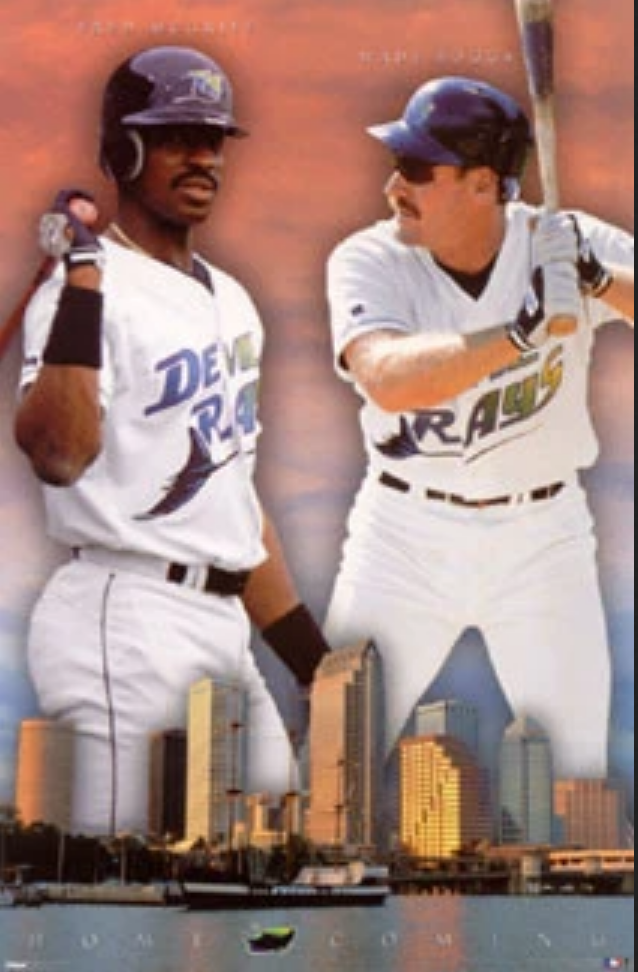
Fred McGriff and Wade Boggs on a 1998 Devil Rays poster. Both players grew up in the Tampa area. (Courtesy of the Tampa Bay Rays)
The Devil Rays finally took the field in 1998. The team struggled in its early seasons, frequently anchored to the bottom of the American League standings. Even with a roster that featured established stars like Wade Boggs, Fred McGriff, and Jose Canseco, wins were hard to come by. This led to a revolving door in the dugout as the franchise repeatedly changed managers in the hopes of finding someone who could turn the team around.
The team’s mounting financial losses, coupled with a lack of results on the field, sparked a series of bitter disputes between Naimoli and his fellow owners. By 2001, rumors circulated that the internal rift was so deep it threatened the franchise’s ability to meet its payroll. It was a chaotic spring; Naimoli initially announced he would step down as managing general partner, only to reclaim the roles of managing partner and CEO just a few weeks later. Amid the turmoil, the club hired John McHale Jr., a veteran major-league executive, as chief operating officer. McHale lasted less than a year as the boardroom infighting continued. By the summer of 2001, the Devil Rays had hired the investment banking firm J.P. Morgan to oversee a potential sale of the team.15
Throughout his tenure, Naimoli seemed to find new ways to alienate the local community at every turn. His reputation for picking fights became a defining feature of his leadership, whether he was demanding a $750,000 fee to put the team’s logo on a visitor’s guide or insisting a local department store pay for the right to sell Devil Rays gear. That particular move backfired when the store simply cleared its shelves of the team’s products. Naimoli’s litigious streak even extended to a $38,571 tax bill, and he frequently clashed with city officials, often using the threat of relocation to vent his frustrations over sagging attendance. In February 1999, the team sued Danka Business Systems over outstanding payments, a move made just months after the company’s co-founder, Devil Rays general partner Dan Doyle, had left the firm. The most infamous display of Naimoli’s thin skin came in 2000, after a lighthearted newspaper article suggested James Gandolfini—the star of the HBO series “The Sopranos”—should play him in a movie. Infuriated by the comparison, Naimoli ordered St. Petersburg Times newspaper racks hauled away from the fan concourse and dumped at the loading dock, a move that reportedly violated a multimillion-dollar marketing agreement. Relationships with corporate sponsors were equally strained. Naimoli had tried to charge extra for stadium signage, a fee that only kicked in if the team drew four million fans in its first season. When the club fell well short of that mark, the resulting disputes left a bitter taste in the mouths of the region’s business leaders.16
With both the city and the fans weary of the constant friction, the time was right for a change.17
Enter Stuart Sternberg, a New York hedge-fund manager and lifelong Mets fan who had built a fortune on Wall Street. After retiring as a partner at Goldman Sachs, he turned his focus toward owning a ballclub. While a 2002 attempt to buy into the Mets fell through, a different door opened in St. Petersburg. At the time, Sternberg had no ties to the region and was initially skeptical when his bankers suggested the Devil Rays. “I was like, ‘oh, the Devil Rays? They’re pretty bad.’ And they said, ‘Yeah, but look, you’ll speak to them and maybe you’ll see something.’ So I did, I sat down with them, and I saw immediately that it could have been a real good opportunity,” he later told the Associated Press. Under the new arrangement, Naimoli kept 15 percent, while the remaining 37 percent stayed with the limited partners. Although Sternberg wasn’t scheduled to take over as managing partner until January 2007, he was eager to begin his overhaul of the organization. In October 2005, he reportedly paid Naimoli an additional five million dollars to accelerate the timeline and take over as controlling owner immediately.18
One of Sternberg’s first priorities was to distance the franchise from its rocky past by dropping “Devil” from the team’s nickname. Along with the new identity, the rebranded Rays underwent a complete visual makeover. The original green and black were scrapped in favor of a new color scheme of navy and light blue.19
Beyond the new look, Sternberg overhauled the front office with a focus on modern analytics. He brought in two key figures to lead the charge: Matt Silverman, who had helped orchestrate the purchase of the Rays while at Goldman Sachs, and Andrew Friedman, an executive from the private equity firm MidMark Capital. To lead the team on the field, the club hired Joe Maddon, who served as manager from 2006 through 2014. This new leadership group fundamentally changed how the small-market franchise competed. While Friedman eventually left to become president of baseball operations for the Los Angeles Dodgers, Silverman remains with the Rays as co-president alongside Brian Auld.
Under Sternberg’s leadership, the front office transformed the Rays into one of the most consistently well-run franchises in baseball, reaching the World Series in 2008 and 2020. Yet, despite the on-field success, the stadium situation remained a constant shadow over the team. For more than a decade, the organization explored options in both St. Petersburg and Tampa, searching for a way out of Tropicana Field. Locked into a lease through 2027, the club’s chronically low attendance became a drag on the league’s revenue-sharing system, putting immense pressure on Sternberg to find a solution Commissioner Rob Manfred made it clear that further league expansion was off the table until the Rays and the Oakland Athletics—who eventually moved forward with plans to relocate to Las Vegas—built new stadiums. “I think there is urgency with respect to Tampa Bay,” Manfred told reporters after an owners meeting in June 2022. “I’ve said this before and I’m going to say it again, there needs to be a resolution in the Tampa Bay region for the Rays. Obviously, the end of that lease is a hard deadline. But you need to take into account that stadiums take a little bit of time to build, right?” Manfred also didn’t mince words when it came to the possibility of the team leaving the region entirely. “I think a great man once said all good things must end at some point,” he said. “Right now, we’re focused on Tampa Bay.”20
With pressure mounting, Sternberg continued to search for a way out of the stadium stalemate. This led to a creative, albeit highly controversial, proposal to split the season between St. Petersburg and Montreal, a city that had been without a major-league team since the Expos relocated to Washington in 2004. MLB ultimately rejected the “sister city” scheme, forcing the Rays back to the drawing board.21
As the stadium search dragged on, a new wave of legal trouble surfaced from within the organization. Several minority partners filed lawsuits against Sternberg, alleging he had enriched himself through a series of improper and hidden maneuvers. Central to the accusations was the claim that Sternberg had secretly transferred operational control of the franchise to an entity he personally controlled, known as “Rays Baseball Club.” The Rays dismissed the litigation, issuing a statement calling the allegations “baseless”22
Court documents filed in Pinellas County eventually pulled back the curtain on the team’s intricate ownership structure. The filings revealed a patchwork of stakeholders, including the MacDougald Family Limited Partnership with a 1.331 percent share and Robert Kleinert with a 5.002 percent stake. Other minority interests included Gary Markel at 2.1465 percent, while Stephen Waters held a 0.7166 percent personal stake alongside the 0.4 percent held by the Stephen Mitchell Waters 2020 MLB Irrevocable Trust Agreement.23
Then, in May 2023, reports surfaced that local businessman Dan Doyle Jr.—whose father was one of the team’s original general partners—was interested in acquiring the club. A month later, hedge-fund founder Trip Miller began rallying investors for a bid estimated at $1.85 billion. Sternberg dismissed the idea of a sale, maintaining that his focus remains on building a new ballpark in the region and continuing his tenure as the owner of the Rays.24
The Rays’ search for a new home seemed to have ended in September 2023, when the club announced plans to build a new, 30,000-seat domed stadium near Tropicana Field at a cost of $1.3 billion. But in the spring of 2025, still reeling from the damage caused by Hurricane Milton, the team announced it would no longer pursue the stadium, once again casting doubt on the future of the franchise in St. Petersburg.25
In January 2026, now under the Zupski group’s ownership, the team announced plans to build a new stadium on the campus of Hillsborough College in Tampa. The move would mark the end of major league baseball in St. Petersburg. But if the past 28 years have shown anything, it’s that nothing is guaranteed when it comes to baseball in Tampa Bay.26
Last revised: October 1, 2026
Notes
1 Associated Press, “Rays to return to Tropicana Field in ’26 after hurricane repairs,” November 12, 2025, ESPN.com, https://www.espn.com/mlb/story/_/id/46947195/rays-return-tropicana-field-26-hurricane-repairs. Date Accessed: September 1, 2026.
2 Jorge Castillo, “MLB 2025: Inside the transformation of Steinbrenner Field,” MLB.com, March 28, 2025, https://www.espn.com/mlb/story/_/id/44416191/mlb-2025-tampa-bay-rays-new-york-yankees-steinbrenner-field-transformation. Date Accessed: March 24, 2026.
3 “Report: Stu Sternberg to Sell Tampa Bay Rays for $1.7 Billion,” ESPN, July 14, 2025, https://www.espn.com/mlb/story/_/id/45741438/report-stu-sternberg-sell-tampa-bay-rays-17-billion; Tampa Bay Rays, “Tampa Bay Rays Sold to New Ownership Group,” press release, September 30, 2025, https://www.mlb.com/press-release/tampa-bay-rays-sold-to-new-ownership-group; Evan Drellich and Ken Rosenthal, “MLB Owners Approve Sale of Tampa Bay Rays to Group Led by Dan Doyle Jr.,” The Athletic, September 22, 2025, https://www.nytimes.com/athletic/6652783/2025/09/22/tampa-bay-rays-sale-approval/.
4 A.M. de Quesada. Baseball in Tampa Bay (Charleston, SC: Arcadia Publishing, 2000), 7;
Will Michaels. The Making of St. Petersburg (Charleston, SC: The History Press, 2010), 125–126.
5 Jonah Keri. The Extra 2%: How Wall Street Strategies Took a Major League Baseball Team from Worst to First (New York: Ballantine Books, 2011), 18.
6 Rick Vaughn. 100 Years of Baseball on St. Petersburg’s Waterfront: How the Game Helped Shape a City (Charleston, SC: The History Press, 2022), 35–37.
7 Vaughn, 17–22.
8 Vaughn, 88–93.
9 Keri, 19; “Tropicana Field,” Tampa Bay Times, November 10, 2007. https://www.tampabay.com/archive/2007/11/10/tropicana-field/. Date accessed: August 17, 2023.
10 Keri, 15–28.
11 Associated Press, “Committee discusses expansion,” February 25, 1995.
12 Marc Topkin. “Original Rays franchise owner Vince Naimoli dies at age 81,” Tampa Bay Times, August 26, 2019. https://www.tampabay.com/sports/rays/2019/08/26/original-rays-franchise-owner-vince-naimoli-dies-at-age-81/. Date accessed: September 6, 2023; Marlene Sokol. “His success is the story of a decade: the ‘80s,” Tampa Bay Times, August 8, 1992. https://www.tampabay.com/archive/1992/08/08/his-success-is-the-story-of-a-decade-the-80s/. Date accessed: September 6, 2023.
13 Keri, 29–30.
14 Marc Topkin. “The Rays Ownership Group,” Tampa Bay Times, March 31, 1998. https://www.tampabay.com/archive/1998/03/31/the-rays-ownership-group/. Date accessed: August 18, 2023; Dick Scanlon. “For Rays, New Owners, Same Boss,” The Ledger, January 29, 2004. https://www.theledger.com/story/news/2004/01/30/for-rays-new-owners-same-boss/26097165007/. Date accessed: August 18, 2023.
15 “D-Rays Deny Financial Woes,” The Salina Journal, May 13, 2001; Keri, 46; “T.B. Hired JP Morgan to Handle Possible Sale,” Santa Cruz Sentinel, August 14, 2001.
16 “Devil Rays React to Spoof Story by Moving Newspaper Racks,” The Salina Journal, April 12, 2000; Keri, 36–38; Jeff Harrington. “Rays Cry Foul as Danka Shirks Suite Deal,” Tampa Bay Times, February 26, 1999. https://www.tampabay.com/archive/1999/02/26/rays-cry-foul-as-danka-shirks-suite-deal/. Date accessed: August 18, 2023; Ameet Sachdev, “Doyle Leaves Troubled Danka,” Tampa Bay Times, October 24, 1998, https://www.tampabay.com/archive/1998/10/24/doyle-leaves-troubled-danka/. Date accessed: August 18, 2023.
17 Topkin. “Original Rays franchise owner Vince Naimoli dies at age 81.”
18 Associated Press, “No More Bronx Cheers for Tampa Bay Rays,” September 26, 2008; Keri, 86–87.
19 Associated Press, “‘Devil’ No Longer in Tampa,” November 9, 2007.
20 John Kekis. “Major League Baseball to expand instant replay in 2014,” The Associated Press, August 16, 2013; Marc Topkin. “MLB commissioner says ‘time has come’ for Rays stadium solution,” Tampa Bay Times, June 16, 2022, https://www.tampabay.com/sports/rays/2022/06/16/mlb-commissioner-says-time-has-come-for-rays-stadium-solution/. Date accessed: September 6, 2023.
21 Associated Press, “Rays say split-season plan with Montreal rejected by MLB,” January 20, 2022. https://www.usatoday.com/story/sports/mlb/2022/01/20/rays-say-split-season-plan-with-montreal-rejected-by-mlb/49677925/. Date accessed: August 18, 2023.
22 Thomas Barrabi. “Tampa Bay Rays Owner Stu Sternberg Sued for Alleged ‘Fraudulent Transfer’ of Team Control,” New York Post, June 29, 2022, https://nypost.com/2022/06/29/tampa-bay-rays-owner-stu-sternberg-sued-for-alleged-fraudulent-transfer-of-team-control/. Date accessed: August 18, 2023; “Rays Release Statement About Lawsuit,” MLB.com, July 8, 2022. https://www.mlb.com/news/tampa-bay-rays-statement-on-lawsuit. Date accessed: August 18, 2023.
23 The MacDougald Family Limited Partnership, LLLP v. Rays Baseball Club, LLC, Case No. 22-003119-CI, Filing #152280652, in the Circuit Court of the Sixth Judicial Circuit, Pinellas County, Florida, Civil Division.
24 Erik Cagle. “Art of the Deal: M&A-Minded DEX Imaging Sets Sights on Reaching $750 Million,” ENX Magazine, February 25, 2023. https://www.enxmag.com/twii/dealer-spotlight/2023/02/art-of-the-deal-ma-minded-dex-imaging-sets-sights-on-reaching-750-million/. Date accessed: August 18, 2023.
25 Lindsey Adler. “Tampa Bay Rays Will Build Another Dome—This Time, With Windows,” Wall Street Journal, September 19, 2023. https://www.wsj.com/sports/baseball/tampa-bay-rays-new-stadium-15f47429. Date accessed: September 19, 2023; “Rays Withdraw from St. Petersburg New Stadium and Redevelopment Deal,” D Rays Bay, March 13, 2025, https://www.draysbay.com/2025/3/13/24384047/rays-withdraw-from-st-petersburg-new-stadium-and-redevelopment-deal. Date accessed: March 24, 2026.
26 Nina Moske and Colleen Wright. “5 ways the Rays stadium deal in Tampa differs from St. Petersburg,” Tampa Bay Times, March 23, 2026. https://www.tampabay.com/news/2026/03/23/rays-stadium-tampa-hillsborough-stpete-pinellas/. Date accessed: March 24, 2026.