

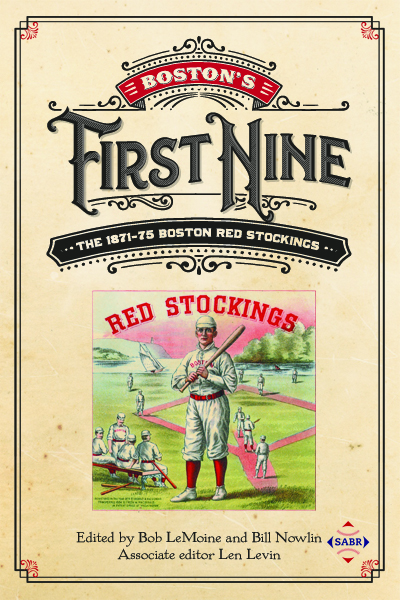
Boston Red Stockings: The 1874 Season
This article was written by William J. Ryczek
This article was published in 1870s Boston Red Stockings essays
For the Boston Red Stockings, the 1874 campaign bore a great similarity to baseball’s strike season of 1981; each year’s pennant race was divided into two segments, separated by an interruption of roughly two months. In 1981, the players union, under the leadership of Marvin Miller, initiated a work stoppage, while in 1874 the Red Stockings and Philadelphia Athletics, under the leadership of Harry Wright, sailed across the Atlantic to bring the American game of baseball to England. Miller’s group had a better financial outcome, but the trip to Europe was a historic journey that was well worth the monetary loss.
Boston, winner of the previous two National Association championships, took the field with a lineup virtually unchanged from 1873. The only departing regular was right fielder Bob Addy, who had played such a controversial role in the 1873 pennant race. Addy’s replacement was Cal McVey, an original 1871 Red Stocking who spent the 1872 and 1873 seasons in Baltimore. McVey was a much better hitter than Addy, and in 1874 he led the team in batting average, runs, hits, and runs batted in.
A second addition to the team was 25-year-old outfielder George Hall, who arrived from the Canaries of Baltimore to spell Harry Wright in center field. Baltimore had a strong team in 1872 and 1873, but in 1874 the Canaries were reduced to cooperative status, which made it difficult for them to retain their players. Wright, 39, was in his last season as an active player (except for token appearances during the next few years) and was no longer able to play every game.
As always, there had been turnover during the offseason, and the NA would field just eight teams in 1874, the smallest number in its five-year life. The limited quantity, however, did not substantially improve the quality. Baltimore, as a co-op that couldn’t afford top talent, was in for a rough year. The Blues of Hartford were a new team with experienced but mediocre talent and would battle the Canaries to stay out of last place. The Atlantics had played poorly since joining the NA in 1872, and the Mutuals were almost as bad in 1873. The Philadelphia White Stockings’ roster had been eviscerated by the raid of Chicago, which was back in the major leagues for the first time in three years. It appeared that Boston’s primary challenge for the 1874 pennant would come from their old rivals, the Athletics.
At the end of the 1872 season, Boston had been in financial distress, but by the time the 1874 campaign got under way, the fiscal ship had been righted. Even after paying roughly $4,000 in 1872 expenses in 1873, the treasury, buoyed by stockholder contributions of $3,700, showed a surplus of $700. Despite two championship seasons, the payroll had been reduced from $16,700 in 1872 to $15,800 in 1874. With a cushion in the treasury and lower expenses, the financial outlook for 1874 was relatively bright, despite the pall cast by the financial panic of the previous September. Wright hoped that the European venture would provide an additional boost to the exchequer.
The start of the season was delayed by unseasonably cold weather, and Boston’s home opener, scheduled for April 25 against the Philadelphia White Stockings, was postponed when a spring storm dropped six inches of snow on the city. Although the skies cleared, the Union Grounds remained unplayable, and a second game against the White Stockings was called off, as was a match against Hartford scheduled for the 29th.
Finally, on May 2, the Red Stockings were able to open the season, and their 12-3 victory over the Mutuals was the first of 13 consecutive wins. Two losses in late May—shocking defeats at the hands of the Atlantics—were followed by five more victories to bring Boston’s record to 18-2, giving the Red Stockings a 6½-game lead over the second-place Athletics.
The Atlantics weren’t a great team, but they provided a few surprises in 1874. The most important addition to the Brooklyn club was 18-year-old pitcher Tommy Bond, who late in the season came within a single out of pitching the first no-hitter in major-league history. Harry Wright liked what he saw, and after Al Spalding left for Chicago, Bond pitched Boston to National League pennants in 1877 and 1878.
Despite their two wins, the Atlantics were not a threat to dislodge the Red Stockings from the top slot. Neither was Hartford, despite a strong start, nor Baltimore. Philadelphia had lost too many top players to contend, and the Chicago team those players joined was plagued by the same suspicious play that sank Philadelphia in 1873. The White Stockings had a disastrous road trip in early June that proved the undoing of the team.
In Philadelphia, Chicago dissipated a 6-1 lead and lost 15-6 to the other White Stockings, their collapse marked by a number of suspicious errors. Concerned about the integrity of their players, the White Stockings held some of them out of the lineup for a game against the Mutuals. The new lineup played far worse than the old, and Chicago sustained an ignominious 38-1 defeat, a debacle caused by numerous errors (the teams combined for 36) and 34 Mutual hits. Catcher Ferguson Malone, the former Philadelphia player now with Chicago, became disgusted with his pitcher’s erratic delivery, and after several wild pitches, he made only a perfunctory effort to chase the errant heaves. The margin of defeat was the largest ever for a professional team.
The Red Stockings continued to hold first place, but fell off their torrid early pace. George Wright missed a month with an injury variously described as a sprained ankle and an injured knee. Second baseman Ross Barnes was below par due to a bad hand. In early July Harry Wright took time out from the NA schedule to take his team on a tour that included a swing into Canada which, according to Wright’s reports, was a great financial success.1 On July 15, after their return from the north, Boston lost to the Athletics, 6-4, a defeat that cut their lead over the latter club to 4½ games. The contest was billed as the farewell game, for afterward the two teams embarked for Europe, and the Red Stockings did not play another championship game for nearly two months.
Current teams occasionally travel to Japan for regular-season games, complain about the 14- to 15-hour flight, and often play poorly upon their return. In 1874 travel was much more grueling, and it took the Red Stockings and Athletics 11 days to sail from Philadelphia to Liverpool. The return journey was plagued by four days of stormy weather and the death of a passenger (not one of the baseball entourage).2
Because of the heat, most clubs played a light schedule in August, and the absence of the NA’s two best teams created an additional problem. The six remaining clubs had to play each other far too frequently to sustain fan interest, and a crowd of more than a thousand spectators was rare. Philadelphia had the White Stockings, but Boston was without baseball for two months, so the Hartford and Philadelphia nines scheduled games there on August 12 and 13. Only 500 attended on the 12th, and the next day’s game was postponed by rain.
Finally, on September 10, the Red Stockings and Athletics, who had spent a month in England and Ireland playing baseball against each other, did the same thing on US soil. After an enthusiastic welcome in Philadelphia, Boston won 5-4 in a game marked by a controversial call of umpire Theodore Bomeisler that went in favor of the Red Stockings. After Bomeisler left the field under police protection, the two teams boarded the New York Express on the Albany Road and received a second rousing reception in Boston, where the Athletics reversed the result of the previous game and defeated the Red Stockings by a single run.
While the two top teams were away, the Mutuals had feasted on weak competition to lift themselves into the thick of the pennant race. After the games of September 10, the standings were as follows:
| W | L | Pct. | GB | |
| Boston | 31 | 8 | .795 | — |
| Athletics | 23 | 11 | .676 | 5½ |
| Mutuals | 30 | 17 | .638 | 5 |
| Philadelphia | 23 | 20 | .535 | 10 |
| Chicago | 22 | 25 | .468 | 13 |
| Hartford | 12 | 22 | .353 | 16½ |
| Atlantics | 11 | 28 | .282 | 20 |
| Baltimore | 7 | 28 | .200 | 22 |
The Mutuals were the most unpredictable team in the NA, and certainly one of the most suspect. The club had been connected with Tammany Hall since its inception in the 1850s, and politicians like John Wildey and Alex Davidson had been active in management. The infamous William M. “Boss” Tweed was also involved with the club, and on at least one occasion helped it obtain funds from the City of New York. During the amateur era, many Mutual players were employed by the city’s coroner’s and street-cleaning departments.
Gamblers followed the Mutuals wherever they played, and in early August 1874 the club had been involved in a suspicious affair. Betting odds before a game with the White Stockings were puzzling, and when the Mutuals removed star pitcher Bobby Mathews with an alleged groin injury after one inning, those who had backed them believed the fix was in. Nothing was ever proven, and a doctor certified to Mathews’ disability, but there had been so many shady episodes involving the Mutuals that any unusual circumstance was grounds for suspicion.
The Mutuals had played horribly in 1873, and many were convinced that their poor performance was not accidental. In 1874, however, they were playing better than they’d played in several years. When the Red Stockings and Athletics left for England in mid-July, the Mutuals were just 17-16. While the two teams were away, they won 13 of 14 games to move within 5½ games of the Red Stockings with nearly two months of the season remaining.
The Mutuals and Red Stockings were scheduled to play each other on September 22 and 24, and by that time the New York nine had crept to within three games of the lead. In the first game, Harry Wright was the starting pitcher for the first time all season. Al Spalding had pitched the day before and lost and perhaps Harry, who was more conscious than most NA managers of his pitcher’s workload, wanted to spare him a few innings.
Harry turned over a 4-3 advantage to Spalding when the latter took over the pitching chores in the fifth, but Boston’s ace couldn’t hold the lead. The Mutuals scored three times in that inning, and although Boston rallied to tie the game, the Mutuals scored the winning run in the ninth inning on a sacrifice fly by Dick Higham—the same Dick Higham who later became the only major-league umpire ever banished for dishonesty. The lead was down to two games.
Two days later, the margin was reduced to a single game when the Mutuals beat Boston 8-5. The Mutuals had won 19 of 20 games, while Boston had lost five of seven since returning to the United States.
| W | L | Pct. | GB | |
| Boston | 32 | 13 | .711 | — |
| Mutuals | 34 | 17 | .667 | 1 |
Nothing could rejuvenate a faltering team like three home games against the last-place Baltimore club and, as expected, the Red Stockings won all three. Boston, due to the interruption caused by the European tour, had played several fewer games than their pursuers. In order to complete their full quota of games (they would be the only NA team to do so), the Red Stockings had to endure a grueling October schedule. NA teams generally played no more than three or four games a week, but during the last 19 days of the 1874 season, Boston played 16 championship games.
As in 1873, much of Boston’s stretch run was scheduled to be played against the NA’s weaker teams, the same teams the Mutuals had feasted upon. At one point, 28 of New York’s 36 wins were at the expense of Chicago, Hartford, the Atlantics, and Baltimore. During the final month, they had to test their mettle against the top clubs. Of Boston’s final 26 games, 17 were against Hartford, Baltimore, and the Atlantics. The quality of the competition was reflected in the results. Following the second loss to the Mutuals, Harry Wright’s crew finished 20-5, while the Mutuals were just 8-6. Boston won its third consecutive pennant by a comfortable margin.
| strong>W | strong>L | strong>Pct. | strong>GB | |
| Boston | 52 | 18 | .743 | — |
| Mutuals | 42 | 23 | .646 | 7½ |
| Athletics | 33 | 22 | .600 | 11½ |
| Philadelphia | 29 | 29 | .500 | 17 |
| Chicago | 28 | 31 | .475 | 18½ |
| Atlantics | 22 | 33 | .400 | 22½ |
| Hartford | 16 | 37 | .302 | 27½ |
| Baltimore | 9 | 38 | .191 | 31½ |
Good had triumphed over evil. The Mutuals and their Tammany backers had fallen to Boston in what the New York Clipper described as a “triumph of good training, discipline, and earnest, united efforts to win.”3 On November 6, to celebrate a third consecutive pennant, the Boston stockholders held a banquet for the players. After dinner, Albert Spalding stood up and proposed a toast “to the Boston Baseball Club—may we fly the pennant in 1876.”4 The Red Stockings would indeed fly the pennant that year, but Spalding would see it only when he visited Boston with his Chicago teammates.
Late in the 1874 season, there were rumors that Spalding planned to sign with the White Stockings for 1875. Teammate James White had supposedly turned down a Chicago offer of $2,000 per year. “Chicago has become the last city a professional wants to go to,” said the Clipper. “Players strive to get engagements in Boston, where they meet with considerate treatment.”5 A year later, however, White, Spalding, McVey, and Barnes decided to move to the city where the weather was cold, the press was critical, and the fans were demanding, but the money was right. They had one more year in Boston, and that year they would lead the Red Stockings to perhaps the most dominant season of any team in major-league history.
has written a trilogy on 19th century baseball: Baseball’s First Inning, When Johnny Came Sliding Home, and Blackguards and Red Stockings. The latter is a history of the National Association that covers the period when the Boston Red Stockings dominated major-league baseball. He has also written on baseball and football during the 1960s, including books on the Yankees, the Mets, and the American Football League’s New York Titans. Bill is a finance professional who lives in Wallingford, Connecticut.
Notes
1 Hartford Courant, July 4, 1874.
2 The tour is covered in a separate chapter.
3 New York Clipper, November 7, 1874.
4 New York Clipper, November 14, 1874. The team that won a pennant was considered the champion of the subsequent season. Therefore, by winning in 1874, Boston was entitled to fly the pennant in 1875.
5 New York Clipper, July 11, 1874.