
Boston Red Stockings: The 1875 Season
This article was written by Bob LeMoine
This article was published in 1870s Boston Red Stockings essays
“In no other major league campaign did a team’s superiority show as it did in 1875.” — David Quentin Voigt1
In 1975 Cincinnati, dubbed “The Big Red Machine,” visited Boston in the World Series. It is doubtful anyone remarked “Well, it’s nothing like the ‘Big Red Machine’ Boston had in 1875.” Those 1875 days were long forgotten, but Boston did have a Big Red (Stocking) Machine that dominated baseball, going 71-8 with an .899 winning percentage, simply unheard of in the modern day.2 Very few ever mention such a feat, and some only consider the “modern” era of baseball from 1901 on.
The 1875 season saw unique attempts at expanding the National Association of Professional Base Ball Players. To use the language of modern business, several startup companies tried and failed, and lack of management and structure created great gaps between the haves and the have-nots. The NAPBBP was baseball’s first experiment with a professional league, and it would die a slow death in 1875 while Boston dominated yet again. This was the end of an era.
This would be the final year for the Boston Red Stockings – Harry Wright would give up the name to Cincinnati when it re-entered professional baseball in 1876. Four core players of the team would leave for Chicago, as owner William Hulbert opened his wallet and Midwest charm for these Boston stars. But his action also included ending the National Association itself, which somehow survived a five-year run despite major organizational flaws. It was the end of player-dominated teams. Baseball was now organized under a group of business owners determined to escape the transient nature of the National Association. Baseball was moving into big business. Just around the corner was 1876 and the new National League that is still with us today.
The 1875 season saw six new clubs pay the user-friendly $10 fee and join the National Association, pushing the league total to 13 teams, with disastrous results. Three of the new clubs were located in the West; though ambitious, they proved to be financially unsustainable. Much of Boston’s success was due to the total lack of talent now entering the league. If the season were being replayed in a video montage, perhaps the best background music would be Queen’s “Another One Bites the Dust.” “Given the economic depression of the times and the obvious superiority of Boston, it was unrealistic for newcomers to hope for large crowds,” wrote historian David Quentin Voigt.3
The Philadelphia Centennial club was created on the assumption the City of Brotherly Love could support three clubs. That was not the case. The Centennials went 2-12 and were outscored 138-70. They did manage a huge upset of their city rival Athletics, which the Philadelphia Times called “one of those freaks that baseball is subject to.”4 They followed their surprising win with a 20-1 loss to the same team the next day. The final game of their short existence resulted in a 5-0 shutout loss to Albert Spalding and Boston on May 24 upon which the Times commented, “(H)ad they wished their heartiest to lose they could not have done worse.”5 About 100 devoted fans were there to see the grand finale, and the Times summed up that despite the franchise’s doing okay financially, “better to disband ere money was lost.”6
The breakup of the Centennials also led to a first in baseball history. Knowing the team would not be able to survive the season, the stockholders sold George Bechtel and Bill Craver to the Athletics for $1,500. This reportedly is the first known club-to-club player transaction in baseball history, “and the future possibilities of such a tactic captured the imagination of more mercenary promoters,” wrote Voigt.7
The only major-league club ever located in Iowa was the Keokuk Westerns, which had the distinction of a 1-12 record and a .180 team batting average. The White Stockings traveled to Keokuk to begin the season, made only $68 on the trip from the low gate attendance, and “will not pay another visit there for a long time,” the Chicago Tribune wrote.8 Boston made the trip to Iowa on June 10, won 6-4, and decided to forfeit their games on June 12 and 14 and head for Chicago “on account of their many games and their recent hard traveling,” the Boston Globe reported.9 Boston made more money playing in Chicago. Keokuk soon disbanded, and the hopes that professional baseball would spread west would have to wait.
The new Washington Nationals also struggled, batting .193 as a team, and were outscored 338-107, being shut out five times. Of the 338 runs the Nationals allowed, only 105 were earned, the result of 285 errors. Eight players had 20-plus errors for the season. Washington started the season 0-11; in five consecutive losses their opponents scored more than 20 runs (including 22-5 and 24-0 routs by Boston). They finished their miserable season 5-23, dropping out of the league after a July 4 game. It was reported that the club’s business manager made off with team funds and the players were left without two dimes to rub together over 1,000 miles from home.10 More likely, however, the players concocted the story themselves to solicit funds to pay their way home.11
That July 4 contest was also the final game for the St. Louis Reds, who played Boston only once, losing 10-5 on June 3 in St. Louis. Boston’s win on that date put them at 26-0, the last win in their season-opening undefeated streak dating back to April 19, while St. Louis fell to 2-8. The average age of the St. Louis players was just under 23, and the team batting average for the season was .199. They were outscored 161-60 with 150 errors making only 50 of those runs earned. They finished the season 4-15. Because of poor gate attendance, the club was given no invitations to travel east.
New Haven was Connecticut’s second attempt at fielding a professional baseball club. Boston defeated the Elm City club in the first two games of the season, 6-0 and 14-3. New Haven went on to lose its first 15 games, and a surprise win on July 2 against Boston only pulled the team’s record up to 3-24. New Haven’s final record of 7-40 caused less of a stir in the league than did players Henry Luff and Billy Geer, who were arrested for leaving hotels with more luggage than they had entered with.12 Extra luggage didn’t amount to better play on the field, however, as Luff and Geer had 50 and 49 errors respectively, on a club that committed 447, was outscored 397-170, and had a .218 team batting average.
The final new club to join in 1875 was the other St. Louis club, the Brown Stockings. They were the most respectable new club, going 39-29, good enough for fourth place, led by Lipman Pike’s .346 batting average and George Bradley’s 33 wins. While being outscored by Boston 77-35, the Brown Stockings did pull off two victories: 5-4 and 5-3 victories on June 5 (Boston’s first loss after 26 victories) and August 21. Those two victories accounted for 25 percent of Boston’s losses for the season. This St. Louis club would spend two seasons in the National League, and then disband in 1877.
Then there was the legendary Brooklyn Atlantics club, who were a shell of their former selves. Founded in 1855 and one of the founding clubs of the National Association of Base Ball Players, the club’s fate in 1875 was a sad ending to a storied franchise. This Atlantics team batted .195 as a team, with 432 errors contributing to 299 unearned runs. The team was outscored 438-132. Not surprisingly, Boston was undefeated against Brooklyn, going 6-0 and outscoring the Atlantics 74-22. Even using 35 players did not help the Brooklyn cause. The Atlantics won their second game on May 26 to go 2-11, but then lost their last 31 games to finish a horrendous 2-42.
The Philadelphia Athletics were the not-so-close second-place finishers to Boston. The Athletics were a formidable 53-20, led by four players in the starting lineup batting over .300 (Bill Craver, Davy Force, Ezra Sutton, and Dave Eggler) and one at .299 (George Hall). Twenty-three year-old Cap Anson batted .325 and pitcher Dick McBride won 44 games with a 2.33 ERA. Still, Philadelphia finished 15 games behind Boston.
Hartford finished a strong third (54-28) with a rare feature at the time of two strong starting pitchers, Candy Cummings (35-12, 1.60) and Tommy Bond (19-16, 1.43). The Philadelphia Whites (or Pearls) brought in a young pitcher who didn’t want his father to know he played baseball for a living, so he took the name Joe Josephs. Facing Chicago on July 28, the pitcher, whose real name was Joe Borden, threw a no-hitter, the first in professional baseball history, mostly disregarded by those who do not count the National Association as a “major league.”
Stories happening off the field are commonplace today, but not so much in the 1870s. Yet, two major off-the-field stories dominated the baseball world during the season.
While the 1874 season was still in progress, the Chicago White Stockings had signed infielder Davy Force to an 1875 contract dated September 18. When the 1874 season ended, the Philadelphia Athletics also signed Force to a contract, dated December 5. National Association rules forbade a player to sign a contract with a team while under contract with another, but newspapers frequently posted late in the season a “who’s who” of player changes for the coming season. Even though the Chicago signing was legally November 2 and not September18, the Association’s Judiciary Committee ruled that Force belonged to Chicago. However, politics were at play, and the committee was to give its report in the evening of the general session.
In the meantime, new officers for the National Association had been elected, and Charles Spering of the Athletics was voted in as president. Not surprising, Spering refused the committee’s report and attempted to persuade the delegates that Force belonged in Philadelphia. He then postponed the decision until the next morning. The next day was also when the newly elected members of the Judiciary Committee would meet. One of the newly elected members, from the Keokuk club, declined to accept the position, so Spering found it in the best interests of all to fill the position himself, placing three men from Philadelphia on the five-man committee. The ruling on Force was reversed. Chicago was, of course, irate, as was Harry Wright, over the injustice. Unruly crowds followed Force and the Athletics, and the Philadelphia fans countered. A June 28 extra-inning game at the Athletics saw Boston leave with a 10-10 tie and an unruly mob on the rain-drenched field.
Boston made only three personnel moves before the 1875 season. Outfielder Jack Manning, a member of the 1873 club, returned, and along with his glove he also threw 144 innings from the pitcher’s box, starting 18 games. Utilityman Frank Heifer spent his entire 11-game career with Boston and also pitched in relief. First baseman Jumbo Latham appeared in 16 games. Harry Wright also officially retired as a player in 1875, at the age of 40, although he did allow himself to play in one game a year in 1875, 1876, and 1877. Manning filled the role Wright had provided as relief help for Al Spalding, but still the workhorse threw 570⅔ innings, going 54-5 with a 1.59 ERA. The top 10 batting averages for the league included five by Red Stockings: Deacon White (.367), Ross Barnes (.364), Cal McVey (.355), George Wright (.333), and Andy Leonard (.321). The same “fab five” also led the league in hits and total bases.
The team scored 831 runs and allowed 343, with a team batting average of .321.
The 1875 Red Stockings were one of the first teams to play professional baseball below the Mason-Dixon Line. Playing the Washington Nationals on April 29 and May 1 before a hostile crowd in Richmond, Virginia, Boston won 22-5 and 24-0. On May 18 Boston (16-0) played at Hartford (12-0) in a battle of undefeated teams. A huge crowd that included Mark Twain packed the stadium and the entire city seemed to close in anticipation. Boston struggled for a 10-5 win, and Twain’s umbrella was stolen.
The second big off-the-field story of 1875 was the impending breakup of the Red Stockings, leaked to the press in July. Imagine the look on Harry Wright’s face at the restaurant in Taunton, Massachusetts, when he was given the news, recounted in the Boston Daily Advertiser on July 23. “While the Red Stockings were dining at Taunton, on Tuesday last, McVey said to Captain Harry that he had concluded not to play in Boston next year. Harry laughed, thinking it merely a jest, but his amusement was turned into surprise after dinner, when White told him, in answer to a question about playing here next season, that he had given his word to go to Chicago, and that Spalding, Barnes, and McVey had also bound themselves verbally to the same club. The managers of the Boston club were naturally astonished at this intelligence.”13
A Worcester (Massachusetts) Spy report showed that already in the 1870s biblical allusions were being used by New Englanders to describe their local baseball team. “Like Rachel weeping for her children, she refuses to be comforted because the famous baseball nine, the perennial champion, the city’s most cherished possession, has been captured by Chicago.”14 One could imagine a modern scenario of four Red Sox stars signing with the New York Yankees and the phone lines on Boston sports talk shows lit up with irate fans. Even in 1875, passion for the Hub team was strong. A Boston Globe reader named “Grand Stand” wrote a letter to the editor asking, “Why didn’t these men, when offered, ‘fancy prices,’ go to the managers of the Boston club and tell them, and then, if Boston could not pay these prices, they could accept the situations with good grace? Not one of them ever said a word, for if they had they could have had the same prices, if they were so disposed, and remained in the [sic] Boston. All of them owe their present position to Captain Harry Wright, he having brought them out of an obscure country village in Illinois, and this is the reward the ‘old man’ receives.”15
“The time is out of joint,” declared the Boston Daily Advertiser. “Tweed is escaping from the penalty of his crimes, there are bad crops in Europe, the democratic party is marching rapidly under its soft money flag, the monarchists are gaining victory in the French Assembly, – and now the famous Boston nine has been assaulted and captured by Chicago. There is probably no paragraph of news this week that has caused so much real vexation out of doors in Boston as this last. The pride of Boston in its base ball team has been something unique.”16
Despite the shocking news and the groans of the fans, the 1875 Boston Red Stockings never let the distractions get to them on the field, and despite the negativity launched at Spalding, he was still able to have winning streaks of 22 and 24 games during the season.
Even while contractually bound to leave for Chicago, Boston’s big four continued to dominate the 1875 season with the Red Stockings. Chicago owner William A. Hulbert had first approached Spalding and convinced the pitching ace that a boy from the Midwest would be better off pitching in the Midwest. “I would rather be a lamppost in Chicago than a millionaire in any other city,” Hulbert pitched to him.17
The New York Clipper bemoaned the breakup of the Red Stockings, who in its view represented class and integrity. “Having tried in vain for years to defeat the Boston Red Stockings on the field, it would appear as if an effort were to be made to break up the club altogether, as the only way of ever being able to get hold of the coveted pennant. Is there no law of fair dealing that suggests to club-managers that this violation of the spirit of an Association rule is discreditable?”18
There was talk at the winter convention in March 1876 of expelling the defecting Boston players from the league.19 Hulbert had an ax to grind with teams in the East over the Force case, and also thought the preponderance of gambling and other evils in the National Association meant the league itself should dissolve anyway. So before there was a chance his players could be banned, he and Spalding drafted the constitution for a new National League of Professional Base Ball Clubs. Note the “clubs” instead of “players” in the organizational title, for this was not mere verbiage. The structure of professional baseball was changing. The National Association’s five-year run was a player-driven endeavor; now, power would be in the hands of the owners. Gone were the days of Harry Wright giving a player what he felt he deserved. Gone were the days of games played in small towns with mismatched schedules with umpires pulled off the street or a team bench. Harry Wright, sensing Hulbert’s business sense, went along with the new league, as did Hartford, the St. Louis Brown Stockings, and the New York Mutuals. The two new clubs came from the west: Cincinnati and Louisville. The National League was born, and a new chapter in baseball history had begun.
There was still one final game to play in 1875, however, and it was truly the end of an era.
At the South End Grounds on October 23, Boston and Chicago played an exhibition game at 3 P.M. with the four “defectors” wearing Chicago uniforms. “One of the largest crowds of the season,” according to the Boston Daily Advertiser, came to see Borden, still going by the name Josephs, pitch for Boston. Spalding refused to pitch against his former teammates, instead playing left field, “either not daring to set his reputation ‘on a cast and stand the hazard of the die,’ or for some other reason,” wrote the Springfield Republican.20 The crowd was not happy, “the game being deprived by it of about half its interest, and furthermore, it involved a breach of good faith on the part either of the Boston club managers with the public or of Spalding with the managers,” wrote the Daily Advertiser.21
McVey actually did the pitching and “surprised all his friends and was apparently as much at home in his new position as he was in his own place with the Bostons,” wrote the Boston Journal.22 Chicago players obviously felt they had something to prove, scoring four in the first inning, then three in the second, fourth, and fifth innings and one in the sixth for the 14-0 win. Yet, none of the runs against Borden were earned, all coming as a result of 23 Boston errors. “It was muffing from beginning to end,” the Advertiser wrote, and the fans “indulged in the despicable practice of ‘chinning’ and booing at the umpire for calling strikes on Boston batsmen.”23
The Boston Red Stockings era was over, as was that of the National Association. This was baseball’s first experiment with a professional league, and served as a “time between the times” of baseball history. Baseball was moving away from being a purely amateur sport, as more teams and players were turning professional. People worried that paying players would ruin the “purity” of the game. We are now 145 years and counting from the earliest days of professional baseball. The game has changed along with the ebb and flow of time. But these were professional baseball’s pioneers who, through their amazing successes and glaring mistakes, paved the way to the National League and a lasting structure for professional baseball.
Boston was not without a professional baseball team come 1876. Though outside our brief survey here, Harry Wright pulled together another team going by the name Red Caps (disgruntled Boston fans apparently still called them Red Stockings) in the new National League. The team included brother George and former National Association players Leonard, Manning, O’Rourke, and Schafer, adding Joe Borden and others to the mix, perhaps most notably Foghorn Bradley and Tim Murnane. The 1876 team finished in fourth place, but finished first in 1877 and 1878. In 1883 it became known as the Boston Beaneaters, and eventually the Boston Braves. It is the same franchise that today plays in Atlanta.
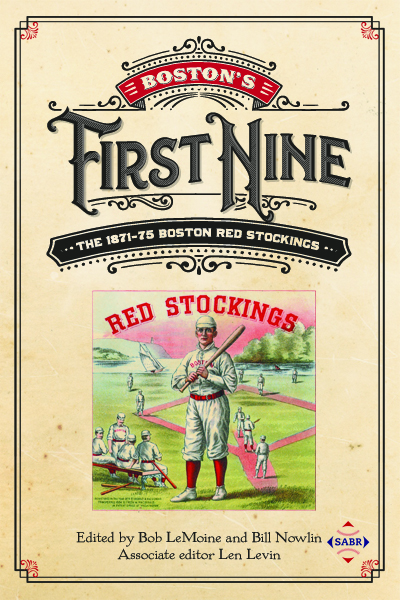
For the full story on the Boston National League club from its beginnings in 1871 until its move to Milwaukee in 1953, see Harold Kaese’s The Boston Braves 1871-1953. For an interest in the history of Braves Field in Boston and the great games played there from 1914 to 1953, see SABR’s Braves Field: Memorable Moments at Baseball’s Lost Diamond.
came up with the idea for this book while researching the beginnings of professional baseball in Boston, wondering “How did all of that come together?” He often daydreams about time traveling to the 19th Century too see early baseball games, horse and buggies, and meet the legendary stars. Actually, he’d just like to see a game for 25 cents. Bob works as a high school librarian and lives in Barrington, New Hampshire.
Sources
In addition to sources cited in the Notes, the author consulted the following:
Batesel, Paul. Players and Teams of the National Association, 1871-1875 (Jefferson, North Carolina: McFarland, 2012).
Nemec, David. The Great Encyclopedia of Nineteenth-Century Major League Baseball (New York: David I. Fine Books, 1997), 65-84.
Special thanks to SABR members Bill Nowlin and Dixie Tourangeau for suggestions on information to include in this article.
Notes
1 David Quentin Voigt. American Baseball: From Gentleman’s Sport to the Commissioner System (Norman, Oklahoma: University of Oklahoma Press, 1966), 51.
2 There were also three tie games, all played in Philadelphia.
3 Voigt, 50.
4 “Centennial Club Dissolved,” Philadelphia Times, May 27, 1875: 4.
5 “The Base Ball Field,” Philadelphia Times, May 25, 1875: 4.
6 “Centennial Club Dissolved.”
7 Voigt, 58.
8 Quoted in the Hartford Courant, May 19, 1875: 2.
9 “Base Ball. The Champions Defeat the Keokuks,” Boston Globe, June 11, 1875: 1.
10 “Base Ball,” Cincinnati Daily Gazette, July 7, 1875: 1.
11 William J. Ryczek, Blackguards and Red Stockings: A History of Baseball’s National Association, 1871-1875 (Wallingford, Connecticut: Colebrook Press, 1992), 194.
12 Ryczek, 195-196.
13 “The Boston Nine. Secession of Spalding, White, Barnes, and McVey – Their Engagement by the Chicago Club for 1876,” Boston Daily Advertiser, July 23, 1875: 1.
14 Worcester (Massachusetts) Spy, July 24, 1875, cited in Peter Levine, A.G. Spalding and the Rise of Baseball: The Promise of American Sport (New York: Oxford University Press, 1985), 21.
15 “The Seceding Players – How They Came to Secede,” Boston Globe, July 28, 1875: 8.
16 “A Base Capture,” Boston Daily Advertiser, July 23, 1875: 2.
17 Voigt, 62.
18 “Breaking-Up the Boston Team,” New York Clipper, July 31, 1875: 139.
19 Harold Kaese, The Boston Braves, 1871-1953 (Boston: Northeastern University Press, 2004), 15.
20 “The New Reds Defeated By the Old,” Springfield (Massachusetts) Republican, October 25, 1875: 8.
21 “Out-Door Sports. A Notable Game on the Boston Base Ball Grounds,” Boston Daily Advertiser, October 25, 1875: 1.
22 “Out Door Sports. Base Ball,” Boston Journal, October 25, 1875: 4.
23 “Out-Door Sports. A Notable Game on the Boston Base Ball Grounds.”