
Cleveland’s Negro Leagues in 1942: The Buckeyes, the Tryout that Sort-Of Happened, and the East-West Game
This article was written by Alan Cohen
This article was published in The National Pastime: Baseball on Lake Erie (2026)
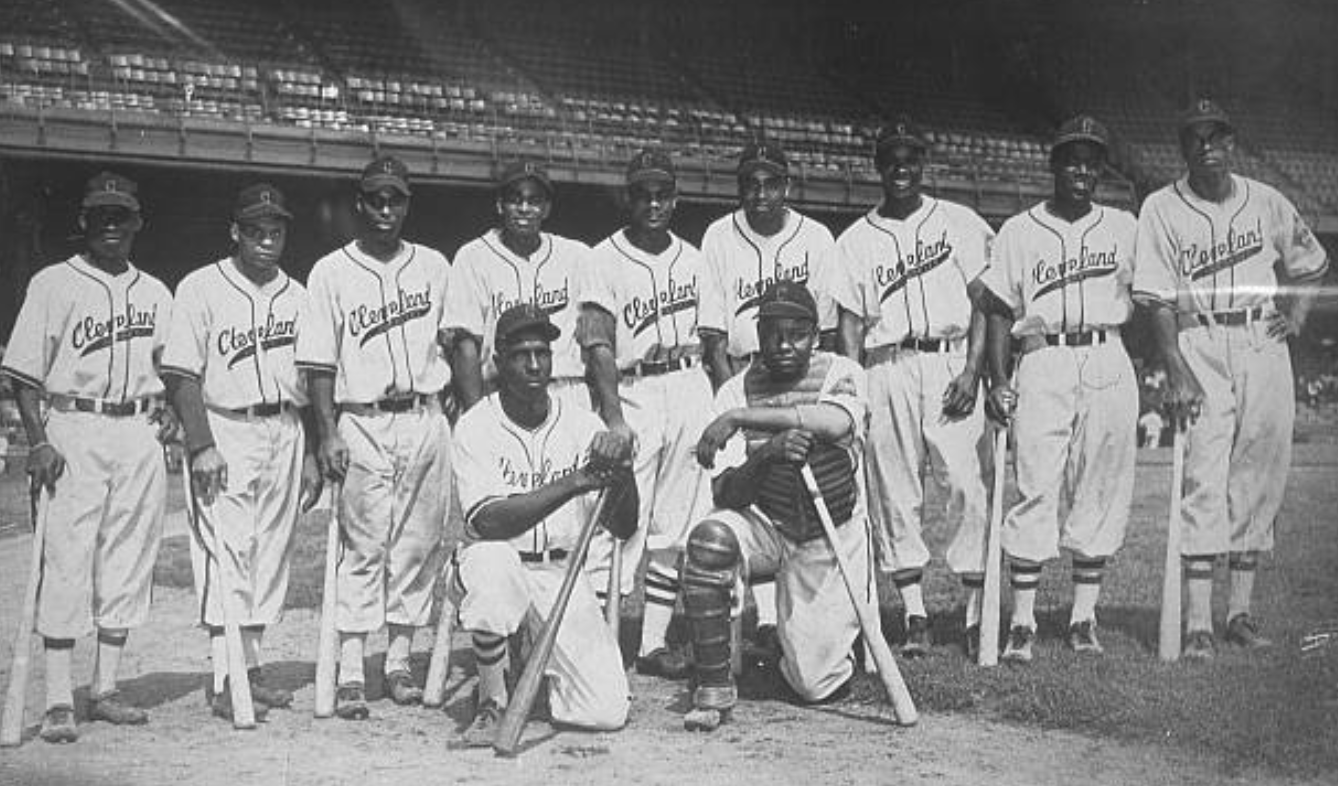
1947 Cleveland Buckeyes team photo (SABR-Rucker Archive)
It was the summer of 1942. The United States had entered World War II, but baseball continued. Segregation still plagued the sport, and all areas of life in America, but calls for integration were growing louder.
In Cleveland, there was a new team in town. Black baseball teams had played in Cleveland since 1921, but many of them came and went quickly. The Buckeyes first played in Cleveland in 1942—that is, when they weren’t playing in Cincinnati. They played most of their games at League Park, which was also being used for 34 home games by the Cleveland Indians of the American League.
Cleveland had been a part of the Negro National League as early as 1922. The team that year was called the Tate Stars, and they played their home games at Tate Field. They played independently in 1921 and 1923, becoming members of the Negro National League in 1924. Then, they were known as the Cleveland Browns and played their games at Hooper Field. Their top player was 19-year-old Vic Harris. The team finished eighth in the nine-team league and lasted only one season, but the Cleveland Elites emerged in 1926 and finished in seventh place. The following season, they became the Cleveland Hornets, led by Frank Duncan. Their status in the Negro National League was unchanged, and they finished last with a 12-37 record.
Another name change in 1928 (this time to the Tigers) and a change in venue to Luna Park did not bring any improvement. They finished seventh with a 20-59 record. In 1931, Cleveland was back in the Negro National League and played their home games at Kinsman Hardware Field. They were a landmark baseball team of sorts for the city, as they were the first Cleveland-based Black team to finish over .500. On the pitching staff for the first part of the season was 24-year-old Satchel Paige, but by season’s end Paige had moved on to the Pittsburgh Crawfords.
After the 1931 season concluded, Cleveland played host to a barnstorming exhibition between a Negro National League All-Star team comprised mostly of players from the Homestead Grays and Pittsburgh Crawfords, and Steve O’Neill’s American League All-Stars, who were All-Stars in name only. They had very few players of major league quality and the Negro League team won, 18-0. In that game, Josh Gibson hit the first two homers in the history of Cleveland Stadium.
And then came 1932. The Negro National League had fallen victim to the Great Depression.
The East-West League struggled through the season and the Cleveland Stars (also known as the Cleveland Cubs) finished out of the running with a 5-13-1 record. Their top player, Branch Russell, had played for the St. Louis Stars during their winning years in the 1920s. On June 18, Cleveland and the Pittsburgh Crawfords split a doubleheader at Cleveland Stadium. Strangely, the Crawfords were the “home” team. Josh Gibson and Oscar Charleston homered in the opening game, won by the Crawfords. Cleveland won the second game, 6-5, scoring three runs in the top of the ninth.1
With the second iteration of the Negro National League in 1933 came the Cleveland Giants, who also called Akron home for part of the season and finished last with a 3-8 record. In 1934, as the Cleveland Red Sox, they moved into League Park, the home of the Cleveland Indians, and went 3-25.
For the next four seasons, Cleveland was without a Negro League baseball team but served as a neutral site for some games, mostly involving the Homestead Grays and Pittsburgh Crawfords. On May 29, 1938, the Homestead Grays swept a doubleheader from the Washington Black Senators, with Josh Gibson, Buck Leonard, Ray Brown, and Jerry Benjamin supplying home runs.
In 1939, the Cleveland Bears emerged and played at Cleveland Stadium. They finished third in the Negro American League, and, in 1940, their right fielder, Duke Cleveland, was in the top five of the league in batting average. They finished third again in 1940.
Once again, in 1941, Cleveland was without a Negro League team. However, the Kansas City Monarchs visited on several occasions. On August 3, they swept the St. Louis-New Orleans Stars in a doubleheader and Willard Brown and Ted Strong homered.
1942 was the first season of baseball after the US entered the Second World War, and many players, both Black and white, entered the military. The Black newspapers continued to push for integration of the major leagues. The Double-V campaign, supported by the Pittsburgh Courier, stood for victories not only against foreign aggressors, but also at home against years of Jim Crow.
In 1942, the Cincinnati Buckeyes joined the Negro American League. But there was another team in Cincinnati, the Clowns, and the Buckeyes were off to their new home. The Buckeyes played nine Negro American League games in Cleveland in 1942.
Shortly after Commissioner Kenesaw Mountain Landis had stated that there was nothing in writing barring Blacks from playing in organized baseball, the Daily Worker, a Communist-leaning publication, broke a story July 26, which was picked up by newspapers coast-to-coast. Three players, Roy Campanella, Sammy Hughes, and Dave Barnhill, would be given a tryout by the Pittsburgh Pirates on August 4.2
Campanella first joined the Washington Elite Giants in 1937. His first game, on June 19, was a neutral site game in his hometown of Philadelphia. He was only 15 years and seven months old at the time, making him the youngest player in major league history. He captured the starting job and was an All-Star in 1941 when he batted .320 at the age of 19.
Hughes burst on the scene with the Louisville Black Caps in 1930. He first played with the Elite Giants in 1933 when they joined the reincarnated Negro National League, then stayed with the team as they migrated from Nashville to Columbus to Washington, and then to Baltimore.
Barnhill, in his early years with the Clowns, where all players had nicknames, was known as “Impo,” due to his 5-foot-6 height. He was with the Ethiopian Clowns when they appeared in the Denver Post Tournament that season, and joined the Cubans in 1941.3
The tryout never happened. Shortly after the story had been published, the Pirates denied ever having made such an offer.4 Although receptive to the cause of integration, team president William Benswanger was persistent in denying that a date had been set and players had been identified.5 August 4 came and went, and there was no tryout in Pittsburgh.
But Cleveland stepped in. The trio was invited to play in a fundraising exhibition on August 9 between the Buckeyes and the All-Nations All-Stars. The Buckeyes had been scheduled to play the Memphis Red Sox, but they canceled that game, scheduled for League Park, and agreed to participate, with Campanella, Hughes, and Barnhill in the lineup, in the Amateur Day festivities at Cleveland Stadium. The All-Nations team was comprised of players from the Cleveland sandlot associations, representing anywhere from 15 to 26 different nationalities, depending on the source.6
In the first game on August 9, two of the top sand-lot teams faced off. The second game was a one-sided affair as the Buckeyes won, 9-0. The game was stopped by rain in the bottom of the sixth inning, and the score, 12-0 at the time, reverted to the score after five innings of play.7 Leading the charge for the Buckeyes was Billy Horne, who had two singles and a triple.
Each of the trio was paid $250 for their day’s work.
Campanella wasted little time in the game showing his merit. In the opening inning, he singled and raced home on a double by Sam Jethroe. The Buckeyes scored five runs in the first inning before a batter was retired. Archie Ware singled to start the rally, and hits by Horne, Parnell Woods, Campanella, and Jethroe followed in quick order.
Barnhill pitched the shutout for the Buckeyes, striking out nine batters. The All-Nations team mounted a threat in the fourth inning when Frank Erne doubled and advanced to third on an Eddie Baloga single. Barnhill then struck out two batters, and a fielder’s choice ended the inning.
Hughes went 1-for-2 and played an errorless second base for the Buckeyes.
The All-Nations team manager was Eddie Krajnik. Serving as coaches were Bob Way and Paul Lestock. The starting pitcher for the All-Stars was Roy Pinyoun, who had pitched in the minors for the Cleveland organization in 1936 and 1937. None of the other AllNations players were of major league caliber.
The aftermath of this was that Campanella and Hughes were fined and suspended by the Elite Giants. Although the fines were rescinded and the players reinstated, Campanella decided to head to Mexico before the end of the season, playing his last games with Baltimore on August 23.8 He spent the following season in Mexico before returning to the Elite Giants in 1944. He batted .391 for Baltimore in 1944, followed up with .372 in 1945. He was signed by the Brooklyn organization in March or April of 1946 and won three MVP awards during his 10 seasons with the Dodgers.
After the August 9, 1942, game, Hughes stayed with the Elite Giants for the rest of the season. He was 31 at the time and spent the next three years in the military. In 1946, at age 35, he returned to the Elite Giants, batting .265. He retired at the end of the season.
Barnhill was still with the Cubans until 1949, when the New York Giants signed him. He played in their minor league system for three seasons at Minneapolis but never played in the AL/NL majors.
The Buckeyes also played the Memphis Red Sox on August 9. The rescheduled game took place in Akron. Playing multiple games in multiple cities on the same day was nothing new for Negro League teams. Campanella, Hughes, and Barnhill did not accompany the team to Akron.
In the aftermath of the game in Cleveland, the Cleveland Call and Post, the city’s Black weekly, called for the Indians to give tryouts to three of its players, Sam Jethroe, Parnell Woods, and Eugene Bremer. Although the tryout never materialized, Cleveland did become the first American League team to integrate, with Larry Doby joining the Indians in 1947. Satchel Paige joined in 1948, and the Indians won the World Series.
The Buckeyes achieved a degree of success in their inaugural season, going 42-22-1 and finishing second to the Kansas City Monarchs. Sam Jethroe batted .335 with six stolen bases.
And Cleveland, on August 18, 1942, played host to the second of two Negro League East-West All-Star games in 1942, with 10,791 fans looking on at Cleveland Stadium. The Negro National League won the game against the Negro American League, 9-2. Not in the lineup for the East team were Campanella and Hughes. Their suspensions, and the appearance of some late ballots, cost them their roster spots to two members of the Homestead Grays. Josh Gibson started instead of Campanella. Sam Bankhead started in place of Hughes.
In 1945 and 1947, the Buckeyes won the Negro American League championship. In 1945 they won the Negro League World Series, sweeping the Homestead Grays. In 1947, they fell to the New York Cubans.
The Buckeyes’ last competitive season was 1948. With Jethroe leading the way, they finished third in the Negro American League. Jethroe was signed by the Dodger organization prior to the 1949 season and was subsequently traded to the Braves. He was the National League’s Rookie of the Year in 1950. Al Smith was batting .262 for the Buckeyes when the Cleveland Indians signed him on July 11. He spent the balance of the season with Wilkes-Barre of the Eastern League. He made his debut with the Indians in 1953 and played 12 seasons in the American League Also on the roster was pitcher Sam Jones who, after signing with the Cleveland organization in 1950, went on to play 12 seasons in the AL/NL majors, winning 21 games in 1959 with the San Francisco Giants.
In 1949, the Buckeyes started the season in Louisville but returned to Cleveland. With their key players gone, they stumbled to a last-place finish in the Negro American League’s Eastern Division. In 1950, after finishing the first half of the season with a 3-39 record, the Buckeyes dropped out of the league.
But the Buckeyes, in less than a decade, had shined, especially on August 9, 1942, when they showcased three players whose names had, for a few days, been in articles in hundreds of newspapers. To that point, coverage of the Negro Leagues was essentially confined to the Black weeklies. Mainstream newspapers buried Black coverage with incomplete articles and box scores. The three players who traveled to Cleveland on August 9, 1942, would join many others and knock at the door for years, and Cleveland, more than most cities, would open its doors to Black players.
ALAN COHEN has been a SABR member since 2011. He chairs the Bio-Project factchecking team, is Vice President-Treasurer of the Connecticut Smoky Joe Wood Chapter, and is a datacaster (MiLB stringer) with the Eastern League Hartford Yard Goats, the Class AA affiliate of the Colorado Rockies. He also works with the Retrosheet Negro Leagues project and had served on SABR’s Negro League Committee. His biographies, game stories and essays have appeared in more than 80 baseball-related publications. He has four children, ten grandchildren, and two great-grandchildren. He resides in Connecticut with wife Frances, their cats Zoe and Ava, and their dog Buddy.
Sources
Betsch, Chris, “Sammy Hughes,” SABR BioProject, https://sabr.org/bioproj/person/sammy-hughes/
Seamheads.com
Retrosheet.org
Baseball-Reference.com
Notes
1. “Crawfords Win, Lose,” Pittsburgh Sun-Telegraph, June 19, 1932: 24.
2. Nat Low, “Pittsburgh Pirates to Try Out 3 Negro Players,” Daily Worker, July 26, 1942: 1, 8.
3. “Hard Hitting Ethiopian Clowns in Denver Tourney,” Kansas City Call, August 9, 1940: 2.
4. Harold Parrott, “Both Sides,” Brooklyn Eagle, July 27, 1942: 11.
5. Wendell Smith, “Courier to Name Players for Bucs,” Pittsburgh Courier, August 1, 1941: 1,17.
6. “Cleveland Buckeyes Battle All-Stars Amateur Day,” Cleveland Press, July 31, 1942: 26; “15 Nationalities on All-Star Squad, Cleveland Press, August 1, 1942: 8.
7. Alex Zirin, “13,000 Watch Cleveland Buckeyes Triumph, 9-0,” Cleveland Plain Dealer, August 10, 1942: 16.
8. “Elites Beat Cubans Twice as Gaines Hurls 8-3 Win,” Afro-American, August 29, 1942: 22.