How the 1910 Philadelphia Athletics Got Babe Ruth Suspended (Sort Of)
This article was written by Chris Betsch
This article was published in SABR Deadball Era newsletter articles
This article was originally published in the August 2023 issue of the SABR Deadball Era Committee newsletter.
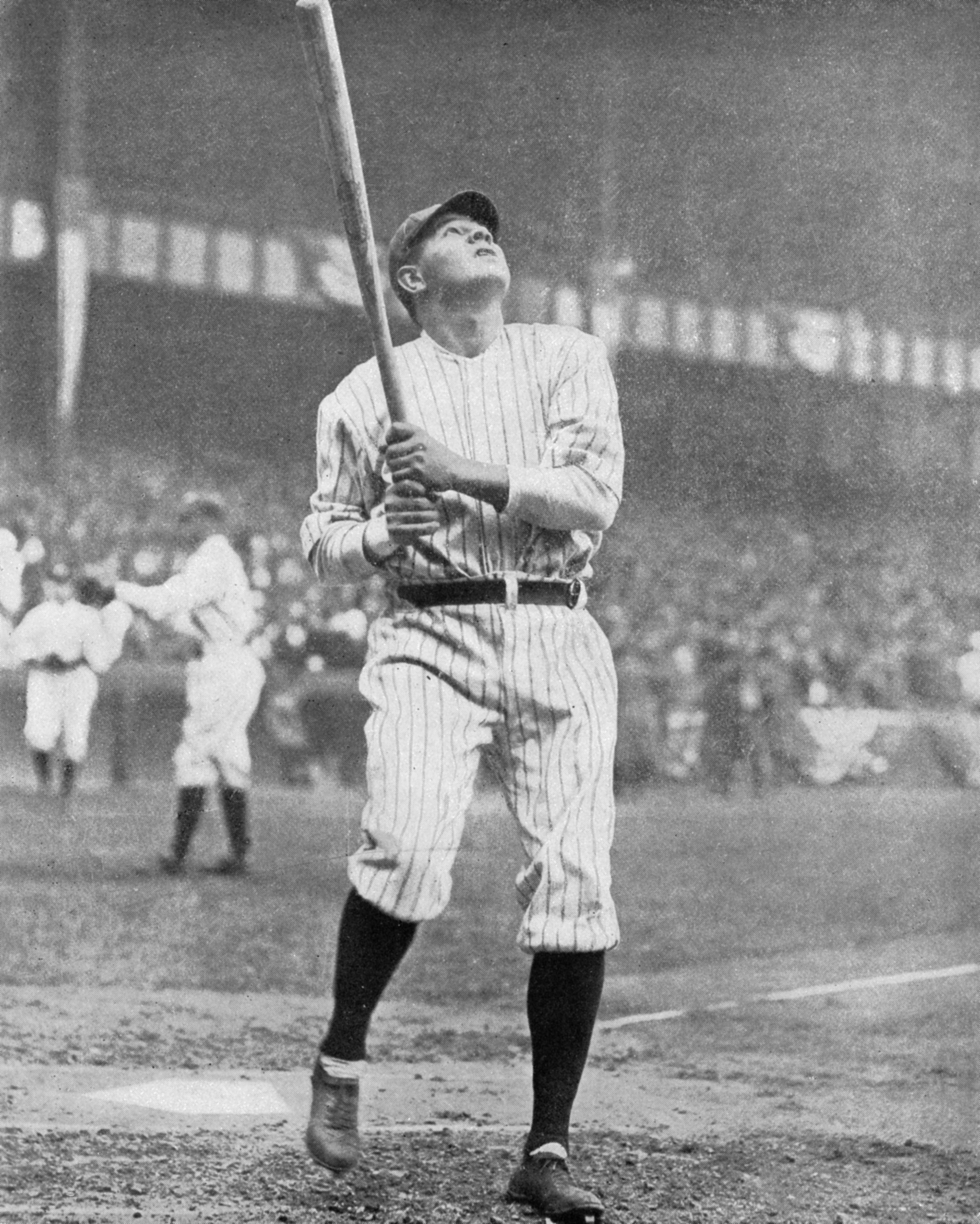
Babe Ruth of the New York Yankees takes a swing during batting practice in 1921 at the Polo Grounds in New York. (SABR-Rucker Archive)
When Babe Ruth was suspended for the first four weeks of the 1922 season, it was considered an early showing of power by baseball commissioner Judge Kenesaw Mountain Landis. Postseason barnstorming by players who had just played in the World Series was not allowed in 1921. Still, Ruth and teammates Bob Meusel and Bill Piercy did just that following their loss to the New York Giants in that year’s Fall Classic, warranting suspensions from the commissioner. The rule had been created more than a decade earlier, but by 1921 most people didn’t even know why it was in use. So why was the policy put into effect in the first place? An unsuccessful trip by the Philadelphia Athletics to Cuba in 1910 was not the sole reason that rules against World Series teams barnstorming were created, but it was a turning point in how the previous ruling body of the major leagues, the National Commission, viewed the practice.
Early Barnstorming Trips
For as long as there had been professional baseball players, there had been exhibition barnstorming tours. Many owners weren’t necessarily against their players going on tour to make some extra money after the end of the regular season, but some didn’t exactly support the practice either. They feared their players may get injured in the additional games or be out of condition by the upcoming spring training. Others thought their players were compensated fairly and didn’t see why they wanted to play against lower teams for what was sometimes a small amount of money. But players were free to travel to wherever they could find a game. Some more supportive owners even traveled with their teams on the tours or at least allowed them to represent the club in their own uniforms.
The National Commission was formed as part of the National Agreement in 1903 that ended the war between the National and American Leagues; the group included the presidents of both leagues and an elected chairman, and it ruled on all baseball matters across both major leagues as well as all minor leagues that were part of the National Association of Professional Baseball Leagues (Organized Baseball). American League president Ban Johnson was the most imposing member of the team and was customarily at the forefront of the decisions being made by the commission. The first rules in baseball that dealt with barnstorming were created by the National Commission not to protect owners’ assets or restrict players’ incomes but rather to punish “outlaw” teams that did not join the National Association.
Before the Commission was even formed, the island nation of Cuba was already becoming a popular location for exhibition games. Frank Bancroft, a manager and promoter in the early days of professional baseball, arranged one of the earliest trips by a team to Cuba. Visiting American teams were usually semi-pro squads that included a smattering of major league players, like Bancroft’s Hop Bitters team, or minor league clubs. Negro league teams also played there in the winters, as they were much more welcome there than they were in many parts of their homeland. Major league teams had also tried to set up trips to Cuba over the previous seasons, but the plans usually fell apart for one reason or another (one reason being strained U.S. relations with Cuba at the time of U.S. occupation).
In October 1908, as the business manager for Cincinnati, Bancroft successfully brought the Reds to Cuba. He collaborated with Cuban baseball manager and businessman Eugenio Jiménez to arrange for the Reds to play a series of games that would include games with the nation’s top two teams: the Blues of Habana and the Reds of Almendares. After closing out a fifth-place finish in the National League, a partial Reds squad of 11 players traveled south for the exhibition series. The Reds knew the Cubans had talented players, but they were confident they would win most of the games. Cincinnati was quickly educated on how good the Cuban players were, including their dark-skinned players, and none more than José Méndez, who didn’t allow a run over 25 innings. The Cuban legend tossed a one-hitter against the Reds (Miller Huggins finally scraped a hit in the ninth inning), and the Reds went 4-7 against the Cuban teams during the visit. Following the series, it was noted that Méndez’s color “… is the only thing that keeps him from being a star in one of the major leagues.”1

Frank Bancroft of the Cincinnati Reds (Library of Congress)
Despite the losing record for the Reds, it was a successful trip financially and for the players’ leisure. But some were not happy with the results of the Reds’ trip, especially with how they lost to teams that included dark-skinned players. Cincinnati Reds President Garry Herrmann, who happened also to be the neutral third elected member of the National Commission, was attributed with saying after the series that the Reds would no longer travel to Cuba. “I find that the Reds are playing certain men in Cuba against whom there is an unwritten law in the big leagues.”2 However, Herrmann and the Reds were still impressed enough with the talent in Cuba that they later signed two natives that were light-skinned enough that they could be accepted in the States: infielder Rafael Almeida and outfielder Armando Marsans.
The World Champions Get Embarrassed in Cuba
Following the end of the 1909 season, Jiménez arranged for a visit from the American League champion Detroit Tigers that would begin following the World Series, which the Tigers lost to Pittsburgh. After the Reds tour, American writers had warned other teams that they would need to bring their full arsenal if they wanted to succeed in Cuba. Still, Detroit stars Ty Cobb and Sam Crawford skipped the trip, as did manager Hughie Jennings (and Donie Bush would leave after a few games). The remnants of the Tigers put up a shoddy performance against the Havana and Almendares teams, losing eight out of twelve games. Almendares pitcher Eustaquio Pedroso bettered Méndez’s performance from a year earlier and tossed an eleven-inning no-hitter against Detroit.
After initially asking the Tigers to extend their visit for four additional games, Cuba instead cut the visit short and ended the series, citing lackadaisical play on the part of the Tigers, who no longer “… put up an article of baseball good enough to make it interesting for the Cuban players.”3 The Tigers had a substitute manager in place in Matty McIntyre, the team was immersed with replacement players, and most players were likely enjoying their time at a tropical destination before heading home for the rest of the winter. But no matter, the runner-up for the so-called championship of the world came back to the states in a battered state. Before the trip, Americans considered Cuban players to be fast and have strong arms but thought that the Cubans “… still lack finish and knowledge of the finer points.”4 But as the Calumet News of Calumet, Michigan, reported after the trip, “The truth struck home that Cuba is indeed on the baseball map.”5
During the 1910 baseball winter meetings that followed in January, both leagues added a clause to standard major league player contracts stating that players should not play in exhibition games after the season unless they received approval from the club owners. Clause 9 of the player contracts also specified that players must refrain from participating in other winter sports such as football, basketball, indoor baseball, or other sports, without first getting permission from owners. Not all owners took issue with players continuing with baseball after the close of the major league season, but some frowned upon their players taking part in other sports over the winter and getting hurt, thus the other sports were added to the clause. Players were frustrated with owners attempting to limit their earning opportunities after the season, but as Ban Johnson pointed out to Sporting Life in January 1910, the clause did not completely rule out barnstorming, it merely helped ensure that owners were made aware of intended trips and had a voice in the matter.6
New contract clause or not, the Tigers wished for a rematch with the Cuban teams in 1910, and after failing to reach the World Series for a fourth straight year, they worked up a trip to return there in October. There may have been concern over the Tigers losing again, but Detroit owner Frank Navin approved the trip.7 This time Cobb and Crawford were present, and the team found some payback, winning seven of the twelve games played (with one tie). Cobb came later when Cuba increased their offer to have him make the trip, and only after Navin heeded part of Clause 9 of the standard player contracts and prohibited Cobb from taking part in an auto race with Nap Rucker.8 The Tigers redeemed themselves, but the Cubans were focused on another opponent looming ahead – the newly crowned winners of the World Series, Connie Mack’s Philadelphia Athletics.
Eugenio Jiménez and Frank Bancroft teamed up again, this time to give the Cubans the ultimate opponent, the winner of the title of world’s champions of baseball. Many people in baseball opposed the A’s going to Cuba and risking another embarrassment. Jiménez and his partners made a substantial offer of $7,000 to the Athletics,9 and business manager John Shibe not only gave his approval but also joined on the trip. The National Commission had become wary of postseason trips after the failures of the Reds and Tigers the previous two falls. In the winter of 1910, however, the Commission devoted their collective attention to promoter D.A. Fletcher and his perceived threat to create a new third major league, which distracted them from Detroit’s return trip to Cuba. The Commission was so preoccupied that they were unaware of Bancroft’s planned trip for the Athletics until the arrangements were made. Or the Commission turned a blind eye to the trips to players might be appeased after hearing that some had received contract offers from Fletcher and might join on with his supposed start-up league.10 Ban Johnson later said that if he had known of the trip earlier, he would have tried to stop it versus risk the Athletics bringing shame upon American baseball. In the eyes of many people, that is just what happened.
Like the Tigers in 1909, the Athletics would take on the Cubans without their manager and some of their top players. Connie Mack and Eddie Collins were both newlyweds and skipped the trip, then Frank Baker and Rube Oldring also dropped out of it. After playing a series with the Tigers, the patchwork Philadelphia squad lost six out of the ten games against the Cubans, three each to Havana and Almendares. The A’s wrapped up the series in embarrassing fashion, getting swept in a doubleheader with one loss apiece to both teams (Eddie Plank and Charles Bender each came out on the losing end of a game). Philadelphia’s top position player during the series was Claud Derrick, a utility player who appeared in only two games during the season but was on the trip’s roster to replace Collins.
The Athletics could use any of the same excuses that were attributed to Cincinnati and Detroit: star players skipping the trip, participating players being worn down from a long season, and some players undoubtedly were more interested in the sights and nightlife of Cuba than they were in playing ballgames. Many fans discounted the results of the series, figuring that the trip was another example of a team that disguised a vacation as a baseball trip and that the Athletics had “… burlesqued the national game rather than to endeavor to play up to their standard.”11 But in the eyes of many reporters, and especially in the minds of the National Commission, the so-called “world’s champions” had sullied the reputation of major league baseball.
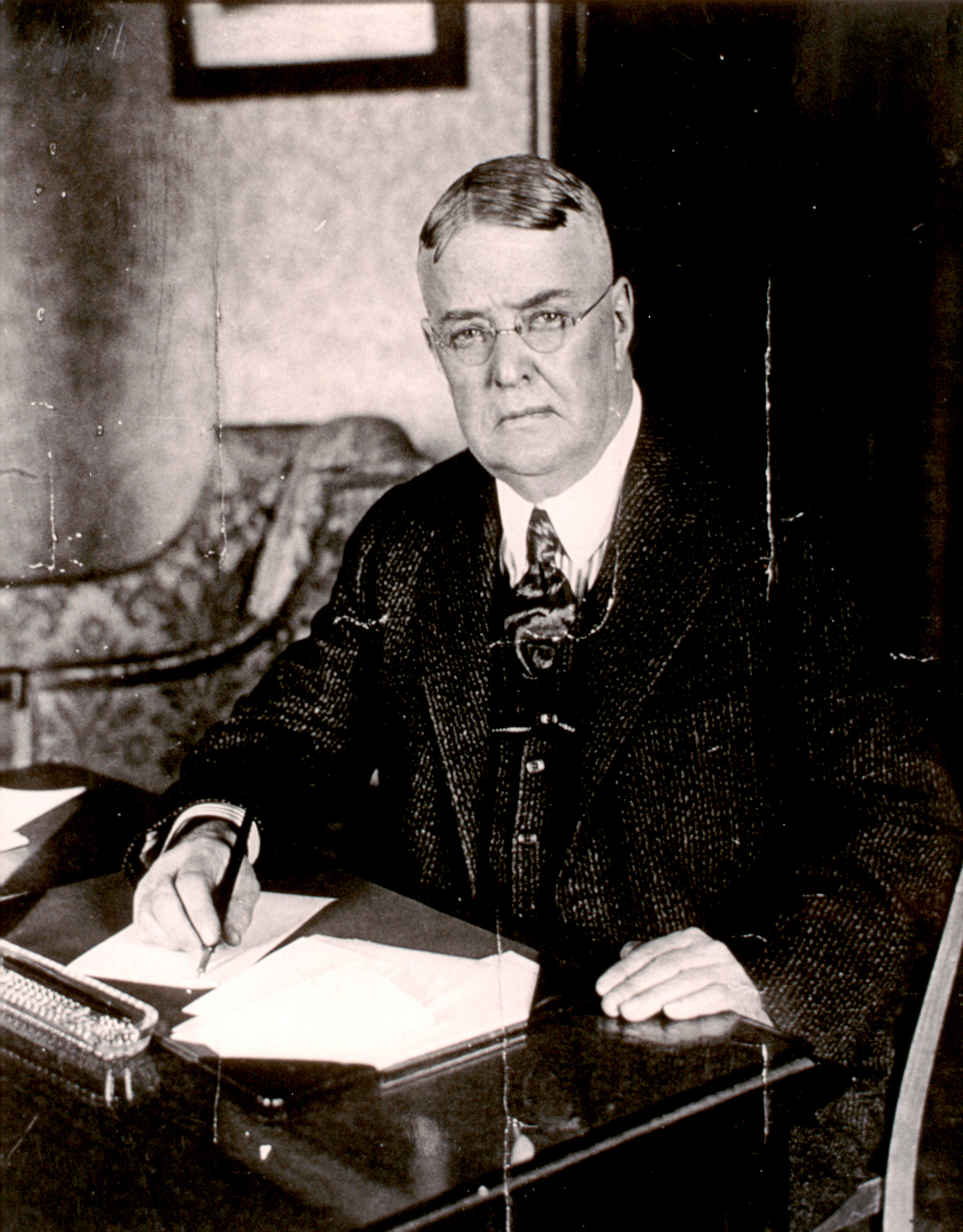
American League president Ban Johnson (SABR-Rucker Archive)
The National Commission’s War Against Barnstorming
The National Commission planned its annual meeting for January 1911, and barnstorming was sure to be one of the main discussion topics. Speaking on behalf of the commission, Johnson felt that “To have a band of champions troop off to other countries out of condition, and play opposing teams in the highest stage of perfect condition, and perchance suffer defeats, cheapens baseball…”.12 Garry Herrmann had helped found the championship series between the two major leagues, so he especially could be expected to take offense at a title team appearing to be vulnerable.
To no one’s surprise, the Commission passed a rule specifying that the World Series winning team would be required to disband immediately following the series, and no players from the team would be allowed to participate in exhibition games for the remainder of that year. What was surprising was that the rule was more lenient than what was expected; many writers had guessed that postseason exhibition games might be banned altogether. Other teams, including the World Series loser, could still participate in exhibition games, provided that “the full teams … be put in the field and that all exhibition games be played … with the spirit of regular championship [regular season] games”.13 The rule even raised fears of players throwing the series since they might make more money on fall barnstorming tours than what World Series-winning shares might bring them. The wording of the rules did not refer to foreign trips, but it was a safe bet that the Commission specifically had trips to Cuba in mind with the rule. As the Cincinnati Enquirer flatly stated, the Commission concluded that “… it does baseball no good to have a patched-up team going around a tropical island being beaten with great regularity by a lot of colored clubs. …”14
A repeat series with the champions of the major leagues would no longer be possible in 1911, so Jiménez and the Cubans instead looked to line up a matchup with the loser of the World Series between the Athletics and the New York Giants. After the Athletics defeated the New York Giants in six games, Bancroft and Jiménez set up arrangements for the New York team to make the journey. The Giants took the new exhibition rule to heart and came to Cuba to reclaim the United States’ reputation as the superior baseball country. Whereas the Tigers and Athletics of previous seasons were short by several key players, the Giants arrived with a squad that included much of the core of their team. Regular players Fred Merkle, Jack Meyers, and Rube Marquard stayed behind. Most of the other regular Giants made the trip, however, including Art Fletcher, Larry Doyle, and most notably, the world-famous Christy Mathewson. Many of the players brought their wives along with them on the excursion, but Giants manager John McGraw let the team know ahead of time that he expected them to remain in playing condition during the trip, with the intent not to repeat the failures of the Tigers and Athletics and instead “… show the islanders that baseball is faster” in the states.15 The Giants began their Cuban series on November 26 and played twelve games through December 18. They came out on top in the series and took nine out of the twelve games, outscoring the Cuban teams by 25 runs.
The Giants’ series victory in 1911 was followed by a much more successful return visit to Cuba by the Athletics in 1912, when they won nine out of the eleven games played. The Dodgers also had a victorious trip in 1913, winning 10 out of 15 games, and the worries over major league teams playing in Cuba seemed to have subsided. But the National Commission still fretted over major league teams appearing inferior against other teams outside the majors. There was still the lingering fear of players getting hurt, and columnists didn’t mind pointing out how much money major leaguers made and asking why they needed more (some things never change). In the November 8, 1913, edition of Sporting Life magazine, editors lambasted major league players that were “…playing for, with, or against every Tom, Dick, and Harry, and accepting ‘chicken feed’ for their services.”16 They called out the Brooklyn club for playing a local city-league team in a game where only 15 cents admission was charged.
That same article also called out Walter Johnson for playing a game against the Mohawk Giants, a colored team. The notion wasn’t explicitly mentioned but with Herrmann still a member of the National Commission it could be presumed that the group still held an overall aversion to major leaguers playing against – and losing to – teams with dark-skinned players, either in Cuba or the states. But the Commission didn’t take much action, especially if team management still approved the games. Charles Bender and other Athletics were reported to have played exhibition games with semi-pro teams and colored teams following their victory in the 1913 World Series, with seemingly no consequence except the promise of the Commission to take more radical measures.17
Promoter and former player Bill Lange planned a trip to California in the fall of 1915 for the Pacific-Panama Exposition in San Francisco for the two teams that had just met in the World Series: the Boston Red Sox and Philadelphia Phillies. The trip went against the regulations of World Series conduct, but it was approved by Ban Johnson and the Commission with the thought that it could promote major league baseball on the west coast. The tour ended up falling apart before it could get started. The Red Sox claimed that the Phillies canceled the series due to a scheduling conflict with a celebration set up in Philadelphia. But there were also reports that the offers made to the players were not enough to entice them to take part in the tour, and some of them were more interested in joining in an all-star tour set up by Frank Bancroft.18 Bancroft had redirected his promotional efforts away from working with entire teams and was instead putting together traveling teams of various major leaguers to play each other.
In an effort to wrangle control of barnstorming after the collapse of the Red Sox-Phillies tour, the National Commission sent out notices to teams in March 1916 saying that “… the Commission will impose adequate penalties on all major league players, who, after the promulgation of this notice, may engage in games not conducted by their respective clubs.”19 The players mostly ignored the rule since they considered the end of the regular season to be the end of their contractual obligation to the clubs. Tours still went on that fall as if teams and promoters “…had forgotten or never knew that they were prohibited …”20
Babe Ruth First Runs Afoul of Barnstorming Rules
Following their victory over the Brooklyn Dodgers in the 1916 World Series, several members of the World Champion Red Sox squad signed on to take part in an exhibition game in New Haven, Connecticut. The team played as the Red Sox against the New Haven Colonials, who had picked up Ty Cobb for the game. The Commission was aware of plans for the game and warned Boston not to play. Red Sox owner Joseph Lannin tried to stop the game at first but allowed it after being made aware of all the preparations made in New Haven21 (a conflicting report later quoted Lannin as saying he was unaware of the game). This combined defiance of the 1910 contract exhibition clause, the World Series rules of conduct, and the 1916 barnstorming notification was too egregious for the National Commission to ignore. The participating Boston players were fined $100 each by the league and had their World Series emblems withheld. Cobb was also fined $50 for taking part in the game. Among the Boston players penalized was their young star Babe Ruth, who had pitched in the contest.
The Red Sox decision opened the door for an inundation of barnstorming fines. While punishments were handed down to the Red Sox players, the Commission also fined as many as 40 other players who had taken part in the various barnstorming tours after the season. Dave Fultz, a former player and now head of the Players’ Fraternity, fought against punishment for the players. He argued that players’ contracts ran out as soon as the season ended, and thus, players should not be held liable for postseason exhibition games. A news article from October pointed out that Fultz had previously agreed to the standard player contract and its exhibition game clause so that as long as a player was held in reserve by a team they should not be allowed to play the exhibition games.22 The same article stated that the owners had handed over decisions on player barnstorming trips to the National Commission earlier in the year, referencing the notice in March. The Red Sox players, including Ruth, still had to pay fines for their exhibition game that followed their appearance in the World Series (Cobb’s fine was also upheld.)
The 1916 exhibition game was still fresh on the minds of Johnson and the Commission when during the 1917 World Series they learned that the American League champion Chicago White Sox had accepted an offer to play a post-series game against a team from Upland, Pennsylvania, in the Delaware County League, an outlaw league outside the National Association. Likewise, there was mention of some members of the National League champion New York Giants playing exhibition games after the series, including a possible return trip to Cuba.
On October 16, the day after the 1917 World Series concluded, the National Commission changed what was now Rule 9 of the World Series conduct rules so that players from both participating teams were prohibited from playing in postseason games. To ensure the rule was followed, $1,000 of the World Series shares for players from both teams would be withheld until January 1 with the promise to pay the players after that date, along with 6% interest added, as long as they did not partake in any games.23 After the series concluded, players for both the White Sox and Giants played a benefit game for soldiers at Camp Mills in Long Island, New York. Following that game, they petitioned the members of the Commission to pay off their entire World Series winnings, and in exchange, the players pledged to not play in any more exhibition games. The National Commission complied and paid the players, but a form of the policy on withholding portions of Series shares stayed in place over the next few years.
The Commission hoped this rule would deal once and for all with the issue of World Series champions playing in exhibition games. Still, Amos Strunk, Joe Bush, and Wally Schang from the Red Sox were each fined for playing in games following Boston’s appearance in the 1918 World Series (none of the players were with Boston in 1916). World Series competitors would still try to skirt the barnstorming rules in 1919 and 1920, but by then, the Commission had moved on to a more pressing matter – the 1919 Black Sox Scandal.
Babe Gets Suspended and No One Is Sure Why
Federal Judge Kenesaw Mountain Landis was named the first commissioner in 1920, specifically to deal with the matter of the scandal, and he came to be the league’s power. The National Commission dissolved following the appointment of Landis, but he held to the rules they established, including the rules around World Series contenders not playing in postseason barnstorming games. After the 1921 season concluded with the Giants topping Babe Ruth’s Yankees in the World Series, Ruth was to begin a tour that would feature other Yankees, including Carl Mays, Wally Schang, Bill Piercy, and Bob Meusel.
Ruth was no stranger to barnstorming; he regularly took part in off-season tournaments where he could capitalize on his immense fame. Besides the New Haven game in 1916, he also went on a popular exhibition tour in 1920 that famously included a trip to Cuba. But a rule is a rule, and before the World Series, Landis penned a memo to members of both the Giants and Yankees teams to remind them of the regulation forbidding them from playing in any exhibition games. Mays and Schang backed out of the tour, but Ruth, Meusel, and Piercy headed to Buffalo to play a game there on October 16.
In December, it was announced that Ruth would be suspended until May 20 and fined his world series share of $3,362. Meusel and Piercey were handed the same punishment (Piercey was dealt to Boston during the offseason.) The sentence was thought by many to be steep, seeing as how Ruth deserved some credit for bringing major league baseball out of the dark cloud of the Black Sox Scandal. It was considered justified by Landis, however, since Ruth was already aware of the barnstorming rule following his fine in 1916 and showed no apprehension about breaking it again. The suspensions didn’t have much impact on the standings, as the Yankees were in first place when Ruth and Meusel returned, but Ruth came up four homers short in his bid to win a fifth straight home run title.
By the time Landis’ ruling was handed down, the original intent of the barnstorming rules, namely, to criticize outlaw leagues and block Cuban trips, had already been all but forgotten. An occasional writer correctly cited the original purpose of the rules when writing about Ruth’s suspension, but the regulations were now widely regarded as a way for other players to have a chance to earn money after the series rather than have World Series players double up on earnings after the season. And when Lee Allen later wrote his book 100 Years of Baseball, he recalled that the rule was “… designed to prohibit the players from exploiting themselves in the tank towns, risking injury on poorly equipped fields.”24 No matter the rule’s origin, most writers, baseball figures, and fans agreed that it had become antiquated. The illustriousness of Ruth also highlighted an aspect of barnstorming that the National Commission had lost sight of, that the offseason games gave many people outside of major cities an opportunity to see him and other players that they usually could only read about in newspapers.
Landis may not have liked the idea that Ruth was becoming more prominent than baseball itself, but with the stain of the Black Sox still on the game, Major League baseball could use all the positivity it could get. Ruth had made a point of this when asked to comment on his suspension, and maybe a bit surprisingly, Landis agreed.25 In August 1922, the World Series code of conduct was amended so that players taking part in a World Series could play in postseason exhibition games after the season, provided they had obtained the written consent of their club management. The new rule also specified that no more than three members of a World Series team could play together in the same barnstorming game.26 The revised standards meant all players could barnstorm while also still incorporating the idea of not letting entire teams go on the road under the title of the “World Champions” of major league baseball, only to get beat by teams of semi-pros or small-town amateurs.
Among his many accomplishments in baseball, Babe Ruth could also count that he could undo the regulations that were put in as a reaction to the Philadelphia Athletics’ failed trip to Cuba in 1910. The resulting rule changes helped set the stage for an era of popular exhibition all-star tours that would let fans all over the country see stars spanning from Ruth and Lou Gehrig through to Dizzy Dean and Bob Feller.
Sources
Francis, Bill, “At Home On The Road,” National Baseball Hall of Fame, accessed October 1, 2023, https://baseballhall.org/discover-more/history/barnstorming-tours
Martínez de Osaba y Goenaga, Juan A. “Cuban-American Series …in Havana (II),” Cuba Debate, March 13, 2016, accessed October 1, 2023, at http://www.cubadebate.cu/noticias/2016/03/13/series-cubano-americanas-en-la-habana-ii/
Echevarria, Roberto Gonzalez. The Pride of Havana: A History of Cuban Baseball (New York, Oxford University Press, 1999).
Flynn, T.S. “Showdown: Babe Ruth’s Rebellious 1921 Barnstorming Tour.” The Babe (SABR, 2019). https://sabr.org/journal/article/showdown-babe-ruths-rebellious-1921-barnstorming-tour/
Bevis, Charlie, “Frank Bancroft,” SABR BioProject, accessed October 1, 2023, at https://sabr.org/bioproj/person/frank-bancroft/
Saccoman, John, “Garry Herrmann,” SABR BioProject, accessed October 1, 2023, at https://sabr.org/bioproj/person/garry-herrmann/
Notes
1 “A Wonderful Pitcher,” Scranton(Pennsylvania) Tribune, December 31, 1908: 8.
2 “Herrmann Is Hurt by Defeat of Team,” Pittsburgh Press, December 7, 1908: 12.
3 “Came Home a Week Early,” Kansas City Star, December 18, 1909: 11.
4 “Baseball in Havana, Cuba,” Courier-Journal (Louisville, Kentucky), November 21, 1909: 38.
5 Baseball Players Are Well Treated in Cuba,” Calumet (Michigan) News, December 7, 1909: 7.
6 “Proper Things Are the New Clauses in The Contracts,” Sporting Life, January 22, 1910: 6.
7 “Navin Is Liberal with His Players,” Detroit Evening Times, November 11, 1910: 11.
8 “Winter Ball but No Auto Races,” Williamsport (Pennsylvania) Sun-Gazette, November 10, 1910: 7.
9 “Dope For the Fans,” Lima (Ohio) Times-Democrat, December 20, 1910: 3.
10 “Fletcher’s League Worries Magnates,” Washington Herald, November 5, 1910: 13.
11 “Barnstorming Injures Teams,” Long Branch (New Jersey) Daily Record, November 18, 1913: 9.
12 H.G. Copeland, “Sullivan Sends His Contract,” Indianapolis Star, December 1, 1910: 8.
13 Frances C. Richter, “The Base Ball Rulers,” Sporting Life, January 14, 1911: 1.
14 Jack Ryder, “Keefe Sure to Stick with The Reds,” Cincinnati Enquirer, January 5, 1911: 8.
15 “Giants’ Trip to Cuba,” New York Times, November 15, 1911: 12.
16 “Major League Players Do Not Conserve Dignity,” Sporting Life, November 8, 1913: 2.
17 A.H.C. Mitchell, “Sidelights on Sports,” Atlanta Georgian, November 6, 1913: 12.
18 Red Sox players Dick Hoblitzel and Hick Cady were both on the 1915 team after the tour was canceled but both players were apparently approved to join the tour. Hoblitzel was even named as manager of the American All-Star team.
19 “Warning Issued,” Cincinnati Enquirer, March 10, 1916: 6.
20 “Cardinals Not Coming,” Mount Carmel (Illinois) Daily Republican, September 26, 1916: 1.
21 “Red Sox Play Despite Orders of Commission,” Meriden (Connecticut) Daily Journal, October 16, 1916: 1.
22 “Fultz’s Memory Is Short, Says Ban Johnson,” Fall River (Massachusetts) Daily Globe, October 26, 1916: 6.
23 “Series Players Can’t Barnstorm,” New York Tribune, October 16, 1917: 12.
24 Lee Allen, 100 Years of Baseball (New York, Bartholomew House, Inc., 1950), 215.
25 “Repeal Of Baseball Rule Prohibiting Barnstorming to Be Sought at Chicago,” Olean (New York) Times Herald, August 14, 1922: 19.
26 “Magnates Consider Changes in Trades During Mid-Season,” Pittsburgh Daily Post, August 15, 1922: 9.