

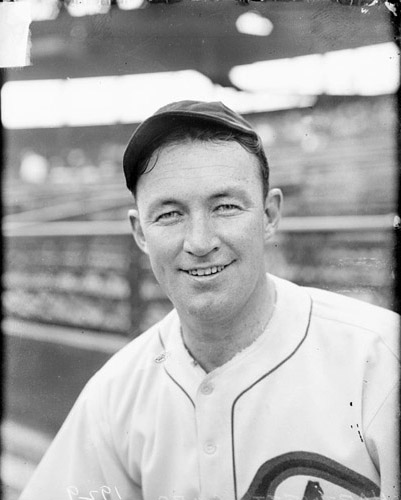
Gabby Hartnett
Recounted and savored over generations, four iconic moments share a single connective thread. In each tableau, Chicago Cubs catcher Gabby Hartnett was not only present at the moment, but was an active participant in the various scenes. Even without those brushes with what came to approach mythological status, Gabby Hartnett was a Hall of Fame player.
He carved out a career as one of the finest catchers ever to play the game, and into the 21st century was still widely acknowledged as the best catcher in the National League during his playing career in the 1920s and 1930s. In his life span of 72 years, almost to the minute, he wasted few moments, on the diamond or off. In any litany of baseball memories from the 1930s, perhaps no event stands out more than Babe Ruth’s “called shot” home run off Cubs pitcher Charlie Root in the 1932 World Series, unless it was the feat of New York Giants pitcher Carl Hubbell and his consecutive strikeouts of five future Hall of Fame hitters (Ruth, Lou Gehrig, Jimmie Foxx, Al Simmons, and Joe Cronin) in the 1934 All-Star Game. For Cardinals fans and baseball historians, the 1937 All-Star Game will remain forever cast in notoriety because of the injury to Dizzy Dean’s big toe from Earl Averill’s shot back through the box, an injury that caused Dean to change his delivery and led to an all-too-premature career-ending injury.
Finally, though certainly not least, was the famous 1938 “Homer in the Gloamin’,” a shot whose momentum propelled the Cubs past the Pittsburgh Pirates and into the World Series. Gabby Hartnett was a critical part of each of those dramas.
Charles Leo Hartnett was born on December 20, 1900, in Woonsocket, Rhode Island, the eldest of 14 children born to Fred and Ellen “Nell” (Tucker) Hartnett. Fred, a laborer, moved his family to Millville, Massachusetts, just over the state line from Woonsocket, when he took a job at Banigan’s Millville Rubber Shop. Fred played semipro baseball in his younger years and managed the Millville town team for a period, and was considered to have a tremendous throwing arm. It was a genetic legacy he passed to his son, Leo.
The boy, known as Leo but called Dowdy by the locals, after his father, grew up listening to his father talk baseball. As soon as Leo was able, he began playing baseball, and gravitated to the role of catcher, just as his father had. At 14 Leo finished the eighth grade at Longfellow Grammar School and took a job as a laborer at the Rubber Shop.1 He also joined the town’s baseball team, along with another future professional, Tim McNamara, who went to Fordham University and pitched for the Boston Braves and New York Giants from 1922 through 1926. Though Leo later left the Rubber Shop to attend the prestigious Dean Academy in nearby Franklin, Massachusetts, it was on the baseball diamond that he got his education.
The young catcher had a terrific throwing arm, so good that in 1920 the American Steel and Wire Company in Worcester offered him a job in its shipping department just so he could play on the company baseball team. Hartnett thrived, perhaps even discovering that work was occasionally getting in the way of baseball, instead of the reverse. There is a story, impossible to prove but widely recounted and intriguing, that the New York Giants’ John McGraw heard of Hartnett and sent scout Jesse Burkett to have a look at the prospect. Evidently Burkett felt the catcher’s hands were too small for major-league baseball, so the Giants passed. What is a matter of record is that Hartnett signed his first professional baseball contract with the Worcester Boosters of the Class A Eastern League on March 12, 1921.
Appearing in 100 games for Worcester, Hartnett played well enough that Cubs scout Jack Doyle offered him $2,500 to sign with Chicago. Leo accepted and the Cubs sent him to spring training with the team on Catalina Island, off the Southern California coast. Hartnett did not immediately impress manager Bill Killefer, who already had Bob O’Farrell on the roster as his primary backstop, and it took Doyle’s intervention to persuade Killefer to give Hartnett a legitimate trial at catcher. The manager had the youngster catch Grover Cleveland Alexander for a full game, and afterward the pitcher told his manager that Hartnett was “all right.”2 That verdict was enough to keep Leo on the Chicago roster.
Backing up starting catcher O’Farrell in 1922, the 21-year-old Hartnett barely spoke to anyone, especially not to newspaper reporters. In view of his awkward shyness, teammates and the press dubbed him Gabby, an ironic moniker at the time, but one that he actually grew into as he aged, developing a reputation as something of a chatterbox crouched behind home plate. “… Bill Killefer still wasn’t sure where (Hartnett) would best fit in, since the Cubs had one of the best catchers in the league in Bob O’Farrell. Killefer considered playing Hartnett in the outfield, or at first base, but the outfield was finally ruled out because of Hartnett’s lack of speed. … He was tabbed as O’Farrell’s understudy and a backup at first base.”3
After making his major-league debut on April 12, 1922, Hartnett appeared in only 34 games and collected a mere 14 hits for the season. Behind the plate, though, he made only two errors, a mark that highlighted his value as a defensive backup and kept him on the roster for the next season. In 1923 Gabby’s batting average climbed over 70 points, and when O’Farrell was injured in 1924, Hartnett was poised to fill the void. Making the most of the opportunity, he hit .299 and homered 16 times in 111 games, and finished tied for 15th in voting for the National League’s Most Valuable Player.
From then on Hartnett played his position better than any of his predecessors and most of his successors. Large for the time, the 6-foot-1, 195-pound Gabby became the first player to hit five or more homers in the first six games of a season, and then went on to break the single-season record for home runs by a catcher in 1925 with 24. “… (Harnett) discovered how to exploit the newly inviting left-field fence and smashed a one-season team record 22 home runs (and moreover, the major league’s venerable single-season mark for catchers) by midseason, then slumped badly in the second half after Veeck removed most of the left-field bleachers. …”4 In spite of the slump, he finished second in the league in home runs, trailing only Rogers Hornsby’s 39. In 1924 and 1925, only 136 bases were swiped off Hartnett, compared with a league average of 178 against other starting catchers.5 During his 1926 season he demonstrated the necessary maturity behind the plate by throwing out 60 percent of the runners attempting steals against him while finishing third among National League catchers in assists and tied for third in putouts.
Hartnett’s 1927 season saw his offensive production increase to the point that he finished tenth in the league’s Most Valuable Player balloting. The Cubs carried two catchers for most of the year, 26-year-old Gabby and Cuban-born Mike Gonzalez, a decade older. Hartnett carried the brunt of the catching load for the fourth-place team, appearing in 127 games while improving his batting average to .294, and leading the circuit in putouts, assists, errors, and runners caught stealing.
He continued his growth the following year, 1928, with a .302 batting average, 26 doubles, 9 triples, and 14 homers in only 388 at-bats, but the Cubs managed only a one-place improvement, to third. He also earned yet another nickname. “As he grew older and added weight, the big catcher developed a ruddy complexion, resulting in the nickname ‘Old Tomato Face,’” a biographer wrote. “According to one sportswriter, ‘There were three distinguishing characteristics associated with the likeable Irish-American – a red face, a big cigar, and a laugh in which he simply wound up and let go, laughing all over. His frame shook like a dilapidated jalopy.’”6
As spring training began in 1929, on Catalina Island just off the coast of Los Angeles, Hartnett and his new bride, Martha Henrietta (Marshall) Hartnett, planned to use the trip as both preseason conditioning and a honeymoon on the isolated resort.7 The couple, married on January 28, had a son, Charles Leo Jr. (known as Bud), born in December 1931, and a daughter, Sheila, born in June 1935.
Mitigating the matrimonial bliss, though, was unexplained deadness in Hartnett’s right arm, which ultimately limited his season to one game in the field and 25 pinch-hit appearances. Unable to throw well and unresponsive to treatment, Hartnett rested for the year. While he did come to bat three times as a pinch-hitter during the 1929 World Series against the Philadelphia Athletics, he did not record a hit in his first postseason contests. Whatever the cause of the malady, Hartnett recovered to the point that he was able to post a .339 batting average in 1930, with career highs in hits (172), runs scored (84), home runs (37), RBIs (122), slugging (.630) and OPS (1.034), while committing only eight errors in 136 games behind the plate. Also, on the defensive side, Hartnett led the league catchers in putouts (646), assists (68), and runners caught stealing (36).
In 1932 the Cubs won the pennant by four games over the Pittsburgh Pirates, and faced the Yankees in the World Series. The Cubs pitchers sported the lowest earned-run average in the league that year (3.44), in part due to Hartnett’s experience calling the games. During the top of the fifth inning in Game Three of the Series, Hartnett was behind the plate when Babe Ruth raised his arm and gestured toward the pitcher and the outfield. According to Hartnett biographer William McNeil, Gabby later said, “I don’t want to take anything from the Babe, because he’s the reason we made good money, but he didn’t call the shot. He held up the index finger of his left hand … and said, ‘It only takes one to hit.’ ”8 Regardless of whether Ruth did or did not “call his shot,” the story has become an apocryphal slice of baseball lore, one that refuses to fade with time.
Hartnett, however, was too busy with the 1933 season to fret over Chicago’s sweep by the Yankees in 1932 despite his .313 batting average in the Series. At the top of his game, he was selected as a National League reserve in the inaugural All-Star Game. The next year, batting .336 with 13 home runs by the time of the game, he was named the starting catcher in a battery with Giants ace Carl Hubbell. It was in the top of the first inning, after a leadoff single by Charlie Gehringer and a walk to Heinie Manush, that Hubbell started his historic streak. He struck out Ruth, Lou Gehrig, and Jimmie Foxx to end the inning, and then picked up where he left off in the second, whiffing Al Simmons and Joe Cronin before Bill Dickey broke up the string with a base hit. Hartnett went 0-for-2 at the plate, but never played a more memorable All Star Game.
The following season, 1935, was one of Hartnett’s best. His body was 34 years old, but he played as if he were ten years younger, and his mind was as sharp as ever. He batted .344, made only nine errors in 110 games and led the Cubs to the World Series against the Detroit Tigers. Hartnett played well that postseason, batting .292, but the Cubs fell in six games. After the season he was named the National League’s Most Valuable Player, over pitcher Dizzy Dean of the St. Louis Cardinals and Arky Vaughn of the Pittsburgh Pirates, a small comfort for again falling short of a championship.
In 1937 Harnett was again selected for the All Star Game, his fifth consecutive appearance, and found himself behind the plate paired with Cardinals rival Dizzy Dean. In the bottom of the third inning, with two outs and the game scoreless, Dean gave up a single to Joe DiMaggio and a home run to Lou Gehrig. Earl Averill then smote a sharp drive directly back to the mound, a hit so hard that it clipped the pitcher’s left foot before finding second baseman Billy Herman’s glove for the eventual throw and the putout at first base. Dean left the game, his career changed forever. Averill’s low line shot had broken the big toe on Dean’s left foot, and when the pitcher tried to come back before it had fully healed, he altered his delivery to avoid the pain. That caused Dean to permanently damage his arm and finally retire from the game prematurely (but not before pitching for three seasons for the Hartnett-managed Cubs).
Hartnett finished a close second behind the Cardinals’ Joe Medwick in MVP voting in 1937, but he saved his greatest moment for 1938, and another Chicago pennant chase. On July 20, 1938, the Cubs languished in third place in the standings, 5½ games behind league leader Pittsburgh, despite having won seven straight games after a six-game losing skid during the preceding two weeks. Chicago owner Philip Wrigley fired established manager Charlie Grimm and replaced him with novice Hartnett. The move worked. By late September the Cubs were 1½ games out of first and had a three-game series in Chicago remaining with the Pirates. After the Cubs won the first game to pull within a half-game of the lead, the teams met again at Wrigley Field on September 28.
With the score tied at 5-5 after eight innings, and as the early-autumn darkness threatened the unlighted stadium, the umpires agreed that the ninth inning would be the last of the day. They also decided that, in the event of a makeup the following day, the entire game would be replayed, and not just picked up where it was stopped. Hartnett came to bat against the Pirates’ standout relief pitcher, Mace Brown, with two out in the bottom of the ninth. Brown used the reduced visibility to his advantage and got two quick fastball strikes on the catcher. With darkness setting in and visibility decreasing, Brown inexplicably threw Hartnett a high curve. Gabby knocked the pitch over the fence in left-center field, and into immortality. “Most fans were unable to follow the flight of the ball in the darkness, but when it settled into the left field seats for a walk-off home run, Wrigley Field erupted with a deafening roar that could be heard for blocks. Thousands of … spectators came spilling out of the stands screaming and racing toward the diamond.”9
Hartnett said, “I swung with everything I had, and then I got that feeling, the kind of feeling you get when the blood rushes out of your head and you get dizzy. A lot of people have told me they didn’t know the ball was in the bleachers. Well, I did. Maybe I was the only one in the park who did. I knew the moment I hit it. … I don’t think I saw third base … and I don’t think I walked a step to the plate – I was carried in.”10 The “Homer in the Gloamin’,” as it is remembered, remains one of the signature walk-off home runs of all time. The Cubs won again the next day to complete a series sweep of the Pirates. The 10-1 victory capped a ten-game Chicago winning streak that placed the Cubs on the path to win the NL pennant by two games. The ending was not entirely happy, however, as the Cubs were swept in the World Series by the Yankees.
Hartnett, now under media scrutiny as the Cubs’ manager, began to show the strain. He was accused by some players of favoring pitcher Dizzy Dean; there were other petty squabbles; and Gabby found himself catching more often than he’d have liked simply because his was the best bat on the team among the catchers. On August 28, 1939, Hartnett’s durability was formally acknowledged when he caught his 1,728th game, breaking Ray Schalk’s major-league record for games caught by a catcher. (The record has since been broken by several catchers.)
After the 1940 season, following nearly two decades with the club and despite a three-season record of 203-176 (.536), Hartnett was abruptly fired as manager on November 13. Less than a month later, on December 10, he signed as a player-coach with the New York Giants, and, at the age of 40, hit .300 in 64 games in 1941. On September 24 of that season, Hartnett went 1-for-4 against the Philadelphia Phillies in what proved to be his final big-league game.
Not quite done with baseball, Hartnett managed five seasons in the minors from 1942 through 1946. In 1942 he managed Indianapolis of the American Association to a 76-78 record, and from 1943 through 1945 led Jersey City of the International League. In 1946, his final year managing, he piloted Buffalo of the International League.
After retiring from baseball, Hartnett opened Gabby Hartnett’s Recreation Center in Lincolnwood, a Chicago suburb. The enterprise ultimately grew to 20 bowling lanes, a barbershop, a soda fountain, a cocktail lounge, and a sporting-goods store. On January 26, 1955, with a career major-league batting average of .297, 1,912 hits, and one of the most famous home runs in the history of the game, he was elected to the Baseball Hall of Fame with an illustrious class that also included Joe DiMaggio, Ted Lyons, and Dazzy Vance.11
Hartnett lived his entire post-baseball life in Illinois. He was a coach and scout for the Kansas City Athletics for two years in the mid-1960s, but spent much of his time playing golf, hunting, and enjoying his golden years. His health deteriorated. In 1969 he was taken to the hospital after spitting blood on the golf course. The next year his spleen was removed, but it was an unwinnable fight. At 5:20 A.M. on his 72nd birthday, December 20, 1972, in Park Ridge, Illinois, Gabby Hartnett died of complications from cirrhosis of the liver. He is buried in All Saints Cemetery in Des Plaines, Illinois.
Hartnett’s obituaries conveyed a portrait of a genuinely good man: “(It) was his winning personality that set him apart on the field – a friendly wave to the men in the press box, a hundred handshakes with friends he had made in every city in the circuit, and autographs for everyone, young and old, who asked him to sign.”12
Nearly three decades after his death, as Major League Baseball built its All Century Team in 1999, Hartnett’s achievements were sufficiently notable that he was a finalist, but he finished behind Johnny Bench and Yogi Berra in the voting. His greatest epitaph, though, was penned in his obituary: “‘Old Tomato Face’ they called him. His last game long since played, but his love of baseball undiminished to the end. … As man and player … Rhode Island can be proud to call him a native son.”13
This biography appears in “Winning on the North Side: The 1929 Chicago Cubs” (SABR, 2015), edited by Gregory H. Wolf.
Notes
1 William McNeil, Gabby Hartnett: The Life and Times of the Cubs’ Greatest Catcher (Jefferson, North Carolina: McFarland, 2004), 31.
2 Roberts Ehrgott, Mr. Wrigley’s Ballclub (Lincoln: University of Nebraska Press, 2013), 77.
3 McNeil., 50.
4 Ehrgott, 37.
5 McNeil, 64.
6 McNeil, 112.
7 McNeil, 152.
8 McNeil, 174.
9 McNeil, 256
10 Eddie Gold and Art Ahrens, The Golden Era Cubs: 1876-1940 (Chicago: Bonus Books, 1985), 149.
11 William Mead, Low and Outside: Baseball in the Depression, 1930-1939 (Alexandria, Virginia: Redefinition Books, 1990).
12 Irv Haag, “Baseball’s All-Time Greatest Catchers,” Baseball Digest, April 1973.
13 “Gabby Hartnett, Noble Son of R.I.,” Pawtucket Times, December 26, 1972.
Full Name
Charles Leo Hartnett
Born
December 20, 1900 at Woonsocket, RI (USA)
Died
December 20, 1972 at Park Ridge, IL (USA)
If you can help us improve this player’s biography, contact us.