


Al Capone: A Life in Baseball
This article was written by Bill Lamb
A memorable scene from the 1987 movie The Untouchables focuses upon a lavish private banquet hosted by Chicago underworld boss Al Capone (played by Robert De Niro). With all present resplendent in formal evening attire, Capone inspires his associates with an after-dinner speech crafted in baseball metaphor. To drive home his point about the paramount importance of loyalty and teamwork, Capone then bashes in the skull of an untrustworthy underling with a baseball bat.
The event is fictional, created by screenwriter David Mamet for dramatic effect. Only slightly less contrived is the gangland legend that spawned the movie scene: namely, that Capone had beaten three turncoat members of his organization to death with a baseball bat in May 1929. Post-mortem examination revealed that the men – mob thugs John Scalise, Albert Anselmi, and Joseph Giunta – had been shot to death.1 But inhabiting these underworld myths is a central truth – Al Capone knew how to handle a baseball bat.
Capone’s bat handling skills were grounded in experience – he was an avid amateur and semipro ballplayer during his teenage years in Brooklyn. A first baseman-pitcher who batted and threw righthanded, the future crime lord even captained an eponymous nine in 1918, the Al Capone All-Stars. The paragraphs below explore this little-known aspect of Capone’s life before surveying his higher-profile connection to the game in Chicago. The narrative begins, however, with some family background.
Family Roots
Unlike many contemporaries who took up a life of crime, the young Capone was not some footloose street urchin or chronic juvenile delinquent. Raised in a stable, closely knit Italian immigrant family, Alphonse Gabriel Capone led a largely unremarkable early life. Born in Brooklyn on January 17, 1899, he was one of nine children2 raised in the household of barber/billiard parlor proprietor Gabriele Capone (1865-1920) and his wife Teresina (née Raiola, 1867-1952), recent arrivals from a village outside Naples. As a teenager, Al attended school until age 14; enjoyed dances, parties, and other social events; and took part in the activities of his parish’s youth organizations. Although he had friends who already were involved in crime and rubbed elbows with neighborhood gangsters, Capone mostly stayed out of trouble during his teen years.
The Youthful Ballplaying of Al Capone
As youngsters, the Capone boys gravitated toward sports, with Al being particularly influenced by his baseball-playing older brother Ralph Capone. A corner infielder who also batted and threw righthanded, Ralph first garnered notice leading an amateur club called the Algerians in 1912. Although a non-professional side, the club’s matches were always accompanied by a side bet on the outcome.3 The following summer, Ralph was likely the first baseman listed in published box scores of the J.J. Lattemann Company team of Brooklyn.4 A good athlete, Ralph may also have been the Capone playing basketball for the City Park Triangles five during the winter of 1914-1915.5
In January 1915, Ralph Capone served on a parish committee to aid the community poor sponsored by St. Michael the Archangel Church, his family’s house of worship.6 Several months thereafter, Ralph organized the baseball team fielded by the Young Men’s Catholic Club, a parish youth group.7 Meanwhile, organizing a rival neighborhood team, the Federal Careers B.B.C.,8 was reputed cousin Charles Fischetti, later a Capone bodyguard and operative specializing in gambling rackets and corrupting politicians useful to the “outfit” (as Al dubbed his criminal syndicate).
For the 1916 season, Ralph was joined on the St. Michael’s team by younger brother Al. Previously the first baseman, Ralph shifted over to third to allow his 17-year-old sibling to man the initial sack. Although separated by a five-year age difference, the Capone brothers were remarkably similar in size – a muscular 5-foot-10+ and about 200 pounds as young men9 – and facial appearance. Indeed, it is sometimes difficult to distinguish the two in photographs. And throughout their lives, Ralph and Al were very close, although the latter soon assumed the role of dominant Capone brother.10
The St. Michael’s team generally took their lumps that summer, as exemplified by a 9-2 beating administered by the Albany A.C. in early July. During that contest, one of the Capone brothers, likely Al, did the pitching, striking out four while walking the same number. He also got a base hit and scored a run. Removed from the box, Al finished the game at shortstop, where he handled six chances cleanly.11 The following week, St. Michael was on the losing end of a 9-6 decision dropped to the Fed Careers B.B.C., notwithstanding two hits and two runs scored by third baseman Ralph Capone. Brother Al was held hitless but handled six defensive chances flawlessly at first.12 Days later, Ralph was elected vice-president of the team’s parent organization, the St. Michael’s YMCC.13
It appears that Al Capone played no team baseball in 1917, his time consumed working at a Coney Island night spot. Brother Ralph, however, stayed busy on the diamond, playing for the Marquette Council club in the Brooklyn Catholic League. But the Marquettes were a hapless outfit. With Ralph going 1-for-7 at the plate, a June 24 doubleheader loss to the All Saints nine dropped the Marquette record to 0-8.14 Handling 20 fielding chances without a miscue at first base was the twin bill’s only redeeming feature for the elder Capone. While Al’s name disappeared from sports pages that year, it did not disappear from newsprint entirely. An item in a Brooklyn Standard Union social column recorded Al’s presence at a November masquerade party hosted by Mrs. Bridget Coughlin, an Irish neighbor and the mother of Capone sweetheart Mae (Mary Josephine) Coughlin.15
The brothers reunited in 1918, forming the semipro Al Capone All-Stars. Also joining the nine was third baseman Charlie Fischetti, aka Charles Fischer. The All-Stars got off on the wrong foot, a ninth-inning rally by the Lockport A.C. costing the club a 6-5 defeat on May 30. The inexplicable use of nicknames (rather than surnames) in the game box score makes divining who played a matter of guesswork;16 Fischetti is likely the “Charley” who manned third base, but whether either Capone brother was in the lineup is uncertain. In any case, a week later the All-Stars evened the score with the Lockports, winning 13-6. “The feature of the game was the twirling of Al Capone,” reported the Brooklyn Citizen.17 The good-hitting hurler supported his own cause with a pair of singles and a double. But the game’s foremost batting star was third baseman Fischetti, who went 4-for-4 with two home runs.
The final discovered game of the Al Capone All-Stars saw all three of its future felons in the spotlight. Pitcher Al Capone “was saved by fine support” which included a home run, double, and single by brother Ralph and two base hits and two runs scored by “cousin” Charles Fischer (Fischetti).18 Al chipped in three hits and a run scored of his own and staggered to a 17-10 pitching victory over the Lockports. Thereafter, the All-Stars vanished from the baseball scene.
As far as has been determined, neither Al nor Ralph Capone ever played organized team baseball again. Capone scholar Mario Gomes identifies three events that may have affected Al’s early retirement from the game, all of which occurred in December 1918.19 The first was the birth of his only child, son Albert Francis “Sonny” Capone on December 4. Four days later, Al was slashed across the face either during a night club brawl precipitated by insulting remarks or, more likely, a mugging on the street near his home.20 Prompt treatment at Methodist Episcopal Hospital preserved Capone’s health but the incident left him with the three prominent remnants that begat the Scarface nickname that he detested. Last but perhaps most important, the month closed with Al’s marriage to his infant son’s mother, longtime girlfriend Mae Coughlin. Al’s beautiful Irish bride was never fully accepted by the Capone clan, but Mae Capone would prove devoted for life to her husband and child.
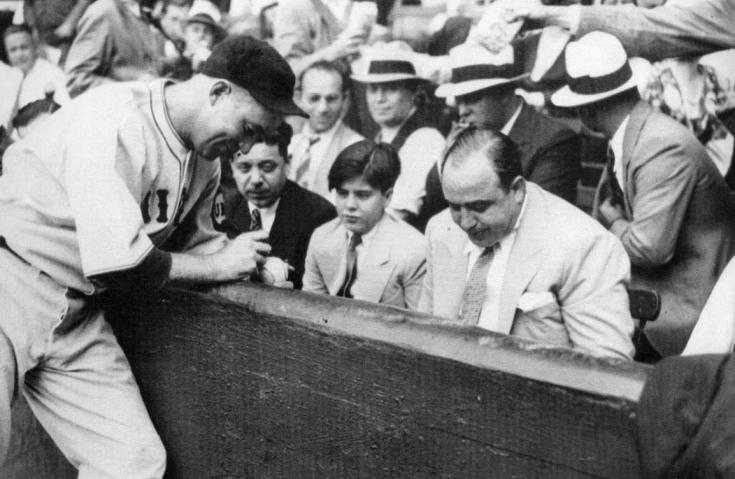
Chicago Cubs player Gabby Hartnett autographs a baseball for Sonny Capone, who is sitting with his father, Al Capone, and other gangsters at a charity baseball game on September 9, 1931. (Library of Congress)
Al Capone and Baseball in Chicago
As his time on the ball field drew to a close, Al Capone moved on to a life of crime, a career change facilitated by his employment as a waiter and bouncer at night spots operated by local hoodlums. But the key to underworld advancement was his acquaintance with rising Brooklyn mobster Johnny Torrio, a friend of the Capone family. As the Prohibition Era began, Torrio moved to Chicago, where he quickly rose high in city gangland hierarchy. Following Gabriele Capone’s death in November 1920, the Capone family relocated to Chicago, as well. There, in time, Al became a Torrio protégé. And when Torrio went into “retirement” following a failed assassination attempt, Al Capone assumed control of Torrio’s criminal enterprises. As early as 1925, young Al Capone was Chicago’s top mobster.
As an adult, Al Capone was often charming and good humored, probably the favorite gangster of the Chicago press corps. But make no mistake, Capone had become a hard-core criminal, ruthlessly ambitious and not at all averse to resolving threats to his bootlegging, protection, and gambling operations via assault, arson, and other violent means, including murder. The infamous St. Valentine’s Day Massacre of February 1929 – in which five members of a rival Chicago mob (plus an innocent garage mechanic and a gangster wannabe) were machine gun executed on Capone’s orders – provides the most graphic illustration of his penchant for resorting to brutal solution of business and territorial challenges.
As they grew older, both Al and brother Ralph, an outfit counselor and lower-level racketeer, put on weight. But the Capones remained athletic, with golf supplanting baseball as a leisure time activity. Al also played some tennis. But while he no longer played baseball, Al Capone never lost his interest in the game. According to reports recently circulated on social media, Capone hoped to purchase the Chicago Cubs and install New York Yankees star Babe Ruth as playing-manager sometime in the late 1920s.21 If ever more than a pipedream, the scheme came to naught.
On a more realistic level, attending Chicago White Sox and/or Cubs games was a way for Capone to bond with Sonny, his physically frail and sheltered only child. One such ballpark outing garnered national attention. On September 9, 1931, the White Sox and Cubs interrupted regular season play to stage an exhibition game for the benefit of an unemployment relief fund recently established by Illinois Governor Louis L. Emmerson.22 Among the nearly 35,000 fans at Comiskey Park to witness the contest were Al Capone and his 12-year-old son, nattily dressed in suit and tie and seated in a front row box near the Cubs dugout. Surrounding the Capones were an assortment of local politicians and the ever-present phalanx of Capone bodyguards, including the notorious Machine Gun Jack McGurn (born Vincenzo Gibaldi).
Prior to first pitch, Cubs star catcher (and future Hall of Famer) Gabby Hartnett stopped by the Capone box for a brief chat. Hartnett then obliged the Chicago crime boss by autographing a baseball for Sonny. In the following days, sports pages around the country carried Associated Press and/or International Newsreel photographs of the encounter, with some identifying Capone as “Scarface Al” and “Public Enemy No. 1.”23 The photos’ circulation evoked the chagrin of major league baseball commissioner Kenesaw Mountain Landis, who subsequently issued an edict forbidding players from speaking to anyone in the stands.24 Hartnett obeyed the directive but had no regrets, saying that he would still gladly sign autographs for any youngster, regardless of the reputation of the child’s father.25
In any event, Capone excursions to the ballpark soon came to an end. On October 17, 1931, he was convicted of income tax evasion by a federal court jury26 and was thereafter sentenced to an 11-year prison term.27 Upon arrival in the federal penitentiary in Atlanta, medical examination uncovered a long-untreated case of neurosyphilis in the new inmate. Belated treatment slowed the progress of the disease, but already existent brain damage was irreversible, and Capone’s mental condition continued to gradually deteriorate. He was later transferred to Alcatraz, a newly refurbished prison fortress in San Francisco Bay. Capone was released on parole from California’s Terminal Island federal lockup in November 1939. He was only 40 years old but his days as a crime boss were long behind him.
Al Capone spent his final years in residence at his estate in Palm Island, Florida, tenderly cared for by his wife. During this time, he had good days and bad days, receiving visitors on occasion. In early 1947, Capone suffered a stroke. Ensuing complications included pneumonia. He eventually went into cardiac arrest and died at his home on January 25, 1947. Alphonse Gabriel Capone was 48.
Less than 20 years removed from his Prohibition Era heyday, Al Capone was pretty much a relic by the time of his passing. Nostalgia-flavored news articles recalled his bygone reign as crime overlord of Chicago and recounted the particulars of his subsequent imprisonment, physical decline, and death. Left unmentioned was reference to the deceased’s teenage days on the baseball diamond or his lifelong interest in the game.
Photo credits
Library of Congress
Acknowledgments
This profile is adapted from an article published in the August 2025 issue of The Inside Game, the quarterly newsletter of SABR’s Deadball Era Committee. Sources are specified in the endnotes below. It was reviewed by Gregory H. Wolf and Rory Costello and fact-checked by Jeff Findley.
The writer is indebted to Capone scholar Mario Gomes for info and insight into the life and times of Al Capone. Readers interested in learning more are advised to consult Mario’s authoritative website Myalcaponemuseum.com.
Notes
1 Informative dissection of this incident as well as other controversial aspects of the gangster’s life is provided by the engrossing website maintained by Al Capone authority Mario Gomes. See Myalcaponemuseum.com.
2 Daughter Erminia did not survive infancy.
3 See “Amateur Baseball,” Brooklyn Standard Union, May 29, 1912: 7. Interested rivals were directed to contact R. Caponi [sic]. See also, “In Boston,” Brooklyn Standard Union, June 16, 1912: 5: Contact Ralph Capon [sic].
4 See e.g., “Amateur Baseball,” Brooklyn Standard Union, June 22, 1914: 12.
5 See “Basketball,” Brooklyn Times, February 15, 1915: 4.
6 Per “Aiding the Poor,” Brooklyn Citizen, January 4, 1915: 7.
7 As reported in “Amateur Baseball,” Brooklyn Standard Union, March 7, 1915: 11.
8 “Challenges,” Brooklyn Citizen, June 30, 1915: 5.
9 Police/prison records later listed Al Capone’s height as between 5-feet-10 1/4 and 6-feet-½ but much heavier in weight than his youthful self. Ralph Capone was slightly shorter.
10 This included another Capone brother (John, né Erminio) who later joined the Chicago rackets.
11 Per the box score published in the Brooklyn Standard Union, July 6, 1916: 11.
12 See “Careers Lose and Then Win,” Brooklyn Citizen, July 12, 1916: 5.
13 As reported in “Catholic Club Elects,” Brooklyn Citizen, July 16, 1916: 8; “St. Michael’s Club Elects New Officers,” Brooklyn Standard Union, July 16, 1916: 2.
14 See “Lourdes Team Now Has a Clean Record,” Brooklyn Daily Eagle, June 25, 1917: 5.
15 “In the Social World,” Brooklyn Standard Union, November 17, 1917: 5.
16 See “Lockports Beat Cafone [sic] Stars, Brooklyn Citizen, May 31, 1918: 8.
17 “Capone’s Stars Beat Lockports,” Brooklyn Citizen, June 5, 1918: 5.
18 “Capone Stars Beat Lockports,” Brooklyn Citizen, July 30, 1918: 20.
19 See Mario Gomes, “Al Capone: The Early Years,” at Myalcaponemuseum.com.
20 As reported in “Italian Victim of Assault,” Brooklyn Times, December 9, 1918: 1: “Alonzo [sic] Capone … was approached by two men last night. One of them slashed his right cheek with a knife.”
21 No contemporaneous support for this assertion has been discovered but a near century after-the-fact the claim that Capone intended to acquire the Cubs and install Ruth as manager made the rounds on social media.
22 For a detailed account of the event, see the excellent Games Project article by Jack Zerby.
23 See e.g., “Capone Takes Son to Ball Game,” St. Louis Post-Dispatch, September 10, 1931: 3. See also, “Gang Chief and His Son Among Those Who See Charity Game,” Chicago Tribune, September 10, 1931: 34.
24 The ban was later rescinded for National League players by NL President John Heydler. See “Non Talking Rule Is Lifted,” Evansville (Indiana) Press, May 20, 1932: 8; “‘Talking’ Is Permitted in Nat. League,” New York American, May 20, 1932: 17.
25 As reported by sportswriter George A. Barton in “Sportographs,” Minneapolis Tribune, May 20, 1932: 22.
26 Earlier in June 1930, Ralph Capone had been convicted of the same offense and sentenced to a three-year term in the federal penitentiary in Leavenworth, Kansas.
27 An exhaustive account of the Capone legal proceedings complete with vintage photographs is provided by the Myalcaponemuseum website.