

Babe Ruth’s Anomalous 1929 Season: Why Did His Bases on Balls Plummet?
This article was written by Herm Krabbenhoft - Michael Haupert
This article was published in Spring 2026 Baseball Research Journal
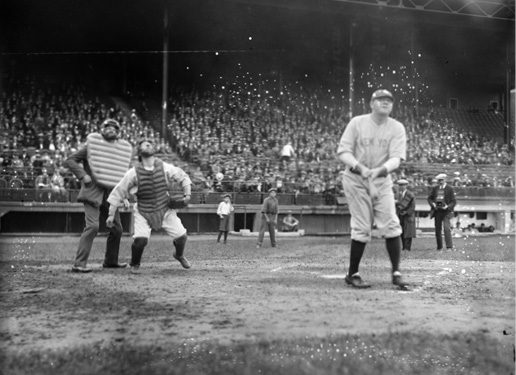
Babe Ruth did not take many pitches in the batter’s box during his unusual 1929 season. His walk rate plummeted to 12.27% after he had led the American League in bases on balls in the previous three seasons. (SABR-Rucker Archive)
Babe Ruth was an extraordinary batter with respect to the “three true outcomes” in baseball.1 In the two positive outcomes—hitting home runs and receiving bases on balls—the Sultan of Swat topped the American League twelve times and eleven times, respectively. In the negative true outcome—striking out—the Bambino led the AL just five times.
In his 1974 biography of Babe Ruth, Robert W. Creamer wrote,
From 1926 through 1931, as he aged from thirty-two to thirty-seven, Ruth put together the finest sustained display of hitting that baseball has ever seen. During those six seasons he averaged 50 home runs, 155 runs batted in, 147 runs scored; he batted .354.2
In support of Creamer’s contention, it is added that George Herman led the AL in homers in each of those six seasons and also drew the most walks in each of those seasons—except in 1929, in which he finished tenth with a total of only 72 free passes. For the three previous seasons (1926–28) Ruth had averaged 139 walks per season. And for the three subsequent seasons (1930–32) Ruth averaged 131 walks per season. What happened in 1929?
OBJECTIVE
The objective of our research endeavor: To arrive at a plausible hypothesis to answer the question, “Why did Babe Ruth’s bases on balls plummet in 1929?”
RESEARCH PROCEDURE
To investigate Babe Ruth’s walk performance in 1929, compared to that in the 1926–28 and 1930–32 seasons, we utilized the statistical information provided on the Baseball Reference and Retrosheet websites. It is important to point out that the Retrosheet statistical information we used is from Retroheet’s play-by-play and box score files (summarized in Retrosheet’s player splits files) and as a result may not agree with the “official” totals as displayed on Retrosheet’s main player and team pages. The details for the specific games responsible for Retrosheet’s different numbers are provided in Retrosheet’s discrepancy file. For non-statistical information we consulted biographies of Babe Ruth.3,4,5,6
RESULTS
In Table 1 we present pertinent statistics for the three true outcomes for Babe Ruth during the 1926–1932 seasons. Focusing on Ruth’s walks, his 1929 total of 72 seems anomalous. Indeed, applying the Q-Test to the walk percent (W%) values for the seven seasons comprising the 1926–1932 time period yields a Q-value of 0.717 for 1929’s 12.27 W%, which, being greater than 0.680, suggests that 1929’s 12.27 W% can be excluded as an outlier with 99% confidence in assessing Ruth’s walk performance during the 1926–1932 seasons.7
Table 1. Babe Ruth’s Three True Outcomes Statistics for the 1926–32 Seasons

Likewise, ascertaining the standard deviation (SD) for Ruth’s W% values clearly shows that his 1929 12.27 W% is a serious outlier: For 1926–32, the average W% is 19.46 with an SD of 3.33. Excluding the 1929 W%, the average W% is 20.53 with an SD of 1.20.8
Similarly, the Z-score for the 1929 W% value is –2.31, a score which fully supports excluding 1929’s W% in the statistical analysis of Ruth’s walks during the 1926–1932 seasons.9
Note also that Ruth’s strikeout rate in 1929 (11.85%) was lower than his strikeout rate in 1928 (16.23%), as well as those in 1927 (16.67%) and 1926 (15.35%). We’ll come back to that later.
So, while the 1929 W% is a serious outlier and can be excluded with 99% confidence in evaluating Ruth’s bases on balls performance in the 1926–32 period, it is real—Ruth actually achieved that abnormally low 12.27 W%. The salient question then becomes: Why did Ruth walk so infrequently in 1929?
To address this question, the first order of business is to assess the overall walk rates for the AL during the 1926–32 period—i.e., was there anything unusual or systemically different about bases on balls during the 1929 season? Table 2 presents the relevant stats for the three true outcomes for the American League for the 1926–32 seasons.
Table 2. American League Statistics for the Three True Outcomes (1926-32)

As can be seen, there does not appear to be anything unusual or out of sorts for any of the three true outcomes—there are no serious outliers. The 1929 values for the three true outcomes are pretty-much smack-dab in the middle of the values for the other six seasons. So, league-wise, there was nothing peculiar about the 1929 season with respect to the strikeouts, homers, and walks for the AL players overall. What about particular players—such as those players who have a knack for drawing bases on balls? Did any of them—in addition to Ruth—encounter an anomalous decline in walks in 1929? In the next section we examine the pertinent stats for the AL players who accumulated the most walks during the 1926–32 seasons.
Other Players with a Knack for Drawing Bases on Balls
During the 1926–32 seasons, the top-ten players in the American League who accumulated the most walks were: Babe Ruth (884), Max Bishop (802), Lou Gehrig (760), Lu Blue (670), Willie Kamm (495), Earle Combs (479), Goose Goslin (469), Mickey Cochrane (465), Tony Lazzeri (463), and Jimmie Foxx (461). Appendix A (available online) provides a list of the Top-Ten AL players in walks for each season during the 1926–32 time period. Appendix B provides tables corresponding to Table 1 for each of the above-mentioned players.
Table 3 provides a comparison of Ruth’s W% performance with the W%s for the other top-ten walkers. The items included are the W% range, the median W% (and the year), the composite W%, the mean W% (and the SD), the outlier W% (and the year), and the Q-Test quotient for evaluating the outlier W%.
Table 3. Comparison of W% Achieved by the Top–Ten AL Players in Walks (1926–32)

Babe Ruth’s 1929 W% of 12.27 with a Q-Test quotient of 0.717 can be excluded with 99% confidence in conducting a statistical analysis of his walk performance during the 1926–32 seasons, the datum rejection quotient being Q>0.680. None of the outlier W% values for the other players can be excluded—even with only 90% confidence, the datum rejection quotient being Q>0.507. Thus, among the AL’s top players in drawing bases on balls during the 1926–1932 time frame, only The Bambino experienced a grossly anomalous season with respect to receiving free passes. What made Ruth unique in this regard?
What was different for Ruth in 1929? What about the pitchers against whom the Sultan of Swat squared off? In the next section we examine Ruth’s walk performance against the pitchers he faced.
The Pitchers Who Faced Babe Ruth
We have already demonstrated that Ruth’s reduced number of walks in 1929 was not the consequence of a league-wide effect. Perhaps his decrease in walks was due to a select group of pitchers who collectively prevented Ruth from walking at his usual rate. The key question for this section is: were there significant differences in Ruth’s W% for 1929 compared with his W% in other seasons for the pitchers he faced? To address this question, it is important to point out that Ruth’s composite W% for the 1926–28 seasons was 20.62, and for 1930–32 his composite W% was 20.44. Based on Ruth’s composite W% for both the 1926–28 and 1930–32 periods (20.53), it is reasonable to expect that Ruth would have amassed about 120 walks in 1929, i.e., 48 more walks than the 72 walks he actually accumulated in the 587 plate appearances he had in the 135 games he played. By analyzing individual pitcher performances against Ruth we can determine which pitchers were particularly responsible for Ruth’s reduced bases on balls.
Appendix C provides relevant information for each of the 62 pitchers against whom Babe Ruth had at least one PA in 1929. According to the W% values that Ruth accomplished against these hurlers, it would have been expected that he would have ended up with around 118 walks, a figure which is reasonably close to the 120 walks estimated for Ruth assuming typical performance in the 135 games he played in 1929. In actuality, he collected 72 walks.
While Ruth had comparatively high numbers of “missed” walks from a few pitchers, it seems that most of his “missing” walks were generally spread out. The term “missed” walks indicates the difference between the number of walks Ruth would have received under usual circumstances and the number of walks he actually received. The pitchers who subjected Ruth with the most “missed” walks were: Ed Morris (Red Sox, 4.33), Bobby Burke (Nationals, 4.13), Ownie Carroll (Tigers, 3.38), Red Faber (White Sox, 3.32), Tommy Thomas (White Sox, 3.32) and Garland Braxton (Nationals, 3.14). These six moundsmen collectively shortchanged Ruth by about 21–22 walks, less than half of the “missing” 46–48 walks. Of the 55 pitchers who faced Ruth in 1929 and in 1926–28 and/or 1930–32 (i.e., excluding the seven “1929-only” pitchers), only 14 hurlers exceeded their expected number of walks issued to Ruth. The pitchers who surpassed their expected number of walks issued to Ruth the most were: George Smith (Tigers, 2.45), Willis Hudlin (Indians, 2.08), Johnny Miljus (Indians, 2.00), George Earnshaw (Athletics, 1.40), Wes Ferrell (Indians, 1.20), and General Crowder (Browns, 1.18). So, the story does not seem to be that a few pitchers effectively joined forces to shackle Ruth’s typical excellent walk-drawing ability, thereby suppressing his expected bases on balls by 46–48 free passes.
At this point we know who the pitchers were that walked Ruth—at a reduced rate—in 1929. But, we don’t yet know why. Did the pitchers, in general, throw more strikes, which Ruth swung at—and hit? Was Ruth less selective and/or less patient against these pitchers than he had been in the past (1926–28)? It should be emphasized that when Ruth did swing the bat in 1929 he was successful 34.5% of the time in hitting the ball safely—i.e., getting a hit. For the 1926–1928 seasons he had compiled a composite .349 batting average, just four points higher than his 1929 batting average. And, as previously shown, he smacked an AL-leading 46 homers in 1929, despite missing 16 games during June due to a chest cold. Thus, in 1929, when Ruth swung the bat, he hit for average and he hit for power—just as he had done in his three previous seasons. And as he would also do in his next three seasons. So, at this point, there is not yet a clear answer to the question, “Why did Babe Ruth have an anomalously low W% in 1929?” Right now, all that can be said is that it seems that The Babe just swung at pitches more frequently in 1929 than he did in 1926–28 and than he would in 1930–32.
BABE RUTH’S SPLITS (1926–32)
We next turn our attention to the specific situations in which Ruth walked—and did not walk. Was there anything different about Ruth’s 1929 walks compared to his walks in 1926–28 and 1930–32 that would show up in his splits for these seasons? Table 4 exhibits some of the splits compiled for Ruth by Retrosheet.
Table 4. Splits for Bases on Balls Received by Babe Ruth (1926–32)

The information given in Table 4 shows that, on a percentage basis, Ruth’s 1929 home-away walks were 50–50, which is right in line with the 49–51 split he had for the entire 1926–1932 period. Similarly, his righty-lefty walks in 1929 were 76–24, which is fairly close to the 70–30 split for the 1926–1932 time frame. Likewise for the splits for runners on base—in 1929, The Bambino walked with the bases empty 46% of the time, which is reasonably close to the 42% he had during the 1926–32 seasons. So, nothing stands out as exceptional in these splits for the walks Ruth received in 1929.
Another split worth examining is Ruth’s position in the batting order. Table 5 provides pertinent information on his walks as a function of his batting slot. As can be readily seen, 1929 is noticeably different from the other six seasons.
Table 5. The Players Who Batted Behind Ruth (1926–32)

In 1929, Ruth split his time equally between the number three slot and the number four slot. For the 1926 season, Ruth primarily batted in the number four slot [126 games (84.5%)]. For the 1927 and 1930–1932 seasons, Ruth occupied the number three slot exclusively—100%. In the 1928 season, Ruth batted in the number three hole most of the time [132 games (85.7%)]. Rather than Ruth’s spot in the batting order, his tendency to be walked would likely be most affected by who was batting immediately behind him.
Eight different players batted right after Ruth in 1929. Each of the eight had at least one game behind Ruth when he was the number three batter; Lou Gehrig followed Ruth in the most games [35 out of the 66 games (53%)]. Three of the eight players split up batting behind Ruth when he was the number four batter; Tony Lazzeri followed Ruth in the most games (55 out of the 66 games, 83%).
Upon examining Table 5, two questions immediately jump out: (1) Was there any significant difference in Ruth’s 1929 W% when Gehrig followed him in the number three slot compared to his composite W% when the other seven players followed him in the number three slot? (2) How did Ruth’s 1929 W% with Lazzeri batting behind him (when Ruth batted clean-up) compare with Ruth’s 1930 W% with Lazzeri batting behind him (when Ruth batted third in the lineup)? Here are the answers:
In the 35 games that Gehrig followed Ruth (batting third) in 1929, Ruth had 147 plate appearances and drew 21 walks, which afforded a 14.3 W%. For the 31 games that Dickey, Combs, Meusel, Lazzeri, Durst, Paschal, and Byrd followed Ruth (batting third), Ruth had 124 plate appearances and received 12 bases on balls, which gave a 9.7 W%. Thus, not surprisingly (based on Ruth’s W% in the 1927 and 1930–32 seasons), Gehrig batting right behind Ruth had a significant positive impact on Ruth’s W% compared to Dickey et al. However, the 14.3 W% that Ruth produced in 1929 with Gehrig batting behind him was substantially and significantly less than the 20-plus W% that Ruth fashioned when Gehrig was the batter hitting right behind him in the 1927 and 1930–32 seasons. Why was that?
In the 55 games that Lazzeri followed Ruth (batting cleanup) in 1929, Ruth had 249 plate appearances and drew 35 walks, which afforded him a 14.1 W%. In 1930, with Ruth batting third, Lazzeri followed The Bambino in 82 games, during which Ruth had 317 plate appearances and 86 walks, affording a 27.1 W%. So, just as was the case with Gehrig batting behind Ruth in 1929 (in the third slot), with Lazzeri batting behind Ruth in 1929 (in the fourth slot), Ruth’s W% was substantially and significantly less in 1929. Why was that?
In 1929, Ruth’s W% with either Gehrig or Lazerri hitting immediately behind him was relatively lackluster—14.3% and 14.1%, respectively—compared to the composite 20.53 W% he manufactured in the 1926–28 and 1930–32 seasons. Akin to what was found for the pitchers, for the players who batted behind Ruth we know what the impact was. But, we don’t know why Ruth had a sharply reduced W% in 1929. The take-away message from the various splits considered in this section is that a definitive answer to the question, “Why did The Bambino’s walks plummet in 1929?” did not emerge.
Streaks
Was Ruth’s 1929 decline in bases on balls the result of a few streaks of extremely low walk rates? To address this possibility, Table 6 provides a chronology of Ruth’s performance as a hitter and as a walker in 10-game increments.
Table 6. Chronology of Babe Ruth’s BA and OBA in 10-Game Increments (1929)

As can be seen, there were three 10-game spans in which Ruth had only one or zero walks—(1) May 15–25 (one walk); (2) August 17–27 (one walk); (3) August 28–September 07 (zero walks). For the other ten 10-game periods Ruth typically walked between six and seven times. So, those three 10-gamers with one or zero walks cost Ruth about 20 walks—less than half of the “missing” 46–48 walks. To reach the expected 118–120 walks, Ruth needed to average about nine walks every ten games. So, Ruth just walked less than normal pretty much every week. Had Ruth walked between six and seven times in each of the 13 10-game segments and 3 times in the 5-game segment he would have amassed a total of about 87 walks, a total not even remotely close to the 118–120 walks he would accumulate in a typical 1926–28 or 1930–32 season. Thus, the take-away message here is: three drastic periodic walk slumps, while contributors, were not the cause of Ruth’s low number of walks in 1929. Appendix D provides three tables which give some self-explanatory details about those three 10-gamers. The Yankees went 13–17 in those 30 games. Perhaps the only positive item in the 30 games was that Ruth did slug eight home runs.
Babe Ruth’s Walks on a Team-by-Team Basis
Next, we examined the walks Ruth received in 1929 on a team-by-team basis.10 As indicated previously, in 1929 Ruth should have accumulated between about 118 and 120 walks. Extrapolating from the 118 walks that Ruth should have collected (instead of the 72 walks he actually received), in his 587 plate appearances he would have been hit by a pitched ball 5 times (instead of 3 times), hit 9 sacrifice flies (instead of 14), had 455 at bats (instead of 498), collected 157 hits (instead of 172), and slugged 42 homers (instead of 46). He still would have led the league in home runs as Gehrig finished in second place with 35 homers.
Table 7 presents the numbers of walks Ruth received from each team during the 1926–28 and 1930–32 seasons and his expected and actual walks for 1929.
Table 7. Walks Received by Babe Ruth on a Team-By-Team Basis (1926–32)

Inspection of Table 7 reveals that each of the seven opposition teams walked Ruth fewer times in 1929 than expected based on the free passes they issued to him in the 1926–28 and 1930–32 seasons. Significantly, the number of “missing” bases on balls were pretty much the same for each club—6–8 “missing” walks (except for Boston which shortchanged Ruth by 4 walks). Thus, the take-away here is that his “missing” walks in 1929 were not dependent on any particular opposition team’s mound staff.
SUMMARY
Under ordinary circumstances, like those during the 1926–28 and 1930–32 seasons, Babe Ruth would have reached first base via a walk 118–120 times in 1929. However, since he walked only 72 times, it means that 46–48 free passes were “missing.”
We know Ruth walked less in 1929. We know that Ruth’s total of 72 walks in 1929 is a statistically significant outlier, which can be excluded with 99% confidence. But, we have not yet found a definitive answer as to why he walked less in 1929. Babe Ruth was the only player among the top-ten AL players in total walks during the 1926–1932 time frame who suffered a significantly reduced W% in 1929 (or any other season). The top-ten included seven Hall of Famers, three of whom—Gehrig, Combs, and Lazzeri—were Ruth’s teammates. From the information presented in the Results section, we have essentially learned that there is no “on-the-field” explanation for Ruth’s anomalously low walk rate in 1929: W%(1929)=12.27; W%(1926–28)=20.62; W%(1930–32)=20.44; W%(1926–28,30–32)=20.53.
The bottom-line take-away from the Results section is that it seems that Ruth himself was the primary reason for his unusually low number of walks (and W%) in 1929.
DISCUSSION
When a pitcher hurls the ball toward the plate, the batter has two choices: (1) he can choose to swing at the pitch or (2) he can choose to not swing at the pitch. In order for a player to get a walk, he has to choose to not swing at least four times in a plate appearance. For Babe Ruth, during the 1926–28 and 1930–32 seasons, he chose to not swing a sufficient number of times that he ended up drawing walks at the rate of 20.53%. In 1929, Ruth instead chose to swing—and hit the ball—enough times that he ended up drawing walks at the rate of only 12.27%. Thus, in 1929, it appears that Ruth chose to swing at pitches more frequently than he did in the 1926–28 seasons and than he would in the 1930–32 seasons.
That Ruth swung at more pitches in 1929 can be reasonably interpreted to mean that he had less patience and was less selective (more aggressive?) in the batter’s box than he was in the 1926–28 campaigns and than he would be in the 1930–32 campaigns. And, very importantly, when he did swing at the pitches in 1929, he hit them just as effectively as he did in every other year during the 1926–28 and 1930–32 seasons. It is also important to point out that Babe Ruth’s intentional walks were not a factor at all in his stark decrease in walks in 1929. On average, The Sultan of Swat was purposely walked 7.7 times per season during 1926–28 and 6.0 times per year during 1930–32. In 1929 Ruth was walked intentionally five times.11
Why would Babe Ruth have less patience and be less selective (more aggressive?) in the batter’s box in 1929 compared to his previous three seasons and his subsequent three seasons? As described above, based on our research, the Why does not seem to be related directly to baseball—i.e., to what happens between the foul lines. Perhaps, Ruth simply decided to be less selective (more aggressive?) in 1929 in hopes of getting more hits and more homers (and, therefore, drive in more runs) than he had during his (three) prior seasons. However, when his 1929 results were pretty much in alignment with those in his 1926–28 seasons, he reverted back to his more selective approach for 1930 (and 1931 and 1932). While this simple explanation is plausible, we, instead, surmise that the why may have been of a more-personal nature to Babe, perhaps subconsciously so.
Off-the-Diamond Influence
On Friday, January 11, 1929, while Babe Ruth was residing in New York City, Helen Ruth, George Herman’s estranged wife, perished in a house fire in Watertown, Massachusetts. Babe learned of this tragedy the next night (Saturday) while he and his mistress, Claire Hodgson, were at a party hosted by his teammate, Joe Dugan. Later, on Sunday, after having taken a 1:15AM train to Boston, Ruth told the reporters who besieged his hotel room, “My wife and I have not lived together for the last three years. During that time I have seldom met her. I have done all that I can to comply with her wishes. Her death is a great shock to me.”12 As described in three biographies of Babe Ruth, this was a tremendously emotional time for Ruth, exacerbated with several subsequent complications that resulted in Helen’s funeral and interment finally taking place on Thursday, January 17.13
On April 17, 1929, less than 100 days after Ruth’s wife had died, Babe married Claire Hodgson, a former model and actress whom he had first met in May of 1923, when the Yankees were playing the Nationals in Washington. As described in biographies of Ruth, he and Claire had been a couple for the past three years.14
Either or both of these happenings could have affected Ruth’s mindset such that he chose—consciously or unconsciously—to swing more frequently at the pitches offered to him, thereby taking fewer pitches resulting in drawing fewer walks during the 1929 baseball season than he had drawn during the 1926–28 seasons (and would draw during the 1930–32 seasons).
However, we speculate that neither the passing of Helen nor his marriage to Claire was likely the biggest “distraction” that Ruth encountered during the 1929 season. Related closely to Helen’s death, Ruth faced a substantial and significant financial setback that year. This setback was unrelated to the stock market crash that would usher in the Great Depression that October. The stock market crash (aka “Black Thursday”) occurred on October 24, 1929, two weeks after the World Series. While devastating for millions of people, thanks to the counsel of his investment manager/agent, Christy Walsh, Ruth was well insulated from the scourge of the Wall Street disaster. With Walsh’s fiscally conservative guidance, Ruth had been persuaded to open an irrevocable trust at the Bank of Manhattan in February 1927. “The deal was: all ancillary income would go into the trust while Ruth kept his Yankee salary to live on and play with.”15 Adhering (at least somewhat) to Walsh’s strategy, over the ensuing years Ruth “invested 70 percent of his [investment] money in fixed-income US government and municipal bonds and 30 percent in dividend-paying blue chips, utilities, and railroads. … When the crash came, the King of Clout would not take a hit.”16
However, Ruth’s financial situation was unexpectedly tight in 1929. Although he had been legally separated from Helen, he was required by law to provide financial support for their daughter, Dorothy. As it developed, at the time of Helen’s death, Ruth was more than $30,000 behind in his payments to Helen, and had not made a payment in 16 months.17 Ruth was continuing with his modus operandi: “I like to live as big as I can.”18 Within the next year (from the date of Helen’s death on January 11, 1929, until everything was finally settled with Helen’s estate on January 7, 1930), Ruth caught up with his debt, paying a total of $33,057.04 to Helen’s estate.19
Here are the pertinent financial details for Babe Ruth (1928–30): In 1928, Ruth earned $44,233 from endorsements, $70,000 in salary from the Yankees, and $3200 in dividends. He contributed only $10,000 to his trust.20 That left him with $107,433 (less taxes) to live on and play with. Nothing was paid to Helen. In 1929, Ruth earned $34,225 from endorsements, $70,000 in salary from the Yankees, and $4,000 in dividends. He contributed just $20,000 to his trust. Thus, he had only $88,225 (less taxes) to live on and play with.21 BUT, he also had to pay Helen’s estate $33,057 in back payments and interest over the last four months of the year after settling with Helen’s estate.22 Thus, in 1929, Ruth really had just $55,168 (less taxes—more on that in a moment) to live on and play with—less than half as much as he had had the previous year. In 1930, Ruth earned a total of $114,262 ($28,967 from endorsements, $80,000 in salary from the Yankees, and $5295 from dividends). He contributed a whopping $50,000 to his trust. Thus, even with Helen completely out of the picture, his bottom-line to live on play with was “just” $64,262 (less taxes), an amount which was considerably less than his 1928’s $107,433 (less taxes).23 However, it is noted that Ruth’s comparatively exorbitant $50,000 investment in his trust (rather than using much of it as “play” money) is in alignment with (a) Babe being now (presumably happily) married to Claire (who exercised a relatively firm grip on the purse strings) and (b) Babe legally adopting Claire’s daughter, Julia (and with Claire legally adopting Ruth’s daughter, Dorothy).24
Ruth’s unexpected tight financial situation in 1929, initiated by Helen’s untimely death, likely weighed heavily on Ruth as the new baseball season was about to begin and continued throughout the entire campaign. And, as if that was not bad enough, midway through the 1929 season Ruth was informed by the Internal Revenue Service that he was being audited for underpayment of his 1927 taxes. The IRS claimed he had underpaid his federal taxes for that year by nearly 20% and still owed them almost $4000. Even though that amount was just 5% of his annual salary, dealing with the IRS is not typically a pleasant task, and likely does nothing to reduce any stress. In December he settled the case, for just under $4000.25
A Possible Explanation
A possible way for Ruth to mollify the emotional anxiety of his financial situation (and any lingering grief over Helen’s passing) could have been for him to really focus on playing baseball, especially batting. In particular, getting hits. But one can only get hits by swinging the bat. And, if one swings the bat, one can’t get pitches called balls. And, if one doesn’t get four called balls in a plate appearance, one can’t draw a walk.
So, in 1929, it is possible that Ruth was less patient and less selective (more aggressive?) in the batter’s box. He could have swung at pitches more frequently than he had in the past, when he was not emotionally and financially stressed, and would again in the near term (i.e., the very next season), when the financial stress had been alleviated, and any emotional stress was further in the background.
Our Hypothesis
In 1929, with his mind distracted by his unexpected and pervasive year-long personal stress (chiefly financial), Babe Ruth chose (perhaps subconsciously) to swing at—and hit—more pitches (on a percentage basis) than he had in the 1926–28 seasons and than he would in the 1930–32 seasons, which resulted in him drawing fewer bases on balls in 1929, thereby producing a significantly lower walk rate (W%=12.27) than that he had fashioned in the 1926–28 seasons (W%=20.62) and than he would in the 1930–32 seasons (W%=20.44).
Unfortunately, the “to swing at—and hit—more pitches” contention in our hypothesis cannot be supported with hard and fast numbers. There are no data available on the actual numbers of the pitches and the calls of the pitches that Ruth received and swung at during Ruth’s playing time. Such pitch information has only been officially tracked since 1988 for pitch counts, e.g., balls and strikes, and since 2008 for pitch classifications, e.g., curveballs, sliders, cut fastballs, etc. and types of strikes.26,27
Nonetheless, while we hypothesize that, in 1929, Ruth was swinging at pitches more frequently, he was not swinging wildly at pitches. He hit .345 (only four points lower than the composite .349 batting average he had compiled during the 1926–28 seasons). And, he still hit with power—he belted a league-leading 46 circuit clouts (a 9.24% home run rate, just 1.01% less than the 10.25% home run rate he had produced during his financially stress-free 1926–28 seasons). Moreover, as noted earlier, Ruth struck out at an even lower rate in 1929 (11.85%) than he had in the 1926–28 campaigns (16.10%). One cannot get a hit if one swings and misses.
We also state that Ruth may not have knowingly or purposely chosen to swing at more pitches and thereby receive fewer walks in 1929 than in the 1926–28 seasons and in the 1930–32 seasons. His season-long choosing to swing at more pitches in 1929 may have been governed by his subconscious (not conscious) response to the financial stress he was enduring. Being proficient at receiving bases on balls and thereby enhancing one’s on base percentage was not an item of daily interest (or motivation) during the 1926–1932 period. The nowadays very useful and highly regarded on base percentage metric (OBP) was totally unknown during Ruth’s diamond career. OBP was not created and introduced until 1954 (thanks to Alan Roth and Branch Rickey) and did not reach the forefront for the evaluation of batter performance until 1973 (thanks to Pete Palmer).28,29 The official recognition of OBP by major league baseball did not occur until 1984.
During Ruth’s time, the batting records that appeared each week in The Sporting News and in the sports sections of numerous Sunday newspapers did not include the walks that batters received. The only stats presented were games (G), at bats (AB), runs (R), hits (H), runs batted in (RBI) and batting average (Pct or Ave). It was not until a few months after the end of the baseball season that the number of walks players received were published in The Sporting News and other newspapers. See Appendix E for the pertinent accounts provided in The Sporting News for the American League’s bases on balls leaders during the 1926–1932 seasons. For the 1929 season, the following statement, which is germane to our discussion, was included in The Sporting News article: “Ruth, who has been honored for years with more than 100 passes per season and holds the record with 170 [established in 1923], walked 72 times in 135 games [in 1929].”30
Once the financial burden of settling Helen’s estate was finally eliminated on January 7, 1930, so was Ruth’s financial stress. In the 1930 diamond campaign Ruth resumed his usual unfettered performance in the batter’s box. He returned to his more disciplined selective swinging and thereby achieved his normal high walk rate: W%=20.12. And, furthermore, as shown in Table 1, Ruth slightly improved his strikeout rate in 1930, lowering it to 11.78% while increasing his batting average 14 points to .359 and upping his home run rate to 9.46%.
THE PSYCHOLOGY OF HITTING
A batter has an infinitesimally brief time in which to decide whether or not to swing at a pitch.
“Depending on the pitcher and his delivery, the ball begins its flight [to the plate] roughly fifty-six to fifty-eight feet from the hitter. It’s traveling about 139 feet per second and so will cross the plate about four tenths of a second after being released.…So, the hitter must begin his swing at least 0.19 seconds or so before the moment of contact.”31
Thus, during that split-second time the batter needs to ascertain the speed (angular velocity) of the ball and decide whether or not to swing at the ball. If the initial decision is to swing, the batter must also decide where (horizontally and vertically) to swing the bat in order to intercept the ball. Also very important, close to the end of that “split second” is the batter’s reaction time for his critical final decision—to check his swing or to swing through.
By virtue of making it to the major leagues, MLB hitters are among the best in the world at reaction time and eye-hand coordination. Two of the greatest hitters in baseball history, Babe Ruth and Albert Pujols, stood out among their peers to such a degree that they specifically were scientifically evaluated for their seemingly superhuman abilities.
In 1921, psychology researchers at Columbia University tested Babe Ruth’s visual reactions and coordination. They discovered “that his eyes [vision] and ears [hearing] function more rapidly than those of other players; that his brain records sensations more quickly and transmits its orders to the muscles much faster than does that of the average man,” resulting in the ability of his brain to record sensations and more quickly transmit them to muscular movement. For example, they measured the response time of the average man to the stimulus of light as 180 one-thousandths of a second. Babe Ruth, however, needed only 160 one-thousandths of a second to make the same response.32 In 2006, scientists at Washington University (in St. Louis, Missouri) replicated the tests, using many of the same methods, which are still the standards for such examinations, and found similar results for Albert Pujols.33
We suggest that Babe Ruth was affected mentally—his mind being distracted—during the 1929 season due his stressful personal life situation (chiefly financial), and that this stress-induced distraction impacted his approach to judging pitches—i.e., first deciding whether to swing or to not swing and then deciding whether to swing through or check his swing. In 1929, we suggest that, because of his financial stress, Ruth chose (subconsciously?) to both swing more frequently and to swing through more frequently than he had done in the 1926–28 seasons and than he would in the 1930–32 seasons.
Evidence in Support of our Hypothesis
As presented in Atkinson and Hilgard’s Introduction to Psychology, “Another common reaction to a stressful situation is anger, which may lead to aggression. … Direct aggression toward the source of frustration is not always possible or wise. When circumstances block direct attack on the cause of frustration, aggression may be displaced [such as swinging a baseball bat at a pitched ball].”34 Furthermore, “In addition to emotional reaction, people often show substantial cognitive impairment when faced with serious stressors. They find it hard to concentrate and organize their thoughts logically. As a result, their performance on tasks, particularly complex tasks, tends to deteriorate [such as having reduced reaction time to decide whether or not to check the swing of the bat at a pitched ball—a very complicated task].”35,36
For Ruth, in 1929, because of his financial stress, rather than take a close pitch, he may have been more likely to swing at the pitch or to not react quickly enough to check his swing, which resulted in him receiving fewer walks than he would have if not burdened and distracted by the anxiety of his financial situation.
It is important to emphasize that while Ruth was less patient and less selective (more aggressive?) at bat during the 1929 season, his “bat-swing” mechanics were so highly developed that his decreased selectivity (increased aggressiveness?) did not diminish his overall performance as a hitter. He just walked less because he swung more. Because of receiving fewer walks, his on base percentage went down (as did his run scoring—see Appendix F, but his power did not. In 1929 he led the league in home runs and slugging average, as well as in the nowadays highly regarded metric “On Base Plus Slugging” (OPS).37 Ruth was not swinging out of control—recall that his strikeout rate in 1929 (11.85%) was lower than it was in 1928 (16.23%). He was just swinging more often (and/or checking his swing less often). As a result, his overall season performance does not stand out as below normal except in the category of bases on balls.
We liken Babe Ruth’s (subconsciously-governed?) increased swinging (and decreased checked swings) to the classic subconsciously-controlled action of an automobile driver routinely driving his car along the same route day after day.38,39,40 Because of unanticipated anxiety or stress, the automobile driver, when confronted with an amber traffic signal, might speed up slightly to “make the light” rather than slowing down and stopping for the upcoming red light as he would normally do when not under stress. The Bambino, because of the anxiety and stress of his unexpected season-long tight financial situation in 1929, swung at close pitches that he normally would have checked and usually received a “ball” call. Because the pitch was close enough to being a strike in his hitting zone, he was still able to hit the ball with his normal high level of skill such that his batting performance was not negatively impacted.
CONCLUDING REMARKS
Babe Ruth’s 1929 season was anomalous with regard to his 12.27 W% compared to the composite 20.53 W% he achieved during the 1926–28 and 1930–32 seasons. 1929’s 12.27 W% is a serious statistical outlier in the 1926–1932 sequence of W% results, as well as for his entire career.41 As described in the Results section, we have ascertained that the why appears to be of his own doing throughout the duration of the 1929 season and was not dependent, for example, on the pitchers he faced or the teammates who batted behind him. Instead we suggest that the why was of a personal nature for Ruth, directly related to his unexpected financial anxiety which cascaded from the unexpected premature tragic passing of his estranged wife. The financial stress consumed the entirety of 1929—from her death on January 11 until her estate was settled on January 7, 1930.
Not surprisingly, a diamond consequence attributable to a personal situation is not unheard of. There are numerous examples of players hitting home runs on special days, such as birthdays.42 Similarly, there are many instances of players “promising to try to do something special” for a child dealing with a life-threatening situation or condition—such as, in 2022, Tampa Bay’s Brett Phillips coming through for 8-year old Chloe Grimes battling cancer or, in 2016, Boston’s David Ortiz declaring that he’s “gonna hit a home run for you” (Maverick Schutte, a 5-year old with a congenital heart defect).43 Of course, there’s the famous example involving George Herman and Johnny Sylvester (an 11-year old hospitalized with a serious brain injury)—The Bambino signed a baseball with the message, “I’ll knock a homer for [you in] Wednesday’s game [of the 1926 World Series]. Babe Ruth.”44 Fulfilling his pledge, Ruth proceeded to belt three round-trippers in that game.
Another example, particularly germane to this article, concerns Hank Aaron’s 1971 season. Aaron had a stellar season that year following a five year “winding down my career decline” during which he compiled a relatively low .294 batting average while averaging 39 homers per season. In his previous twelve seasons (including his 1954 rookie campaign) he had assembled a sterling .320 batting average—the highest composite batting average in the majors during the 1954–1965 time frame—and averaged 33 homers per year. In 1971, following his 1966–1970 decline, he fashioned a robust .327 batting average and walloped 47 home runs—the most homers he slugged in a single season during his Hall of Fame career. In his autobiography, Aaron, who in 1971 was going through a divorce from his first wife stated, “I felt lonely and angry, and, to a degree, I was taking my domestic problems out on the pitchers. The only way I knew to feel better was to pound the ball into the seats.”45 With his personal issues behind him, Aaron returned to his “winding down my career” level of performance in his final three nearly full-time seasons (1972–74), composing a rather pedestrian .278 batting average and averaging 31 homers per year. It seems reasonable to presume that there are other examples, besides Ruth and Aaron, of a player’s performance between the foul lines having been impacted by personal off-the-diamond circumstances.
Babe Ruth apparently never commented on why the number of his bases on balls (or W%) in 1929 was so anomalously low compared with his other seasons (particularly 1926–28 and 1930–32). Thus, we may never know exactly why. None of the biographies of The Bambino (end notes 4–6) even included mention of the anomalously low number of walks he received in 1929. Likewise, as best as we were able to determine, with the exception of the aforementioned solitary sentence in The Sporting News (end note 30), none of the numerous books and newspaper and magazine articles on The Sultan of Swat mentioned anything about his anomalously low number of walks in 1929. We contend that our hypothesis is plausible and that the documented facts of Ruth’s finances during the 1928–30 period fully support the plausibility of our hypothesis.46
HERM KRABBENHOFT is a retired organic chemist (BS, Wayne State University, 1970; PhD, University of Michigan, 1974) and author of Leadoff Batters of Major League Baseball (McFarland, 2001). Among the various baseball research topics he has pioneered are: Ultimate Grand Slam Homers, Consecutive Games On Base Safely (CGOBS) Streaks, Quasi-Cycles, Imperfect Perfectos, Downtown Golden Sombreros, Pitcher’s Cycles, and Predators on the Mound; Prey at the Plate. In addition to The National Pastime and the Baseball Research Journal, Herm has contributed articles to the newsletters for these SABR Committees: 19th Century, Deadball Era, Statistical Analysis, and Baseball Records. Krabbenhoft has received three SABR Baseball Research Awards (1992, 1996, 2013).
MICHAEL HAUPERT is co-chair of the SABR Business of Baseball Committee.
Acknowledgments
Grateful thanks are extended to Larry Annis, Patti Colla, Bill Deane, Chris Green, Jeanie Krabbenhoft, Cassidy Lent, Pete Palmer, Jeff Robbins, Gary Stone, Mary Anne Todgham, and Dixie Tourangeau for very helpful discussions and inputs.
Notes
1. David Firstman, “The Growth of ‘Three True Outcomes’: From Usenet Joke to Baseball Flashpoint,” SABR Baseball Research Journal, Volume 47, Number 1 (Spring 2018), 29–37.
2. Robert W. Creamer, Babe…The Legend Comes to Life (Simon and Schuster, 1974; reprinted by Penguin, 1986), 301.
3. Creamer, 1974.
4. Babe Ruth (as told to Bob Considine), The Babe Ruth Story (E.P. Dutton & Co., 1948, Pocket Book edition).
5. Leigh Montville, The Big Bam (New York: Doubleday, 2006).
6. Jane Leavy, Big Fella: Babe Ruth and the World He Created (Harper Collins, 2018).
7. Kathryn Haas, “Rejection of Outliers (Q-Test),” May 8, 2024. Accessed January 6, 2025. https://chem.libretexts.org/Courses/Duke_University/CHEM_310L%3A_Physical_Chemistry_I_Laboratory/CHEM310L_-_Physical_Chemistry_I_Lab_Manual/09%3A_Under_Construction/9.09%3A_The_Treatment_of_Experimental_Error/9.9.04%3A_Rejection_of_Outliers_(Q-test). Following the Q-Test procedure using the W% values given in Table 1, one calculates Q(exp) to be 0.717 [(19.31—12.27) / (22.09—12.27) = 7.04 / 9.82 = 0.717]. According to the Q-Test table for 7 data, Q (99%) is 0.680. Since Q(exp) is greater than Q(99%), the datum 12.27 can be excluded with 99% confidence.
8. The means and standard deviations were obtained from the Standard Deviation Calculator on “Calculator.Net.” Accessed January 11–15, 2025. https://www.calculator.net/standard-deviation-calculator.html?
9. The Z-score was obtained from the Z Score Calculator. https://www.calculatorsoup.com/calculators/statistics/z-score-calculator.php. Accessed July 18, 2025.
10. The authors thank Chris Green for the guidance to consider Ruth’s walks on a team-by-team basis—Chris Green, email correspondence with the authors, July 9–11, 2025.
11. It is important to point out that “intentional bases on balls (IBB)” were not an officially recorded stat until 1955. Thus, the IBB numbers stated here (as given on the Retrosheet website) are based on available information in game descriptions presented in various newspaper accounts and may not be complete. The authors thank Bill Deane for bringing this to their attention—Bill Deane, email correspondence with the authors, July 21–24, 2025.
12. Creamer, 338.
13. Creamer, 335–41; Montville, 281–87; Leavy, 339–55.
14. Creamer, 341; Montville, 178–80, 196, 204, 209, 263, 288–90; Leavy, 58, 252, 254–55, 260, 274, 276–84.
15. Leavy, 132.
16. Leavy, 395.
17. Creamer, 228–29, 281–82, 302–03, 320–23; Montville, 44, 52–54, 120, 130, 157, 163, 170, 178, 207–8, 365; Leavy, 7–58, 83, 207–8, 242, 248–50, 274–75.
18. Creamer, outside back cover.
19. Michael Haupert, “The Business of Being the Babe,” SABR Baseball Research Journal, Volume 50, Number 1 (Spring 2021), 7.
20. Leavy, 501–11.
21. Leavy, 501–11.
22. $2,000 (August 9, 1929), $13,000 (September 4, 1929), $18,057.04 (January 7, 1930). Letter from James J. Conlin to Christy Walsh, September 4, 1929.
23. Leavy, 501–11.
24. Leavy, 372–75.
25. Letter from IRS to George Herman Ruth, December 18, 1929.
26. Cory Schwartz and Sam Sharpe, “MLB Pitch Classification,” MLB Technology Blog, February 3, 2020. https://technology.mlblogs.com/mlb-pitch-classification-64a1e32ee079. Accessed July 17, 2025.
27. Mike Petriello, “Feel the breeze: The pitches that get the most extreme whiffs,” MLB.com, February 22, 2024. https://www.mlb.com/news/biggest-statcast-bat-tracking-missed-pitches-of-2023. Accessed July 17, 2025.
28. Branch Rickey, “Goodby to Some Old Baseball Ideas,” Life, August 2, 1954, 78.
29. Pete Palmer, “On Base Average for Players,” SABR Baseball Research Journal, Volume 2 (1973), 87.
30. “Simmons’ Value to A’s Shown in Run Scoring,” The Sporting News, January 23, 1930, 7.
31. Mike Stadler, The Psychology of Baseball (New York: Gotham Books, 2007), 7, 15.
32. Hugh S. Fullerton, “Why Babe Ruth is the Greatest Home-Run Hitter,” Popular Science Monthly, Volume 99, Number 4, 19.
33. Gary Everding, “St. Louis Cardinals slugger Pujols gets Babe Ruth test at Washington University,” The [Washington University] Source, August 22, 2006. https://source.washu.edu/2006/08/st-louis-cardinals-slugger-pujols-gets-babe-ruth-test-at-washington-university/. Accessed February 5, 2025.
34. Susan Nolen-Hoeksema, Barbara L. Frederickson, Geoff R. Loftus, Willem A. Wagenaar, Atkinson and Hilgard’s Introduction to Psychology (Boston: Engage Learning, 2009), 502. https://invent.ilmkidunya.com/images/Section/introduction-to-psychology-css-psychology-book.pdf. Accessed February 13, 2025.
35. Susan Nolen-Hoeksema, Barbara L. Frederickson, Geoff R. Loftus, Willem A. Wagenaar, 512, “Cognitive impairment.”
36. That hitting a baseball is a “very complicated task” is supported by what Ted Williams stated: “Hitting a baseball—I’ve said it a thousand times—is the single most difficult thing to do in sport.” Ted Williams and John Underwood, The Science of Hitting (1970, free copy). https://dt5602vnjxv0c.cloudfront.net/portals/27871/docs/the%20science%20of%20hitting%20by%20ted%20williams.pdf. Accessed July 19, 2025.
37. Pete Palmer, “Why OPS Works,” SABR Baseball Research Journal, Volume 48, Number 2 (Fall 2019), 43.
38. Susan Nolen-Hoeksema, Barbara L. Frederickson, Geoff R. Loftus, Willem A. Wagenaar, Chapter 6, “Consciousness.”
39. Eliezer J. Sternberg, NeuroLogic (New York: Pantheon Books, 2015), Chapter 2, “Can Zombies Drive to Work?”
40. Adam Gazzaley and Larry D. Rosen, The Distracted Mind (Cambridge, MA: MIT Press), 94.
41. Conducting the Q-Test on Babe Ruth’s entire full-time field-position career [i.e., excluding the seasons he pitched for the Red Sox (1914–19) and the abnormal partial seasons he had with the Yankees in 1922 (a six-week suspension by Commissioner Landis, which resulted in Ruth missing the first 33 games of the season) and in 1925 (illness, dubbed “the bellyache heard ’round the world,” and surgery, which resulted in Ruth missing the first 41 games of the season)], asserts that the 1929 W% (12.27) can be rejected as an outlier with 99% confidence—Q-quotient = 0.628; Q-quotient threshold for data point rejection with 99% confidence = 0.617. See: “Dixon’s Q Test: Definition, Step by Step Examples + Q Critical Values Tables,” Statistics How To, https://www.statisticshowto.com/dixons-q-test/.
42. (a) Herm Krabbenhoft, “Birthdays: Motivation for Enhanced Home Run Performance,” By The Numbers, SABR Statistical Analysis Committee, Volume 2, Number 3 (June 1990), 7–10. (b) Sarah Langs, “9 Outstanding baseball birthday performances,” MLB.com, January 2, 2023. https://www.mlb.com/news/best-baseball-birthday-performances. Accessed August 7, 2025.
43. (a) Adam Berry, “‘Chloe, you’re an inspiration’: Phillips homers for young fan,” MLB.com, April 13, 2022. https://www.mlb.com/news/brett-phillips-hits-home-run-inspired-by-young-fan. Accessed August 20, 2025. (b) Nik DeCosta-Klipa, “David Ortiz keeps promise to inspirational young fan with game-winning home run,” Boston Globe, April 30, 2016. https://www.boston.com/sports/boston-red-sox/2016/04/30/david-ortiz-promise-homer-fan/. Accessed August 20, 2025.
44. “Ruth and Johnny Sylvester,” Babe Ruth Central. Accessed August 7, 2025. https://www.baberuthcentral.com/babesimpact/legends/little-johnny-sylvester/; “The Babe, The Boy, & The Ball,” YouTube MetroFocus, July 16, 2018. https://www.google.com/search?q=babe+ruth+johnny+sylvester+ball&rlz=1C5CHFA_enUS971US972&oq=babe+ruth+johnn&gs_lcrp=EgZjaHJvbWUqCAgBEEUYJxg7MgYIABBFGDkyCAgBEEUYJxg7MgcIAhAuGIAEMggIAxAAGBYYHjIICAQQABgWGB4yBggFEEUYPDIGCAYQRRg8MgYIBxBFGDzSAQg2NzkwajBqN6gCALACAA&sourceid=chrome&ie=UTF-#fpstate=ive&vld=cid:2ad8b06d,vid:URuK7wlgvYo,st:0. Accessed August 31, 2025.
45. Hank Aaron with Lonnie Wheeler, If I Had a Hammer (New York: Harpercollins, 1991), 210.
46. Some of the research in this article was presented at SABR 53, the 2025 convention of the Society for American Baseball Research in Mike Haupert and Herm Krabbenhoft’s presentation, “Babe Ruth’s Anomalous 1929 Season.”