

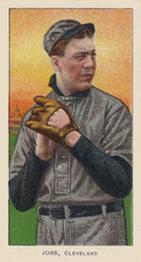
April 20, 1910: Cleveland’s Addie Joss outduels Doc White, no-hits White Sox for second time
Less than two years after his October 1908 perfect game against the Chicago White Sox, Cleveland Naps right-hander Addie Joss became the first pitcher in American or National League history to have thrown the majors’ two most recent no-hitters when he no-hit the White Sox again on April 20, 1910. Sadly, it was also one of the final appearances of Joss’s major-league career, and he died less than a year later.
Following mediocre seasons in 1909, when both the White Sox and Naps finished at least 20 games behind the AL champion Detroit Tigers, each club looked for a fresh start in the young 1910 season. Cleveland took two of three from Detroit to start the season, while Chicago disappointingly split a two-game series with the lowly St. Louis Browns. In the first game of the series between the Naps and White Sox on April 19, Cleveland’s Heinie Berger outlasted Chicago’s Frank Smith in a 2-1 game that took 12 innings.
A day later, on a chilly Wednesday afternoon, the two teams were set up for another pitchers duel. Cleveland sent to the mound the 30-year-old Joss, who had been roughed up in his first start of the season at Detroit, when he surrendered seven runs. But he was coming off a dominant 1909 season in which his 1.71 ERA was tied for fourth in the AL.1 Chicago started 31-year-old lefty Doc White, who was making his first start of the year after a great 1909 season in which he was just a tick behind Joss with a 1.72 ERA.
The two starting pitchers stood taller than 6 feet and were relatively thin,2 which led Chicago Tribune columnist Sy Sanborn to call the matchup “the battle between the Human Slats.”3
The Naps opened the contest threateningly in the first. After left fielder Art Kruger was retired, third baseman Bill Bradley poked a ball into left field for Cleveland’s first hit. Bradley stole second and advanced to third on a groundout by second baseman Terry Turner. White stifled the threat by getting Cleveland first baseman Nap Lajoie to ground to third.4
From the start, the White Sox were unable to make hard contact against Joss, who retired the first four batters he faced. The game’s sole controversy came in the second when White Sox center fielder Freddy Parent hit a weak grounder to Bradley, who bobbled the ball and was unable to throw out Parent at first.
According to the Cleveland Press, the play was initially ruled a hit by most of the scorers in attendance, but as it continued to loom as the only White Sox hit, Chicago and Cleveland writers covering the game got together to find the official scorer and ask him to change the hit to an error.
The group of writers, who were part of the Base Ball Writers’ Association of America, discovered that White Sox owner Charles Comiskey had not appointed an official scorer, and all agreed Bradley had a better than even chance to make the throw had he not bobbled the ball.5
After Joss stranded Parent on first in the second, he walked White in the third, but once again got out of the inning without the runner advancing. Joss then set down Chicago’s 2-3-4 hitters—Rollie Zeider, Chick Gandil, and Cuke Barrows, who was playing in the seventh game of his 32-game career—in order in the fourth.
Chicago got a runner into scoring position for the only time in the game in the fifth. Parent reached base for the second time via a walk and got to second on a sacrifice by Billy Purtell. He advanced to third on a groundout by rookie shortstop Lena Blackburne to Joss—one of Joss’s 10 assists in the game. White Sox catcher Fred Payne squandered the chance to score Parent by popping out to Cleveland shortstop Neal Ball.
While Joss took all the headlines for keeping Chicago out of the hit column, White also had an impressive outing, highlighted by two pickoffs of Cleveland baserunners. Naps catcher Jay Clarke got aboard on a walk in the second inning and moved up a base on a groundout before White picked him off at second to end the inning. With one down in the top of the fourth, Turner hit a ball in front of the plate that White was unable to get to, resulting in an infield single.
During the next at-bat, White threw over to first once with Turner retreating safely, only to fire the ball back with Turner just off the base, his attention turned away. The Cleveland Plain Dealer remarked that White made Turner, who finished his career as Cleveland’s all-time leader in games played, “look like a two-year-old.”6
The only run of the game came on a couple of big hits by Cleveland in the sixth. With one down in the inning, Kruger singled on a soft liner over second. After White retired Bradley, Turner skied a slow pitch from White just over the head of Barrows in left, the ball glancing off his glove as he dove for it. Kruger had been off and running with two outs and scored easily from first. Turner rolled into second with a double.7
Lajoie, still Cleveland’s all-time franchise hits leader as of 2025, grounded out, leaving Turner on second. The Naps threatened again in the seventh by way of a Clarke single and a Joe Birmingham hit-by-pitch with one out, but Ball and Joss failed to bring home an insurance run.
Luckily for the Naps, it did not matter that they also left a runner on in the eighth, and Clarke popped up a sacrifice bunt attempt that turned into a double play in the ninth. Joss had his best stretch of the game in the final four frames, not allowing a single baserunner.
After Joss made two putouts to start the ninth, the South Side crowd cheered against their White Sox for the first time that afternoon in hopes of seeing history.8
Joss induced a groundout to Bradley to complete the 11th no-hitter in AL history, the first time a pitcher no-hit the same team twice. Joss stood alone in that category for 104 years until San Francisco Giants right-hander Tim Lincecum no-hit the San Diego Padres in 2013 and 2014.
“It’s pretty nice to get credit for a no-hit game, but I would rather it had been so clean that there would have been no chance for a moment’s hesitation by the scorers,” Joss said after the game, referencing the debated Bradley error in the second.9
Sanborn wrote that if Parent’s weak grounder on that play had been an intentional bunt, the decision may have been different.
“But it wasn’t even a bunt, and there wasn’t anything else in the White Sox outfit which even made noise like a base hit, except one or two which Slat Joss mercilessly stabbed in midair,” Sanborn wrote.10
Bradley took the blame for the error, saying, “If ever a man pitched a no-hit game, Addie is that man and Wednesday was the day.”11
Although Joss had etched his name in baseball history once again in his storied career, he remained humble.
“But remember this: the credit is due to the grand support I got,” Joss said. “And on top of that I was lucky. A man is always lucky to get those no-hit games at any time and against any team.”12
Neither the Naps nor White Sox came close to competing for an AL title in 1910, each finishing more than 30 games behind the eventual World Series-champion Philadelphia Athletics. Chicago’s .211 team average in 1910 was the worst of any AL or NL team.
Joss pitched only 11 more games in 1910 due to a torn ligament in his throwing arm that caused him to miss significant time in June and ended his season in July. His no-hitter marked the last scoreless outing he ever pitched, as he died from tubercular meningitis before the 1911 season the following April.
The day after the game, Wisconsin sportswriter Ray Speer reflected in the Eau Claire Daily Leader on Joss’s rise from humble origins in rural Wisconsin to a major-league great in what would be his final season. Speer wrote how Joss was unlike the ordinary people Thomas Gray described in his poem Elegy Written in a Country Churchyard.
“He became a hero,” Speer wrote. “If you doubt my word consult manager Duffy of the Sox and I dare say you will have another think coming.”13
Acknowledgments
This article was fact-checked by Larry DeFillipo and copy-edited by Mike Eisenbath.
Photo credit: Addie Joss, Trading Card Database.
Sources
The author relied on Baseball-Reference.com and Retrosheet.org for pertinent information, including the box score. The author drew play-by-play information from game coverage in the Cleveland Plain Dealer, Cleveland Press, and Chicago Tribune newspapers.
https://www.baseball-reference.com/boxes/CHA/CHA191004200.shtml
https://www.retrosheet.org/boxesetc/1910/B04200CHA1910.htm
Notes
1 The Tigers’ Ed Killian also had a 1.71 ERA. Harry Krause of the Philadelphia Athletics led the AL with a 1.39 ERA.
2 During their playing careers, Doc White was 6-foot-1 and weighed 150 pounds while Addie Joss was 6-foot-3 and weighed 185.
3 Sy Sanborn, “No Hits, No Runs, Joss Blanks Sox,” Chicago Tribune, April 21, 1910: 8.
4 Cleveland’s regular starting first baseman for the 1910 season, George Stovall, started the year on the bench until becoming the starter on April 27. Lajoie was the primary starting second baseman from that point on.
5 “No Hit Game Won by Joss,” Cleveland Press, April 21, 1910: 12.
6 “New Record for Tall Addie Joss,” Cleveland Plain Dealer, April 21, 1910: 8.
7 “New Record for Tall Addie Joss.”
8 “Notes on the White Sox,” Chicago Tribune, April 21, 1910: 8.
9 “No Hit Game Won by Joss.”
10 “No Hits, No Runs, Joss Blanks Sox.”
11 “No Hit Game Won by Joss.”
12 “No Hit Game Won by Joss.”
13 Ray Speer, “As You Like It,” Eau Claire Daily Leader, April 21, 1910: 2.
Additional Stats
Cleveland Naps 1
Chicago White Sox 0
South Side Park
Chicago, IL
Box Score + PBP:
Corrections? Additions?
If you can help us improve this game story, contact us.