


‘Whiteyball’ in the Shadow of the Gateway Arch: The 1982 St. Louis Cardinals
This article was written by Russell Lake
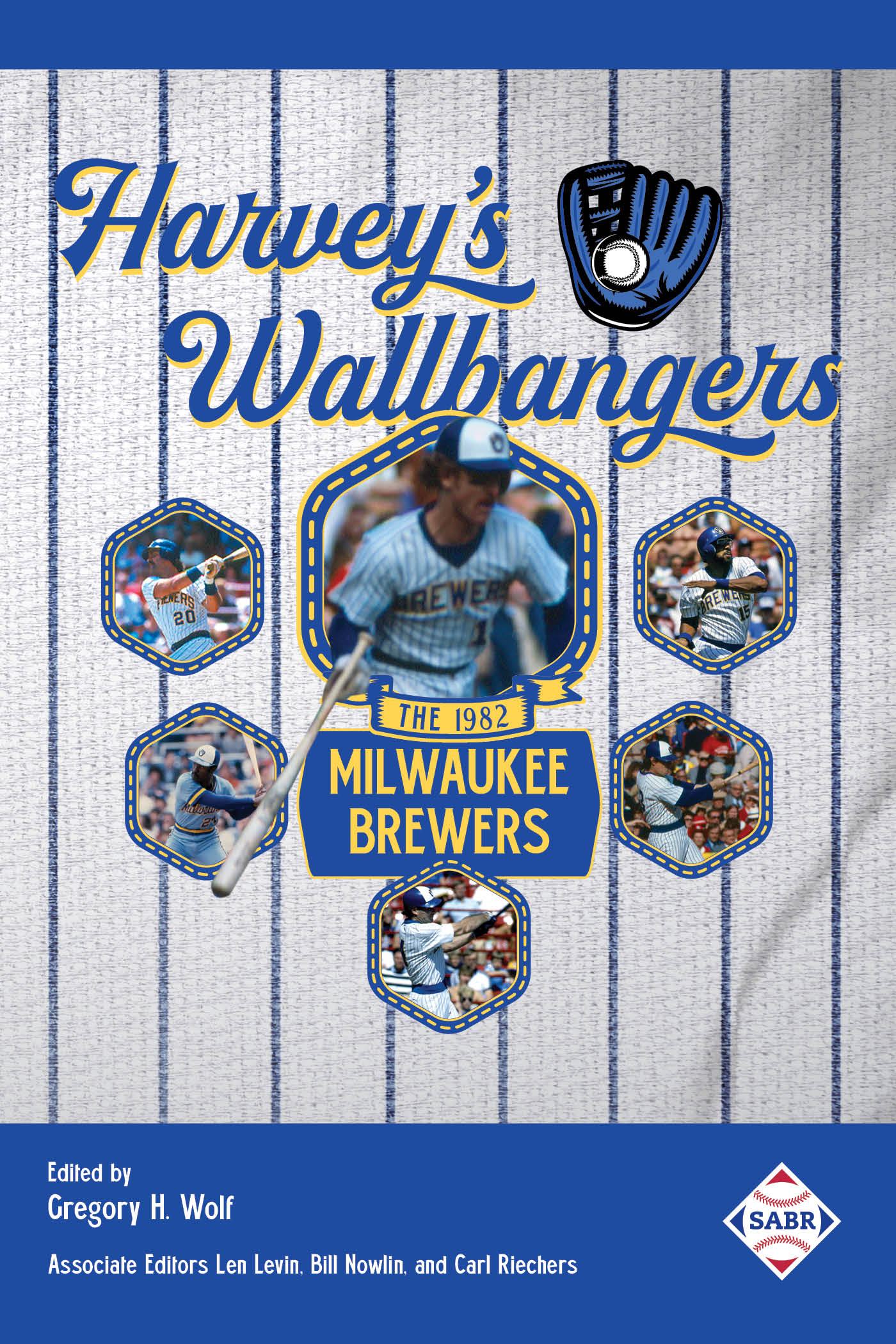
This article was published in Harvey’s Wallbangers: The 1982 Milwaukee Brewers
 On September 27, 1982, pregame showers in Montreal held up the contest between the St. Louis Cardinals and the Expos. The “Magic Number” for the Redbirds to win their first-ever National League East Division was two. Radio announcer Jack Buck remembered several unpleasant “north-of the-border” events involving his beloved team. The last two St. Louis managers were relieved of their duties in Montreal. The 1981 players strike prompted Commissioner Bowie Kuhn to authorize a split-season playoff format. The Cardinals, with the best overall record in the NL East, remained on the postseason sidelines after finishing second, initially to Philadelphia and later to Montreal.1
St. Louis lit the scoreboard with a four-run first inning. Up one with two on, Willie McGee’s two-out sinking liner skipped to the wall after it eluded center fielder Andre Dawson. Dane Iorg and Darrell Porter scored while the speedy McGee circled the bases for an inside-the-park home run.2 In the ninth, the Redbirds held a two-run margin with closer Bruce Sutter on the hill vying for his 36th save. The Cubs had defeated the second-place Phillies, so except for the shouting, the division race was over.
Dawson lined to center, and Al Oliver grounded out. Gary Carter stepped in, and Buck made the long-awaited call that pronounced St. Louis the champs, “The pitch. A groundball to third, Oberkfell has it. Throws. That’s it. The Cardinals have won it by the score of 4-2. And that one is for Mr. Busch, for Butch Yatkeman, for Ken Boyer, and for all the Cardinal fans who have been so loyal this year.”3 The team eventually ended the regular season 92-70 for their best finish since 1968.
Prosperity improved for the St. Louis Cardinals after they hired Whitey Herzog as manager on June 8, 1980. The 48-year-old “White Rat” turned down an initial one-year offer because of past difficulties negotiating his annual agreements with Kansas City. Busch and his lawyer quickly approved a three-year deal.4 Herzog replaced Ken Boyer with St. Louis in last place in the NL East with an 18-34 mark.5 He joined his new team in Atlanta the next evening, and began to see examples of what cost Boyer his job. After a short time, he reported to Busch that it was the first time he had ever been scared to walk through his own clubhouse. Redbirds GM John Claiborne was fired, and later Herzog, on a plea from Busch, accepted the front-office position. Herzog would be the guy to remove players and add talent. Busch agreed that Herzog could return as manager after the “housecleaning” was completed.6
The 81-year-old Busch wanted one more world championship, and was stunned by Herzog’s report that the Cardinals were in no position to win anything with the “sorry bunch” of players on the roster; or with much of the minor-league assemblage. Busch asked to be kept informed and gave Herzog carte blanche to construct a team to his preference.7 On a suggestion from former Cardinals GM Bing Devine, Herzog frequently visited Busch at his home over some Budweiser to talk baseball.8
The Cardinals had All-Star talents in catcher Ted Simmons, first baseman Keith Hernandez, and shortstop Garry Templeton. Simmons was an exciting switch-hitter, but lacked the “pitcher-handling” and defensive abilities required by a backstop. Hernandez was a proven leader in offense and defense, and shared the 1979 NL MVP. The brash-talking, switch-hitting Templeton batted with “hard-nosed” authority, but could be a challenge on the defensive and hustling lines.
In the offseason, Herzog first pursued a catcher, and set sights on Kansas City’s Darrell Porter. Joe McDonald, the former New York Mets GM, was made an assistant, and they got Porter (who was on his honeymoon cruise) to agree to a five-year deal. The plan was to shift Simmons to first with Hernandez moving to left. Hernandez said the outfield was fine with him, and Simmons (through his agent) agreed to his position relocation. With that rework seemingly done, Herzog chased after a needed closer. The first big deal of the winter meetings was made with San Diego’s Jack McKeon to acquire relief ace Rollie Fingers, catcher Gene Tenace, southpaw Bob Shirley, and minor-leaguer Bob Geren for young catcher Terry Kennedy and five other roster denizens whom Herzog felt he could do without.9 “I’ll be back tomorrow,” Herzog promised the media.10
Former Cy Young Award winner Sutter was the reliever Herzog coveted, but getting Chicago Cubs GM Bob Kennedy (whose son the Cardinals had just traded) to support such a transaction proved cumbersome. Kennedy wanted first baseman-outfielder Leon Durham and infielders Tommy Herr and Ty Waller. Herzog wanted to keep Durham and Herr, so he offered third baseman Kenny Reitz. After relenting on Herr, Kennedy asserted, “No Durham, no Sutter.” As pieces came together, Herzog learned that Reitz had a no-trade clause. St. Louis bought this out for $50,000 to complete the bartering. Finally, Herzog had Sutter and his split-finger fastball. Fingers insisted that he would be fine in the same bullpen, but after Herzog offered game-situation scenarios, Fingers felt he would be better off with another team.11
A problem surfaced a day later when Simmons balked about playing first, and told his agent to inform Herzog that he had changed his mind. Herzog liked Simmons, but was upset about this reversal since he now had to deal with another significant roster shakeup. The Oakland A’s and Milwaukee Brewers were the only teams willing to talk about Simmons and his large no-trade contract. Simmons vetoed Oakland because it was too far away. A multiplayer package was compiled, but Brewers GM Harry Dalton froze once Herzog requested Milwaukee’s top prospect, outfielder David Green. Simmons requested $750,000 for his no-trade to be purchased, so Milwaukee started to withdraw from the proposal. Suddenly, George Steinbrenner informed Herzog that the Yankees wanted to acquire Simmons, and it did not matter how much the buyout would be.12
 Dalton reconsidered and asked Herzog how much the Cardinals would be willing to pay on Simmons’s buyout. Herzog retorted, “Not one red cent. Either you take him or we’ll ship him to someone else.” Since he did not want Simmons moved to a rival, Dalton requested extra time, and then an extension of the Cardinals’ deadline. After lengthy front-office discussion, Milwaukee agreed to swap Green, outfielder Sixto Lezcano, and pitchers Lary Sorensen and Dave LaPoint for Simmons, Fingers, and pitcher Pete Vuckovich.13 While the transactions with San Diego and Chicago had St. Louis fans chirping positively, the trade of Simmons had them proclaiming that it was one swap too many.14
Meanwhile, there were 22 candidates to consider for the St. Louis manager’s position. One applicant told Herzog that he had never played baseball, but did not see why that made any difference. Herzog wrote him back and said he would keep him in mind. Gene Mauch and Joe Altobelli were viewed as front-runners, but went elsewhere.15 Herzog later announced that he would return as the Redbirds’ pilot since he had orchestrated the roster overhaul.16
The media-coined term Whiteyball started taking shape during 1981 spring training in St. Petersburg, Florida. Herzog appointed longtime Cardinals minor-league coach George Kissell to implement ways for St. Louis baserunners to get a better break from third base. Kissell accepted the task and applied his longtime “Cardinal Way” philosophy. Kissell preached to his plebes, “Tell me and I’ll forget. Show me and I’ll remember. Involve me and I’ll understand.”17 Coach Red Schoendienst categorized Whiteyball as good fundamental baseball that worked with productive outs. “It was getting a guy on first, stealing second, moving to third on a groundout, and scoring on a fly ball,” explained Schoendienst.18 Herzog tabbed Chuck Hiller to be his third-base coach. Hiller had served Herzog in the same capacity during prior managerial locations.
The Cardinals opened the 1981 season with a 5-2 loss to the World Series champion Philadelphia Phillies. Many of the Redbirds faithful had already painted a large target on the back of Porter, and the new catcher did not help his cause by grounding into a rally-killing double play while going hitless. Also, on the first ball fielded by Ken Oberkfell at third, his throw sailed high over the reach of Hernandez. Conversely, Sutter entered the next afternoon to notch a save with three frames of relief.
Porter, who had left the Royals for alcohol and drug treatment in 1980, was hitting .176 with nine RBIs when he was shelved on May 18 with a right-shoulder rotator cuff injury. Cardinals surgeon Stan London consulted with Dr. Frank Jobe in Los Angeles on a diagnosis, but the prognosis appeared unfavorable.19 An anticipated players strike started on June 12 with the Cardinals in second place, 1½ games behind the Phillies. Just before play halted, switch-hitting center fielder Tony Scott was traded to Houston for Joaquin Andujar. Herzog directed pitching coach Hub Kittle to bring Andujar out of a delivery funk the high-strung hurler had been in for the past year and a half.20
After the strike was settled in early August, the Cardinals started the “second season” winning five of their first six. However, a concern was festering in the clubhouse and it came to an unfortunate head at Busch Stadium. On August 26 Templeton was nursing a sore knee and complained about having to play in a rain-delayed afternoon contest following a night game. Herzog explained to his shortstop that the team was in a pennant race, and that Templeton would be in the lineup whether he liked it or not. Templeton took his brooding to the field, and failed to run to first on a dropped third strike. The small Ladies Day gathering started booing and resumed their taunts as Templeton returned to his position.21 Templeton responded with an obscene gesture and received a warning from the umpires.22
In the top of the fourth with St. Louis trailing San Francisco, 2-0, Templeton saluted the hecklings with another indecency. Plate umpire Bruce Froemming ejected Templeton, and he stalked off the field.23 At the mound, he grabbed his crotch as the catcalls increased. When the volatile infielder neared the dugout, a furious Herzog reached up and yanked Templeton down the steps before players got between the two combatants.24 A comeback 9-4 win did not appease the locals after they witnessed or learned of the ballfield drama. Herzog later said, “I’m not proud about what I did. But I had to do it. No player is going to show up the fans.”25
Templeton was suspended and fined $5,000. Days later he was hospitalized for depression and a chemical imbalance and requested a change of baseball scenery.26 He returned on September 15, batted .369 through the end of the season, and played pretty well, according to Herzog. However, the damage was done. Templeton had upset the fans, his teammates, and Mr. Busch – who told Herzog to trade the moody talent.27 On the plus side, Andujar finished 6-1, and Porter returned with a healthy shoulder and drove in 23 runs. Nonetheless, the Cardinals lost out on the divisional playoff berth by a half-game and missed postseason play for the 13th consecutive season.
Herzog was voted UPI’s Executive of the Year before thoughts of a new shortstop for the next season could percolate. He executed a pair of offseason transactions that ultimately made heads turn. October brought a deal dubbed negligible when it involved southpaw Bob Sykes going to the Yankees for Double-A switch-hitting outfielder Willie McGee. In November, starting pitchers Silvio Martinez and Sorensen were sent to Cleveland via a three-team trade that brought Philadelphia outfielder Lonnie Smith to St. Louis. The speedy, right-handed-batting Smith was projected as the new center fielder.28
Herzog was earnestly looking for a shortstop to exchange Templeton for and found the pickings slim. After several veterans were eliminated, Herzog checked to see if San Diego’s Ozzie Smith was available, but McKeon said that Smith was untouchable. Nonetheless, during the early part of the winter meetings, McKeon asked Herzog if he was still interested in Ozzie. Herzog was confused, but the San Diego GM explained that the Padres were miffed at Smith’s agent. A package involving six players was orchestrated with Templeton, Lezcano, and minor-league pitcher Luis DeLeon going to San Diego for Smith and pitchers Steve Mura and Al Olmsted.29
However, Ozzie Smith had a no-trade clause and zero desire to leave sunny California, and did not want to be swapped to St. Louis. Reading about the apparent stonewall, “Cardinals Nation” disdained Smith’s two Gold Gloves, and focused on the career offensive yield of Templeton’s .305 outpacing Smith’s .231. A public campaign to rescind the deal was forged, but quickly flamed out. Herzog could see all sides of the matter, and the clubhouse climate he desired prompted him to fly to San Diego and meet with Smith about what Herzog was trying to accomplish. Herzog told Smith and his agent that if one year in St. Louis did not work out, then Ozzie could be a free agent after the season.30
Ozzie Smith finally agreed to the trade and Herzog looked back over 18 months of roster manipulation. The starting lineup from June 1980 had Hernandez, Oberkfell, and George Hendrick still in St. Louis, while the only starting pitcher remaining was Bob Forsch. Herzog had added speed, subtracted difficult personalities, and upgraded pitching, catching, and defense. He felt the guys currently on the roster could play together and win games. It also became time for Herzog to move away from the GM position to concentrate on piloting his crew toward the postseason.31
The 1982 campaign started in Houston on April 6 with the Cardinals blasting the Astros, 14-3. Everyone in the starting lineup collected at least one hit, and it was the most runs scored by the franchise on Opening Day since 1928. After three straight losses, St. Louis followed with 12 consecutive wins. Second baseman Herr commented, “We just go out and play with confidence every day. To me, that’s the sign of a good club.”32 The 12 successive victories were the team’s longest winning streak since 1943, but this particular feat was overshadowed by the Atlanta Braves, who opened the season with 13 wins.33
Green’s hamstring injury in early May brought McGee from Triple A, and he rapidly became a popular fixture in center field. A May 30 walk-off 6-5 win over San Diego was noteworthy after St. Louis rallied for three runs in the ninth to force extra innings. However, the Padres answered with a pair in the 10th to go up 5-3. In the Cardinals’ half with two out and nobody on, the Redbirds pulled a stunner. Down a run, super-sub Mike Ramsey singled home Lonnie Smith with the tying run. After a hit batsman, Iorg knocked home the winner. As Ramsey scored, all Jack Buck could exclaim was, “Unbelievable!”34
St. Louis moved four games up on Montreal after a hard-fought 3-2 walk-off on June 15. A new fan-appreciation measurement had morphed at Busch Stadium when standing ovations held up contests after Ozzie Smith made another spectacular play. Displaying fire and flamboyance on the mound, Andujar, described himself as “One Tough Dominican” while being monitored by Herzog and Kittle. At the All-Star break, Lonnie Smith was batting .306 with 70 runs scored and 41 stolen bases.
The Cardinals slumped from late July into August and found themselves trailing the Phillies by three games. A 7-1 road trip to New York and Pittsburgh vaulted the Redbirds back into first place. On August 22, a steamy afternoon against San Francisco ended astonishingly when third-string catcher Glenn Brummer took it upon himself to steal home with the bases loaded, two outs, and a two-strike count in the 12th. The Giants argued heatedly with plate umpire Dave Pallone, to no avail.35
Philadelphia mounted another charge and moved a half-game ahead of St. Louis on September 13. The next evening at Veterans Stadium, Sutter relieved rookie starter John Stuper with two on and one out in the bottom of the eighth. The Cardinals were leading 2-0, and an infield hit by Gary Matthews jammed the bases. Sutter took a deep breath, went into his stretch, and got Mike Schmidt to ground into a 1-2-3 double play.36 The bearded closer retired the Phillies in the ninth and moved St. Louis back to the top. By winning 11 of their next 14 games, the Cardinals secured the NL East Division title, and were in the postseason for the first time since 1968.
Skippered by former Cardinal Joe Torre, the NL West champion Atlanta Braves came to St. Louis to begin a best-of-five National League Championship Series on October 6. Torre had ex-Redbirds Bob Gibson and Dal Maxvill on his coaching staff. During the regular season, the Braves earned a 7-5 advantage over the Cardinals. Phil Niekro had St. Louis down 1-0 after 4½ innings before heavy rain washed out the game.
The next evening Forsch fired a 7-0 shutout while defeating Pascual Perez with a five-run sixth inning. Rain shrouded the Midwest the next day to push Game Two off 24 hours. Atlanta called on the 43-year-old Niekro again, and the ageless knuckleballer controlled a 3-1 lead after five. The Cardinals plated single tallies in the sixth and eighth to set the stage for the bottom of the ninth. Oberkfell lined a one-out drive just past the reach of center fielder Brett Butler to send Green home with the walk-off 4-3 winner.
With two postponements stretching the NLCS, the teams flew to Atlanta with no day off before Game Three. On October 10 the Cardinals rocked Rick Camp with four second-inning runs and breezed behind Andujar and Sutter for a 6-2 NL pennant-clincher. During the series sweep, Porter and Ozzie Smith both hit .556. Porter also walked five times, and was named the MVP of the NLCS. It was the 13th pennant for the franchise.
The World Series opened in St. Louis on October 12 with the Cardinals facing the powerful Milwaukee Brewers. Managed by Harvey Kuenn, his Wallbangers clouted 216 home runs to the Cardinals’ 67, and plated over 200 more runs than the Redbirds did in the regular season. More than a light rain dampened the Series opener as Milwaukee jumped on St. Louis early and often during a 10-0 thumping. Left-hander Mike Caldwell allowed just three hits, while the first two Brewers, Paul Molitor (5 hits) and Robin Yount (4), amassed three times that figure as part of a 17-hit attack. Herzog said the only good thing about the evening was that they did not have to play a doubleheader.37
In Game Two Simmons proved that you can go home again when he blasted his second homer of the series to give Milwaukee a 3-0 third-inning cushion against Stuper. The Cardinals plated a pair off Don Sutton in the bottom half, but Cecil Cooper nicked Jim Kaat for an RBI single in the fifth. Porter put St. Louis fans on their feet by dropping a two-out two-run double down the left-field line to tie things, 4-4. Steve Braun coaxed a controversial bases-loaded walk from Pete Ladd in the eighth inning to account for the 5-4 finish tying the Series at a game each.38
Game Three became the Willie McGee show. First, the rookie center fielder made a leaping catch at the wall on Molitor’s first-inning drive. With the game scoreless in the fifth, McGee blasted a three-run homer off Vuckovich. In the seventh, after Lonnie Smith tripled and scored on a throwing error, McGee went deep again to make the score 5-0. In the bottom half, Andujar took a painful comebacker to his right leg and was carried off. The advantage was 6-2 with Sutter pitching in the ninth. With one on and no outs, Gorman Thomas knocked an offering high and deep to the left-center alley. McGee raced over and soared high at the fence to backhand the drive.39 Sutter retired the next two, and the Cardinals were up two games to one.
In Game Four, St. Louis had struck for three runs by the third frame with two scoring on Herr’s deep sacrifice fly. Former Brewers southpaw LaPoint was cruising, 5-1, with one out in the seventh when he dropped an easy toss covering first.40 The harmless-looking miscue opened the floodgates as Milwaukee plated six runs on five hits off four hurlers to take a 7-5 lead, and tie the Series at two games each.
The Cardinals figured out how to hit Caldwell in Game Five, but they could not outscore the Brewers during a tough 6-4 loss. Fifteen safeties by St. Louis could not produce enough tallies as they stranded 12. Yount homered among his four hits and was serenaded with MVP chants by the Milwaukee fans. The Redbirds headed back home trailing three games to two.
With precipitation definitely in the St. Louis forecast for Game Six, Stuper was phenomenal, hurling a complete game through separate weather delays totaling over two hours. Cardinals bats thundered throughout a stormy night as Porter and Hernandez each ripped two-run homers, while Iorg collected three hits. Coupled with Sutton and Doc Medich being roughed up, the Brewers committed four errors during the 13-1 blowout to even the Series at three wins apiece.
On a cold and crisp October 20, Game Seven moved into the spotlight with Andujar and Vuckovich squaring off for the title. St. Louis mustered a short-lived 1-0 lead until Ben Ogilvie parked a long home run to open the fifth inning. Milwaukee seemingly took command during the sixth, scoring two runs on three hits, Andujar’s error, and a sacrifice fly to go up 3-1. With one down in the bottom half, the “Smith Brothers” rallied the Cardinals. Ozzie punched a single to left, and Lonnie scorched a double into the left-field corner.41 Lefty Bob McClure relieved and walked pinch-hitter Tenace, with Ramsey coming in to pinch-run.
Hernandez laced a game-tying two-run single to right-center with Ramsey diving safely into third. Hendrick directed a single to right to plate Ramsey for a 4-3 lead. With one out in the seventh, Milwaukee’s lefty-swinging Roy Howell lofted a drive to left. Lonnie Smith turned the catchable fly ball into a twisted-running “lucky stab” for a “heart-stopping” second out. After Charlie Moore singled, Jim Gantner was retired when Andujar threw him out at first. Unexpectedly, Andujar and Gantner exchanged verbal barbs near the baseline. As the benches began to stir, plate umpire Lee Weyer wrapped up Andujar, and instructed Kittle to accompany the fiery competitor to the dugout.42
Sutter, who was hit hard in County Stadium, retired Milwaukee in order in the eighth. The Cardinals added important insurance runs in their half with two-out RBI singles off Caldwell by Porter and Braun to increase their advantage to 6-3. In the ninth, Sutter got Simmons and Ogilvie to ground out before fanning Thomas for the final out. Porter ripped off his mask and flung it high as he ran to embrace Sutter before the rest of the Redbirds and thousands of fans joined the celebration.43
In an unusual twist of ironies, Darrell Porter, the Brewers’ top draft pick in 1970, was selected the World Series MVP. August Busch Jr., who kept the Cardinals’ franchise from moving to Milwaukee in 1953 after his brewery purchased the team, accepted the World Series championship trophy.44 The championship was the ninth in Cardinals history. Porter happily reflected, “Ever since I was a Little Leaguer, I wanted to be on a world championship team. And now my dreams have come true.”45
RUSS LAKE lives in Champaign, Illinois, and is a retired college professor. The 1964 St. Louis Cardinals remain his favorite team, and he was distressed to see Sportsman’s Park (aka Busch Stadium I) being demolished not long after he had attended the last game there on May 8, 1966. His wife, Carol, deserves an MVP award for watching all of a 13-inning ballgame in Cincinnati with Russ in 1971 — during their honeymoon. In 1994 he was an editor for David Halberstam’s baseball book “October 1964.”
Sources
In addition to the sources cited in the Notes, the author accessed Retrosheet.org, Baseball-Reference.com, Baseball-Almanac.com, Newspapers.com, and SABR.org/bioproject.
Photo credit: Whitey Herzog, SABR-Rucker Archive.
Notes
1 With no games that were missed due to the players strike from June 12 to August 10 to be made up; the Cardinals (59-43) and the Cincinnati Reds (66-42), with the best won-lost records for the full season in the NL, did not qualify for the playoffs.
2 Video, The Saint Louis Cardinals, The Movie (St. Louis National Baseball Club, 1985).
3 Video, The Saint Louis Cardinals. During his end-of-game call, Jack Buck paid homage to August A. Busch for his 30th season of team ownership; Butch Yatkeman, the well-liked Cardinals clubhouse man, who was retiring in 1982 after 59 years of service; Ken Boyer, captain of the Cardinals, 1964 MVP, and former St. Louis manager, who succumbed to lung cancer on September 7, 1982; The St. Louis fans who made the ’82 Busch Stadium turnstiles click a then franchise-high 2,111,906 times.
4 Whitey Herzog and Kevin Horrigan, White Rat, A Life in Baseball (New York: Harper & Row, 1987), 115-116.
5 Boyer skippered the 1980 Cardinals to an 18-33 record before he was fired by GM John Claiborne on June 8, 1980, between games of a doubleheader. Third-base coach Jack Krol (0-1) piloted St. Louis during their loss in the nightcap.
6 Herzog and Horrigan, 119-120.
7 Herzog and Horrigan, 117-118.
8 Jack Buck with Rob Rains and Bob Broeg, Jack Buck: That’s a Winner! (Champaign, Illinois: Sports Publishing, 1997), 174.
9 Herzog and Horrigan, 124-127.
10 Bill Conlin, “While Rivals Snoozed, Herzog Pulled Heists,” The Sporting News, December 27, 1980: 46.
11 Herzog and Horrigan, 127-128.
12 Herzog and Horrigan, 129-131.
13 Herzog and Horrigan, 129-131.
14 Rick Hummel, “Fans Give Whitey a Heat Treatment,” The Sporting News, January 3, 1981: 52.
15 Hummel, “22 Candidates in Cards Derby,” The Sporting News, October 25, 1980: 35; Dick Young, “Young Ideas,” The Sporting News, September 27, 1980: 16.
16 Rob Rains, The St. Louis Cardinals, The 100th Anniversary History (New York: St. Martin’s Press, 1992), 241.
17 Derrick Goold, “Now in Book Form: The Cardinal Way,” St. Louis Post-Dispatch, May 18, 2012: stltoday.com, accessed August 18, 2018.
18 Red Schoendienst with Rob Rains, Red, A Baseball Life (Champaign, Illinois: Sports Publishing, 1998), 181.
19 Rick Hummel, “Rincon Injury Shakes Redbird Roost,” The Sporting News, May 30, 1981: 41.
20 Herzog and Horrigan, 134.
21 Herzog and Horrigan, 135-136.
22 Rick Hummel, “Templeton Gets Psychiatric Help,” The Sporting News, September 12, 1981: 39, 53.
23 Hummel, “Templeton Gets Psychiatric Help.”
24 Herzog and Horrigan, 136.
25 Hummel, “Templeton Gets Psychiatric Help.”
26 Herzog and Horrigan, 136.
27 Herzog and Horrigan, 136.
28 Herzog and Horrigan, 139.
29 Herzog and Horrigan, 137-138.
30 Herzog and Horrigan, 138.
31 Herzog and Horrigan, 139-140.
32 Rick Hummel, “Cards Halted by Carlton,” St. Louis Post-Dispatch, April 26, 1982: 26.
33 Hummel, “Cards Halted by Carlton.”
34 Video, The Saint Louis Cardinals, The Movie.
35 Video, The Saint Louis Cardinals, The Movie.
36 Video, The Saint Louis Cardinals, The Movie.
37 Dick Kaegel, “A Contrast in Styles,” The Sporting News, October 25, 1982: 3.
38 Kaegel, “A Contrast in Styles.”
39 Kaegel, “A Contrast in Styles.”
40 Kaegel, “A Contrast in Styles.”
41 Video, The Saint Louis Cardinals, The Movie.
42 youtube.com, 1982 World Series – Game 7, accessed August 30, 2018.
43 youtube.com, 1982 World Series – Game 7.
44 Gregory H. Wolf, ed., Sportsman’s Park in St. Louis (Phoenix: Society for American Baseball Research, 2017), 55.
45 “Porter Delivers the Goods,” The Sporting News, November 1, 1982: 28.