

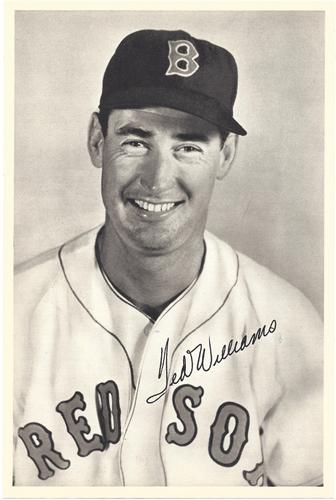
July 31, 1955: Ted Williams was ‘never better’ than when playing against the Tigers
The battle between pitcher and batter was one Ted Williams enjoyed. And Hank Aaron appreciated what Ted brought to it. “What made Ted so great was that he refused to think that a pitcher could get him out. I mean he just refused to buckle, and that’s what it takes to be great. Somehow you’ve got to feel that you are the best. That’s how he played the game, and that’s how he left the game, as the best.”1
Ned Garver was a pitcher that Williams hit well, batting over .400 against him over the years and connecting for 10 home runs, including two game-winners in 1955. On June 21, Williams’ three-run, eighth-inning homer decided a 5-4 Boston Red Sox win over Garver’s Detroit Tigers.2
A little over a month later, on the last day of July, Williams’ fourth-inning grand slam was another game-winner. It was his first grand slam since he returned from the Korean War in the latter half of 1953.3
On July 1, the Red Sox had climbed into fourth place. They were still there on July 31 and remained there the rest of the season.
The Sunday afternoon doubleheader at Fenway Park drew a capacity crowd of 35,057. The Red Sox and Tigers had split the first two games of the series. On Friday, July 29, Williams’ first-inning home run off rookie Jim Bunning, appearing in his third major-league game, had put Boston ahead to stay in a 5-0 win. He had homered against another rookie, Babe Birrer, a day later, but Detroit went on to a 5-2 win.
Starting for Mike Higgins’ Red Sox was right-hander Frank Sullivan, whose 18 wins in 1955 tied for the American League lead with Whitey Ford and Bob Lemon. He came into this game with a 2.98 ERA and 13-8 on the season, but the Tigers didn’t take long to pounce.
After getting shortstop Harvey Kuenn to ground out, Sullivan walked center fielder Bill Tuttle and hit Al Kaline on the left elbow with a pitch. Kaline was replaced by pinch-runner Charlie Maxwell, who played right field the rest of the game. X-rays of Kaline’s left arm proved negative.
Earl Torgeson singled to right field, driving in Tuttle. Maxwell took third and scored from there on a ground ball to second base by third baseman Ray Boone. Detroit led, 2-0.
Garver was riding a five-game winning streak for Tigers manager Bucky Harris. Garver walked two batters – left fielder Williams and right fielder Jackie Jensen – but escaped the bottom of the first unscathed.
The only batter to reach base for either team in the second inning was Boston third baseman Grady Hatton, with a single to center field.
The Red Sox got one run back on a solo home run by shortstop Billy Klaus in the third.
First baseman Norm Zauchin led off the bottom of the fourth by singling to right field. After catcher Sammy White flied out to center, two more Red Sox singled, both to left field. First was Hatton, and then center fielder Jimmy Piersall.
Sullivan reached on an infield single past Kuenn’s glove, scoring Zauchin and Hatton and giving the Red Sox a 3-2 lead. Second baseman Billy Goodman flied out for the second out, but Klaus walked.
That brought Williams to the plate with the bases loaded. He’d walked his first time up and grounded out to shortstop the next.
In this at-bat, the first pitch he hit was a hard-hit long drive to right field, but foul. Then he hit one out, on a 2-and-2 pitch that, according to the Boston Globe, “went into the visitors bullpen, , eluding [Tigers right fielder Charlie] Maxwell’s desperate attempt to grab it.”4 The score became Boston 7, Detroit 2. It was Williams’ third homer in three days, 19th of the season, and 385th of his career. It was also his 12th lifetime grand slam.
Garver was due to lead off in the top of the fifth. Bubba Phillips pinch-hit for him and lifted a pop-up that Frank Sullivan caught. The Red Sox pitcher retired the Tigers in order in the top of the fifth.
Maxwell was first to bat in the sixth inning; he hit a solo home run into the center-field bleachers to make the score 7-3.
Paul Foytack had taken over pitching duties for Detroit beginning in the fifth inning. The only Boston baserunners in his first couple of innings came on walks – to Piersall in the fifth and to both Goodman and Jensen in the sixth.
Gene Stephens replaced Williams in left field after the sixth inning.
No one reached base for either team in the seventh.
In the eighth, Maxwell singled with two outs, but remained there as Torgeson flied out to deep center field. The ball was almost a home run, as reported in the Boston Globe: “Torgy’s shot went over the extreme left end of the Boston bullpen where Piersall reached over and grabbed it with both hands.”5
Sullivan was still pitching. He was first to bat in the bottom of the eighth. He flied out to right field. Billy Goodman doubled to left field. Klaus drew a base on balls. Stephens grounded out, unassisted, to first base. Both baserunners moved up 90 feet. Jackie Jensen was given an intentional walk, loading the bases. Norm Zauchin drew a base on balls, which forced in Goodman for an 8-3 lead. White grounded out to end the inning.
Sullivan closed out the Tigers in the ninth for his 14th win, a four-hitter.
Garver took the loss, his record becoming 10-10.
“Williams is never better than when he’s playing against the Tigers,” wrote the Associated Press.6
Over the course of his career, Williams hit 11 game-winning homers against the Tigers at Fenway Park, four more than against any other team. He hit 11 game-winning home runs at Briggs Field, more than at any other park.
In the second game of the day’s doubleheader, Billy Hoeft held the Red Sox to two first-inning runs and had a 2-2 tie going into the bottom of the ninth, when Jimmy Piersall led off with a home run to win the game. Williams was 0-for-2 with an RBI on a sacrifice fly and a walk. The game was Red Sox left-hander Frank Baumann’s debut; he earned the win with 5⅔ innings of scoreless relief. It was the first walk-off home run of Piersall’s career.
Writing about pitchers who were stubborn in their approach, Williams said, “Ned Garver was another one. Sliders all the time, and you could anticipate when and where they’d be, usually inside. A guy who can swing a bat is going to hurt a pitcher who throws him inside – from the middle of the plate in. In a jam, I could always figure on a slider from Garver. I got to Garver pretty good.”7
Acknowledgments
This article was fact-checked by Carl Riechers and copy-edited by Keith Thursby.
Photo credit: Ted Williams, Trading Card Database.
Sources
In addition to the sources cited in the Notes, the author also consulted Baseball-Reference.com and Retrosheet.org.
https://www.baseball-reference.com/boxes/BOS/BOS195507311.shtml
https://www.retrosheet.org/boxesetc/1955/B07311BOS1955.htm
Notes
1 Jim Prime and Bill Nowlin, Ted Williams: The Pursuit of Perfection (New York: Sports Publishing, 2002), 97.
2 A “game-winning home run” is defined here as a home run that provides a game’s final margin of victory, giving the winning team at least one more run than the opposing team scored. For example, if a two-run homer increased a team’s lead from 2-1 to 4-1, and it went on to win 4-3, it qualifies as a game-winning home run. (This is different from the definition of “game-winning RBI” in baseball’s official statistics from 1980 through 1988, which counted as “game-winning” the RBI that provided a winning team the lead that it never relinquished.)
3 The last time he had hit a grand slam was on May 27, 1951.
4 Bob Holbrook, “Sox Win on Williams Slam, 8-3; On Piersall Homer in 9th, 3-2,” Boston Globe, August 1, 1955: 1, 4.
5 Bob Holbrook, “Tiger’s [sic] Antics Rile Red Sox Players,” Boston Globe, August 1, 1955: 4. The “antics” referenced in the article’s headline primarily related to Billy Hoeft in the second game, where he took an usually long time in between pitches to Williams, one clocked as long as 45 seconds, deemed as “trying to confuse him,” while shortstop Kuenn kept jumping up and down at shortstop and running back and forth between short and second while some Tigers in the dugout yelled things out at Williams. Two were ejected by umpire Ed Rommel. Jensen called it “bush.” The Herald provided more detail. Arthur Sampson, “Kuenn Antics on Ted bring Sox Protests,” Boston Herald, August 1, 1955: 1, 10.
6 Associated Press, “Terrible Ted Again Paces Bosox in Double Tiger Licking,” Grand Rapids Press, August 1, 1955: 33.
7 Ted Williams, with John Underwood, The Science of Hitting (New York: Fireside Books, 1986), 20.
Additional Stats
Boston Red Sox 8
Detroit Tigers 3
Game 1, DH
Fenway Park
Boston, MA
Box Score + PBP:
Corrections? Additions?
If you can help us improve this game story, contact us.