

May 10, 1946: Red Sox extend longest winning streak in franchise history to 15 games
The Boston Red Sox started 1946 by winning their first five games, then slumped by losing three out of four. Their third loss in that brief downturn – a 12-5 decision to the New York Yankees on April 24 – dropped them a game behind the first-place Yankees in the American League standings.
It was the only such day all year long.
On April 25, the Red Sox reversed the previous day’s score and beat the Yankees, 12-5. That kicked off a 15-game winning streak, which as of 2026 remained the longest win streak in franchise history.1
The Red Sox won three in Philadelphia, then began a homestand. They swept the defending World Series champion Detroit Tigers in three games at Fenway Park – culminating in a series-concluding 5-4 walkoff in 10 innings on a Ted Williams home run. Two more wins over the Cleveland Indians followed. After a Sunday rainout, the St. Louis Browns lost both games of a doubleheader on Monday, May 6 – the second game another 5-4 walkoff, this one in the ninth when Dom DiMaggio singled in Williams.
On May 7, it was the Browns again. The Red Sox overcame deficits of 4-0 and 6-2, and saw Leon Culberson win the game on a grand slam in the bottom of the 14th. The next day, Boston scored 14 runs, beating the visiting Chicago White Sox, 14-10. On May 9, the Red Sox beat Chicago again, 7-5.
Boston had won 14 games in a row to push its record to 20-3, good for first place, 4½ games ahead of the second-place Yankees.
The Red Sox left friendly Fenway and headed south to Yankee Stadium on May 10. New York manager Joe McCarthy had 41-year-old right-hander, former Red Sox, and future Hall of Famer Red Ruffing as his starter. It was just Ruffing’s second start of the season; he had won a complete game against Cleveland, 6-3, on May 1.
Red Sox skipper Joe Cronin had righty Joe Dobson start for Boston. Dobson was 4-0. He’d picked up the first win in relief back on April 21, then won three consecutive complete games. His ERA coming into the game was 1.93.
Everyone was pumped up for the game, it being still early in the first season of postwar baseball and there being questions about how good this Red Sox club truly was. Many players on both teams had missed two or three seasons to military service. The “implausibly hot” Red Sox were seen as a potential pennant rival to the Yankees. Though not an official Ladies Day, the reported attendance of 64,183 included thousands of women admitted free due to different promotions.2 The New York Daily News reported the Friday afternoon gathering as “the largest week-day crowd in baseball history.”3
The Boston Globe’s veteran Hy Hurwitz wrote, with perhaps some hyperbole: “No World Series game has been played under more tenseness. Everybody was keyed up. ‘Even me,’ confessed Ted Williams…’For the first time that I remember,’ the Kid admitted, ‘I squawked on a called strike in the first inning.’”4
It was “a contest that was dramatic and tense all the way,” according to the New York Times.5
The Red Sox grabbed a 3-0 lead in the top of the second. With two outs, catcher Hal Wagner singled to left. Third baseman Culberson did as well, Wagner stopping at second base. Dobson helped his own cause with yet another single to left field, this one driving in Wagner. Right fielder George Metkovich doubled down the left-field line to bring home both Dobson and Culberson. Sox shortstop Johnny Pesky popped up to third base for the final out.
Dobson got himself in trouble in the bottom of the inning. Left fielder Charlie Keller singled to left and first baseman Nick Etten walked. After Dobson struck out second baseman Oscar Grimes, catcher Bill Dickey walked to load the bases for Ruffing, who hit .269 with 36 home runs in his 22-season career. But Ruffing struck out, and shortstop Phil Rizzuto grounded out to third, stranding all three baserunners.
Neither team scored in the third or fourth innings. Back-to-back one-out walks in the top of the fifth to Bobby Doerr and Ted Williams put two on, but nothing came of it.
Held scoreless on three hits through four innings, the Yankees rallied in the fifth. Rizzuto led off and was awarded first base on catcher’s interference by plate umpire Hal Weafer, a Boston-area native. Third baseman Snuffy Stirnweiss singled to right. Tommy Henrich, the left fielder, drew a walk and the bases were loaded with nobody out – and Joe DiMaggio coming to bat.
DiMaggio hit a grand slam “deep into the right-field stands,” reported the New York Times.6 It gave the Yankees a 4-3 lead and drove Dobson from the game. Though he had been struggling a bit at the plate, it was the 31-year-old DiMaggio’s sixth homer of the year and eighth career grand slam.
Cronin immediately summoned left-hander Earl Johnson from the bullpen. Johnson had been with the Red Sox in 1940 and 1941, then missed four full seasons due to World War II. He was awarded a Bronze Star and Silver Star for heroic action in combat, which had included throwing hand grenades at a German tank. Johnson had worked 12⅓ innings to this point in 1946, with a 1.46 ERA.
Johnson walked Keller but got Etten to hit into a 6-4-3 double play and struck out Grimes.
In the top of the sixth, Ruffing walked Wagner and Culberson. Earl Johnson executed a sacrifice. Ruffing then walked Metkovich. With the bases loaded, McCarthy called in left-hander Joe Page, whose first three appearances of 1946 – all starts – had yielded a 5.19 ERA.7 Pesky bounced one to Page, who threw home for the second out. Williams took a called third strike.
Johnson set the Yankees down in order in the bottom of the sixth – Dickey, Page, and Rizzuto.
Page was back on the mound in the seventh, but this time he could not deny the Red Sox. Bobby Doerr drew a base on balls. He scored on a triple by Rudy York – a five-time All-Star obtained in a December 1945 trade with the Tigers – some 425 feet to deep left-center. Dom DiMaggio then singled to right, driving in York. It was 5-4, Red Sox.
Joe DiMaggio’s grand slam had given the Yankees the lead; his brother Dom’s single had reclaimed the lead for the Red Sox.
Dom DiMaggio was then picked off first base. Wagner and Culberson both made outs.
A fly ball to right, a strikeout, and another fly ball to right, and Johnson retired the Yankees 1-2-3 in the eighth.
In the top of the ninth, Doerr walked, York flew out to right, and Dom DiMaggio singled. A double play followed, Wagner striking out and Dickey firing the ball to third base to catch Doerr trying to steal the bag.
Johnny Lindell pinch-hit for Page as first up in the bottom of the ninth. Johnson struck him out, then induced Rizzuto to ground out 5-3 and Stirnweiss to ground out 6-3. Johnson had allowed just one hit in five innings and no Yankee got as far as second base; the New York Daily News dubbed him “the hero of the day.”8
The game was over, and Boston had its 15th consecutive win. Most of the large Yankee Stadium crowd went home disappointed – though they could always say they saw Joe DiMaggio hit a grand slam.
The Red Sox were exhilarated, and exhausted. Tex Hughson, the next day’s scheduled starting pitcher, said postgame, “Wow, I’m more tired than if I was out there pitching, rooting and watching that one.”9
Leonard Cohen of the New York Post advised, “The Sox streak has not sent the closer student of the game into ecstasies. They point out the Sox, as a team, are hitting way over their heads and then some of them start falling off at the plate, the pitching staff will have to flash a much stronger brand of hurling than it has to date to keep the club on the winning road.”10
A slightly smaller crowd on Saturday saw New York’s Tiny Bonham throw a two-hitter and snap the Red Sox streak. Gene Mack’s sports page cartoon in the Boston Globe was titled “Can’t Win ‘Em All.”11 On Sunday afternoon, Boston prevailed again. Both teams had but three hits, but three Yankees errors made the difference in a 3-1 Red Sox win.
By season’s end, Boston was 104-50, winning the franchise’s first pennant since 1918. From May 29 through June 11, the Red Sox won 12 games with a six-game streak, an interrupting 8-8 12-inning tie, and then another six-game winning streak. They took the St. Louis Cardinals to the seventh game of the 1946 World Series, but lost by one run, 4-3.
As of May 2026, the closest that the Red Sox had come to their 15-game winning streak of 1946 was a 13-game streak in July 1948.
Acknowledgments
This article was fact-checked by Bruce Slutky and copy-edited by Keith Thursby.
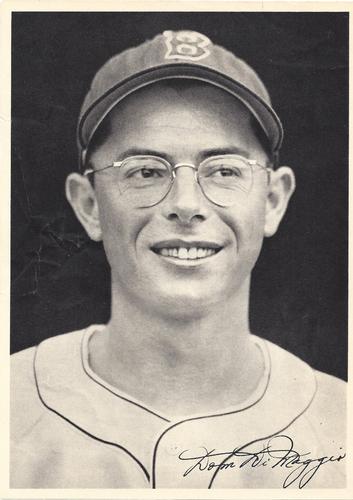
Photo credit: Dominic DiMaggio, Trading Card Database.
Sources
In addition to the sources cited in the Notes, the author consulted Baseball-Reference.com and Retrosheet.org for pertinent information, including the box score and play-by-play.
https://www.baseball-reference.com/boxes/NYA/NYA194605100.shtml
https://www.retrosheet.org/boxesetc/1946/B05100NYA1946.htm
Notes
1 The most recent streak of 15 or more games had been the 17 consecutive wins by the Philadelphia Athletics in 1931. The Yankees’ longest winning streak, 19 games, came in 1947. As of May 2026, the major-league teams with the lengthiest winning streaks of all were the 1916 New York Giants and 2017 Cleveland Indians, with 22 each. For a complete list by franchise, see “Each MLB franchise’s longest winning streak,” MLB.com, August 17, 2025. https://www.mlb.com/news/baseball-s-longest-win-streaks-c268160952
2 Both the characterization of the “implausibly hot” visitors and the attendance figures come from the New York Herald Tribune’s Red Smith, “Fans Found Stadium Scene Mighty Strange,” Boston Globe, May 11, 1946: 5. Official attendance was 55,889. More than 1,500 servicemen had free admission as well. The first 500 women were given free nylon stockings.
3 Joe Trimble, “Bosox Nip Yanks, 5-4, for 15th Straight Before Record 64,183,” New York Daily News, May 11, 1946: 25.
4 Hy Hurwitz, “Woburn Hal Weafer’s Insult Spurs Red Sox to Sparkling Victory,” Boston Globe, May 11, 1946: 1, 4. The “insult” in question came after beefing about plate umpire Weafer’s interference call that granted Rizzuto first base in the fifth inning.
5 Louis Effrat, “64,183 see Red Sox Down Yankees, 5-4,” New York Times, May 11, 1946: 31.
6 Effrat.
7 A season later, the Yankees moved Page to the bullpen full-time, and he became one of the game’s most effective firemen of the late 1940s.
8 Trimble.
9 Jack Barry, “Yanks Have Now Read, Heard and Seen Sox,” Boston Globe, May 11, 1946: 5.
10 Leonard Cohen. “The Sports Parade,” New York Post, May 11, 1946: 18.
11 Gene Mack, “Can’t Win Em All,” Boston Globe, May 12, 1946: 32.
Additional Stats
Boston Red Sox 5
New York Yankees 4
Yankee Stadium
New York, NY
Box Score + PBP:
Corrections? Additions?
If you can help us improve this game story, contact us.