
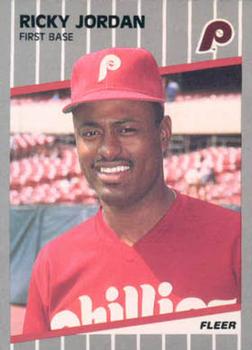
Ricky Jordan
Over 23,000 men have appeared in at least one major league baseball game. Fewer than 140 of those men have hit a home run in their first at-bat and just seven have done it while wearing a Philadelphia Phillies uniform.1 Ricky Jordan became the fourth member of that exclusive set when he homered in his first at-bat on July 17, 1988.2 That home run kicked off a rookie season in which Jordan collected 84 hits in 69 games and came in eighth in the NL Rookie of the Year Award voting. Later in his career, the first baseman was known for his pinch-hitting prowess. During 150 at-bats as a pinch-hitter for the Phillies, Jordan collected 43 hits and 24 RBIs. His .287 batting average in that role is the fifth best in Phillies history.3 Jordan was a member of the Philadelphia Phillies squad that won the National League pennant in 1993.
Paul Scott “Ricky” Jordan was born on May 26, 1965, in Richmond, California. He was adopted soon after birth but the father in the family who adopted him passed away when he was five. A youth sports coach encouraged his athletic endeavors, and he became a baseball star at Grant Union High School in Sacramento, California.4 “From the time I played in Little League on, I always wanted to be a major leaguer. I was kind of hungry, I guess you could say. It wasn’t that we lived in the projects or anything, but we were far from rich,” Jordan remembered.5
He was taken by the Phillies in the first round of the 1983 draft. Philadelphia’s scouting director, Jim Baumer, commented, “As for Jordan, he has real power potential. We’re excited about drafting him.”6 Jordan decided to forego college and spent most of the next five seasons in the Phillies’ minor league system. He didn’t regret that decision. “I got a lot of experience playing in the minor leagues and I’m still young. I’m pretty happy…I just go out and play hard every day, don’t think about what day it is, or how many years I’ve been in the minors or nothing,” he said.7
Jordan moved up to the organization’s Triple-A affiliate in Maine at the start of the 1988 seasonn. He played well there; his .308 batting average at the All-Star break in mid-July was third best in the International League.8 Philadelphia called him up after first baseman Von Hayes was placed on the disabled list. The 23-year-old Jordan made his debut at Veterans Stadium on July 17 against the Houston Astros. After reaching base with a walk in his first big-league plate appearance in the bottom of the second, Jordan came to bat in the fourth with runners at the corners. He pulled the first pitch he saw from fellow Californian Bob Knepper over the left-center field wall to become the 33rd National League player to hit a home run in his first official at-bat. Jordan called it a dream come true.9
The rookie continued his heroics the next day in the second game of a doubleheader against Atlanta. Germán Jiménez, making the fourth start of his major-league career for the Braves, had pitched five perfect innings when Jordan stepped into the box to lead off bottom of the sixth. He singled to break up the no-hitter and scored the first run of the game on a hit by Phillies starting pitcher David Palmer. Jordan flashed his power again the next inning with a home run in his second consecutive game. The memorable start to his career continued with another three-run homer off Knepper in Houston on July 22 and his first three-hit game on July 27, which included going 2-for-3 against 1985 Cy Young Award winner Dwight Gooden. He finished his rookie campaign with 11 home runs and 43 RBIs. In a statistical coincidence, Jordan had the same batting average, .308, with the Phillies in 1988 as he did in Triple-A earlier that season.
Jordan didn’t sit on his laurels during the off season. He played winter ball in Puerto Rico and helped Indios de Mayagüez win the league championship.10 The team’s manager, Tom Gamboa, had this to say about Jordan: “He has tremendous work habits. One time we had three days in a row off so I scheduled optional workouts at 10 a.m. He’s hitting .407 and when I get to the park he’s in uniform and sitting in the dugout.” When Gamboa asked him why he was there, Jordan said he has a good stroke and didn’t want to lose it.11
He was hopeful about the upcoming 1989 season. “I definitely have more confidence this year. I’ve come in here with a real opportunity. They’ve told me it’s my job to lose,” he said.12 But Jordan struggled at the plate in spring training and was hampered by an injury to his left wrist he sustained sliding into second shortly before the start of the regular season.13 Hayes started at first for the Phillies on Opening Day, but Jordan came in as a pinch-hitter in the sixth. His bases-loaded single drove in two runs that cut the deficit to one run in an eventual loss. Hayes and Jordan shared starts at first base over the first month of the season, but Jordan became the Phillies’ regular first baseman in early May.
Despite getting regular playing time in May, Jordan struggled to recover his form from the previous season. He batted .239 for the month and had just one home run and a .244 overall batting average at the end of May. But as the weather heated up, so did Jordan. He batted .289 in June and put three balls over the fence. At the end of the month Jordan had a seven-game hitting streak in which he collected 11 hits. His hot streak continued into July – he had hits in 11 of his last 12 games as of July 3 to increase his average to .268. He attributed the improvement to a change in his stance. “I’m trying to get back to that little crouch I had last year,” he said. “I was chasing a lot of bad pitches and getting myself out. I’ve been getting a few more hits lately, but I’m glad I’m starting to drive the ball a little more. You can’t be a first baseman and just hit singles.”14
More evidence of Jordan’s improvement came in the form of two career bests over the next month. The Phillies were in Cincinnati on July 19 with southpaw Tom Browning on the mound for the Reds. Jordan came to bat five times in the contest. The results were: single, single, home run, single, and double. It was the only five-hit game of his career and the first of just six games where he scored three runs. Jordan was a triple shy of hitting for the cycle.
Less than a month later the Dodgers were in Philadelphia for a three-game set. During the first game on August 15, Jordan came to bat in the bottom of the fourth with the Phillies trailing by three and a man on first. His two-run homer reduced the deficit to a single run. The score was tied at 6-6 when Jordan stepped into the box to lead off the bottom of the eighth. His second home run of the game proved to be the difference in Philadelphia’s victory. It was the first of just two games in his career where he hit two long balls. He attributed the result to his wrist being fully healed and a change in his mindset. “I’m not a home-run hitter. I’m a line drive hitter and when I’m hitting like that some home runs are going to come,” he maintained. “I have to always remind myself that I can’t try to hit home runs.”15
Jordan finished the 1989 season with a .285 batting average, a dozen home runs, and a career-high 75 RBIs in 144 games. He was especially effective batting with the bases loaded, leading the league by going 4-for-7 with a .571 average.16 Assessing what the Phillies learned that year, general manager Lee Thomas opined, “We found out that Ricky Jordan is a legitimate player who could be a good RBI man for years to come.”17
He was good off the field as well as on it. After the season, Jordan agreed to visit a Philadelphia neighborhood to meet some kids. He was greeted by about 50 shouting children with items to sign. Jordan stayed to sign every piece and then hit flies to the kids before playing basketball with them. Asked about his personal habits, he revealed he didn’t chew tobacco or drink alcohol. One of the parents who watched this unfold wrote, “Thank you, Mister Jordan. Watching the joy you brought to these youngsters was very satisfying and erased from my memory all the negative articles I have been reading on professional athletes.”18
Despite a 32-day lockout in February and March 1990 that wiped out most of spring training, Jordan was optimistic about the upcoming campaign. “I’m really looking forward to this year. If I can go a full season without getting hurt, I really can’t wait to see what I can do,” he said.19 He started at first base on Opening Day and began the season with a four-game hitting streak. Jordan collected hits in five straight games in late April before a case of severe stomach cramps caused him to miss a few games.
However, he made up for lost time when he got back in the lineup. His first home run of the season was memorable. On May 6, the Dodgers were in Philadelphia with a 5-3 lead at the seventh-inning stretch. In the home half of the seventh, Jordan stepped to the plate with the bases loaded and sent the first pitch he saw from Tim Crews over the left-field wall. It was the first grand slam of his career and gave the Phillies a lead they would not relinquish. Asked about his mindset when he stepped to the plate, Jordan replied, “I was just thinking about getting the ball into the air to at least get one run home. I was just happy that I stayed back on the ball because I had been jumping at some balls, making outs because I was a little too anxious.”20
Jordan went into a batting slump over the next month that lowered his batting average from .318 on May 12 to .256 on June 10. The next day, he sprained his previously injured left wrist on a checked swing; it kept him out of the lineup until July 4.21 His slump continued over the next month, and he was sent down to Triple-A in mid-August, playing in 27 games before being recalled early in September. But he couldn’t shake the slump and finished the season with a .241 batting average and five homers in 92 games.
Jordan’s lack of production was frustrating for the ballclub. At the end of the season, manager Nick Leyva observed, “I wish Ricky Jordan would have done better. It didn’t seem like he improved, he went backwards. When he gets into the heat of battle, he reverts back to his old ways.”22 On the eve of spring training in 1991 Leyva added, “We have to know which Ricky Jordan we’ve got. Is it the guy who did so well a couple of years ago? Or is it the guy who hasn’t been healthy the last couple years?”23 For his part, Jordan decided to go back to the way he used to hit, being aggressive and going the other way to find his stroke again.24
During spring training, John Kruk, as a prelude to his first All-Star selection that season, outhit Jordan to earn the starting job at first base. Kruk started at first base during the opening 10 games of the season, but the two men shared starting duties for the rest of the April. Jordan put a temporary end to that platoon system in early May. A five-game hitting streak increased his batting average to .375 and Jordan collected four RBIs in two consecutive games. On May 8 in San Diego, he turned a one-run deficit into a three-run advantage with one swing of the bat. It was the second (and last) grand slam of his career. The following day he went 4-for-5 with two homers and four RBIs. The outburst earned Jordan most of the starting assignments at first base over the next two months.
However, it was becoming apparent that Jordan was much more effective against left-handed pitching than he was against righties. Over the course of the season he hit .310 versus southpaws compared to .246 when a right hander was on the mound.25 Therefore, Jordan’s role over the last few months of the season became pinch-hitting against left-handers and starting at first when a southpaw was on the mound for the opponent. He did well in pinch-hitting situations, batting .321 (9 for 28) during the season.26 The team didn’t lose much from a defensive standpoint when Jordan was used as a pinch-hitter. His career .993 fielding percentage at first base was very close to the league average fielding percentage of .992.
But Jordan didn’t like the situation because he wanted to be an everyday player. His position with the team became even murkier when Philadelphia signed Kruk to a three-year contract in September 1991. “I’m not going to say, ‘Get me out of here,’” said Jordan. “If it doesn’t happen, I’ll do what I did this year. But it would be real tough, because there are places I could go to play every day. It’s not like my skills are deteriorating,” he declared. General manager Thomas said the club still wanted Jordan and had no intention of trading him just because of the Kruk signing.27
Jordan began spring training in 1992 by going 5-for-14 (.357) with a home run. But his good start was aborted when he was hit in the face by a line drive while taking fielding practice. The liner broke his jaw in two places and kept him out of the lineup until May.28 He made his 1992 debut as a pinch-hitter on May 11 and started at first base two days later. On May 15 Jordan hit his first home run of the year, a three-run shot off Scott Ruskin in Cincinnati. But he was streaky at the plate and couldn’t find his power stroke over the rest of the season, finishing with just four long balls. He . A burst in June increased his batting average to .306 on June 17, but that mark was down to .243 at the end of July. A 12-game hitting streak at the end of the season drove his batting average up to .304 overall. Another highlight that year was a steal of home off Bret Saberhagen on September 29.
Unfortunately for Jordan, Kruk was repeating as an All-Star. Jordan was relegated to the same role he played most of the previous year. But Jordan wanted to play every day and asked to be dealt before the trade deadline.29 Nothing came of that, so he soldiered on, but Jordan wasn’t happy about the situation. During his hitting streak at the end of the season, he remarked, “I’m just playing for myself right now. I know John Kruk is the first baseman here and that’s fine. He should be. I might not be an all-star, but I know I’m a capable player, know I can hit.”30
Jordan used the leverage he’d gained from his fine finish to the 1992 season to earn a $1 million contract for 1993. But he’d become philosophical about having limited playing time behind Kruk. “It’s been the same thing for the last few years, so I’m kind of used to it by now,” he said. “So, I’m not going to worry about it. I’m just going to do what I can to try to help this team win. I’ve come to realize that you never really know in this game. We’ll just have to see what happens.”31
Indeed, he helped the team win. Jordan got hits in his first two pinch-hitting opportunities of the season; walks in his next three plate appearances as a pinch-hitter left him with a 1.000 batting average into mid-April. He made his first start at first base on April 27 and went 3-for-4 with his first homer of the season. Jordan went 3-for-4 the next night too. At the end of the opening month the Phillies were 8-5 in games in which Jordan had appeared.
About two months later, Jordan’s three-run homer against the Padres on July 2 helped the Phillies overcome a 5-0 deficit in an extra-inning victory. The win put Philadelphia six games ahead of St. Louis and the team stayed in first place in the NL East for the rest of the season. Jordan appeared in 61 games as a pinch-hitter, batting .302 in that role. He also played 33 games at first base.32
Philadelphia took on Atlanta in the National League Championship Series. Jordan appeared as a pinch-hitter in the Phillies’ Game Two loss and worked a walk off future Hall of Fame pitcher and reigning Cy Young Award winner Greg Maddux. He also made a pinch-hitting appearance in the pennant-winning Game Six victory but grounded out with the bases loaded to end the seventh inning. The win earned Philadelphia its first trip to the World Series since a loss to Baltimore in 1983. Jordan was the designated hitter in Game One of the Fall Classic against the Toronto Blue Jays and went 1-for-5 in the opening game loss.
He went 1-for-4 as the designated hitter in the Phillies’ Game Two victory that evened the series, but when the series moved to Philadelphia for Game Three (without a designated hitter) Jordan was out of the lineup. Asked about his experience as a designated hitter, Jordan said, “I think I could have fun with it. It uses another player off the bench and gives him an opportunity. I think I could handle it.”33 Jordan made his final appearance in the World Series as a pinch-hitter in Game Four, grounding out in the fifth inning.
Despite rumors that he would be traded after the 1993 season, Jordan was back with the Phillies in 1994. He signed a one-year contract for $1.1 million in January, but he chafed about still being in Philadelphia when spring training opened. “I don’t want to disrupt anything, but a year ago I knew I wasn’t going to play much and that was cool. Well, it’s not cool anymore. I’m not happy. I’m very surprised to be here. And somewhat disappointed.”34
Even so, Jordan didn’t let it affect his on-field performance. He played well during spring training, batting .373 after going 4-for-4 on March 27 and he started at first base on Opening Day with Kruk on the disabled list.35 His bat stayed hot early in the season – he collected six hits in his first four games. After Kruk returned to make his first start on April 11, he and Jordan shared first base duties during the strike-shortened season.
May was Jordan’s best month that year. He went 4-for-5 with his first home run of the season on May 8 and 3-for-4 with another long ball two days later. During the month, he played in 24 games, collecting 27 hits – including four homers – for a .314 average, driving in 17 runs. The outburst included an eight-game hitting streak late in the month.
He didn’t play as well in June or July, though, and was batting .282 with eight home runs when the players’ strike ended the season. Given that Jordan had been playing behind Kruk for a few years, it’s notable that he hit more homers than Kruk, who finished the aborted season with five. However, Kruk had a higher batting average than Jordan, .302.
An off-the-field incident in July revealed Jordan’s appreciation for the history of the sport he loved. Willie Mays accompanied the San Francisco Giants to Philadelphia for a three-game series in mid-month. Before the first game of the series Mays signed baseballs for a few of the Phillies players. Jordan was excited to get the legendary player’s autograph.36
He became a footnote to history himself about a month later. The players went on strike after play on August 11. Jordan’s walk-off single against the Mets in the 15th inning was the final hit of the Phillies’ season. It was also Jordan’s last hit while wearing a Philadelphia uniform.
Jordan became a free agent after the season, but like many free agents in early 1995, he was not picked up by another club. He had to settle for signing a minor-league contract with the California Angels and played for their Triple-A affiliate that season. The Seattle Mariners purchased his contract from the Angels during spring training in 1996. Jordan batted .280 for Seattle through May 1 but then missed four months with a shoulder injury.37 He never played in the big leagues again after the Mariners released him following the 1996 season. His pro career ended after playing 52 games in Class AA for the Pittsburgh Pirates organization in 1997.
After his playing days were over, Jordan returned to Sacramento, California, where he ran a tile company with his stepfather as well as working on other business ventures. He coached a travel baseball team and participated in events for the Phillies such as baseball fantasy camp.38 Jordan has also been involved in the Darren Daulton Foundation. Daulton was Jordan’s teammate on the Phillies; after Daulton passed away from brain cancer in 2017, Jordan became an ambassador for the Foundation. Jordan is passing along his hard-won baseball knowledge to aspiring major leaguers as a pro advisor at the Sportstime Baseball Academy in Northern California.
Jordan and his wife Keanna have a son (Justin) and a daughter (Ashley). He was inducted into the Sacramento Sports Hall of Fame on February 5, 2026.
Last revised: May 20, 2026
Sources
In addition to the sources cited in the Notes, the author also consulted Baseball-reference.com, Retrosheet.com, MLB.com, and SABR.org.
Acknowledgments
Many thanks to SABR members Gregory H. Wolf and Rory Costello. Their careful reading of this biography and the modifications they suggested significantly improved the final product, which was also reviewed by Alan Cohen and fact-checked by Dan Schoenholz.
The author is not related to Ricky Jordan.
Notes
1 As of opening day 2026.
2 The other Phillies to hit a home run during their first at-bat are: Bill Duggleby, April 21, 1898, Heinie Mueller, April 19, 1938, Ed Sanicki, Sept. 14, 1949, Marlon Anderson, Sept. 8, 1998, Weston Wilson, Aug. 9, 2023, and Felix Reyes, April 18, 2026. The list is taken from Ed Eagle, “Players With Home Run in First At-bat, MLB.com, September 12, 2025, https://www.mlb.com/news/home-run-in-first-at-bat-c265623820.
3 Jordan’s pinch-hit data generated by Stathead at Baseball-Reference. For example, the Stathead query for his at-bat total is https://www.sports-reference.com/stathead/tiny/nV6ix.
4 “Ricky Jordan Facts for Kids,” Kids.kiddle.co, accessed November 20, 2025, https://kids.kiddle.co/Ricky_Jordan.
5 Paul Hagen, “Now, Everyone’s in Jordan’s Corner,” Philadelphia Daily News, February 27, 1989: 72.
6 Peter Pascarelli, “Phils Make First Pick a Slugger,” Philadelphia Inquirer, June 7, 1983: 4-F.
7 Bill Conlin, “The Rites of Swing,” Philadelphia Daily News, July 18, 1988: 91.
8 Peter Pascarelli, “Phillies Notes,” Philadelphia Inquirer, July 15, 1988: 3-D.
9 Ed Eagle, “Players With Home Run in First At-bat, MLB.com, April 18, 2026, https://www.mlb.com/news/home-run-in-first-at-bat-c265623820.
10 “Indios de Mayagüez,” Baseball-Reference/Bullpen, accessed November 23, 2025, https://www.baseball-reference.com/bullpen/Indios_de_Mayag%C3%BCez#Year-by-Year_Record.
11 Paul Hagen, “Jordan Not Letting His Bat Get Cold Over the Winter,” Philadelphia Daily News, February 16, 1989: 74.
12 Paul Hagen, “Now, Everyone’s in Jordan’s Corner,” Philadelphia Daily News, February 27, 1989: 72.
13 Peter Pascarelli, “Phillies Notes,” Philadelphia Inquirer, March 30, 1989: 8-D.
14 Paul Hagen, “Phils Bury Dead Reds,” Philadelphia Daily News, July 20, 1989: 82.
15 Peter Pascarelli, “Jordan Powers Phillies,” Philadelphia Inquirer, August 16, 1989: 1-C.
16 Peter Pascarelli, “A’s Look Good for the Long Haul,” Philadelphia Inquirer, October 15, 1989: 7-E.
17 Peter Pascarelli, “Phils Made Improvements But More Are Needed,” Philadelphia Inquirer, October 2, 1989: 4-C.
18 Robert R. Moss, “Letters to the Editor,” Philadelphia Inquirer, November 15, 1989: 9-BR.
19 Paul Hagen, “New Attitude,” Philadelphia Daily News, March 27, 1990: 78.
20 Paul Hagen, “Jordan Slams Door on LA,” Philadelphia Daily News, May 7, 1990: 86.
21 Paul Hagen, “Jordan Sprains Wrist, Joins Lengthy Injury List,” Philadelphia Daily News, June 12, 1990: 79.
22 Ted Silary, “Thomas, Leyva Liked What They Saw,” Philadelphia Daily News, October 4, 1990: 87.
23 Paul Hagen, “Phillers,” Philadelphia Daily News, February 22, 1991: 104.
24 Jason Stark, “Future Shock,” Philadelphia Inquirer, February 27, 1991: 6-D.
25 Baseball-Research Stathead searches: https://www.sports-reference.com/stathead/tiny/ZvYCx and https://www.sports-reference.com/stathead/tiny/utZMr.
26 Baseball-Research Stathead search https://www.sports-reference.com/stathead/tiny/g7OQ3.
27 Paul Hagen, “Despite Kruk Deal, Phils Still Want Jordan,” Philadelphia Daily News, September 16, 1991: 86.
28 Frank Fitzpatrick, “Jordan is Injured at Practice,” Philadelphia Inquirer, March 12, 1992: 1-D.
29 Paul Hagen, “Phillers,” Philadelphia Daily News, July 28, 1992: 67.
30 Frank Fitzpatrick, “Kruk to Undergo Surgery; Howell’s Future Uncertain,” Philadelphia Inquirer, October 2, 1992: D3.
31 Paul Hagen, “Jordan’s Content to Wait for Chance,” Philadelphia Daily News, March 4, 1993: 74.
32 Baseball-Research Stathead search https://www.sports-reference.com/stathead/tiny/cQb40.
33 Joe Juliano, “World Series Notes: Call Him DH Jordan,” Philadelphia Inquirer, October 19, 1993: C8.
34 Paul Hagen, “Jordan Disappointed to Still be a Phil,” Philadelphia Daily News, February 25, 1994: 108.
35 Sam Donnellon, “Phillers,” Philadelphia Daily News, March 28, 1994: 81.
36 Bill Conlin, “Don’t Look Now but Bonds is Getting Hot,” Philadelphia Daily News, July 19, 1994: 71.
37 “Cleveland Rocks Mariners Twice: Notes,” Spokesman-Review (Spokane, Washington), May 4, 1996: C4.
38 Martin McNeal, “Former Philly Jordan’s First Love was Basketball,” Sacramento Bee, September 18, 2008: C2.
Full Name
Paul Scott Jordan
Born
May 26, 1965 at Richmond, CA (USA)
If you can help us improve this player’s biography, contact us.