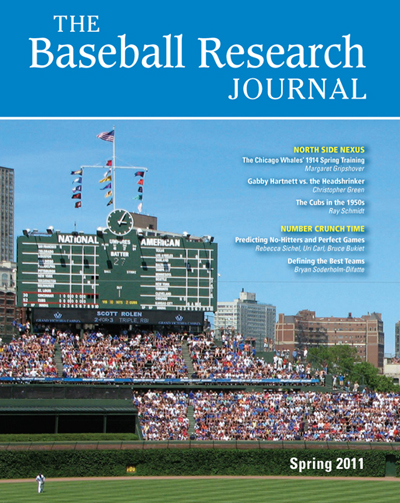
Spring 2011
Volume 40, Issue 1
-
A Baseball with a Story: Fireworks in Philadelphia, July 4, 1911
This is the story of a remarkable day in baseball, one that occurred exactly a century ago. The retelling of this tale began 26 years ago when the author discovered and purchased the baseball that he now keeps displayed above his fireplace.
-
Sid Loberfeld: Brooklyn’s Early Radio Baseball Broadcaster
In the history of New York baseball broadcasting, Sid Loberfeld is as far removed from Red Barber and Mel Allen as Crash Davis is from Babe Ruth. But Loberfeld holds a distinction that he was reluctant to discuss. Back in the early 1930s, when barely out of his teens, he was — ever so briefly — a radio play-by-play man for the Brooklyn Dodgers.
-
Surprise Swings at Intentional Balls
Compiling an in-progress list of all known instances of a batter taking a swing while being walked intentionally.
-
The Infinitely Long MLB Plate Appearance
A standard baseball plate appearance, with its strategic mix of balls, strikes, and foul balls can — mathematically — take an infinitely long time to complete … in fact, four times infinitely long to complete, which is just infinitely long. Here's how.
-
Choosing Among Winners of the 1981 AL ERA Title
The strike-shortened 1981 season resulted in confusion as to who had the lowest earned run average in the American League. Three different pitchers have a legitimate argument for who was the league leader in ERA that year.
-
The Marathon Game: Endless Baseball, its Prelude, and its Aftermath in the 1909 Three-I League
For 57 years, the Bloomington Bloomers and Decatur Commodores of the Three-I League held the distinction of playing the longest completed professional ballgame in the United States.
-
Interesting Inter-American League Items
This article is a sidebar to John Cronin's "When a Dream Plays Reality in Baseball: Roberto Maduro and the Inter-American League", Baseball Research Journal, Spring 2011.
-
When a Dream Plays Reality in Baseball: Roberto Maduro and the Inter-American League
Before the 1970s, nearly all minor-league teams had an affiliation with a major-league team. The one exception during that era was the Inter-American League, a true “indie” which began play in the 1979 season. The realities, however, of independent baseball — the need for purposeful marketing and business development, a developed fan base and low overhead costs — put the IAL in jeopardy from the outset.
-
Observations of Umpires at Work
On September 10, 2010, a group of SABR members watched a ballgame in an unusual way: They watched the umpires — and only the umpires. Afterward, they met with two of the umpires to discuss their observations and resulting viewpoints.
-
The Longest Streaks of Consecutive Games in Which a Detroit Tiger Has Scored a Run (1920–44)
Having firmly established an accurate, official game-by-game runs-scored database, here is the longest Consecutive Games Run Scored (CGRUNS) streak achieved by each Detroit Tigers player in each season during the period from 1920 through 1944. Some of the results of Krabbenhoft's CGRUNS streak research are described in this article.
-
The Authorized Correction of Errors in Runs Scored in the Official Records (1920–44) for Detroit Tigers Players
The run is the most fundamental and the most important statistic in baseball. Regrettably, clerical errors have been made in the process of crediting the runs scored by the individual players in MLB’s official records. This article presents results from a comprehensive investigation of the accuracy of the official baseball records for runs scored by Detroit Tigers players.
-
Modeling Perfect Games and No-Hitters in Baseball
Through Major League Baseball’s first 134 years, 1876–2009, some of its most interesting and uncommon events have been the 260 no-hitters (18 of which have been perfect games. In 2010, pitchers threw six no-hitters, two of which (and almost a third) were perfect. In this paper, we investigate whether simple mathematical models can explain the frequency of perfect games and no-hitters over the years. We also investigate whether the pitchers who actually pitched the perfect games were those who “should have been expected” to do so.
-
Now I Can Die In Peace
Any Red Sox fan with a few years under their cap identified with Cubs fans. Even if they couldn’t name a single player in the NL Central, Red Sox fans knew in their hearts that the Cubs were “their” National League team. Until 2004.
-
Why A Curse Need Not Be Invoked To Explain The Cubs' Woes
The most striking facet of the Chicago Cubs’ long-term underachievement has been the team’s lack of World Series success. But just how improbable is the Cubs’ run of failure in the Fall Classic?
-
29 Years and Counting: A Visit With Longtime Cubs Scout Billy Blitzer
The 2011 season marks Billy Blitzer’s 29th consecutive year scouting for the Cubs, a rarity in these days of rapid turnover when too many owners and team managements are looking for quick fixes and think the development process can be miraculously speeded up.
-
Growing Up With The 1950s Cubs
For a youngster passionately devoted to baseball and living on the north side of Chicago during the 1950s, every summer revolved around the fortunes of the Chicago Cubs and getting to Wrigley Field as often as possible. There, in a ballpark that dominated the immediate neighborhood, we were always swept up by the most colorful and exciting surroundings our young imaginations could handle.
-
The Chicago Cubs and 'The Headshrinker': An Early Foray into Sports Psychology
In addition to cultivating the image of being a progressive business leader, Cubs owner Philip K. Wrigley was known as a bit of a crank. So, when he hatched the idea to bring in a university psychologist to work with the Cubs, no one was sure whether Wrigley’s scientific side or his more instinctive “outré” dynamic was actually at work.
-
Wrigley Field: A Century of Survival
Wrigley Field’s idyllic charms—the ivy, hand-operated scoreboard and bleacher sunshine—belie a tenuous past. The North Side ballpark, in fact, is lucky to be around at all.
-
Weathering Spring Training: The Chicago Federals in Shreveport, Louisiana, 1914
This article examines the factors contributing to the Chicago Federals’ troubles during the 1914 spring training season, particularly due to geographic location and weather. The outcomes of the Chifeds’ (one of many team nicknames) 1914 spring training influenced not only the team’s fortunes, but also owner Charles H. Weeghman’s.
-
The 1906-10 Chicago Cubs: The Best Team in National League History
Once upon a time, the Chicago Cubs dominated the world. They were the best team in baseball not just for the one incredible year of 1906, but for five years, winning nearly 70 percent of their games, four National League pennants, and two World Series.
-
Chicago's Role in Early Professional Baseball
Most Cubs fans with historical interest know that the Chicago club was once a powerhouse. If any 1880s franchise could have been called an “evil empire” it would have been Chicago. Less widely known is the club’s earlier role in creating and preserving the enterprise of professional baseball as we know it.
-
The Cubs Fan Paradox: Why Would Anyone Root For Losers?
Cubs fans raise a fundamental question about the nature of games and spectatorship. It seems paradoxical for a franchise that hasn’t won a World Series since 1908, or a National League pennant since 1945, to have such a large, loyal, and vocal fan base, not just on the North Side of Chicago but nationwide.
-
Arms and the Man
On "High Heat: The Secret History of the Fastball and the Improbable Search for the Fastest Pitcher of All Time"
-
Beating the Bushes
On "Cougars and Snappers and Loons (Oh My!): A Midwest League Field Guide"
-
The Italian Immigrants' Game
On "Beyond DiMaggio: Italian Americans in Baseball"
-
Henry Chadwick Award: J.G. Taylor Spink
As publisher of The Sporting News from 1914 until his death in 1962, Spink oversaw production of a weekly newspaper so indispensable to the baseball fraternity that it was venerated for decades as the “Bible of Baseball.”
-
Henry Chadwick Award: Clifford S. Kachline
One of SABR's founding members and its first Executive Director, Kachline served as historian at the National Baseball Hall of Fame and left an indelible mark on baseball research.
-
Henry Chadwick Award: John B. Holway
Holway is the author of many notable books on the Negro Leagues, perhaps most notably "Voices from the Great Black Baseball Leagues."
-
Henry Chadwick Award: Sean Forman
Forman is the founder of Baseball-Reference.com, which has become the game's premier statistical website.
-
Henry Chadwick Award: Charles C. Alexander
Alexander has written numerous books on baseball history, including the first scholarly biographies of Ty Cobb and John McGraw.