

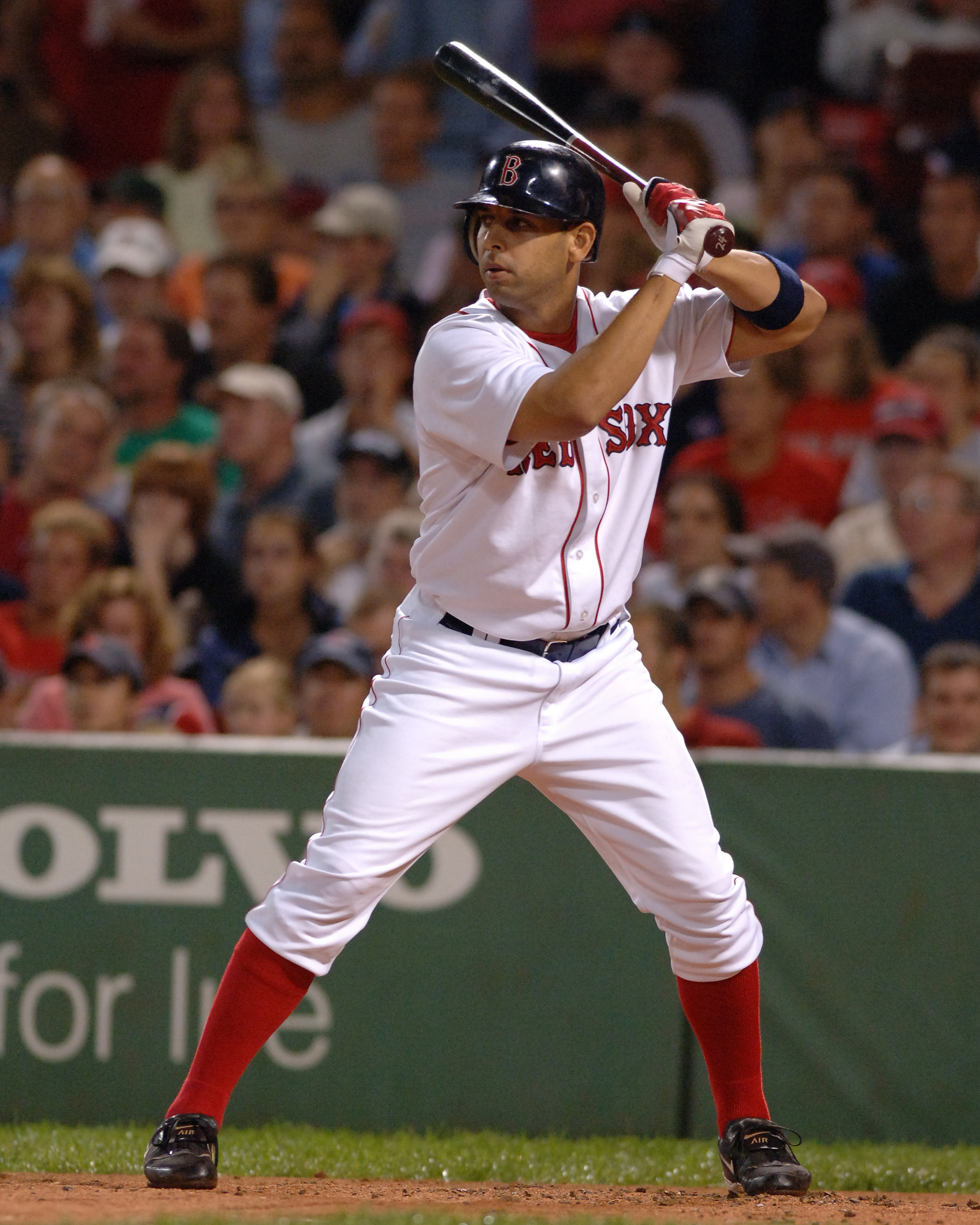
Alex Cora
“That is one of finest at-bats that I have ever seen!” announced Vin Scully on May 12, 2004. “And then to top it all off with a home run, that is really shocking.” Los Angeles Dodgers shortstop Alex Cora just hit a home run off Chicago Cubs right-hander Matt Clement in an 18-pitch at-bat. Cora justly took a curtain call from the Dodger Stadium crowd. Scully agreed, “Yeah take a bow, Alex! You deserve it and then some!”1 The scoreboard at Dodger Stadium flashed a message: “Now that’s an at-bat!”2
Alex Cora, infielder from a Puerto Rican family, graduated from the University of Miami and was drafted by the Los Angeles Dodgers. He had achieved a rare feat.
José Alexander Cora, known as Alex, was born on October 18, 1975, in Caguas, Puerto Rico. He grew up in a baseball family and followed in the footsteps of older brother Joey (José Manuel) in the little, minor, and major leagues.
By the time Joey starred at Vanderbilt University, Cora won the Mustang (ages 10–11) level tournament MVP Award. He earned two mound victories for the Kool-Aid Caguas Villa Nueva, outmatching his peers with “a repertoire of fastballs and curveballs.”3 Wise beyond his years, he noted, “I’m in pretty good shape and was prepared to play in the tournament…my manager…teaches us pitches.”4 A few days earlier, an article added the suffix “Joey’s brother” as it lauded his two-hit, seven-strikeout victory over the Hawaiian team.5 To gain an advantage at the plate, he learned to hit left-handed, a preference he kept throughout his career.
He attended Bautista High School and soon after graduating in June 1993 he was drafted in the 12th round of the free-agent draft by the Minnesota Twins. Instead, he enrolled at the University of Miami and in each of his three seasons playing for the Hurricanes, Cora helped lead the team to the College World Series. (In 1996 the Hurricanes went to the final, losing to Louisiana State, 9–8, despite Cora’s three hits and three RBIs.) That season Baseball America rated Cora the best defensive player in the college game.6 He was inducted into the University of Miami Hall of Fame in 2006.
Cora’s college efforts were rewarded when, on June 4, 1996, the Los Angeles Dodgers drafted the 6-foot, 200-pound left-handed batter in the third round. Brother Joey was already in his ninth major-league season, playing second base for the Seattle Mariners, and Alex signed 10 days later.
Alex rose rapidly through the Dodgers farm system: Vero Beach in the high-A Florida State League for the rest of the 1996 season, San Antonio of the Double-A Texas League in 1997, and Triple-A Albuquerque (Pacific Coast League) in 1998. In June of 1998 he was called up to the Dodgers and made his major-league debut on June 7 in a game at Seattle, whose leadoff batter was brother Joey, playing second base. With the Dodgers leading, 7–1, Alex replaced Eric Young at second base in the bottom of the eighth. He led off in the top of the ninth and was caught looking at three strikes. Brother Joey was 2-for-5.
For the next two seasons Alex bounced between Albuquerque and the Dodgers. He came up for good in 2000, when he played in 109 games, batting .238 with four home runs and 32 RBIs. Cora was a regular for the Dodgers through 2004, playing mostly shortstop in 2000 and 2001 then second base after his double-play partner Mark Grudzielanek was traded to the Chicago Cubs. In 2003 he led the National League by turning 112 double plays and in putouts with 286.
Cora’s home run to climax an 18-pitch at-bat on May 12, 2004, was a rare feat in major-league baseball. Of his battle with Matt Clement, a stalwart of the Cubs pitching rotation, Cora said, “It was tough; he was throwing good pitches. When they put it on the scoreboard [as the string of consecutive fouls built], that put me under a little bit of pressure. I had to stand back and regroup.” He drove a 2–2 pitch into the bullpen in right to put the Dodgers up, 4–0, in the seventh.7 How rare is an 18-pitch at-bat? Paul Swydan in an article in Hardball Times commenting on a 14-pitch at-bat wrote that an 18-pitch at-bat happened only four times in the major leagues, 1988–2013. Cora’s at-bat was one of the four times.8
Cubs manager Dusty Baker called it a “heck of an at-bat,” but didn’t necessarily approve of the way Cora reacted. “He kind of spoiled it a little bit at the end by flipping the bat,” Baker said. “He won the battle already, so you don’t rub it in. But that’s modern stuff, I guess.” The next day, May 13, Alex Cora was hit by a pitch.9
That 2004 season was the last one in which Cora played 100 or more games, though he hung around in utility roles until 2011. The Dodgers made the playoffs in 2004, Cora’s first postseason appearance. He played in all four games in the National League Division Series against the eventual National League champion St. Louis Cardinals. He tripled and drove in a run in Game One, but had only one other hit in 16 plate appearances.
After the 2004 season Cora signed a two-year free-agent deal with the Cleveland Indians. Indians general manager Mark Shapiro said, “Alex is overqualified to be called a utility player and has the upside to be a starter. He should get a chance to start 50, 60 games.”10
Cora played in 49 games for Cleveland and batted .205. On July 7, 2005, he was traded to the Boston Red Sox for Ramón Vázquez. In Boston, Cora was seen as the backup shortstop for Édgar Rentería. The shortstop position had been a revolving door for the Red Sox since Nomar Garciaparra left in a July 2004 trade-deadline deal with the Chicago Cubs. Cora played in 47 games with the Red Sox, batting .269, and helped hold the door, completing the remainder of the 2005 season with the Red Sox after a .205 mark with the Indians. He reached the postseason again, but played only briefly in the 2005 American League Division Series, with Rentería getting the bulk of the work. The Red Sox were swept, 3–0, by the eventual World Series champion Chicago White Sox.
Cora remained with Boston in 2006. Rentería had been a major disappointment for the Red Sox and he had been traded in the offseason to the Atlanta Braves. Cora played 96 games (63 at shortstop), batting .238 with one home run and 18 RBIs. He was a free agent after the season but re-signed with Boston on a two-year, $2 million deal. The team had, however, signed Julio Lugo to be the primary shortstop so Cora was assigned a backup role. In 2007 the Red Sox beat Cleveland in the American League Championship Series and swept the Colorado Rockies in the World Series. Cora played only briefly in the postseason, working in late-inning defense in three games. In his one plate appearance, in the ninth inning of Game Three of the World Series, he executed a sacrifice bunt to advance baserunner Mike Lowell.
Again backing up Julio Lugo in 2008, Cora was 2-for-11 in the postseason as the Red Sox defeated the Los Angeles Angels of Anaheim in the Division Series and fell in seven games to the Tampa Bay Rays in the ALCS.
A free agent again after the 2008 season, the 33-year-old Cora signed a one-year, $2 million deal with the New York Mets for 2009. He batted .251 while playing 82 games for the 70–92 Mets. He re-signed with the Mets for 2010. Batting .207, he was released on August 7.
Ten days later, Cora signed as a free agent with the Texas Rangers, but played in only four games and was released on September 7.
In February 2011 Cora signed a one-year deal for $900,000 with the Washington Nationals. He was 35 and nearing the end of his career. The deal included an invitation to spring training, but it was the lowest salary he had received since 2002 with the Dodgers. Cora batted .224 in 91 games in a backup role. The Nationals did not re-sign him after the season.
After the season with the Nationals, Cora played winter ball in Puerto Rico and contemplated retirement. He even announced his retirement officially once winter ball ended. However, the St. Louis Cardinals offered Cora a minor-league contract with an invitation to spring training,11 and he accepted the offer. But he played poorly in spring training and was released on March 25.12 He signed another last-ditch effort with the Detroit Tigers, but was released again, and retired as a player.
Cora thrived against Clement (7-for-18), Kevin Jarvis (8-for-18), Daniel Cabrera (13-for-30), Curt Schilling (9-for-24), and Brett Tomko (11-for-33). He was puzzled by Woody Williams (1-for-26), A.J. Burnett (1-for-22), Adam Eaton (7-for-39), and Roy Halladay (6-for-32). His offensive output (.243/.310/.338, 72 OPS+, or adjusted on-base plus slugging) trailed Joey’s (.277/.348/.369, 90 OPS+), but Alex’s defense yielded similar wins above replacement, or WAR (7.0 for Alex, 7.9 for Joey).
Cora played 14 seasons in the Puerto Rico Winter League (PRWL), all with his hometown Caguas Criollos. He led the league in triples, home runs, and runs scored in 2000–2001, the only time a player has paced all three categories in the same season.13
 Cora took a year off from the game but returned to other work in February 2013. ESPN hired him as a studio analyst for Baseball Tonight and SportsCenter, and as a Spanish-language broadcaster for ESPN Deportes.14
Cora interviewed for the San Diego Padres’ managerial opening, and also interviewed for manager of the Texas Rangers during the 2014 offseason. Media reports linked him to other big-league manager openings in Seattle, Miami, and Washington.15
On March 2, 2016, Cora was named general manager of Puerto Rico for the 2017 World Baseball Classic. In the press release, Cora said, “No matter what happens in the future, if I am leader of Major League Baseball or general manager, as people always say, I think being a team manager Puerto Rico goes beyond that. It is a unique experience, you do not dream to be general manager of your country.”16
On November 16, 2016, Cora was named the bench coach for the Houston Astros.17
His only season as a major-league bench coach ended with absolute perfection: a World Series ring with the Astros. On October 27, prior to Game Three, he was hired on a three-year contract as manager of the Boston Red Sox. “I’m going to bring a ring, and that’s the important thing.”18 He told Dan Shaughnessy of the Boston Globe that during the final days of the World Series win over the Dodgers, he’d told the Astros, “I want to win one with you guys. And then next year we kick your ass!”19
The accolade brightened a dark year, as Hurricane María ravaged Puerto Rico in mid-September. The worst natural disaster to strike the island, it provided the coup de grâce to infrastructure battered by Hurricane Irma earlier that month. Puerto Ricans in the mainland, including Cora, were incommunicado with their loved ones for weeks. In January 2018 he partnered with JetBlue and the Red Sox organization to bring 10 tons of relief supplies to the island, where thousands remained without electricity.
Cora and Dave Dombrowski, the Red Sox president of baseball operations and de facto GM, enjoyed a close relationship. Although the team was a preseason favorite, it exceeded expectations to finish 108–54, the best record in franchise history, led by MVP Mookie Betts. The Red Sox steamrolled the competition in the 2018 postseason with only three defeats. The Yankees, Astros, and Dodgers managed only a win apiece against the Boston juggernaut.
Cora finished behind the A’s Bob Melvin in Manager of the Year voting and was feted by the Puerto Rican Association of Sports Journalists with the Pedrín Zorrilla Award, given annually to the most distinguished Puerto Rican in the major leagues.20 He returned to the island, this time with the Commissioner’s Trophy, the first Puerto Rican-born manager to win the World Series.21
Some regression to the mean was expected in 2019, and the Red Sox dropped to 84–78, third place in the AL East, and missed the postseason. The offense was again formidable, with Xander Bogaerts (6.3 WAR), Betts (7.2 WAR), and Rafael Devers (5.4 WAR) among the top 12 MVP candidates. Pitching proved to be the Achilles’ heel as Chris Sale (4.40 ERA), David Price (4.28 ERA), and Nathan Eovaldi (5.99 ERA) each missed 10 turns in the rotation, while Rick Porcello (5.52 ERA in 32 starts) struggled. Only Eduardo Rodríguez reached 200 innings. As the defending World Series champion, Cora managed the AL to its seventh straight All-Star Game victory, but the team surprisingly fired Dombrowski.
Cora and the team sought redemption in 2020, but plans were altered by two earth-shattering developments. MLB’s investigation into the Houston Astros’ 2017 World Series-winning team concluded they had cheated using methods to alert their hitters. Revealed as the architect, Cora was suspended for a year. The COVID-19 pandemic then threw the season in disarray, and Boston finished 24–36 in the truncated season under Ron Roenickele ace Sale recovered from injury. Team leader Betts, traded prior to the season by new team president Chaim Bloom, thrived in the NL while Alex Verdugo and the rest of the players acquired in the Betts trade struggled with the Red Sox.
Cora returned to the dugout and led the 92–70 Red Sox to a wild card berth in 2021, aided by Sale’s August return. They beat the Yankees, a fellow wild card, in the one-game playoff, and dispatched the Tampa Bay Rays, the AL’s sole 100-win team, in the ALDS, in four games. Dreams of another World Series stirred Boston, but Cora’s ghost of postseason past stood in the way, and Houston triumphed in a hard-fought six-game ALCS.
The 2022 and 2023 seasons brought identical 78–84 last-place records despite different formulas. Bogaerts’s 5.7 WAR led the team in 2022, but he departed for San Diego the next season when the front office declined to seriously entice the homegrown star to remain in Boston. Trevor Story played a combined 137 games and struggled away from Coors Field. Sale missed all but two games in 2022 and posted a 3.80 FIP (fielding-independent pitching) in 2023, a career high. While the team avoided public clashes, fissures between Cora and Bloom on the organizational direction were apparent in roster construction. During the offseason, Cora was inducted into the Puerto Rico Sports Hall of Fame.22
A modest three-game improvement in 2024 brought scattered sunshine to Fenway. Devers continued to post stellar numbers while youngsters Ceddanne Rafaela, Jarren Duran, and Wilyer Abreu enjoyed breakthrough seasons. Pitching was again suspect, with three starters suffering double-digit losses. Craig Breslow, who replaced Bloom, sought to replenish the farm system, a move that sparked frustration for the skipper.
Boston’s topsy-turvy 2025 season saw the team sign Alex Bregman, an all-star third baseman, without considering the implications for Devers, the all-star incumbent, who was traded by mid-year. The team nevertheless improved to 89–73, and Cora placed fourth in Manager of the Year voting.
On April 25, 2026, hours after a 17–1 victory over the Orioles, the Red Sox fired Cora. Boston’s 10–17 record was last in the American League East despite multiple lineup changes to spark better play. Red Sox CEO Sam Kennedy noted that “AC’s impact on Boston and our city will be felt forever. The memories that we all shared from 2018 are gonna last a lifetime. He’s a friend to so many in Boston and across New England, so that contributed to making this a very difficult decision. And so we thank him and wish him well.”23
Players expressed frustration about the situation. Story lauded Cora and his staff as “some of the best coaches in the world…I felt like they didn’t get a fair shot.”24 Garrett Whitlock described the botched communication, as Breslow spoke for two minutes, and new interim manager Chad Tracy spoke for three to five minutes. Both Sam Kennedy and owner John Henry stood by a wall in the clubhouse during the meeting and didn’t speak.
Besides Cora, hitting coach Pete Fatse, third-base coach Kyle Hudson, bench coach Vázquez, assistant hitting coach Dillon Lawson, and major-league hitting strategy coach Joe Cronin were let go, while franchise icon Jason Varitek was reassigned to another role. Only first-base coach José David Flores survived the purge.
Despite the friction between the front office and Cora, he helped Tracy’s transition. According to Ken Rosenthal of The Athletic, “It’s what we do. We are a fraternity, I learned that at a young age, and you have to pay it forward. You don’t forget that no matter your role in baseball. Chad has always been there for me. From the moment he joined the organization, I felt like I had a teammate who saw things the way I did and who was always willing to listen when I needed someone to talk to about team matters.”25
At the time of his dismissal, Cora’s 620 victories ranked third among all-time Red Sox managers, trailing only Joe Cronin and Terry Francona. His .534 winning percentage ranked sixth, behind Don Zimmer, Francona, Jimy Williams, Cronin, and John Farrell, and his 18 postseason wins were second only to Francona. Cora, often called a “players’ manager” by the media, proved adept at adapting his strategy to his personnel. During his tenure, the Red Sox were 3% better than league average in second-base stolen attempts, but 16% behind in would-be thefts of third. Bunts were rare, given the era’s analytics-driven ethos, but Cora was an avid user of pinch hitters (10% above MLB average).
While Cora was rumored to be a candidate for other managerial jobs, he opted to spend the rest of the year with his family. He returned to Boston to attend a FIFA World Cup game and reminisced about his experience with the Red Sox. “It’s not easy in this market. Doing it for so many years in a row takes a toll, mentally and physically. Craig Breslow decided to go with another voice, and they’re doing a great job,” he explained. About his future, “a lot of people take it as a given, I’ll be with this or that team. I was offered a job but, along with my family, decided to pass. It’s not a certainty I’ll be interviewed for any opportunities during the offseason. I’m happy right now, with my family.”26
Last revised: October 16, 2026
Sources
The authors consulted Alex Cora’s player file at the National Baseball Hall of Fame Library, and relied upon Baseball-Reference.com.
All collegiate baseball stats were provided by HurricaneSports.com.
Notes
1 Link to video m.mlb.com/video/topic/6479266/v21317087/chclad-alex-cora-wins-18pitch-battle-with-a-homer.
2 New York Daily News, May 16, 2004.
3 Raymond Pérez, “El título se quedó en Caguas,” El Mundo, August 3, 1986: 102, https://gpa.eastview.com/crl/elmundo/newspapers/mndo19860803-01.1.101
4 Pérez.
5 Georgie Cruz, “Mustang: PR a final,” El Mundo, July 31, 1986: 105.
6 Baseball America, June 10-23, 1996.
7 Amalie Benjamin, “An At-Bat for the Ages,” boston.com, January 13, 2009. Accessed August 26, 2016.
8 Paul Swydan, “Just How Rare Is a 14-Pitch Plate Appearance?” The Hardball Times, May 16, 2014. hardballtimes.com/tht-live/just-how-rare-is-a-14-pitch-plate-appearance/.
9 espn.go.com/mlb/recap?gameId=240512119.
10 Associated Press, “Indians Agree to $2.7 Million Deal with Cora,” ESPN.com, January 18, 2005. espn.com/espn/wire/_/section/mlb/id/1969953.
11 “Cora Joins Cards on Minor League Deal,” MLB.com, February 6, 2012.
12 Associated Press, “Cardinals Release Alex Cora & Koyie Hill,” via KTVO-TV website, March 25, 2012.
13 Alex Cora, Béisbol101.com, https://beisbol101.com/jugador/alex-cora/
14 Kristen Hudak, “Alex Cora Joins ESPN as MLB Analyst in Multiplatform Role,” ESPN MediaZone, February 19, 2013.
15 espn.com/mlb/story/_/id/13896267/alex-cora-interviews-san-diego-padres-manager-position
16 todaysknuckleball.com/mlb-news/alex-cora-will-be-puerto-ricos-gm-for-wbc/.
17 m.mlb.com/news/article/208927892/astros-name-alex-cora-as-bench-coach/.
18 Chad Jennings, “Alex Cora Comes to the Red Sox Wearing New Bling,” Boston Herald, November 3, 2017. http://www.bostonherald.com/sports/red_sox/2017/11/alex_cora_comes_to_the_red_sox_wearing_new_bling
19 Dan Shaughnessy, “World Series Title in Hand, Alex Cora Can Turn Attention to Red Sox,” Boston Globe, November 3, 2017.
20 Asociación de Periodistas Deportivos de Puerto Rico, https://apdpur.org/premio-pedr%C3%ADn-zorrilla
21 As of the conclusion of the 2026 season, he remains the only Puerto Rican-born manager to win the World Series, although Dave Martínez, born to Puerto Rican parents in New York, led the Nationals to the 2019 title.
22 “Fotos: Clase del 2023 del Pabellón de la Fama del Deporte Puertorriqueño,” Primera Hora, October 28, 2023, https://www.primerahora.com/deportes/otros/fotogalerias/fotos-clase-2023-del-pabellon-de-la-fama-del-deporte-puertorriqueno/
23 Ian Browne, “Red Sox part ways with Cora and 5 members of staff amid rough start to ’26,” MLB.com, April 26, 2026, https://www.mlb.com/news/red-sox-dismiss-alex-cora-and-members-of-coaching-staff
24 Spencer Nusbaum, “Angry Red Sox players blast front office’s purge of Alex Cora, multiple coaches,” The Athletic, April 26, 2026.
Full Name
Jose Alexander Cora
Born
October 18, 1975 at Caguas, (P.R.)
If you can help us improve this player’s biography, contact us.