


Joe Linsalata
Umpiring provided Joe Linsalata with employment across five decades, from the 1940s through the 1980s, though he spent only one of those seasons working in the major leagues.
The veteran Triple A ump got the call to the American League for the expansion season of 1961, then was sent back to the minors the following spring. Disappointed but undeterred, Linsalata kept working, becoming a traveling minor-league umpire supervisor. He also taught his craft for many years, helping to develop future big-league umps as well as amateurs.
Linsalata’s career might best be measured by the company he kept and the generations he bridged. Hall of Famer Bill Klem, who reached the majors in 1905, was an early mentor of Linsalata’s. Joe West – who retired in 2021 after breaking Klem’s record for the most games worked by a big-league umpire – was among Linsalata’s students.1
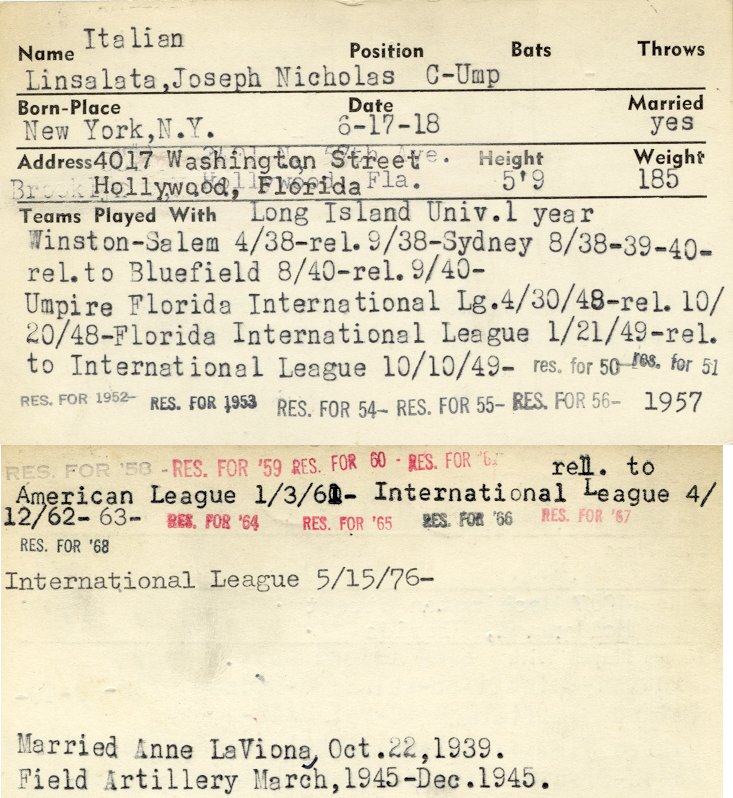
Joseph Nicholas Linsalata was born on June 17, 1916, in Brooklyn, New York. Like so many others in the baseball business, a year or two went missing from his age over the decades. His Sporting News umpire card gives his birth year as 1918.2 When he reached the majors in December 1960, wire-service accounts shaved off four years, giving his age as 40.3
By 1930, he was one of nine children of iceman Philip Linsalata and his wife, Angelina, both Italian-born.4 Philip’s US naturalization papers idiosyncratically list his son’s first name as Giuseppe, with a birthdate of October 15, 1916. But documents from Linsalata’s adult life, including a World War II military draft card, use the first name Joseph and the June 17 birthdate.5
Linsalata’s baseball career at Brooklyn’s Abraham Lincoln High School flourished after he moved from shortstop to catcher.6 Described as “peppery,” Linsalata earned praise on offense and defense, and the Brooklyn Times Union newspaper named him to informal postseason all-star teams in 1933 and 1934.7
One write-up from his senior year said he had attracted scouts’ attention and was likely to get a pro offer.8 Instead, Linsalata spent the next several years playing sandlot ball for local teams called St. John’s Athletic Association and the Bushwicks.9 In 1937, he played against the Newark Eagles, a Black team featuring future Hall of Famers Willie Wells, Leon Day, Mule Suttles, and Ray Dandridge.10 Linsalata also played with the House of David, the barnstorming team known for its players’ thick beards. Linsalata – who reportedly had trouble growing a beard – later said the team’s heavy workload caused him to have a mental breakdown at season’s end.11
In his closest brush with the majors as a player, Linsalata took part in Brooklyn Dodgers spring training in 1938 as a temporary replacement for the ailing Clyde Sukeforth, who served as both catcher and manager for the Dodgers’ Elmira, New York, farm club.12 One news story also described Linsalata as serving as “batting practice catcher” that spring.13 He did not stick with the Dodgers, but split the season between a New York semipro team called the Farmers14 and the Sydney, Nova Scotia, team of the short-season Class D Cape Breton Colliery League.
Linsalata returned to Sydney in 1939, hitting .266 in 49 games for a ballclub that won regular-season and playoff championships. He also faced an assault charge filed by a fan after a players-and-fans on-field brawl in New Waterford, Nova Scotia, that July. Available sources do not specify the outcome of the criminal charge, but Linsalata paid a $25 fine to the league.15
Linsalata became a husband at around this time, marrying Anna Lavigna.16 The 1940 Census found the couple living in Brooklyn with eight-month-old daughter Geraldine. Linsalata’s employment was listed as “file clerk” and his highest education as four years of high school.17 A second child, son Phil, was born about three years later.18 A military registration card from 1940 provides some idea of Linsalata’s physique during his playing career. His height was listed as 5 feet, 8½ inches and his weight as 180 pounds.19
The catcher’s career in the affiliated minors ended in 1940 with 15 games as a member of the Bluefield (West Virginia) Blue-Grays of the Class D Mountain State League. Two significant injuries ruined Linsalata’s campaign. A spike wound in his first game kept him out for several weeks; after he returned, he was beaned, suffering a skull fracture and concussion that ended his season.20
World War II sidelined many professional ballplayers’ careers, but Linsalata’s military service began late and was relatively brief. He served in the US Army Field Artillery between March and December 1945.21 Linsalata continued to play ball during the war years, at one point hitting three homers in a doubleheader to help the Arma Corporation company team win the championship of the Brooklyn-Long Island Defense League.22
Linsalata’s brothers Tom and Nick served in the military during World War II, so Joe might have been needed at home to help support his parents and siblings, along with his wife and children.23 Nick Linsalata died while serving in the US Navy in October 1945, shortly after the surrender of Japan ended fighting.24 A younger brother, Ben, played three seasons of Class D ball from 1948 to 1950, then served in the military during the Korean War.25
Linsalata, nursing a troublesome throwing arm, retired from semipro play after the 1946 season but wanted to stay in the sport. So he enrolled in an umpiring school in Florida run by National League ump George Barr.26 Linsalata met Klem through the school, and the two spent hours talking about umpiring. Klem urged Linsalata to get experience at the semipro level before going professional.27 After following this advice, the aspiring ump landed his first job in the Class C Florida International League, working the 1948 and 1949 seasons there. At the time, Class C was the second-lowest of six pro levels.
In 1950, Linsalata leaped all the way to the Triple A International League, one step below the majors – evidence that he was highly thought of. He’d been on the job in the IL less than two seasons when league President Frank “Shag” Shaughnessy labeled him the circuit’s best umping prospect in August 1951.28 Linsalata said he tried to outwork and outhustle the players, adding, “Even if I call a play wrong, [a player] can’t come back at me and say I was too far away to see it properly. Condition is a prime factor with me.”29
But after that promising start, Linsalata stuck in the IL for a decade without getting a call to the majors. He was well-respected: In 1951, his crew was described as the best in the league, and in 1960, he was singled out for praise as “probably the best arbiter” in the IL.30 At various times he worked the league playoffs, the Junior World Series, and an IL all-star game against the Pittsburgh Pirates.31 He also worked intrasquad games at Dodgers spring training in Vero Beach.32 But the closest he came to a real big-league job was in the spring of 1956, when the National League evaluated him but hired two other umps instead.33
What kept Linsalata out of the majors? In 1964, he told an interviewer that the NL had judged him “too fiery … too red-necked and rabbit-eared … too ready to throw a guy out of a game.”34 The ump’s height, which might have been less than his listed 5 feet, 8 1⁄2 inches,35 probably worked against him as well. “They like ’em tall up there,” Linsalata once said.36 His love of the game carried him through his years in the IL – “umpiring is in my blood,” he said — as did small pleasures like hearing his teenage daughter’s recording of “The Star-Spangled Banner” played before some games.37
The call Linsalata had waited for, and perhaps given up on, finally came on Christmas Eve, 1960. With the Los Angeles Angels and second Washington Senators preparing to debut as expansion teams, the AL needed more umps. Linsalata and Sam Carrigan were hired from the minors, while Bill Kinnamon and Harry Schwarts, who’d had tryouts in 1960, joined the staff full-time.38 “What a Christmas present,” Linsalata enthused.39
Spring training didn’t go particularly well for him. In one game, Linsalata lost track of balls and strikes and had to ask sportswriters in the press box what the count was.40 A few days later, working at third base, he didn’t signal either fair or foul on a long foul drive down the left-field line, as Detroit’s Harry Chiti rounded the bases.41
Still, he was there on Opening Day on April 10 at Washington’s Griffith Stadium, making his major-league debut umpiring at third base as the second incarnation of the Senators franchise lost to the Chicago White Sox, 4-3. The crowd on hand included US President John F. Kennedy.42 “Griffith Stadium looked immense to me,” Linsalata later recalled. “[F]or the first three innings, I’ll be honest, I completely forgot my position. Luckily there were no close ones at third because I was in a new world. After the third, I came to and everything was okay.”43
Opening Day was probably the most notable game of Linsalata’s career – he did not work any no-hitters, cycles, World Series games, or All-Star Games. He umped a full slate of 166 games, splitting time evenly between home plate, first, second, and third base.44 Linsalata also made seven ejections, including Angels manager Bill Rigney twice, on June 26 and August 5.
Any umpire will face a few disputed calls over the course of a season, and Linsalata had his share. They included:
- A possibly blown “out” call at home plate on April 22.
- A difficult situation with two runners on third base on April 23.
- An “automatic out” call on a second-base force play on June 16 that led to the ejection of New York Yankees manager Ralph Houk.
- A foul tip dispute on June 26 that so angered and distracted Yankees catcher Elston Howard that Howard inadvertently went out to catch the next inning without his chest protector.
- An out call at second base in a late-season Cleveland Indians game that a Cleveland reporter labeled “horrible,” suggesting that Linsalata wanted to get a meaningless game on a rainy day over with.45
Houk and Howard also figured in a stunt that, by one telling, had long-term negative repercussions for Linsalata. In the ninth inning of a Yankees-Boston Red Sox game at Fenway Park on June 1, right-handed Howard came to the plate, apparently to hit for lefty teammate Johnny Blanchard. Plate umpire Linsalata wrote Howard’s name onto his lineup card. (By some accounts, the umpire also gestured for a public address announcement, but the gesture was missed and no announcement was made.)46
Seeing Linsalata’s actions, Red Sox manager Mike Higgins summoned righty Tracy Stallard from the bullpen. Once Stallard entered, though, Howard returned to the bench and Blanchard came back up to hit. Higgins claimed that Linsalata’s writing Howard onto his lineup card meant Howard had entered the game. But senior umpire Charlie Berry said substitutions are only official when signaled by the manager, and Houk had given no such signal. Higgins protested the game, which Boston won, 7-5. Afterward, Houk confirmed intentional gamesmanship: “I delayed my move deliberately. Howard knew what he was doing.”
In a book published in 1979, longtime NL umpire Tom Gorman blamed Linsalata’s firing in part on his actions during this game. Gorman wasn’t present,47 and his account of events is garbled – it has Linsalata forcing Howard to hit, and Houk later winning a protest. According to Gorman, AL President Joe Cronin was in the stands and was unimpressed with Linsalata’s handling of the game. “At the end of the year Linsalata was gone. The row with Houk was one of the reasons Cronin fired him,” Gorman wrote in his book Three and Two!.48
Gorman’s account may be true at its core, with a few details made hazy by time, or it may be scuttlebutt from the baseball grapevine.49 Gorman was correct about the bottom-line result, though. After a busy offseason working multiple jobs in Florida,50 Linsalata returned for AL spring training in 1962, only to be told shortly before Opening Day that his contract was being returned to the IL.51
In subsequent interviews, Linsalata maintained that he’d been given a raise and positive reviews, and said AL umpiring supervisor Cal Hubbard never gave him a reason for the demotion. Linsalata also claimed Hubbard told him he’d be back in the AL by July 4 – a call that never came.52 Twenty years later, Linsalata suggested that he no longer dwelled on his firing: “One of those things,” he told a reporter. “I guess they figured they had better umpires.”53
Linsalata did dodge one very public bullet during his season in the bigs. In July 1961, The Sporting News ran a poll of coaches and managers rating major-league umps in various categories, including negative honors for Most Sarcastic, Most Difficult to Talk To, Quickest to Eject Players, Worst Pop-Off, and Biggest Grandstander. Linsalata flew beneath the radar, not getting the most votes in any category, positive or negative.54
Linsalata remained in the IL until a new opportunity opened up in February 1968. He was named a field supervisor for the National Association of Professional Baseball Leagues’ umpire development program, joining former minor-league ump Barney Deary in that role. The new job required Linsalata to observe, evaluate, and train minor-league arbiters across the country.55 It also occasionally called on him to strap on the mask and work games in place of umpires who were injured or had stepped away.56
The role of teacher and mentor was ideal for Linsalata, who’d been teaching offseason umpiring clinics since at least 1954.57 “If an umpire is missing certain pitches or has picked up other faults, we try to watch him, talk to him and iron out his problems,” Linsalata said that June. “We don’t go in to spy. We go in to help. We’re regarded as the umpire’s friend.”58 He told another reporter about a test he’d learned from Klem: “He told me he liked to judge an ump when things were tough. Any guy, he said, could handle the easy games, easy calls. He wanted to see [the umpire’s] reaction when it wasn’t all love and kisses.”59
At least some young umps appreciated his counsel, including Dale Ford, who worked with Linsalata as a 28-year-old in the Carolina League in June 1971. “I’ve learned more the last few days just watching and working with Joe than I have in my two years of umpiring,” said Ford, later a member of the AL’s umping staff from 1975 to 1999.60
Linsalata remained active as a minor-league umpire supervisor through the late 1980s, particularly for Florida-based leagues.61 However, his on-field career as a pro ump ended after a scary incident in May 1976.62 Returning to the IL as a fill-in, Linsalata – about a month shy of his 60th birthday – suffered major chest pains while working a game in Memphis and was taken to a local hospital.63 Tests eventually ruled out a heart attack.64 It was the latest in a series of injuries he’d suffered on the field, including an arm injury from a wayward pitch in 1950; a foul tip that coldcocked him in 1952; a severely bruised leg muscle from a flying bat in 1955; a severely bruised collarbone in 1960; and a foul tip that hit him in the throat near the end of the 1964 IL season.65
In addition to their roles as traveling supervisors, Linsalata and Deary collaborated in the offseason. By the early 1970s, Linsalata was a partner in Deary’s annual five-week umpire clinic, where the teaching staff also included current or future major-leaguers John McSherry, Bill Deegan, Frank Pulli, Jim Scott, and Nick Bremigan.66 Linsalata’s role included finding professional jobs for program graduates.67 Bill Kinnamon, who’d been hired by the AL alongside Linsalata in 1961, was also involved; a chronic hip problem had ended his big-league career during the 1969 season.68

In the mid-’70s, most umpires hired into professional baseball came either from the Deary-Linsalata-Kinnamon program, or from a similar school operated by former minor-league ump Al Somers.69 Friction arose between the programs, however, and the major leagues withdrew their financial support for Deary, Linsalata, and Kinnamon. With Deary no longer able to pay his partners, Linsalata and Kinnamon set up their own school, expanding from Florida to southern California in 1974. Al Barlick and Johnny Stevens, umpire supervisors for both major leagues, personally attended to size up candidates.70 Kinnamon bought Linsalata out of that program in 1975.71
How extensive was Linsalata’s influence, along with that of his partners? Just one class of the Deary-Linsalata-Kinnamon program, in 1972, produced five future big-league umps in Ed Montague, Durwood Merrill, Mike Reilly, Al Clark, and Steve Palermo.72 Joe West and Bob Davidson placed first and third, respectively, in the Linsalata-Kinnamon school’s class of 1974, and substitute ump Wade Ford attended that year as well.73 Drew Coble and Charlie Williams followed in 1975, as did shorter-tenured big-leaguers Tom Lepperd, Scott Graham, and Cy Ryberg.74
After parting ways with Kinnamon, Linsalata kept a lower profile, but continued to teach umpiring classes in Florida at least until the late 1980s.75 He also supervised local college umps.76 Every few years a newspaper reporter would come to one of his classes to watch him teach, and from these visits we get a sense of Linsalata’s outlook on umpiring, baseball, and life:
- “The louder you call it, the more you impress in their mind that’s what it was. Remember, umpiring is 92 per cent ability and 8 per cent showmanship. … Don’t be too quick. Let the play materialize. If anything, it’s better to hesitate a split second before you make the call.” – 197677
- “When you’re a major-league umpire, after the game you don’t have to worry about whether you wore the collar [went hitless] or went two-for-three. You can go to sleep. No one bothers you – until the next night.” – 198078
- “I don’t miss [professional umpiring] one bit. I’m tired. I’ll sit down, watch a ballgame, and after two innings turn it off. But I love teaching. I love working with young, raw umpires. It gives me a sense of satisfaction that I’m doing something for the umpiring profession.” – 198379
Having left his imprint on umpires from the majors to the sandlots, Joe Linsalata died in Florida on January 25, 2000, at age 83.80 His wife, Anna, died about three months later.81 His death passed without remark in newspapers and The Sporting News, and as of December 2025, Findagrave.com had no record of his resting place.82
Acknowledgments
This biography was reviewed by Gregory H. Wolf and Rory Costello and fact-checked by Larry DeFillipo. The author thanks the Giamatti Research Center at the National Baseball Hall of Fame and Museum for research assistance.
Sources and photo credits
In addition to the sources credited in the Notes, the author consulted Baseball-Reference.com and Retrosheet.org for background information on players, teams, and seasons.
Photo of Joe Linsalata from the Brooklyn Eagle, February 4, 1954: 20. Photo of advertisement for the Joe Linsalata-Bill Kinnamon Specialized Umpire Training Course from the Philadelphia Daily News, September 12, 1974: 69.
Notes
1 Linsalata’s connection with Klem was mentioned in several news stories, including “Jimmy Murphy’s Column,” Brooklyn Eagle, February 4, 1954: 20; and Alf Van Hoose, “Russian-Election Count, and Minority Won It,” Birmingham News, June 21, 1968: 32. West’s attendance of Linsalata’s umpiring school in the mid-1970s is mentioned in Jon Nowacki, “Bob Davidson Never Gave Up on Becoming a Big League Umpire,” Decatur (Illinois) Herald & Review, May 20, 2019: B3.
2 The Sporting News umpire card for Joe Linsalata, accessed via Retrosheet in April 2025, https://retrosheet.org/TSNUmpireCards/Linsalata-Joseph.jpg. The 1930 US Census entry for the Linsalata family gives Joseph’s age as 14, consistent with a 1916 birthdate. 1930 US Census entry for Philip and Angelina Linsalata and family accessed via Familysearch.org in April 2025, https://www.familysearch.org/ark:/61903/1:1:X4V5-JSV?lang=en.
3 Associated Press, “IL’s Joe Linsalata Goes to Majors,” Rochester (New York) Democrat and Chronicle, December 28, 1960: 21.
4 1930 US Census listing for Philip and Angelina Linsalata and family.
5 US naturalization listing for Filippo Linsalata, dated October 1924, accessed via Familysearch.org in April 2025, https://www.familysearch.org/ark:/61903/3:1:3Q9M-CSMG-1ST2-S?view=index&action=view&cc=2060123&lang=en; World War II draft card for Joseph Nicholas Linsalata, also accessed via Familysearch.org in April 2025, https://www.familysearch.org/ark:/61903/3:1:3Q9M-C3WP-C9ZZ-X?view=index&action=view&cc=3288447&lang=en. Two of Linsalata’s siblings also have Italian first names on his father’s naturalization paperwork (Maria and Damiano) and Anglicized first names on the family’s 1930 US Census listing (Mary and Thomas.)
6 James J. Murphy and Joseph Gorevin, “Scholastic Highlights,” Brooklyn Daily Eagle, February 13, 1933: 18.
7 Bernard I. Kremenko, “Defending Champions Have Strongly Balanced Outfit,” Brooklyn Times Union, April 8, 1934: 16; Kremenko, “Heavy Hitters Predominate on All Star School Nines,” Brooklyn Times Union, July 2, 1933: 18; Kremenko, “R.P.I. Trackfest Next on Tap for Scholastic Aces,” Brooklyn Times Union, April 28, 1934: 3A; Kremenko, “St. Francis Prep Wins Praise for Probe of Nugent,” Brooklyn Times Union, May 26, 1934: 3A.
8 James J. Murphy, “Lincoln High Expects to Cut Big Swarth [sic] in P.S.A.L. Activities,” Brooklyn Daily Eagle, March 30, 1934: 24.
9 “A.A. Nine Seeks Revenge,” Brooklyn Times Union, July 25, 1935: 2A; William J. Granger, “Johnny Bittner Pitches Great Ball and Bushwicks Beat Cedarhursts, 6-1,” Brooklyn Citizen, June 12, 1937: 6.
10 William J. Granger, “Bushwicks Get Only Two Hits off Newark Eagles’ Pitchers and Lose, 7-1,” Brooklyn Citizen, August 14, 1937: 6.
11 “Sportpourri,” Brooklyn Daily Eagle, June 24, 1936: 18; “Joe Linsalata Proving Big League Timber,” Madison (New Jersey) Eagle, July 1, 1937: 6.
12 “MacPhail Calls Camilli to Camp,” Brooklyn Daily Eagle, March 13, 1938: D5; “‘Cookie’ Lavagetto Figures to Win Bets Easily from MacPhail and Grimes,” Brooklyn Citizen, March 16, 1938: 6.
13 “Diamond Dust,” New York Daily News, April 11, 1938: 36.
14 Linsalata’s Sporting News umpire card lists him as playing with the Winston-Salem Twins of the Class B Piedmont League in 1938. However, a search of North Carolina newspapers in Newspapers.com in May 2025 – including a full run of the Winston-Salem Journal and Sentinel – found no mention of his name during the baseball season, and Baseball-Reference’s page for the 1938 Winston-Salem team did not mention him. Linsalata is mentioned as the Farmers’ catcher in box scores printed in the Brooklyn Eagle in the spring and summer of 1938 – including a game against the House of David, recorded in “Farmers End Losing Streak,” June 27, 1938: 12.
15 Canadian Press, “Sydney Club Manager Is Cut during Diamond Melee,” Moncton (New Brunswick) Daily Times, July 31, 1939: 2; “How Things Look In Sport Circles,” Fredericton (New Brunswick) Daily Gleaner, August 1, 1939: 2; “Homer After Fine,” Moncton Daily Times, August 8, 1939: 2.
16 Some sources – including Linsalata’s Sporting News umpire card, his Social Security record, and various newspaper articles – give his wife’s first name as Anne. Sources that identify her as Anna include the family’s 1940 US Census listing, cited directly below; Anna’s own Social Security record, accessed in November 2025 via FamilySearch.org, https://www.familysearch.org/ark:/61903/1:1:6K9Q-8QMN?lang=en; daughter Geraldine’s Social Security record, https://www.familysearch.org/ark:/61903/1:1:6KMT-VPJ5?lang=en; and a death notice for Anna’s brother Angelo Lavigna published in the New York Daily News, September 18, 1969: 105.
17 Marriage date as printed on Linsalata’s Sporting News umpire card; 1940 US Census listing for the Linsalata family accessed in May 2025 via Familysearch.org, https://www.familysearch.org/ark:/61903/3:1:3QSQ-G9MY-PRCL?view=index&personArk=%2Fark%3A%2F61903%2F1%3A1%3AK7M3-53L&action=view&cc=2000219&lang=en&groupId=TH-1971-27833-13208-32.
18 Seb Farina, “Umpire Always Overruled at Home Sweet Home Plate,” Fort Lauderdale (Florida) News, July 28, 1959: 2BS. At the time of this profile, Geraldine Linsalata was 19 years old and brother Phil 15.
19 October 1940 military registration card for Joe Linsalata, cited above. Linsalata’s Retrosheet and Baseball-Reference pages list him as 5 feet, 10 inches tall and weighing 185 pounds.
20 “News of West Virginia,” Covington (Virginia) Virginian, September 10, 1940: 6. Linsalata played with the Montpelier, Vermont, team of the Northern League in 1941; as of August 2025, this league was not listed in Baseball-Reference’s list of affiliated leagues for that season.
21 Linsalata’s enlistment date is recorded as March 27, 1945, in US Army World War II enlistment records made available through Familysearch.org and accessed in August 2025, https://www.familysearch.org/ark:/61903/1:1:K85X-D2S?lang=en. His The Sporting News umpire card, cited above, gives the dates of his military service as March through December of 1945.
22 “Joe Linsalata Stars as Arma Wrests Pennant,” Brooklyn Eagle, October 4, 1943: 12. Arma Corporation was a manufacturer of aviation, automotive and other equipment. It supported the war effort in World War II by making gunfire control systems. “Arthur Davis, 72, Founder of Arma,” New York Times, April 22, 1968: 47.
23 Tom Linsalata’s military service is mentioned in Ed Lowe, “The Gift of Tom the Bus Driver,” Newsday(Hempstead, New York), November 2, 1979: 6. Nick Linsalata’s service is mentioned in news items related to his death, cited below.
24 “Linsalata” (death notice), New York Daily News, April 2, 1949: 31; “5,806 More War Dead Are Brought Home,” Brooklyn Eagle, February 21, 1949: 7.
25 “Ben Linsalata, 62, Retired Fire Lieutenant,” Staten Island (New York) Advance, March 11, 1992: A11.
26 “‘Outhustle the Player’ Joe Linsalata’s Slogan,” Baltimore Evening Sun, May 25, 1950: 52.
27 “Jimmy Murphy’s Column”; “‘Outhustle the Player’ Joe Linsalata’s Slogan.”
28 George Beahon, “It’s 11 Straight for Wings as Cubs Fall in 11th, 7-6,” Rochester Democrat and Chronicle, August 18, 1951: 14.
29 “‘Outhustle the Player’ Joe Linsalata’s Slogan.”
30 George Beahon, “Cullop Rejoins Orioles After Illness Siege,” Rochester Democrat and Chronicle, July 31, 1951: 20; Tommy Fitzgerald, “Can’t Sleep with Vincent in the Area,” Miami News, April 5, 1960: 2C.
31 These citations are not meant to be a complete list of Linsalata’s postseason credits as an IL ump, but simply examples. George Beahon, “Wings Rained Out of Season Opener; Royals Lose Lutz,” Rochester Democrat and Chronicle, September 19, 1952: 34; “Out at Home” (photo and caption), Minneapolis Morning Tribune, September 22, 1955: 4S; Associated Press, “Shaughnessy Picks All-Star Tilt Umps,” Miami Herald, August 25, 1959: D1.
32 “Jimmy Murphy’s Column.”
33 George Beahon, “In This Corner,” Rochester Democrat and Chronicle, December 1, 1955: 47; Beahon, “Omaha Nips Wings, 6 to 5, in 11-Inning Camp Battle,” Rochester Democrat and Chronicle, April 7, 1956: 21. The latter story claimed that the NL didn’t have any openings, but this seems questionable, as two umps who worked in the league in 1955 – Al Barlick and Lon Warneke – did not return for 1956, and two new umps – Shag Crawford and Victor Delmore – were hired.
34 Bob Maher, “Linsalata Set for 13th Year as Man in Blue,” Hollywood (Florida) Sun-Tattler, April 23, 1964: 10A.
35 Linsalata’s height was listed as 5 feet 7 inches in Shelley Rolfe, “Ermer Needed Time to Discover Niche as Baseball Pilot,” Richmond (Virginia) Times-Dispatch, January 8, 1961: D5. His World War II military registration card, previously cited, gave his height as 5 feet 8½ inches.
36 Chauncey Durden, “In Re IL Umpiring,” Richmond Times-Dispatch, August 22, 1958: 14.
37 Joe Falls, “Batting the Breeze,” Detroit Free Press, April 10, 1961: 40; George Beahon, “Wings Edge Vees on Markell Slants; Nail Tie for 4th,” Rochester Democrat and Chronicle, September 2, 1955: 28.
38 Associated Press, “New Umpires Report” (photo and caption), Lewiston (Maine) Evening Journal, January 18, 1961: 11.
39 Associated Press, “American League Gets Two Umpires from Minor Loops,” Tampa Tribune, December 28, 1960: 20; Bill Fuchs, “The Baseball Beat,” Washington (District of Columbia) Evening Star, March 7, 1961: A15.
40 “This Man In Blue Has a Bright Red Face Now,” Detroit Free Press, March 26, 1961:E3.
41 Clank Stoppels, “Bengal Bits,” Grand Rapids (Michigan) Press, March 29, 1961: 45.
42 Associated Press, “Kennedy’s First Pitch Caught by Jim Rivera,” Chicago Tribune, April 11, 1961: 3:1.
43 Dale Pullen, “Joe Linsalata, Umpire – Part II,” Hollywood (Florida) Sun-Tattler, October 11, 1961: 8.
44 Linsalata worked 40 games behind home plate and 42 at each base.
45 Jim Schlemmer, “Daley Sparkles as Antonelli Fails – Again,” Akron (Ohio) Beacon Journal, April 23, 1961: C1; “Tricky Play at Third Base Puts Rookie Umpire On Spot,” Cleveland Press, April 24, 1961: D1; “Irked Howard Forgets Pads,” The Sporting News, July 5, 1961: 21; Stan Isaacs, “Houk Quality of Anger Strained,” Newsday (Melville, New York),, June 17, 1961: 31; Bob Dolgan, “Indians’ 4 in 9th Win, 9-5,” Cleveland Plain Dealer, September 24, 1961: 1C.
46 This paragraph and the next are summarized from several sources, including Joe Trimble, “Moose Bangs 2, but Bosox Cow Inept Bombers, 7-5,” New York Daily News, June 2, 1961: C16; Bob Holbrook, “Pinch-Batter Tiff Spices Sox-Yanks Finale,” Boston Globe, June 2, 1961: 37; “So Who’s At Bat?”, Boston Globe, June 2, 1961: 33; Harold Kaese, “When Does Ball Player Officially Get in Game?,” Boston Globe, June 4, 1961: 75; Associated Press, “Red Sox Win by 7-5, Split Yankee Series,” Burlington (Vermont) Free Press, June 2, 1961: 16; and Jim Ogle, “Red Sox Fell Yanks, 7-5; 2 Skowron HRs Wasted,” Newark (New Jersey) Star-Ledger, June 2, 1961: 16. The Daily News story had Linsalata admitting he’d made a mistake; other accounts did not.
47 On June 1, 1961, Gorman was in Philadelphia, umpiring behind the plate at a Chicago Cubs-Philadelphia Phillies game.
48 Tom Gorman (as told to Jerome Holtzman), Three and Two! (New York: Charles Scribner’s Sons, 1979): 90-91, https://archive.org/details/threetwo00gorm/page/n7/mode/2up. None of the newspaper sources cited above specifically mention Cronin’s attendance, but he easily could have been there, as the AL was headquartered in Boston during his reign as league president.
49 It should also be noted that news accounts make no reference to Linsalata having a “row with Houk” as a result of Houk’s lineup gamesmanship. Higgins, not Houk, was the upset party during that game.
50 “Ump Linsalata Now Coach, Recreation Man,” Hollywood Sun-Tattler, November 1, 1961: 3B.
51 Associated Press, “Cronin Lists Umpires for 1962 Openers,” Chicago Tribune, April 4, 1962: Spts-Bus-2.
52 “Joe Linsalata Doesn’t Know Why He Was Optioned,” Hollywood Sun-Tattler, April 18, 1962: 11A; Dale Pullen, “Joe Linsalata Never Squawked,” Hollywood Sun-Tattler, November 5, 1962: 5B. It’s worth mentioning that Bill Haller, the other AL ump whose contract was returned to the minors in April 1962, was called back to the AL in 1963 and remained there through the end of the 1982 season.
53 Gary German, “This Umpire Makes Calls Off the Field,” Miami Herald, September 4, 1983: Neighbors-17.
54 C.C. Johnson Spink, “Barlick Rated No. 1 Umpire in Poll of N.L.,” The Sporting News, July 26, 1961: 1. Since the poll would have had to have been conducted in the season’s first few months, it’s possible that Linsalata went unnoticed because players and managers were less familiar with him than with the AL’s veteran umps.
55 Associated Press, “Linsalata to Supervise Development Work,” Buffalo Evening News, February 14, 1968: 59; John M. Flynn, “The Referee’s Sporting Chat,” Berkshire Eagle (Pittsfield, Massachusetts), February 24, 1968: 17.
56 Ray Holliman, “Development Association Friend to Umpires, Baseball,” Montgomery (Alabama) Advertiser-Journal, June 16, 1968: 3B. In one such example from 1972, Linsalata substituted for Carolina League ump Fred Brocklander, who later reached the NL, while Brocklander was away trying to qualify as an American Basketball Association referee. Dave Thornton, “Big Crowd, Gorinski’s Bat Sparks Mahlmann, L-Twins,” Lynchburg (Virginia) Daily Advance, June 9, 1972: 19.
57 The earliest reference to Linsalata as a teacher that was discovered while researching this biography is “List Umpire’s Clinic,” Brooklyn Eagle, March 2, 1954: 16.
58 Holliman, “Development Association Friend to Umpires, Baseball.”
59 Van Hoose, “Russian-Election Count, and Minority Won It.”
60 Dave Thornton, “He Studies, Grades Umps in Minors,” Lynchburg (Virginia) Advance, June 12, 1971: 9
61 He was described as a Florida State League umpire supervisor in German, “This Umpire Makes Calls Off the Field,” published in September 1983, and was mentioned as an “area supervisor” observing Gulf Coast League umpires in Willie Hiatt, “GCL Umpires Also Dream of Big Leagues,” Bradenton (Florida) Herald, July 23, 1987: D1.
62 Searches of Newspapers.com in July and August 2025 for the words “umpire Linsalata” or “Umpires Linsalata” did not find any box scores in which Linsalata appeared after May 1976. (Since umpires’ last names were usually included at the bottoms of box scores by the mid-1970s, these searches would likely have turned up any additional mentions of the ump at work.)
63 Ray Jordan, “Listless Blues Fall to Aroused Charlies,” Memphis Commercial Appeal, May 25, 1976: 14.
64 “Ump From Grandstand Replaces Ill Linsalata,” The Sporting News, June 19, 1976: 48.
65 Walter Taylor, “Umpire Halts Second Game in 5th Inning,” Baltimore Sun, May 8, 1950: 15; John Gorman, “Watlington’s Timely Single Gives A’s Win,” Ottawa Journal, June 20, 1952: 22; Dink Carroll, “Neal’s Home Run Wins Nightcap; Craig Notches 7th Victory in 1st,” Montreal Gazette, June 20, 1955: 30; Tommy Devine, “Sisler Wants Meeting on Havana,” Miami News, April 14, 1960: 1D; Cy Kritzer, “Recall of Elio Chacon Blocked; Herd Relies on Schreiber at SS,” Buffalo Evening News, September 10, 1964: 59.
66 Scott worked in the majors only during strikes of unionized umpires in 1978 and 1979; the others served as full-time major-league umps.
67 Fred Girard, “Umpires … Baseball’s Training its Own,” St. Petersburg Times, March 11, 1971: C1.
68 Tom Duffy, “Life With a New Hip Begins at 51 for Ump,” St. Petersburg Times, April 5, 1970: 2C.
69 Tom Marshall, “It Takes More than Players to Make Things Go,” Atlanta Journal, July 31, 1974: 3E; “Errors Help Chiefs Win, 6-4,” Syracuse (New York) Post-Standard, April 4, 1974: 21.
70 Bernie Milligan, untitled column, Van Nuys (California) Valley News, December 29, 1974: 32A.
71 Bill Kinnamon interview included in Larry R. Gerlach, The Men in Blue: Conversations with Umpires (New York: The Viking Press, 1980): 253, https://archive.org/details/meninblueconvers00gerl/page/n7/mode/2up; Ron Berler, “Umpin’ It,” Cincinnati Enquirer Magazine, July 11, 1976: 26.
72 Bill Nowlin, “Steve Palermo,” SABR Biography Project, accessed August 2025, https://sabr.org/bioproj/person/steve-palermo/. This list is based on Palermo’s recollection during interviews with Nowlin.
73 Nowacki, “Bob Davidson Never Gave Up on Becoming a Big League Umpire”; “3 New Caloop Umps,” The Sporting News, April 20, 1974: 30. Ford worked six National League games in 1995.
74 “Specialized Umpire Course Grads,” The Sporting News, July 19, 1975: 50.
75 The latest printed reference to one of Linsalata’s umping classes found during research for this biography was a Spanish-language notice: “Se Aproximan Varidos Eventos Locales,” El Miami Herald, August 23, 1987: 19.
76 “Learn to Officiate,” Miami News, August 1, 1984: 1B; Ed Plaisted, “Dream Comes True for Sports Editor-Ump,” The Sporting News, March 31, 1979: 51.
77 Gerald Storch, “One, Two, Three Strikes – You’re Out!,” Miami Herald, September 14, 1976: 1D.
78 David Georgette, “He Teaches Students to Call ‘Em as They See ‘Em,” Miami Herald, September 11, 1980: Neighbors: 17.
79 Gary Ferman, “He Calls ‘Em As He Sees ‘Em – On a Blackboard,” Miami Herald, August 28, 1983: 34 (Neighbors section).
80 US Social Security death index record for Joseph N. Linsalata, accessed in August 2025 via Familysearch.org, https://www.familysearch.org/ark:/61903/1:1:JGHZ-XYX?lang=en.
81 US Social Security death index record for Anna (Lavigna) Linsalata, accessed in August 2025 via Familysearch.org, https://www.familysearch.org/ark:/61903/1:1:JR3V-SWG?lang=en.
82 Linsalata’s clip file at the Giamatti Research Center of the National Baseball Hall of Fame and Museum also had no information on his death as of December 2025.
Full Name
Joseph Nicholas Linsalata
Born
June 17, 1916 at Brooklyn, NY (US)
Died
January 25, 2000 at Hollywood, FL (US)
Stats
If you can help us improve this player’s biography, contact us.