
April 2, 1977: On their way to becoming ‘America’s Team,’ Atlanta Braves make their superstation debut
“I’m giving Atlanta to the nation – to the world!” – Ted Turner1
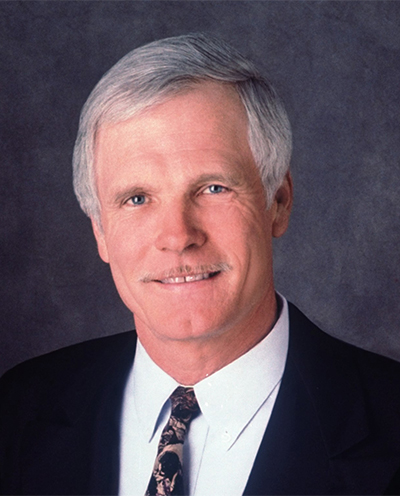
A gambling, cigar-smoking, womanizing, mustachioed yachtsman named Robert Edward “Ted” Turner III explored the sky. He took with him WTCG (or “Watch This Channel Grow”), the small Atlanta UHF station he had bought in 1970 under a different call sign.2 He took the Atlanta Braves, whose games had aired on WTCG since 1973. Having bought the team in 1976 – to keep major league baseball in Georgia – he sought to televise 150 Braves games a year, each a multi-hour showcase of live programming and high-profile advertising. He eyed outer space.3
Turner partnered with a business associate to uplink WTCG’s feed to RCA’s Satcom 1 satellite. The hookup went live at 1 PM on December 17, 1976, for America’s growing number of cable television systems to pluck. Having begun the decade as a money-hemorrhaging ratings bottom-dweller whose over-the-air signal hardly touched Atlanta proper, the channel was now a prototype: a local-national hybrid later known as a “superstation.”
Media experts called it a “two-headed monster.”4 Baseball Commissioner Bowie Kuhn argued that making Braves games available nationally risked stealing eyes from other teams – and devaluing ABC and NBC telecasts.5
The 38-year-old Turner pressed on nonetheless. He bought basketball’s Atlanta Hawks in January 1977. After Kuhn handed him a one-year suspension that same month – for tampering with San Francisco Giants star Gary Matthews’s free agency – Turner received permission to continue baseball operations while he appealed the punishment. He said of the commissioner: “Suspend me? He may as well shoot me.”6
And on April 2, 1977, WTCG readied for the Braves’ first satellite-beamed game. Slotted between No Name on the Bullet and a Lucy Show rerun,7 the team’s Saturday afternoon spring-training game against the Baltimore Orioles in West Palm Beach was viewable as far as Maine, Washington State, Texas, and Alaska.8 “It was like being on the first wagon train west,” recalled play-by-play announcer Skip Caray, the self-described “wise-ass cynic” who often sneered while plugging Turner’s B-movie selections. “We didn’t know where we were going, but we were having a lot of fun getting there.”9
A Braves publicity director told Turner that the increased exposure held risk. “If our teams are good, everyone will know it,” he said. “If our teams are bad, everyone will know about that, too.”10
With a Grapefruit League record of 13-12 – and eager to move past a last-place 1976 finish – Atlanta manager Dave Bristol sent his regulars back to work.11 Outfielders Matthews, Rowland Office, and Jeff Burroughs returned to the starting lineup for the first time in three days.12 On the mound was Phil Niekro, nearing his 14th season as a Braves knuckleballer, four days after holding Baltimore to three hits in six shutout innings.13
The Orioles, runners-up in the 1976 American League East Division race, entered the game with a rough patch of their own. Though their spring-training record was a still-decent 13-7, they had lost two of the past three games. With only three preseason exhibitions after this one, skipper Earl Weaver gave his top two spring hitters – Ken Singleton and Tony Muser – the day off.14 Weaver also rested other tentative Opening Day starters: catcher Rick Dempsey, second baseman Rich Dauer, and outfielder Pat Kelly.
Pitching for Baltimore was Dennis Martínez. Since his major-league debut with the Orioles the previous September, the Nicaraguan right-hander had collected a 1-2 record and 2.60 earned-run average in regular-season play. His outings so far that spring had brought mixed results.
Martínez fell behind early. In the Atlanta first, Office tallied his first of three singles before scoring on consecutive passed balls by Orioles backup catcher Dave Skaggs.15
Second-inning singles by Rod Gilbreath, Office, Jerry Royster, and Willie Montañez gave Atlanta a 3-0 lead.16
Two Baltimore errors in two innings, by second baseman Billy Smith and shortstop Mark Belanger, worsened Weaver’s mood. “We played bad early,” he said, “and that’s what makes a loser out of a winner.”17
By the third inning Martínez settled down. He surrendered no more runs and only two more hits through the sixth.
Yet for the Orioles, the damage was already done. The 38-year-old Niekro pitched himself a one-day-late birthday gift: a seven-inning, seven-strikeout two-hitter against them.18 Two strikeouts came against Lee May, giving the righty hitter five in two games against the knuckleballer.
Only Skaggs and Smith hit off Niekro, albeit with one single apiece. “Even when the Birds did connect, the ball went nowhere because the wind was so strong, not even King Kong could have jerked one out,” wrote Baltimore Sun reporter Ken Nigro. As regular-season interleague play was still 20 years away, Nigro added that “if the Orioles had to face [Niekro] during the season, they might never score.”19
Niekro struck out the side in the seventh inning. “Felt like I could go a doubleheader,” he told a West Palm Beach reporter at the Braves’ spring-training home. “Things went pretty good.”20
The Braves padded their lead in the bottom half. Office singled and reached second on a balk by Randy Miller, who was five months from his major-league debut. An infield single by Royster sent Office to third. A sacrifice fly by Burroughs scored the runner. Atlanta 4, Baltimore 0.
Niekro’s exit spawned an Orioles rally. Off Braves reliever Mike Marshall in the eighth inning, Tom Shopay got on base.21 Skaggs’s second hit of the day, his third of the spring, raised his preseason average to .150. Kiko Garcia, a late-inning replacement for Belanger, notched a hit of his own.22 Smith’s second single of the game scored Baltimore’s first run. A bases-loaded single by Larry Harlow cut the deficit to one.23
But Baltimore failed to build on the three-run, four-hit eighth. May’s third strikeout of the day ended the inning, stranding the tying run at second base. “Not being able to use the designated hitters on the road against these National League teams makes a lot of difference,” said Weaver24 – a full 45 years before major league baseball made the designated hitter’s role universal.25
Marshall’s one-two-three ninth sealed Atlanta’s 4-3 victory. Niekro earned the win, marking his fourth consecutive spring start without a loss.26 The losing pitcher was Martínez.27
A third loss in four games left Baltimore hungry for an Opening Day reset. “Let’s start the season,” May said. “The dog days are setting in down here.”28
The Orioles had better days ahead. They started their regular season on April 7 and finished with a 97-64 record, second once again in the AL East. The franchise’s home attendance was the second highest it had ever been.29 First baseman Eddie Murray – hitless in his April 2 pinch-hit appearance30 – batted .283, hit 27 home runs, drove in 88 runs, and won the AL Rookie of the Year award.
Atlanta’s 1977 went less well. The team lost 17 straight games, including one on May 11 in which Turner named himself acting manager. To worsen matters for Turner, a federal judge upheld his one-year suspension from baseball on May 19. The Braves eventually ended the year with their second-straight last-place finish, their fifth losing season of the decade, nine more losses than in 1976, and without their owner.
Yet Turner stayed busy growing the ballclub’s profile with his own. The so-nicknamed “Captain Outrageous” spent his temporary exile practicing for the America’s Cup, which he won that September. In 1979, with the channel available to some five million cable subscribers in all but a few states, the budding mogul rechristened WTCG as “SuperStation WTBS.” With a new name that not-so-coincidentally rhymed with American broadcast network CBS, the “Turner Broadcasting System” – the home of the Braves – became a national brand.31
As access spread to all 50 states, another brand took hold: “America’s Team.”32 In the decades that followed, TBS brought Braves baseball to once-hard-to-reach locales. A bar in Valdez, Alaska, was renamed “The Braves Lounge.” A billboard in Storm Lake, Iowa, read “THE ATLANTA BRAVES: IOWA’S TEAM.” Hawaiian dignitaries visited Atlanta–Fulton County Stadium and gave leis to the Braves broadcast team of Caray, Pete Van Wieren, and Ernie Johnson Sr.33
“There are so many outlying areas that don’t have major league baseball,” said a Braves publicist during the team’s division-winning 1982 season. “They can get the Braves on cable, and they adopt us.”34
Other teams and channels followed suit. At various points through the 1990s, superstations aired Boston Red Sox, California (later Anaheim) Angels, Chicago Cubs, Chicago White Sox, Los Angeles Dodgers, New York Yankees, New York Mets, and Texas Rangers games through satellite.35
In 2006 – a year before TBS split from its parent UHF station, became cable-only, and stopped televising the Braves nationally36 – Commissioner Bud Selig did what no predecessor had. He praised Turner for pioneering the superstation concept.
“[T]here were many who thought it would be the death knell of our sport,” Selig said. “In fact it helped the sport. Ted’s enlightened television policy didn’t hurt anything at all. He played a great role in the maturing of the relationship between MLB and television.”37
Acknowledgments
This article was fact-checked by Victoria Monte and copy-edited by Keith Thursby.
Photo credit: Ted Turner, courtesy of the Atlanta Braves.
Sources
In addition to the sources cited in the Notes, the author consulted Baseball-Reference.com, Sports-Reference.com, and Retrosheet.org for team statistics.
Notes
1 Christian Williams, Lead, Follow or Get Out of the Way: The Story of Ted Turner (New York: Times Books, 1981), 146.
2 Turner’s purchase of the station was completed on April 6, 1970, when the Federal Communications Commission reassigned the station’s license to Turner Communications. (See “For the Record,” Broadcasting, April 13, 1970: 86.)
Later in 1970, Turner changed the station’s call letters from WJRJ-TV to WTCG, officially for “Turner Communications Group.” He adopted the slogan “Watch This Channel Grow” for promotional purposes. (See L. J. Davis, The Billionaire Shell Game: How Cable Baron John Malone and Assorted Corporate Titans Invented a Future Nobody Wanted (New York: Doubleday, 1998), 24-25.)
3 Like most teams, the Braves’ other 12 games of their 162-game seasons were generally reserved for league-sanctioned national telecasts. In the 1970s and 1980s, major league baseball had contracts with ABC, NBC, and (from ’79 to ’83) USA Network for weekly or twice-weekly showings.
4 David A. Klatell and Norman Marcus, Sports for Sale: Television, Money, and the Fans (New York: Oxford University Press, 1988), 59.
5 In an autobiography, Kuhn accused Turner of running his superstation “in much the same way that ABC or NBC operated their networks.” Kuhn also wrote: “Our concern was that if Braves games began going into other professional baseball markets in large numbers, clubs were going to lose fans at the gate and local broadcasting revenues. This could prompt franchise moves and otherwise destabilize an industry that was entering its first year of free agency with foreboding.” Bowie Kuhn, Hardball: The Education of a Baseball Commissioner (New York: Times Books, 1987), 289-91.
6 Tom Saladino (Associated Press), “Ted Turner – Guilty of No Wrong-Doing,” Florence (South Carolina) Morning News, January 4, 1977: 6A.
7 “Atlanta Television Schedule,” Atlanta Journal and Constitution, April 2, 1977: 38T.
8 Porter Bibb, It Ain’t as Easy as It Looks: Ted Turner’s Amazing Story (New York: Crown, 1993), 103; Dan Cunningham, “A Winning Team: Turner’s SuperStation Hooks Fans Up to Braves,” Miami Herald, July 9, 1982: 5F. See also Francis Kinlaw, “The Franchise Transfer That Fostered a Broadcasting Revolution,” The National Pastime 30, no. 1 (2010), 140-43.
9 Tim Tucker, “The End of a TV Era,” Atlanta Journal-Constitution, September 30, 2007: A1.
10 Tim Darnell, “How the Atlanta Braves Became ‘America’s Team,’” WANF/Atlanta News First, February 26, 2025, https://www.atlantanewsfirst.com/2025/02/26/how-atlanta-braves-became-americas-team/. Accessed March 2026.
11 United Press International, “Tiant Pitches Bosox Past Chicago,” Chapel Hill (North Carolina) News, April 3, 1977: 3B.
12 Ken Nigro, “Braves, Niekro Bop Birds, 4-3,” Baltimore Sun, April 3, 1977: C1.
13 “Braves Zap Orioles 3-0,” Cumberland (Maryland) News, March 30, 1977: 10.
14 Nigro, “Braves, Niekro Bop Birds, 4-3.”
15 Unless otherwise noted, all descriptions of the April 2 game come from Nigro, “Braves, Niekro Bop Birds, 4-3.”
16 Associated Press, “Niekro Puzzles Orioles,” Atlanta Constitution, April 3, 1977: 13D.
17 Nigro, “Braves, Niekro Bop Birds, 4-3.”
18 Unless otherwise noted, all descriptions of the April 2 game come from Nigro, “Braves, Niekro Bop Birds, 4-3.”
19 Nigro, “Braves, Niekro Bop Birds, 4-3.”
20 Greg Forrer, “Niekro Impressive in Atlanta Finale,” Palm Beach Post, April 3, 1977: E1.
21 Available game accounts do not mention how Shopay, who ended the day 0-for-1, reached base. A box score published the next day notes that Shopay batted immediately before Skaggs and touched home. These occurrences had to have happened in the eighth inning, as this was the only frame in which the Orioles scored. See the box score on Baltimore Sun, April 3, 1977: C2.
22 Available game accounts do not mention how Garcia reached base. The Sun box score lists him as 1-for-1 with a run.
23 In addition to Nigro, “Braves Bop Birds, 4-3,” the author consulted the game’s box score, from Baltimore Sun, April 3, 1977: C2.
24 Nigro, “Braves, Niekro Bop Birds, 4-3.”
25 The American League was first to adopt the role of a designated hitter, or DH, at the start of the 1973 season. Until the end of the 2021 season, major-league DHs were used only in AL games and interleague games played at AL ballparks. In 2022 the DH position was adopted throughout Major League Baseball.
26 Associated Press, “Niekro Puzzles Orioles.”
27 “Expos, Blue Jays Square Exhibition Series,” Tampa Bay Times, April 3, 1977: 4C.
28 Nigro, “Braves, Niekro Bop Birds, 4-3.”
29 The 1977 Orioles totaled 1,195,769 home attendees. At the time, the franchise had only attracted a higher turnout during its World Series-winning 1966 season, with 1,203,366. Baltimore broke its franchise record in 1979, with 1,681,009.
30 Forrer, “Niekro Impressive in Atlanta Finale.”
31 Turner wrote in his 2008 autobiography: “Now that we were competing on a national level, I also liked that “TBS” sounded like “CBS.” Ted Turner with Bill Burke, Call Me Ted (New York: Grand Central, 2008), 134.
32 Cunningham, “A Winning Team.”
33 Bill Rose, “A Brave New World for America’s Team,” Miami Herald, July 9, 1982: 1F. See also Helyar, Lords of the Realm, 251.
34 Rose, “A Brave New World for America’s Team.”
35 Aside from WTBS, the superstations that carried MLB games included WGN-TV (Cubs, White Sox), WPIX (Yankees), WSBK (Red Sox), WWOR-TV (Mets), KTLA (Angels, Dodgers), KTVT (Rangers). Though most of these superstation feeds were discontinued by the late 1990s, WGN simulcast its VHF feed – including Cubs and White Sox games – through satellite until December 2014.
36 The national TBS feed aired its final Braves telecast on September 30, 2007. Earlier that year Time Warner, which had bought Turner Broadcasting in 1996, sold the team to Liberty Media. Braves telecasts remained on the Atlanta UHF channel, renamed WPCH-TV, through the 2012 season. Time Warner sold WPCH to Meredith Corporation in April 2017.
37 Tim Tucker, “TBS’ Evolution Continues,” Atlanta Journal-Constitution, October 22, 2006: F2.
Additional Stats
Atlanta Braves 4
Baltimore Orioles 3
Municipal Stadium
West Palm Beach, FL
Corrections? Additions?
If you can help us improve this game story, contact us.