

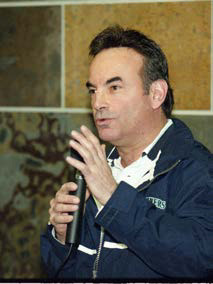
Rick Rizzs

On the heels of Rick Rizzs’s first job in professional baseball, a journalist with the Blue Island (Illinois) Sun-Standard predicted that it was “the start of a long, successful, and happy career.”1 It was a bold claim to make about a 21-year-old kid who had graduated from college just three weeks before, but it was also an easy call to make about someone who had been winning accolades since he was 17.
The grandson of Italian immigrants on both his father’s and mother’s sides, Richard Alfred Rizzs was born on November 17, 1953, in the south Chicago suburb of Blue Island, Illinois, the second son of Donald Rizzs, a shipping foreman for an industrial equipment manufacturer, and homemaker Julia (Galati) Rizzs. When Rick was 5, the Rizzs family moved to the nearby village of Calumet Park, where he could be seen “running around in a jersey with the number 11 on the back” mimicking his idol, Luis Aparicio.2 Like Aparicio, Rizzs played shortstop, and the scrappy kid with a good glove earned the nickname Scooter in Little League.3
While Aparicio was Rizzs’s on-field idol, it was Chicago Cubs Hall of Fame broadcaster Jack Brickhouse whom Rizzs called his hero and inspiration. Rizzs and his mother would listen to Brickhouse call Cubs games on WGN Television until Rizzs eventually started turning down the volume and calling the games himself. When he was 12, he decided: “I would like to be that voice,” and wrote Brickhouse to tell him of his dream.4 Brickhouse wrote back, encouraging Rizzs to “get a great education, believe in [himself], and work hard.”5
One could say Rizzs’s career began during his sophomore year at Blue Island’s Dwight D. Eisenhower High School when he started covering the school’s sophomore sports teams for the Sun-Standard. Rizzs picked up reporting from his father, who would submit write-ups on the Calumet Park Little League to the local paper that were so popular the Sun-Standard made him sports editor in September 1967. Rizzs covered the sophomore Cardinals for two-and-a-half years and took first place at a high-school journalism competition his senior year for an article he wrote about a student-faculty basketball game. Rizzs was also an integral part of the speech team his senior year, receiving a perfect score in radio speaking at three consecutive tournaments to help put Eisenhower’s team among the top three in all the South Suburbs.6
After high school, Rizzs enrolled at Southern Illinois University in the fall of 1971, majoring in radio and television communications. Southern featured one of the top radio and television programs in the nation, but Rizzs was equally drawn by the opportunity to play baseball in Carbondale for legendary coach Richard “Itchy” Jones. Rizzs was believed to be “just too small” to be a ballplayer, having “been 5’6” and 140 pounds since time immemorial,” but Rizzs worked hard and was so proud the day he earned a jersey as the Salukis’ junior varsity second baseman that he slept in it that night.7 Rizzs was invited to the varsity squad his junior year, but he knew his path to major-league baseball was through the broadcaster’s booth and not on the field, so he declined the offer and focused on his studies.8
Though Rizzs played for Itchy Jones only two years, he credits the coach with teaching him the “inside and outside of baseball” and for also helping him develop as a broadcaster.9 Rizzs’s dedication to his schoolwork got him on the dean’s list for the winter 1973 quarter, and helped him earn his first job in commercial radio just a few weeks later when he was hired as sports director of ABC affiliate WCIL in Carbondale, Illinois. Rizzs was the play-by-play announcer for WCIL when the Salukis advanced to the College World Series in June 1974 before being eliminated by the University of Southern California Trojans.
After graduating from SIU in May 1975, Rizzs returned to Chicago hoping to work for WGN Radio until his college friend John Dittrich called with a job offer. Dittrich was the new general manager of the Alexandria (Louisiana) Aces, the San Diego Padres’ affiliate in the Double-A Texas League, and he needed a clubhouse manager. Dittrich added three innings of play-by-play to the offer and Rizzs accepted. Aces management was so impressed with Rizzs that they added a 30-minute postgame show to their broadcasts with Rizzs as the host.
Three weeks after the 1975 season, Aces owner and oil man Bill ZuHone announced that he was breaking his lease with the city of Alexandria for Bringhurst Field and moving the Aces franchise to Amarillo.10 On the drive from Alexandria to Amarillo, Rizzs and Dittrich stopped to visit Texas League President Bobby Bragan and Bragan offered Rizzs the assistant general manager position with the startup Lafayette (Louisiana) Drillers. Rizzs thought about the offer for some time but ultimately turned it down to remain in broadcasting.
Once in Amarillo, the Aces revived the Gold Sox team name that had last been used in 1963. Rizzs was promoted to assistant general manager and was still the voice of the team, but now had the unique challenge of broadcasting road games from a studio in Amarillo rather than accompanying the team.11 Rizzs would wait to start the pregame show until 20 minutes after the actual game had started, then have his assistant call the faraway press box throughout the evening to get the results from the game, which Rizzs retold on KDJW-FM while taped crowd noise played in the background. Rizzs would make up the balls and strikes, press a button labeled “hit” to play the sound of a bat hitting a ball, another labeled “cheer” to simulate crowd response, and another featuring a loud crack of the bat and loud cheers for a home run. Rizzs welcomed the challenge, saying, “I sit there and close my eyes and try to picture the baseball game. I get really wrapped up in it – I love it! It’s a lot of fun.”12
The Gold Sox were league champions in 1976 – as were all four Padres affiliates – and when he compared the team to the one that played in Alexandria the year before, Rizzs said, “[L]ast year [we] had a lot of veterans on the way down who didn’t really care that much. This year, we had a lot of young players on the way up who cared a great deal about winning.”13 Manager and 17-year major-league veteran Bob Miller called it “one of the most super team efforts I’ve ever seen at any level of professional baseball.”14
The offseason brought several personnel changes to the Gold Sox front office, beginning November 1 when John Dittrich left the club to become Bobby Bragan’s assistant after Bragan was elected president of the National Association of Professional Baseball Leagues. Rizzs was elevated to interim general manager of the club and, at 23 years old, stood to become the youngest general manager in professional baseball at the start of the 1977 season until the team was sold in February to longtime baseball executive Len Monheimer. Monheimer praised the work Rizzs had done selling tickets over the winter, but chose to serve as both team president and general manager himself and returned Rizzs to his roles of assistant general manager and broadcaster.

The 1977 Sox also featured a new, reluctant manager in Dave Campbell, who, like Rizzs, longed to be a broadcaster.15 Miller was hired away by the Toronto Blue Jays, and Campbell was hopeful the team could repeat as Texas League champions behind Padres prospects Broderick Perkins and Juan Eichelberger, but the team finished with the worst record in the Texas League and Campbell was fired after his first and only season as a manager.
Though the Gold Sox had a losing season in 1977, Rizzs won recognition as the best sportscaster in Texas when the Associated Press selected one of his taped broadcasts from scores of submissions. Rizzs was cited for his diligent preparation as well as his broadcast work.16
Rizzs left Amarillo just before the start of the 1978 season to join the revival of another classic team name making a return: the Memphis Chicks. Memphis was without minor-league baseball in 1977 for just the second time since 1896 and the expansion Montreal Expos moved their Double-A affiliate there to fill the void. The Chicks had a mediocre season (71-73) in 1978 under second-year manager Felipe Alou but the year was a personal success for Rizzs, who briefly returned to Amarillo in June to marry Kira Cockrell. The two had one son, Nicholas, before divorcing in 1985.
Behind the power of new radio partner WMPS, Rizzs believed the Chicks would gain a larger following in 1979. The additions of future major-league stars Tim Wallach, Tim Raines, and Bryn Smith also helped as the Chicks drew 73,000 more fans in 1979 and made the playoffs for the first time since 1957. The following season was even better when 322,000 fans visited Tim McCarver Stadium – the second-most in franchise history. Rizzs endeared himself to one fan in particular: Bob Rushing, an elderly, blind Chicks fan from Ashland, Mississippi, who, in over 30 years of listening to Chicks games on the radio, named Rizzs his favorite broadcaster for the effort Rizzs put into relaying everything happening at the ballpark to the listeners.17
From Memphis, Rizzs moved to Columbus, Ohio, and up to Triple A, one step closer to his big-league dream. In Columbus, Rizzs broadcast for his fourth team, the Clippers, but unlike the other three, he was not an employee of the club. Instead, Rizzs was hired to be the sports director at WBNS Radio, where he would not only broadcast the New York Yankees top farm team, but also road games for the Ohio State University football team. Columbus was also the first city in which Rizzs worked solely as a broadcaster and wasn’t busy washing uniforms, selling tickets, planning promotions, or being in charge of community outreach as he was in previous cities. With no other commitments, Rizzs focused on his work behind the mic and earned the 1981 Sportscaster of the Year award from the Ohio Sportscasters Association.18
The Clippers won the International League championship in 1981 after essentially replacing the Yankees in the middle of the summer when players from the parent club and the 25 other major-league teams went on strike beginning June 12. Fans and media back in New York turned to the hitting of Clippers Steve Balboni and Tucker Ashford and the pitching of Dave Wehrmeister during the two-month work stoppage. Rizzs even helped make a lifelong baseball fan out of one Columbus kid that summer who became hooked on the “sense of urgency and fun” in Rizzs’ voice.19 That 11-year-old fan was J. David Herman, who later became a journalist whose memories of Rizzs and the Clippers inspired him to write Almost Yankees: the Summer of ’81 and the Greatest Baseball Team You’ve Never Heard Of in 2019.20
Always eager to contribute to his community, Rizzs made the almost disastrous decision to participate in a Girl Scout Cookie eating contest at a Columbus shopping mall in January 1983 to kick off the Scouts’ 50th cookie-selling season. Rizzs, who later called his participation in the innocuous event “the dumbest thing I have ever done in my life,” ended up in the hospital unable to breathe from the pains in his chest.21 Rizzs had not suffered a heart attack like he feared (the cookies had only stretched his sternum), but the morning he spent in the hospital was the morning he was scheduled to meet with George Argyros, owner of the Seattle Mariners, to interview for the team’s junior broadcaster position. Apologetic and sure to be in Argyros’ office the next morning, Rizzs explained the reason for his absence the previous day and Argyros responded with a handshake welcoming Rizzs to the Mariners, saying “[A]nybody willing to risk his life for the Girl Scouts is my kind of guy.”22
While Argyros was quick to hire Rizzs, he never spent much else from his real estate fortune on the team and the years he owned the Mariners (1981-1989) were the worst in franchise history with the team’s payroll the lowest in all of baseball.23 Despite those lean years, Rizzs got to work alongside a future Hall of Famer in Dave Niehaus: “I couldn’t have gotten a better opportunity to break into the major leagues than with Dave. He has allowed me to learn from my mistakes; I’m comfortable working with him and that’s all you can ask.”24 It was Niehaus who picked Rizzs’s tape from the more than 200 submitted to Argyros, and it was Niehaus who imparted to Rizzs that the quality of the broadcast need not reflect the Mariners’ quality of play.25
On their first Opening Day together in 1983, Rizzs brought a small transistor radio into the booth and tuned it to the Mariners’ flagship station 570 KVI. When Niehaus asked him why, Rizzs answered: “David, all my life I wanted to be the voice coming out of an old transistor radio.”26 Three innings later, listeners first heard Rizzs’s signature home-run call, “Goodbye, baseball!” when Richie Zisk hit a home run to give the Mariners the lead.27
At 29, Rizzs was the second-youngest broadcaster in baseball and his youthful exuberance grated on some fans. Listeners asked, “Why is he yelling so much?” and “Can’t Rizzs mellow?” when he made frenzied calls on routine plays.28 Other fans defended Rizzs, however, reminding naysayers that Rizzs was “more than a voice. He is a 162-game-a-year fan [emphasis added]” whose excitement was welcome in their living rooms.29 Rizzs admitted, “I do get excited – that’s the way I am. I want to see this ballclub succeed,” something Jim Moore, writing for the Seattle Post-Intelligencer in 1990, found to be “genuine and, actually, commendable considering the Mariners’ consistently dreadful past.”30
Over time, Rizzs and Niehaus became close friends and Niehaus began to recognize his partner’s talent as a first-rate broadcaster: “I thought he was a No. 1 type of announcer, and he was.”31 And so when the contract of beloved Detroit Tigers broadcaster Ernie Harwell was not renewed after the 1991 season, Niehaus recommended Rizzs for the job.
Replacing Harwell would not be easy. Rizzs himself thought, “I feel sorry for the son of a gun who replaces him,” when he heard Harwell was let go.32 Harwell had been with the Tigers for 32 years and he was the first active broadcaster to receive the Ford Frick Award from the National Baseball Hall of Fame.33 Fans were furious when he was let go, and while they were cordial with Rizzs after his hiring, they reminded him constantly that it was Harwell they wanted with a “We want Ernie” banner that hung in the center-field bleachers all season long. When Tigers fans did get Ernie back part-time in 1993, the pressure on Rizzs and his partner Bob Rathbun only intensified, and every game felt “as if it was Game Seven of the World Series.”34
Tigers fans started to come around to the new voices they were hearing, but Rizzs and Rathbun endured another year of hostility in the Detroit media before they were fired in December 1994 and replaced by Detroit native Frank Beckmann. Rizzs was thankful for the opportunity the Tigers gave him and proud of the work he had done, but left saying: “I was surprised at the writers, the things they wrote in the paper about me and Bob Rathbun, too. … It was very, very difficult. I won’t shy away from that.”35 Tom Gage of the Detroit News agreed: “Man did we dump on them.”36
Rizzs was unemployed for only three months before the Mariners gladly rehired him in February 1995. Vice president of communications Randy Adamack announced, “We are excited that Rick is returning to the Mariner organization. He did an outstanding job here for nine seasons.”37 Rizzs returned at a pivotal time for the franchise. The strike-shortened 1994 season had been tough for the Mariners: they finished with a losing record for the 16th time in the team’s 18-year history, they ranked dead last in attendance in the American League, and their Kingdome home was literally falling in. Making matters worse, taxpayers were not willing to help pay for a new ballpark, and fans doubted the Mariners would stay in Seattle much longer without one.
Behind Lou Piniella, the Mariners started the 1995 season winning six of their first seven games, but played .500 baseball most of the rest of the summer while the California Angels built a 13-game lead in the division. When Ken Griffey Jr. returned from a broken left wrist on August 15 and hit his first-ever walk-off home run nine days later, Rizzs called it “one of the biggest wins ever in the history of this franchise.”38 The comeback ignited the “Refuse to Lose” Mariners, and Seattle went 24-11 down the stretch to finish in a first-place tie with the Angels.39
The tie required an extra regular-season game to determine which team would win the division and go on to appear in the inaugural American League Division Series. The Mariners held a slim 1-0 lead in the bottom of seventh when Luis Sojo came to bat with the bases loaded and two outs. Sojo grounded the first pitch he saw from Mark Langston just fair inside of first base and Rizzs erupted: “Here comes Blowers! Here comes Tino! Here comes Joey!” and after Langston made an errant throw on the relay, “Here comes Sojo! He scores! Everybody scores!”40 In all the excitement of the big play, Rizzs was afraid he’d botched the call and asked his producer after the inning ended if he’d missed anything. “It was so exciting I had to remind myself to take it easy and just describe what’s happening, one piece at a time. Then, ‘Everybody scores!’ just came out.”41 Rizzs cited the “Little League grand slam” as his most memorable call until Cal Raleigh ended a 21-year playoff drought for the Mariners with a pinch-hit, walk-off home run on September 30, 2022.42
The Mariners made their first-ever playoff appearance and defeated the Yankees in Game Five of the Division Series and advanced to face the Cleveland Indians in the Championship Series. After going ahead two games to one, the Mariners scored just two runs in the series’ final three games and were eliminated after a Game Six loss. Nevertheless, the season was, as Rizzs said, such “a thrilling, chilling success” that the state legislature found a way to fund a new ballpark even after a King County referendum was voted down on September 19.43
One night after a game during that historic September, Rizzs and former Mariner Dave Henderson were having a drink at McCoy’s Fire House in Seattle’s Pioneer Square neighborhood when a news story aired on one of the bar’s televisions that deeply troubled him.44 The story reported there were at least 8,316 – a number Rizzs still remembers – homeless people in Seattle.45 Rizzs’ first thought was “How many are kids?” and with the help of Henderson, collected $18,000 from Mariners players to buy and deliver toys to Seattle shelters in time for Christmas.46 The Toys for Kids charity was born that night, and 30 years later, it has raised over $4 million for not only toys but also school supplies, haircuts, hot lunches, and college scholarships for kids throughout Washington.47 “It’s not just a toy,” Rizzs explained, “it represents hope that somebody cares about them and their moms.”48
The Mariners made another late-season push in 1996, and while they fell 2½ games short of the postseason, the excitement brought much-needed joy for many in Seattle, including Rizzs. Rick went through a second divorce in May 1996 and he took solace in his work, saying, “[B]aseball sometimes can be a sanctuary for you when you have other problems. Problems don’t end, and you still have to deal with them, but I do get away by concentrating on doing my job.”49 The Mariners remained among the American League’s best teams for the remainder of the decade and returned to the playoffs in 1997 and again in 2000.
As the new millennium began, so did a new era for the Mariners. Gone were superstars Randy Johnson, Ken Griffey Jr., and Álex Rodríguez, and many wondered how second-year general manager Pat Gillick would replace them. One prospect Gillick brought in was a 27-year-old outfielder who, despite having won several batting titles in his professional career, hadn’t convinced critics he could hit major-league pitching. “We had no idea what to expect,” Rizzs said of the intriguing player named Ichiro Suzuki, “but we found out right away that he was one of the most disciplined, one of the most prepared players we’ve ever seen.”50 Ichiro collected two hits in his major-league debut on April 2 and Rizzs predicted he would “have a heck of a year” and hit .300.51 Rizzs was right. Ichiro’s average rose to .308 two nights later and it only went up from there. Ichiro hit his first major-league home run on April 6, an extra-inning tiebreaker that drew “Sayonara baseball!” from Rizzs.52
Behind a whole cast of contributors, the Mariners were well on their way to their historic 116-win season in 2001 when the September 11 terrorist attacks stopped the world. A week later, as baseball prepared to resume, Rizzs paused to say, “We’ll try and go about our jobs, but not without keeping in mind the tragedy. … I like to have fun on the air, but this is totally different. [Baseball] is just a very small part of the big picture.”53 When the Mariners clinched their division on September 19, there were no champagne showers or celebrations. Instead, “one of the greatest teams in baseball history” took to a knee near the pitcher’s mound at Safeco Field and raised an American flag.54 The “magic ride” that Rizzs called the Mariners’ 2001 season continued with a back-and-forth Division Series against the Cleveland Indians.55 Seattle won the series in Game Five to advance to the American League Championship Series, where they would face the New York Yankees, dubbed “America’s Team” after 9/11.56 The sentimental favorite Yankees eliminated the Mariners in five games.
While it would be another 20 years before the Mariners had another stretch of sustained success like the one they had around the turn of the twenty-first century, Rizzs continued to build his legacy in Seattle. In 2007 he began working exclusively on Mariners radio broadcasts with his longtime friend Dave Niehaus, and when Niehaus died before the 2011 season, Rizzs became the lead radio voice of the Mariners. In 2017 the Seattle Sports Commission named Rizzs their Keith Jackson Award recipient, an honor given to an accomplished Washington state sports reporter, and Rizzs was recognized as a “Seattle institution” in 2019 when he was inducted into the Washington Sports Hall of Fame.57 The next season, Rizzs’s 35th with the Mariners, he surpassed Niehaus for the most years with the team.
In 2025, the Mariners won the division for the first time since 2001 and met the Detroit Tigers in the American League Division Series. In Game Five, Rizzs uttered another instant classic line when Jorge Polanco hit a walk-off single in the 15th inning to win “the Battle in Seattle” and send the Mariners to the Championship Series to face the Toronto Blue Jays.58 The Mariners were just seven outs away from their first-ever World Series when George Springer hit a home run late in Game Seven—one of 25 the two teams hit in the series—to put Toronto ahead and eliminate Seattle.
The 2025 season was also Rizzs’s 40th with the Mariners and his love for his work and for Seattle remained strong. Neither a prostate cancer diagnosis in December 2022 nor a serious ATV accident eight months later could get him to retire. Big offers over the years from teams including the Angels and White Sox – his father’s favorite team – likewise failed to lure Rizzs away from Seattle: “I love living here and I’ll stay here until the day I die.”59 When asked what kept him going, Rizzs remembered something his father once said: “If you wake up in the morning and you’re happy to go to work, you’ve got it made,” and after half a century in the baseball broadcasting business, Rizzs added, “I don’t regret one day of the choice I’ve made.”60
In an emotional press conference on January 28, 2026, Rizzs announced that the upcoming season will be his last as the Voice of the Mariners: “I’ve had an incredible ride and now it’s time for the young guys to take over.”61 Rizzs explained that he wanted to spend more time with his grandchildren, travel, and do all the other things he has missed out on during what will be a 52-year career broadcasting professional baseball. After recognizing the mentorship and friendship he received from the late Dave Niehaus, Rizzs concluded by saying, “I’ve had the most marvelous journey one human being can ever ask for.”62
Last revised: April 1, 2026
SOURCES
In addition to the sources cited in the Notes, the author consulted Ancestry.com, Baseball-Reference.com, and Stats Crew.
NOTES
1 Joe Gatrell, “The Next Voice You Hear …,” Blue Island (Illinois) Sun-Standard, June 12, 1975: II-8.
2 Scott Merkin, “Rizzs Living Out Boyhood Dream,” Chicago Heights Star, July 31, 1994: D5.
3 Don Rizzs, “Calumet Park Baseball,” Blue Island Sun-Standard, July 16, 1964: 19.
4 Scott Hanson, “Mariners Announcer Rick Rizzs Is Living His Dream and It Shows,” Seattle Times, June 10, 2018, https://www.seattletimes.com/sports/mariners/mariners-announcer-rick-rizzs-is-living-his-dream-and-it-shows/.
5 Hanson.
6 Don Rizzs, “Chet Brown’s DDE Speech Team Wins Fourth Place!” Blue Island Sun-Standard, February 7, 1971: 7; “DDE Speech Team Excels,” Blue Island Sun-Standard, December 10, 1970: III-6.
7 Joe Gatrell, “The Next Voice You Hear”; George Ofman, “Seattle Mariners Radio Voice Rick Rizzs,” May 22, 2023, in Tell Me a Story I Don’t Know, podcast, 52:08, https://www.spreaker.com/episode/seattle-mariners-radio-voice-rick-rizzs-tell-me-a-story-i-don-t-know–53966813. The sports teams of Southern Illinois University are known as the Salukis, after the Egyptian hunting dog. Southern Illinois has been referred to as “Egypt” since the 1830s.
8 Hanson.
9 Gatrell.
10 Bill Carter, “Aces Moving to Amarillo Despite Debts of $18,000 Here,” Alexandria (Louisiana) Town Talk, September 26, 1975: A9.
11 Merkin.
12 Paul Sims, “It’s the Same as Being There Claims Gold Sox’ Re-creator,” Pampa (Texas) News, August 11, 1976: 11.
13 Les Giles, “Sox Start Slowly, Rally as Team to Win Title,” Amarillo Daily News, September 14, 1976: 13.
14 Giles.
15 Alex Kupfer, “Dave Campbell,” Society for American Baseball Research (website), accessed December 26, 2023, https://sabr.org/bioproj/person/dave-campbell.
16 “Sportscaster Wins Award,” Blue Island Sun-Standard, July 10, 1977: II-10.
17 “His ‘Eyes’ Describe the Chicks’ Game,” Memphis Commercial Appeal, July 26, 1982: C2.
18 Tim Doulin, “Rizzs to Work in Seattle,” Columbus Dispatch, February 1, 1983: D7.
19 Peter Tonguette, “The Clippers’ Major League Summer,” Columbus Monthly, May 24, 2019, https://www.columbusmonthly.com/story/lifestyle/2019/05/24/the-clippers-major-league-summer/5071724007.
20 J. David Herman, Almost Yankees: The Summer of ’81 and the Greatest Baseball Team You’ve Never Heard Of (Lincoln: University of Nebraska Press, 2019).
21 Hanson.
22 Ofman.
23 Steve Friedman, “Seattle Mariners Team Ownership History,” Society for American Baseball Research (website), accessed December 31, 2023, https://sabr.org/bioproj/topic/seattle-mariners-team-ownership-history and “MLB Payroll 1984-1999,” Fueled by Sports (website), accessed January 1, 2024, https://www.fueledbysports.com/mlb-payroll-1984-1999.
24 Blaine Newnham, “KIRO and KTZZ Score with Broadcasts of M’s Games,” Seattle Times, April 5, 1987: TV2.
25 Brandon Burnstead, “Our Conversation with Legendary Mariners Broadcaster Rick Rizzs,” interview by Gaard Swanson, Seattle Refined, March 20, 2023, https://seattlerefined.com/lifestyle/a-conversation-with-mariners-broadcaster-rick-rizzs-mlb-seattle-dave-niehaus-commentary-hatback.
26 Seattle Mariners, “Rick Rizzs News Conference,” YouTube video, 36:30, January 28, 2026, https://www.youtube.com/watch?v=VNVCMS3RxwY.
27 David Laurila, “Prospectus Q&A: Dave Niehaus and Rick Rizzs,” Baseball Prospectus (website), accessed January 2, 2024, https://www.baseballprospectus.com/news/article/11959/prospectus-qa-dave-niehaus-and-rick-rizzs.
28 C. Farrow, letter to the editor, Seattle Post-Intelligencer, April 9, 1989: C11.
29 James Boegl and James Cederholm, letter to the editor, Seattle Post-Intelligencer, October 16, 1985: B5.
30 Jim Moore, “Despite Abundance of Fizz, Rizzs Fills No. 2 Mariner Role Nicely,” Seattle Post-Intelligencer, May 9, 1990: D7.
31 Laurila.
32 John Lowe, “On the Air, On the Spot,” Detroit Free Press, February 25, 1992: D1.
33 Matt Bohn, “Ernie Harwell,” Society for American Baseball Research (website), accessed January 2, 2024, https://sabr.org/bioproj/person/ernie-harwell.
34 Hanson.
35 Ofman.
36 Tom Gage, “We Sure Did Dump on Rick and Bob,” Detroit News, December 18, 1994: 1E.
37 “Baseball Reunion: M’s Rehire Rizzs,” Seattle Times, February 15, 1995: C3.
38 Dave Niehaus and Rick Rizzs, 1995: A Season to Remember, CD, produced by Kevin Cremin (n.p.: Andreasen & Associates, 1995).
39 Jim Street, “Tino Extends M’s Magic,” Seattle Post-Intelligencer, September 5, 1995: D1.
40 1995: A Season to Remember.
41 Art Popham, “When Mariners’ Rick Rizzs Is on Air, He’s Walking on Air,” Tacoma News Tribune, May 30, 1996: D1.
42 Burnstead.
43 1995: A Season to Remember.
44 Diane Meehl, “Meet Your Neighbors,” Plateau Living, December 2015, 13; Ofman.
45 Meehl.
46 Hanson; Meehl.
47 Toys for Kids (website), accessed January 15, 2024, https://tfkseattle.org.
48 Toys for Kids.
49 Popham.
50 High Heat, “Rick Rizzs on Ichiro’s Career,” hosted by Christopher Russo, aired May 4, 2018, on MLB Network, https://www.mlb.com/video/rick-rizzs-on-ichiro-s-career-c2006290883.
51 Jim Moore, “Stand and Deliver,” Seattle Post-Intelligencer, April 3, 2001: D5.
52 Sweet 116: the 2001 Mariners History-Making Season, DVD, narrated by Dave Niehaus (Seattle: Seattle Mariners, 2001).
53 Laura Vecsey, “For M’s, Nothing the Same,” Seattle Post-Intelligencer, September 18, 2001: C1.
54 Sweet 116.
55 Sweet 116.
56 Ken Rosenthal, “Yankees Became America’s Team in 2001,” Fox Sports (website), accessed March 13, 2024, https://www.foxsports.com/stories/mlb/yankees-became-americas-team-in-2001.
57 “2019 Inductees,” Washington Sports Hall of Fame (website), accessed March 10, 2024, https://washingtonsportshof.org/2019-inductees.
58 Charles Curtis, “Mariners Announcer Bestows Perfect Nickname on 15-inning Marathon Win,” For the Win (website), accessed November 5, 2025, https://ftw.usatoday.com/story/sports/mlb/2025/10/11/mariners-tigers-battle-in-seattle-rick-rizzs/86643698007.
59 Ofman.
60 Bob Taylor, “Living the Dream,” Issaquah Living, Winter 2010, 40.
61 Daniel Kramer, “Iconic Mariners Radio Voice Rick Rizzs to Retire After 2026 Season,” Major League Baseball (website), accessed January 29, 2026, https://www.mlb.com/news/rick-rizzs-mariners-radio-retirement-2026-season.
62 Seattle Mariners, “Rick Rizzs News Conference.”
Full Name
Richard Alfred Rizzs
Born
November 17, 1953 at Blue Island, IL (US)
If you can help us improve this player’s biography, contact us.