

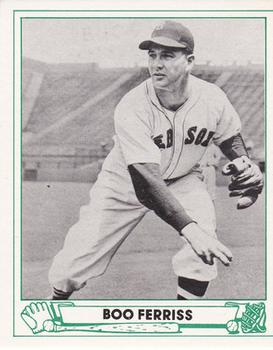
July 30, 1946: Boo Ferriss throws sixth shutout of season for first-place Red Sox in Cleveland
This game was yet another Boo Ferriss shutout. The Boston Red Sox starter had quite a first couple of years in the big leagues. As a rookie in 1945 he was 21-10 with five shutouts. He won every one of his first seven starts, including four shutouts in his first six. He was 8-0 before he lost a game, and he lost that one in part because his team only produced two runs.
In 1946 the right-hander got off to an even better start, as he went 10-0 before losing his first game. Among those 10 wins were four shutouts. The 24-year-old Ferriss was 16-4 with a 2.86 ERA coming into his July 30 start against the Cleveland Indians at Cleveland Stadium. Earlier that month, he’d been named to his first All-Star Game1 but hadn’t played, even though the game took place at Boston’s Fenway Park.
Starting for Lou Boudreau’s Indians was righty Steve Gromek. He’d come off a very good 1945, too – he had been 19-9 (with a 2.55 ERA). But he was not faring nearly as well in 1946. He was 4-9 (4.24) coming into this game. The Indians as a team were 46-51, in fifth place and a full 23 games behind the first-place 69-28 Red Sox.
This Tuesday night game drew a huge crowd – 56,060. From 1932 through 1946, the Indians played some of their home games at League Park, but the ones that looked likely to draw larger crowds were played at Cleveland Stadium, which had a much larger capacity.
Night games were new to most ballparks. In this first postwar year, cities that had tried to maintain darkness for fear of enemy air raids removed any such restrictions. Some parks, such as Fenway, installed lighting for the first time and began to hold their first night games. The Red Sox played their first home night game the following year, on June 13, 1947.2
This game was the 12th the 1946 Red Sox had played under the lights. Some had attracted very large crowds – the July 2 night game at Yankee Stadium had drawn 68,617 and the July 23 game at Comiskey Park was played before 49,376. Crowds were generally larger, with the Second World War over and the economy doing well.
In Cleveland, games drew an average attendance of 13,731 in 1946, up significantly from 7,249 the previous season. The July 30 attendance was the largest crowd to date in 1946, topped only on August 13, when 65,765 saw a 1-0 loss to the Detroit Tigers.
The ’46 Red Sox had a record of 4-7 in night games to this point. They had lost six of their first seven games played at night, giving birth to the notion that they couldn’t play well under lights. This game helped dispel that myth.3
Many had their eyes on Ted Williams. Even in the parks of opposing fans, some confessed they were there hoping to see Ted Williams hit a home run. In the first inning, Gromek set the Red Sox down in order, Williams – who began the day leading the majors with 27 homers and 93 RBIs – grounding out to Heinz Becker at first base, unassisted.
Second up for Cleveland against Ferriss in the bottom of the first was second baseman Jack Conway. He singled to center but was left there.
Rudy York singled to start the Red Sox second. He was forced at second base when Bobby Doerr grounded back to Gromek, and Doerr never made it to second. Becker led off the bottom of the second with a single. Boudreau, the Indians’ shortstop as well as the team’s manager, sacrificed him to second. Nothing more came of it.
Both sides went down in order in the third inning.
Johnny Pesky lined out to Boudreau, his counterpart at short, for the first out of the fourth. When left-handed Williams came to bat, Boudreau employed what later became known as the “Williams Shift,” moving three infielders to the right-field side of second base. Cleveland had debuted the alignment on July 14, for the second game of a doubleheader at Fenway Park.4
But Williams hit Gromek’s pitch into the first row of the lower deck of the right-field seats for a 1-0 Boston lead. Hitting over the shift was, of course, a very good way to foil it. As the Cleveland Plain Dealer put it, “willowy Ted Williams, incomparable slugger…defied Boudreau’s unique defensive formations by pounding his 28th home run into the right-field seats.”5 It was hit down the foul line, about 350 feet, and “not much fair,” wrote the Boston Herald.6
York followed with a double, but the next two batters made outs. This wasn’t the first time Ted Williams had hit a home run on July 30 in Cleveland. He had done so on July 30, 1942, at League Park. The Red Sox, however, had lost that game, 4-3.
The Indians came to bat in the bottom of the fourth. They went down in order again.
In the fifth, another Red Sox home run made it 2-0, Boston. The first man up, third baseman Rip Russell, poled what the Boston Globe called “a well-stroked smash deep into the lower left-field seats and probably a little longer than Ted’s thump to the opposite direction.”7 Ferriss walked with one out, but he was the only other Red Sox batter to reach.
The Indians went down in order again in their half.
Williams led off the sixth and was out on a called third strike. It was a season in which he struck out 44 times but hit 38 home runs. York and Doerr both hit flyball outs.
In the bottom of the sixth, the Indians got their third hit of the game, and it was the second single by Conway. Ferriss had retired 14 batters in a row after Becker’s base hit in the second inning. No one else succeeded in getting on base, or moving Conway along.
In the seventh inning, both sides went down in order.
Ferriss, hitting .216 coming into the game, led off the eighth inning with a single to center field. The Red Sox’ right fielder, Wally Moses, hit a “fiery triple to deep right center, a ball which went to the running track, 400 feet from home,” per the Boston Herald.8 Pesky followed that with a single to center, scoring Moses. The score was now Boston 4, Cleveland 0.
After Gromek had been tagged for three straight hits, Boudreau replaced him with 41-year-old reliever Joe Berry, who had been purchased from the Philadelphia Athletics on the first day of July. Berry walked Williams. He struck out York and got Doerr to hit into a 6-4-3 double play.
The Indians went down in order again in the eighth.
Berry having been lifted for a pinch-hitter, Pete Center pitched the top of the ninth. Russell singled with one out, but the next two batters made outs.
The Indians went down in order again, for the final time. Boo Ferriss had completed another shutout, allowing just three hits, all singles. He hadn’t walked even one batter and had faced only 30 all told. Becker was the only Indian who got as far as second base. Ferriss even got credited for some fine fielding, covering first base twice and making commendable plays on Jim Hegan in the fifth and Gromek in the sixth.
When the year was done, Ferriss was 25-6 (3.26 ERA), leading both the American and National Leagues in winning percentage. His six shutouts tied him for second in the AL behind Cleveland’s Bob Feller, who recorded 10 shutouts. Ferriss threw another shutout in Game Three of the World Series against the St. Louis Cardinals. The Red Sox won 11 of their final 15 night games to finish with an 11-9 record at night.
As noted in his SABR biography, Ferriss suffered a serious shoulder injury in mid-July 1947. During another night game in Cleveland. something snapped in his shoulder. He kept pitching. “Pitched pretty well,” he allows. “But I didn’t have as good a fastball, by any means. I had to do a little more finesse work. I finished up, I believe, 12-11.”9 While he battled through a couple more seasons, he was never again the same pitcher.
Acknowledgements
This article was fact-checked by Joseph Wancho and copy-edited by Mike Eisenbath.
Photo credit: Dave Ferriss, Trading Card Database.
Sources
In addition to the sources cited in the Notes, the author consulted Baseball-Reference.com and Retrosheet.org.
https://www.baseball-reference.com/boxes/CLE/CLE194607300.shtml
https://www.retrosheet.org/boxesetc/1946/B07300CLE1946.htm
Notes
1 It turned out also to be his last.
2 The first-ever Red Sox night game had been at Cleveland Stadium on July 13, 1939, a 6-5 win over the Indians.
3 See, for instance, John Drohan, “Sox Exploding Night Ball Myth,” Boston Traveler, July 31, 1946: 10.
4 Williams had hit three home runs and a single, driving in eight runs, in the first game of the July 14 doubleheader.
5 Alex Zirin, “Ferriss Shuts Out Indians with Three Hits to Snare 17th Victory, 4 to 0,” Cleveland Plain Dealer, July 31, 1946: 14.
6 Burt Whitman, “Sox Blank Indians, 4-0, As Ted Hits 28th Homer,” Boston Herald, July 31, 1946: 1, 11.
7 Gerry Moore, “Williams, Russell Homer As Ferriss Wins 17th, 4-0,” Boston Globe, July 31, 1946: 1, 16.
8 Whitman.
9 Author interview with Dave Ferriss on March 6, 2006.
Additional Stats
Boston Red Sox 4
Cleveland Indians 0
Cleveland Stadium
Cleveland, OH
Box Score + PBP:
Corrections? Additions?
If you can help us improve this game story, contact us.