

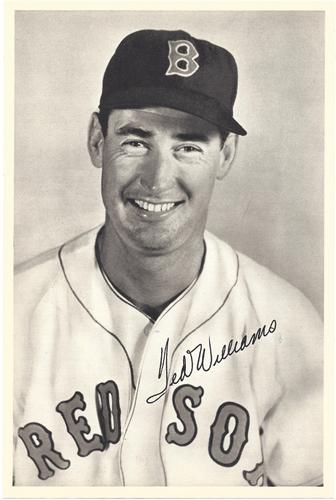
August 19, 1953: A few thousand Little Leaguers get to see a Ted Williams home run in Boston
Seven times before 1953, Ted Williams had hit home runs on August 19. The one he hit this Wednesday afternoon at Boston’s Fenway Park was his 327th career home run. He had previously hit homers number 18, 49, 78, 79, 80, 117, and 319 on August 19. This home run provided the run that won the game for the Boston Red Sox against the visiting Philadelphia Athletics, managed by Jimmy Dykes.1
Captain T.S. Williams, USMC, had completed 39 combat flight missions over North Korea, missing most of the 1952 and 1953 seasons. He had been back less than a month on August 19. This was his third four-bagger since returning. He almost didn’t play in the game; he was reported as being rather sore and stiff before the game.
The 48-70 Athletics were in sixth place in the American League. The Red Sox were 66-55 and in fourth place, but they were 15 games behind the first-place New York Yankees. The Red Sox were only one game behind the Cleveland Indians, though, and a win or two might bump them up to third place.
The paid attendance for the game was 12,084, but enlivening Fenway Park were 4,000 to 5,000 Little Leaguers there as guests of the Red Sox. It was also ladies day, and there were 1,987 ladies, too.
Ben Flowers started the game for Boston. The right-hander had worked his way up in the Red Sox system. He’d appeared in one major-league game in 1951 but had not made it back to the big-league club until 1953. He had appeared in 26 games as a reliever in 1953, setting a major-league record at the time by appearing in eight consecutive games from July 25 through August 1.2 He got his first start on August 5, shutting out the St. Louis Browns, 5-0. He lost his next two starts, the Red Sox scoring only one run in the two games combined. This was his fourth start for manager Lou Boudreau.
Flowers gave up a single to right fielder Dave Philley in the first inning and walked catcher Joe Astroth, who led off the third. Neither of them got as far as second base.
The Red Sox scored one run in the first. Pitching for the Athletics was right-hander Charlie Bishop, in his second year with the team. He’d worked in six games in 1952. He entered this game with subpar statistics: a 3-10 record with a 5.13 earned-run average. The three wins had come earlier in the year; he’d lost his last eight decisions.
The first batter Bishop faced was Red Sox second baseman Billy Goodman, who doubled to center field. Jimmy Piersall hit a fly ball to right field, and Goodman took third base. Ted Williams drew a walk on four pitches. Third baseman George Kell singled to right field, and Goodman scored while Williams reached second base.
Flowers reached on an error by Kell in the second inning and Williams walked again in the third. They were the only other two Red Sox to reach base.
The Athletics took the lead in the top of the fourth. First baseman Eddie Robinson started by singling to center field. Left fielder Gus Zernial homered into the left-field screen. Carmen Mauro, the center fielder, singled but was thrown out trying to steal second. The next two batters grounded out, but Philadelphia had a 2-1 edge.
In the bottom of the fourth, the Red Sox tilted the score back the other way, scoring a pair of runs. Catcher Sammy White led off with a double to left field. Center fielder Tommy Umphlett singled; he took second base on the throw to third base. Shortstop Milt Bolling flied out to right, a sacrifice fly that tied the score. After another fly out, Goodman singled and scored Umphlett. Piersall singled to right field but was thrown out trying to stretch it to a double. Piersall spiked himself making a headfirst slide into second base, bled profusely, and had to be carried from the field on a stretcher.3
Astroth doubled leading off for the Athletics in the fifth. After a couple of outs, Philley singled to center. Astroth was tagged out at the plate trying to score, cut down by Umphlett’s perfect throw to White.4
The Red Sox went down in order in the bottom of the fifth.
Leading off the top of the sixth was Eddie Robinson. He homered over the visitors’ bullpen in right field. The score was tied. Second up was Zernial. He hit his second home run of the game, again into the netting atop the left-field wall. The home runs were numbers 30 and 31 of the season for Zernial; he had now hit one in every American League ballpark during 1953. The Athletics had taken a 4-3 lead.
Boudreau replaced Flowers at this point, bringing in Ellis Kinder. It was Kinder’s ninth relief appearance in 11 days. Two groundouts and a strikeout followed.
Bishop hit Bolling with a pitch in the bottom of the inning and Kinder singled, sending Bolling to second, but the Red Sox failed to score.
Kinder kept the ball in the infield in the top of the seventh.
Right fielder Al Zarilla, who had replaced Piersall in the fifth inning, singled to right field in the Red Sox seventh. On a 3-and-1 count, Ted Williams homered to right, a “410-foot smash far into the right-field stands” – maybe as far as 28 rows up into the Section 3 seats.5 “I guess I hit that one as well as anything I’ve hit for a long time,” Williams said.6
The Red Sox now held a 5-4 lead. Kell followed with a double to left field. First baseman Dick Gernert laid down a sacrifice bunt and Kell ran to third. Sammy White singled to left field, driving in Kell. Morrie Martin relieved Bishop and got both Umphlett and Bolling to ground out.
Kinder retired the three Athletics he faced in the top of the eighth. Martin faced just three Red Sox, but Goodman had reached on an error by shortstop Joe DeMaestri before Zarilla lined into a double play.
In the top of the ninth, Dykes pulled out all the stops trying to get the two runs his team needed to at least tie things up. Kinder was still on the mound. Mauro flied out to center field for the first out. Kinder had retired everyone he had faced, 10 in a row. However, Tom Hamilton pinch-hit for second baseman Cass Michaels and singled. Third baseman Loren Babe walked. Elmer Valo pinch-hit for Astroth. Valo flied out to deep right field. It was the second out of the inning but hit deep enough that both Hamilton and Babe moved up. The tying run was on third base and the go-ahead run on second base.
Morrie Martin was due to bat, so Dykes turned to rookie Neal Watlington to pinch-hit. Watlington walked. The bases were loaded. Shortstop Joe DeMaestri was up next. He was 0-for-4 on the day. Dykes decided to give Ray Murray a role, and Murray stepped into the batter’s box as the fourth pinch-hitter of the half-inning, batting for DeMaestri. Murray hit a “routine fly ball” to left.7
Kinder got the win. Bishop bore the loss.
And a few thousand Little Leaguers got to see a Ted Williams home run.
Coupled with a Cleveland loss to Detroit, this win did indeed edge the Red Sox into third place, for the first time since July 29. The next day, August 20, the Red Sox were idle but the Indians played and won, retaking third place. The Red Sox dropped to fourth, and there they remained for the rest of the 1953 season.
Acknowledgments
This article was fact-checked by Bruce Slutsky and copy-edited by Len Levin.
Photo credit: Ted Williams, Trading Card Database.
Sources
In addition to the sources cited in the Notes, the author consulted Baseball-Reference.com and Retrosheet.org.
https://www.baseball-reference.com/boxes/BOS/BOS195308190.shtml
https://www.retrosheet.org/boxesetc/1953/B08190BOS1953.htm
Notes
1 A “game-winning home run” is defined here as a home run that provides a game’s final margin of victory, giving the winning team at least one more run than the opposing team scored. For example, if a two-run homer increased a team’s lead from 2-1 to 4-1, and it went on to win 4-3, it qualifies as a game-winning home run. (This is different from the definition of “game-winning RBI” in baseball’s official statistics from 1980 through 1988, which counted as “game-winning” the RBI that provided a winning team the lead it never relinquished.)
2 The mark wasn’t equaled until the Los Angeles Dodgers’ Mike Marshall obliterated it with a major-league-record 13 consecutive games from June 18 through July 3, 1974, a mark matched by Dale Mohorcic of the Texas Rangers from August 6 through 20, 1986.
3 Piersall “was cut badly on the right leg yesterday by his own spikes as he tried to stretch a fourth-inning single into a double. … His left shoe caught him inside the right thigh above the knee, cutting him severely, He was taken to Sancta Maria Hospital for six or seven stitches. Piersall apologized to Ted Williams for making the third out and depriving Williams of an at-bat. Bob Holbrook, “Injured Piersall ‘Apologizes’ to Ted,” Boston Globe, August 20, 1953: 1, 6. The number of stitches was reported by the Boston American.
4 A photograph of White applying the tag ran on page 15 of the August 20 Boston Globe. The throw came straight to the plate, without a bounce, illustrated by Vic Johnson’s sports cartoon. Vic Johnson, “Mammoth Wallop,” Boston Herald, August 20, 1953: 23.
5 Policeman Roger Thayer worked in that area and he said it had gone 430 feet; it was described as landing in Row 28. Harold Kaese, “Only 3 Weeks in Uniform and Ted’s Ahead of Pitchers,” Boston Globe, August 20, 1953: 1.
6 Clif Keane, “Piersall Makes Surgeon Wait Until Game Is Over,” Boston Globe, August 20, 1953: 15.
7 F.C. Matzek, “Williams’ Homer Helps Sox Beat A’s, 6-4,” Providence Journal, August 20, 1953: 10.
Additional Stats
Boston Red Sox 6
Philadelphia Athletics 4
Fenway Park
Boston, MA
Box Score + PBP:
Corrections? Additions?
If you can help us improve this game story, contact us.