

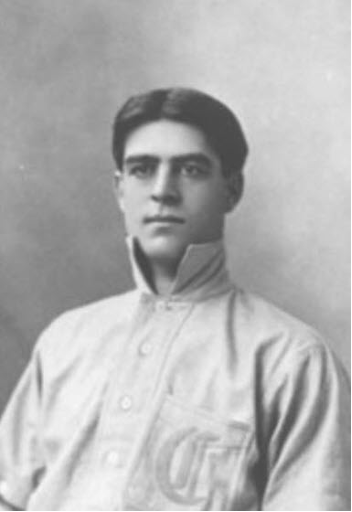
Jake Weimer
Southpaw Jake Weimer burst onto the major-league scene in 1903, and over his first four seasons he won 78 games in the National League. His win total rivaled that of the great right-hander Denton “Cy” Young, who won 85 games during those years. Their nicknames were similar and conveyed the fury of their pitches: “Cy” was short for “Cyclone,” and Weimer was dubbed “Tornado Jake.” But they differed in temperament; while Young was calm and reserved, Weimer was tempestuous, befitting his moniker. Weimer “had quite a temper and would lose his head easily,” recalled his teammate, Joe Tinker.1
In 1906, the elite right-hander Christy Mathewson called Weimer the greatest southpaw in baseball.2 Mathewson, in the National League, perhaps saw little of American League left-handers Rube Waddell and Eddie Plank, yet Weimer had indeed become one of baseball’s best southpaws. From 1903 to 1908, he won more games (97) in the NL than any other southpaw. And according to Baseball-Reference.com, his sterling 2.23 career ERA ranks second all-time among NL left-handers (behind only Jack Pfiester’s microscopic 2.02). But after 1908, Weimer won zero games. Like a shooting star, his career burned brightly and then vanished.
Jacob Weimer was born on November 29, 1873, in Ottumwa, Iowa, and grew up there. His parents, Adam and Mary (née Davis) Weimer, were German immigrants.3 He had three older and three younger siblings. Cigarmaking was a major industry in Ottumwa; Jake learned and practiced that trade.4 In his leisure time, he pitched for local amateur teams.
In 1895 Weimer pitched professionally for a Burlington, Iowa, club which began the year in the Eastern Iowa League and moved up to the Western Association in August. His ability was evident. On June 23, he struck out 12 batters in a victory over Ottumwa, and he beat St. Joseph, Missouri, with a four-hitter on September 3.5 But along the way, he earned criticism for churlish behavior.
On July 24, while pitching with his team ahead 8-3 in the eighth inning, he objected to the calling of balls and strikes, and stormed off the field. His teammates followed, and the game was forfeited.6 On September 10, “he became pettish because he was not supported [by his defense] just right in one inning, and began to ‘lob’ the balls over the plate.”7 Correspondent James H. Lloyd, writing in Sporting Life, said, “If [Weimer] can control that temper of his, he would be good enough for any team. He has tremendous speed and good curves.”8
In the spring of 1896, Weimer joined the Indianapolis Hoosiers of the Western League, but his time with the team was short. In an exhibition game on April 6, he pitched three innings in the Hoosiers’ victory over the Page Fence Giants, a traveling Black team. That day he was severely injured when a bat slipped from the hands of his teammate, Bill Phillips, and struck him in the leg.9 He went home to Ottumwa to recover and declined to return after his recovery.10
Weimer pitched briefly for Burlington in the spring of 1897. He left the team in June with a strained back and went home to rest,11 and again he chose not to return. Meanwhile, he married Rosa Utterback on April 26, 1897; two and a half months later she gave birth to their daughter Gertrude. The marriage lasted about a year.
In the spring of 1898, Weimer returned to Indianapolis and was farmed out to Ottumwa in the Western Association.12 Pitching for his hometown team, he posted a 7-9 record in 1898 and a 9-5 mark in 1899. Both seasons were halted in June by the disbanding of the league.
Over the next three seasons, Weimer rose up as one of the premier pitchers of the Western League. With Des Moines in 1900, he compiled a 19-10 record; for the pennant-winning Kansas City teams of 1901 and 1902, he achieved 23-8 and 24-16 records, respectively.13 At 5-feet-11 and 175 pounds, he was a sturdy workhorse.
In 1902 Weimer led the Western League with 209 strikeouts.14 Eleven of his 16 losses that year were by a single run. Among his wins were a one-hit shutout of Colorado Springs on May 7 and a two-hit shutout of Peoria, Illinois, on July 10.15
Twice he competed with Omaha’s Frank Owen in intense pitchers’ duels. On July 21, both hurlers went the distance in a 16-inning marathon won by Omaha, 2-1.16 In a rematch on September 10, Kansas City prevailed 2-1 as Weimer delivered a two-hitter. He was a right-handed batter, and that day he got two hits off Owen, including the game-winning hit in the ninth inning.17
At St. Joseph on August 25, Weimer started for Kansas City and was ejected in the first inning by umpire Augie Moran for arguing balls and strikes. From the bench, Weimer continued to harp, so Moran ordered him to leave the grounds. As two policemen came to get him, he ran from them, and the crowd got a big laugh to see a policeman chasing him. Weimer finally gave himself up, shook hands with the officers, and left the grounds. This was the start of an extraordinary game; Norwood Gibson, pitching in relief of Weimer, completed a 10-inning no-hitter.18
On October 23, 1902, Weimer married Lulu Ryan. This marriage, like his first, lasted about a year. Lulu reportedly operated a brothel in Des Moines in 1904.19
At 29 years of age and with considerable minor-league experience, Weimer was ready for the majors. In the spring of 1903, he joined the Chicago Cubs (the team was also known as the Colts at this time). After working seven innings in St. Louis in his April 17 debut, he went the distance and earned his first major-league win on April 23 against Cincinnati. The Chicago Tribune praised his “splendid control, a rare thing in a southpaw pitcher,” and “his coolness under fire.”20
On June 18, Weimer pitched his first major-league shutout, outdueling Mathewson of the New York Giants in a 1-0 cliffhanger. He beat Mathewson again with a shutout on September 19 and three days later garnered his 20th win by defeating the Giants’ other ace, Joe McGinnity.
Adding to his splendid 20-8 season record, Weimer was 3-1 in the Cubs’ postseason series against the Chicago White Sox. The Cubs and White Sox split the long series, winning seven games apiece. Weimer’s sole loss came on October 14 when his old rival, Frank Owen, threw a shutout for the White Sox.21
Weimer’s 1904 season began with three narrow losses, to Cincinnati, St. Louis, and Pittsburgh. He was given a one-week suspension for the “abusive language” he directed toward umpire Jim Johnstone during the Pittsburgh game on May 1.22 And the “quick-tempered” southpaw23 was ejected by Johnstone from the game of May 14 for arguing balls and strikes. Weimer’s work was characterized by one reporter as alternately striking out batters and “kicking,” i.e., complaining to the umpire.24
The Cubs were in second place for much of the 1904 season, trying to catch the first-place Giants. Weimer edged Mathewson, 3-2, on May 20. Three days later, in “a battle of skill and nerve,” these aces dueled for 11 innings in a 1-1 tie.25 Mathewson finally beat Weimer by throwing a one-hit shutout on June 10.
On August 25, Weimer dueled with McGinnity, and the Cubs and Giants were deadlocked after nine innings, 1-1. But Weimer, the hothead, derailed the Cubs’ chances in the top of the 10th inning. The Chicago Tribune explained:
“Jake hit Billy] Gilbert, the first batter up in the tenth, and began kicking at the umpire for it. Jack] Warner bunted and Weimer hurled the ball to second, too late to catch Gilbert, who got a running start from first. Umpire Charles] Kennedy called Gilbert safe and the decision, although close, appeared to all but Weimer to be correct. But the southpaw deliberately chased up the official, in spite of the efforts of his teammates to restrain him, and kicked until he had to be ordered to the clubhouse.”26
Weimer was relieved by Bob Wicker, who gave up a single, three walks, and a hit batsman, and the Cubs lost 4-1 to their archrivals. Weimer’s teammates were furious with Weimer, and after the game he and shortstop Joe Tinker engaged in a fistfight, leaving both men with a black eye.27 None the worse for wear, Weimer shut out Philadelphia four days later and Tinker got two of the Cubs’ four hits.
The Cubs finished the 1904 season in second place, 13 games back of the champion Giants. Weimer’s record was 20-14, and seven of the losses were by one run. He threw five shutouts, led the Cubs in wins and innings pitched (307), and ranked third in the National League in strikeouts (177) and fourth in ERA (1.91).
For the third-place 1905 Cubs, Weimer’s record was 18-12 (and 2-0 in the postseason against the White Sox28); his 2.26 ERA was well below the 2.99 league average. He kept hitters off-balance by mixing his fastball with a “deadly” change of pace.29 And he had left-handed batters “breaking their backs trying to connect” with his “wide curves.”30
The Cubs needed a third baseman and had a surplus of pitchers, so on October 20, 1905, Weimer was traded to the Cincinnati Reds for third baseman Harry Steinfeldt.31 The trade worked out well for both teams, but Weimer missed out on the Cubs’ trio of NL championships from 1906 to 1908.
In his first game with the Reds, Weimer faced the Cubs on April 14, 1906. He threw “the ball past his old mates with cyclone speed” in a 1-0 Reds’ victory.32 On May 7, he and Buster Brown of St. Louis went the distance in a 15-inning 2-2 tie; it was the longest outing of Weimer’s major-league career.
On May 30, Honus Wagner slugged three extra-base hits off Weimer in Pittsburgh’s 9-1 rout of the Reds. After this loss, Weimer’s record was 3-7. But he won his next 10 decisions, from June 3 to July 22. And on August 24 and August 26, he pitched consecutive seven-inning shutouts; he allowed no hits in the first of these.
The 1906 Reds finished in sixth place, 51½ games back of the first-place Cubs. Weimer’s season record was 20-14 with six shutouts and a 2.22 ERA. He was the only Reds pitcher with a winning record; the other 13 pitchers combined for a 44-73 mark.
Weimer might have had a couple more wins in 1906, but twice he was ejected for arguing balls and strikes. His temper also flared off the field. According to one report, Tornado Jake had poor luck playing poker with his teammates, and in “fits of peevishness,” he tore up 28 decks of cards and tossed them out of a hotel window.33 “The great trouble with Weimer,” wrote Ren Mulford Jr. in Sporting Life, “is that his nature is explosive.”34
In 1907 Weimer was a holdout in the spring. He made his first appearance with the Reds on June 3 and lost a pitchers’ duel to Stoney McGlynn of St. Louis, 1-0. In Weimer’s third game of the season, he was ejected by umpire Bill Klem for arguing balls and strikes. The Reds again landed in sixth place, and Weimer, for the first time, had a losing season record, 11-14.
On April 16, 1908, Weimer walked eight batters in seven innings in the Reds’ 7-4 loss to the Cubs. He blanked Pittsburgh on June 22, limiting Honus Wagner to one single in four at-bats. But two days later, with Weimer pitching on short rest, Wagner had a single, double, and home run in Pittsburgh’s 5-3 triumph.
On July 8, 1908, Weimer beat the Giants, 8-3, to improve his season record to 8-7. This proved to be his final major-league victory. Two days later, he was traded to the Giants with utilityman Dave Brain for pitcher Bob Spade and $5,000. Weimer refused to report to the Giants unless he got half of this money ($2,500, equivalent to about $90,000 in 2026 dollars).35
When he did not receive it, Weimer stayed home with his family in Chicago and pitched occasionally for local semipro teams. Third wife Laura Trumbull, whom he had married in 1904, gave birth to their second child, son George, in November 1908. Their first child, daughter Mary, was born in 1906. A third child, daughter Laura, would be born in 1914.
The Giants finished one game behind the Cubs for the 1908 NL pennant, and it was suggested that if Weimer had played for the Giants, the team might have won the pennant.36 As noted upon his return the following year, “Weimer is an erratic individual, but he is a star pitcher and will add great strength to the Giants.”37
Weimer reported to the Giants at spring training in 1909, but he had arm trouble. He appeared in only one regular-season game, on May 28, and then went home. During the ensuing winter, he received treatment for his arm from physical therapist Bonesetter Reese, and he returned to the Giants at spring training in 1910.38 But he was of no use to the team and was released.39 His major-league career was over.
Over the next three seasons, Weimer pitched for semipro teams in the Chicago area. His primary focus, though, was his career as a hog trader at Chicago stockyards. In 1922 he coached high school baseball at the Loyola Academy. There he mentored a 16-year-old phenom, Freddie Lindstrom, and recommended him to the New York Giants. Lindstrom was signed by the Giants and went on to a Hall of Fame career.
On June 19, 1928, Weimer died at age 54 in Chicago. According to his death certificate, the cause was appendicitis with diabetes as a contributing factor. He was interred at the Mount Olivet Cemetery in Chicago.
Acknowledgments
This story was reviewed by Bill Lamb and Rory Costello and fact-checked by Dan Schoenholz.
Sources
Ancestry.com, Baseball-Reference.com, and Retrosheet.org, accessed April to June 2026.
Image: 1903 portrait of Jake Weimer by Carl J. Horner.
Notes
1 Joe Tinker, “Tinker to Evers to Chance,” Jackson (Mississippi) Clarion-Ledger, April 11, 1931: 10.
2 “Jake Pitches Shut-outs,” (Covington) Kentucky Post, July 9, 1906: 7.
3 Davis, the name shown in the records, may have been Anglicized.
4 “The City,” Burlington (Iowa) Gazette, October 9, 1895: 4.
5 “Two Straights Won,” Cedar Rapids (Iowa) Gazette, June 24, 1895: 5; Sporting Life, September 14, 1895: 14.
6 “Iowa State League Standings,” Chicago Tribune, July 25, 1895: 5.
7 “Burly Burlingtons,” Rockford (Illinois) Register-Gazette, September 11, 1895: 3.
8 James H. Lloyd, “Burlington Briefs,” Sporting Life, December 14, 1895: 3.
9 “So Bad It Was Funny” and “Pitcher Weimer Injured,” Indianapolis Journal, April 7, 1896: 7.
10 “Game Thrown Out,” Indianapolis Journal, May 18, 1897: 3.
11 “Brief Ball Notes,” Rockford Register-Gazette, June 29, 1897: 3.
12 “News and Comment,” Sporting Life, May 14, 1898: 5.
13 Weimer’s won-lost records in 1900, 1901, and 1902 were tabulated by the author from box scores.
14 Francis C. Richter, ed., Reach’s Official American League Base Ball Guide for 1903 (Philadelphia: A.J. Reach Co., 1903), 198.
15 Sporting Life, May 24, 1902: 18; “Weimer’s Star Game,” Kansas City Journal, July 11, 1902: 5.
16 Sporting Life, August 2, 1902: 14.
17 “Gentlemen of the Kaw Forget Laws of Guests,” Omaha World-Herald, September 11, 1902: 7.
18 “Jake Weimer Leads Officers Merry Chase around Park” and “Saints Didn’t Get a Hit off Gibson in Ten Innings,” St. Joseph (Missouri) Gazette, August 26, 1902: 3.
19 “Divorced Wife in Des Moines,” Marshalltown (Iowa) Times-Republican, September 24, 1904: 5.
20 “Notes of the Colts’ Game,” Chicago Tribune, April 24, 1903: 6.
21 Coverage of the Cubs-White Sox postseason series in the October 10, 17, and 24, 1903, issues of Sporting Life.
22 “National League News,” Sporting Life, May 14, 1904: 7.
23 “Couldn’t Hit,” Boston Globe, May 10, 1904: 5.
24 “Dobbs’ Absence Costly for Brooklyn Team,” Brooklyn Citizen, May 17, 1904: 5.
25 Jack Tanner, “Last Contest with New York Ends in a Draw,” Chicago Inter Ocean, May 24, 1904: 4.
26 “Colts Are Prey for New Yorkers,” Chicago Tribune, August 26, 1904: 6.
27 “Tinker and Weimer in Fight,” Chicago Tribune, August 27, 1904: 6.
28 Sporting Life, October 21, 1905: 9; Sporting Life, October 28, 1905: 7. The Cubs won the 1905 postseason series with the White Sox, four games to one.
29 “Weimer a Wonder,” Ottumwa (Iowa) Courier, February 25, 1904: 7.
30 “Phillies Swatted Weimer for Fair,” Philadelphia Inquirer, May 25, 1905: 10.
31 “Jake Weimer Gets His Notice,” Chicago Tribune, October 21, 1905: 7. The Reds’ Jimmy Sebring was also part of the trade, but he chose not to report to the Cubs.
32 “Jake Weimer’s Wing and Cy Seymour’s Bat Thwart Cubs,” Chicago Inter Ocean, April 15, 1906: Sports, 1.
33 “J. Weimer, of Ottumwa—His History,” Kentucky Post, May 24, 1907: 8.
34 Ren Mulford Jr., “Red Surprises,” Sporting Life, July 25, 1908: 2.
35 “Pitcher Jake Weimer Refuses to Join New York Giants,” Kentucky Post, July 11, 1908: 6.
36 “Weimer’s Return Gives Giants 3 Good Southpaws,” Altoona (Pennsylvania) Times, February 8, 1909: 8.
37 “Weimer Will Join,” Passaic (New Jersey) News, March 16, 1909: 3.
38 “Joined Squad,” Houston Post, March 2, 1910: 3.
39 “Giants Release ‘Jake’ Weimer,” Cincinnati Post, May 17, 1910: 1.
Full Name
Jacob Weimer
Born
November 29, 1873 at Ottumwa, IA (USA)
Died
June 19, 1928 at Chicago, IL (USA)
If you can help us improve this player’s biography, contact us.