

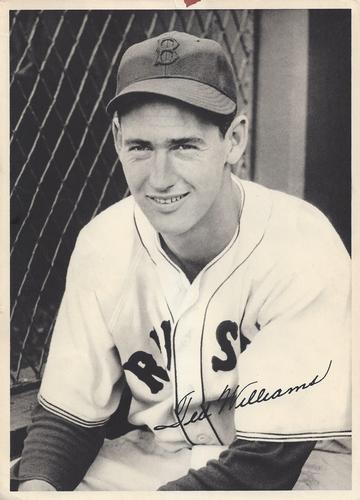
May 29, 1941: Ted Williams, Skeeter Newsome both homer as Boston beats Connie Mack’s A’s
After going 3-for-4 on May 29, 1941, in the Boston Red Sox’ 37th game of the season, Ted Williams was hitting .421. A Thursday afternoon crowd of about 3,200 – a bit less than 10 percent of Fenway Park’s capacity1 – could say they saw the Red Sox slugger win another game with a home run,2 just as he had done two days earlier against the visiting Philadelphia Athletics.
That one was hit in the third inning during the first game of a doubleheader. This one came right after the seventh-inning stretch. In between the two wins, the Sox had lost an 11-1 game to the Athletics, in the second game of the May 27 doubleheader; and a 16-inning game, 8-6, on May 28. Having won nine of their last 11 games, the Athletics were hot.
This game featured Joe Dobson starting for the Red Sox. He hadn’t pitched much yet in 1941 – this was just his third start, and he’d worked a total of only 8⅓ innings, with a 7.56 earned-run average to show for it. He was 0-1.
Dobson gave up a couple of singles in the top of the first, but no one got past second base. In the second, he set down Philadelphia in order.
The only Red Sox hit in the first inning was a single by left fielder Williams. In the second, though, they scored a run. Facing Jack Knott, right fielder Pete Fox singled to left field; so did third baseman Jim Tabor, Fox taking third. Second baseman Skeeter Newsome, formerly with Philadelphia from 1935-39, was filling in for Bobby Doerr, out with an injury; he grounded out to shortstop, Fox scoring. Catcher Frankie Pytlak grounded out to Knott, and Knott struck out Dobson.
Knott had come into the game with a poor ERA, too. He was 5.55 and had a 2-4 record after a win over the Washington Nationals five days earlier. He didn’t have to face Jimmie Foxx in this game; Foxx was suffering from a bout of dysentery.3
Dobson set down the side in order in the third inning, and the Red Sox added two more runs, With one out, first baseman Lou Finney walked. Williams singled again, Finney going first to third. Player-manager Joe Cronin hit a liner to right-center which Wally Moses chased down. It was easy for Finney to tag and score, and Cronin got credit for a sacrifice fly. Fox singled to first baseman Dick Siebert, who flipped the ball to Knott covering, but Knott muffed the play and Williams got all the way to third base. Tabor singled to center field, and the Red Sox had a 3-0 lead.
Nobody from either team reached base in the fourth inning.
The Athletics put their first run on the board in the top of the fifth. A one-out triple off the wall in left-center field by catcher Frankie Hayes set up the run. Third baseman Pete Suder hit a fly ball to left field; Williams caught it backed up against the wall, and Hayes tagged and scored.
Philadelphia added two more runs – tying the score at 3-3 – in the top of the sixth. Again, Dobson got the first out, but right fielder Moses singled. When Benny McCoy grounded out to first base, Moses took second. Bob Johnson doubled to near the flagpole in left center, and Moses scored. Dick Siebert walked, but then center fielder Sam Chapman doubled, too, over third base and down the left-field line. That drove in Johnson. Hayes was given a walk, loading the bases. Suder, however, flied out to right field.
There was a single and a stolen base for the Red Sox in the bottom of the sixth, but the score remained tied. The single came from Tabor, his third of the game.
Dobson retired the Athletics in order in the top of the seventh.
It was Dobson himself who kicked things off after the seventh-inning stretch. He squared up against Knott and singled sharply off the wall in left field. Dom DiMaggio laid down a bunt toward first base, a sacrifice that allowed Dobson to get into scoring position. Lou Finney went for a base hit, but ended up grounding out to first base, unassisted. Dobson went to third, but now there were two outs.
Ted Williams came to bat. He swung at the second pitch and poled a long ball that landed in the “runway between the right field bleachers and the end of the grandstand,” reported the Boston Herald.4 It was Williams’ seventh homer of the season. That made it Boston 5, Philadelphia 3.
Cronin walked but was forced at second base by a groundball Pete Fox hit to Suder at third base.
Dobson didn’t let the ball out of the infield in the top of the eighth.
The Red Sox faced reliever Lum Harris in the bottom of the inning. Harris struck out Jim Tabor, but then on a 1-and-0 count gave up a home run to Skeeter Newsome, hit into the left-field screen. It was Newsome’s first home run since September 27, 1937; as a member of the Athletics, he homered at Fenway Park against Boston’s Bobo Newsom. The Red Sox’ lead was 6-3.
The first batter Dobson faced in the top of the ninth was Sam Chapman, who singled to left and took third on Hayes’ double off the wall in straightaway center. Cronin called Mike Ryba to relieve Dobson. Ryba pitched to Suder, who hit the ball right back to him. He threw to first base for the first out of the inning. The runners held on second and third.
Dee Miles pinch-hit for pitcher Harris. Miles swung at the first pitch and singled to right field. Chapman scored. Hayes held at third base. Chubby Dean pinch-hit for Al Brancato. He hit a fly ball to Cronin at shortstop. Ryba got Moses to ground out, second to first.
Dobson got the win – his first as a member of the Red Sox – evening his record at 1-1. Later in the year, he reeled off seven wins in a row starting in mid-August and finished the season 12-5. Knott bore the loss but went 13-11 for a team that finished last in the league with a record of 64-90, 37 games behind the first-place New York Yankees.5
Williams’ three-hit game on May 29, his second in two days, made him a red-hot .600 in his past nine games, with 21 hits in 35 at-bats. He eventually reached a .436 season average on June 6, which was his highest point after April, on his way to a .406 final mark.
Acknowledgments
This article was fact-checked by Larry DeFillipo and copy-edited by Mike Eisenbath.
Sources
In addition to the sources cited in the Notes, the author consulted Baseball-Reference.com and Retrosheet.org.
https://www.baseball-reference.com/boxes/BOS/BOS194105290.shtml
https://www.retrosheet.org/boxesetc/1941/B05290BOS1941.htm
Notes
1 Official attendance was around 1,900, but this was a Ladies Day game and the actual audience was significantly larger.
2 A “game-winning home run” is defined here as a home run that provides a game’s final margin of victory, giving the winning team at least one more run than the opposing team scored. For example, if a two-run homer increased a team’s lead from 2-1 to 4-1, and it went on to win 4-3, it qualifies as a game-winning home run. (This is different from the definition of “game-winning RBI” in baseball’s official statistics from 1980 through 1988, which counted as “game-winning” the RBI that provided a winning team the lead that it never relinquished.)
3 Gerry Moore, “Red Sox Back in Fifth Place,” Boston Globe, May 30, 1941: 22.
4 Burt Whitman, “Williams’ Homer Chills Macks, 6-4,” Boston Herald, May 30, 1941: 24.
5 The Red Sox finished second, 17 games behind New York.
Additional Stats
Boston Red Sox 6
Philadelphia Athletics 4
Fenway Park
Boston, MA
Box Score + PBP:
Corrections? Additions?
If you can help us improve this game story, contact us.