

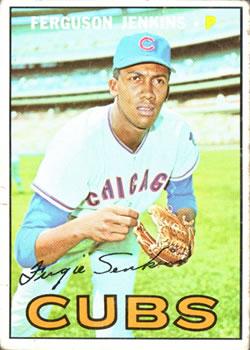
September 29, 1967: Fergie Jenkins wins 20th game of season for the first time
Coming off two dismal eighth-place finishes, the Chicago Cubs made a fateful trade with the Philadelphia Phillies 10 days into the 1966 season, ostensibly to shore up their outfield. The Cubs exchanged two highly paid yet aging workhorses who had combined for 313 career victories, 34-year-old Larry Jackson and 37-year-old Bob Buhl, for three inexperienced players earning “barely over the minimum,” reported the Chicago Tribune.1
The centerpiece of that trio was speedy Adolfo Phillips, who, Cubs skipper Leo Durocher opined, was the best National League center fielder not named Willie Mays or Curt Flood.2
The other two acquisitions were not expected to have a significant impact in Chicago. Utilityman John Herrnstein was traded within five weeks, and Durocher openly dismissed the idea that 23-year-old right-handed reliever Fergie Jenkins, with just eight big-league appearances, was a replacement for his departed veteran hurlers.3
The Cubs finished 1966 with the majors’ worst record (59-103), tying 1962’s franchise mark for losses. But a different narrative emerged a season later. As Chicago enjoyed its best season in more than a generation, Jenkins defied all expectations, earning a spot as the youngest player on the 1967 Sporting News NL All-Star Team. In the final start of a record-breaking season, on September 29, he defeated the Cincinnati Reds for his 20th win.4
Heading into Chicago’s season-capping three-game set in Cincinnati, the fourth-place Cubs – at 85-73 just a half-game behind the Reds – were a “surprising” team, declared Chicago sportswriter Martin Wyant.5 It was the franchise’s best season since their last pennant in 1945 and just their third winning season in 26 years. The primary reason for the team’s 28-game turnaround was its starting pitching, led by Jenkins and supported by 21-year-old third-year big-leaguer Ken Holtzman and two 22-year-old rookies, Joe Niekro and Rich Nye.
Jenkins’ conclusion to the 1966 season had foreshadowed his success in ’67. He entered the starting rotation in the final six weeks, during which he posted a stingy 2.13 ERA in 72 innings over nine starts. His 1967 breakthrough happened after new pitching coach Joe Becker noticed a flaw in his mechanics during spring training. As beat writer Jerome Holtzman explained, Jenkins tipped his pitches, mainly his fastball and breaking balls. With Becker’s guidance, Jenkins developed a new motion, winding up with both hands in front of his body, almost waist high. Employing a rocking motion to maintain rhythm and balance, Jenkins began throwing in a more overhead style, and was thus able to field grounders back to the mound in his follow-through.6
“I figured that if I doubled my six victories of last year that I would be doing really well,” said the Canadian-born Jenkins.7 He exceeded even his own goals by midseason. Selected to the NL All-Star team, Jenkins relied on a deceptive two-seam fastball.8 “[He’s] a lot faster than he looks,’’ raved Cubs beat reporter Edgar Munzel about the 6-foot-5 hurler, who reported to camp under 200 pounds.9 “He’s loose and limber and really whips that ball,” wrote Munzel. “It’s on top of the hitter before he realizes it.”
On September 15 Jenkins set a new Cubs post-1900 season record for strikeouts, breaking Orval Overall’s mark of 205 set in 1909. Becker, who had served as the St. Louis Cardinals pitching coach the previous two seasons, gave Jenkins a lofty comparison: Bob Gibson but with better control.10 Entering his final start, Jenkins was 19-13 (2.86 ERA), and had tossed complete-game victories with 27 punchouts and just six earned runs in his last three starts against the Reds. One of the complete-game wins, on July 2, had briefly put the Cubs in first place in July for the first time since 1945.
On a dreary Friday night, with the temperature 48 degrees and dropping in the Queen City, a sparse crowd of 3,069 spectators populated Crosley Field.11 It’s likely that few of them had taken notice of a breaking news story that day: The Reds had signed a 19-year-old shortstop from Venezuela, Dave Concepción.12 Taking the mound for skipper Dave Bristol’s squad was 19-year-old Gary Nolan (14-7, 2.52 ERA), who had joined Bob Feller (1938) as the only teenagers with 200 strikeouts in a season since 1900.
Billy Williams, already with eight hits in 13 at-bats against the Reds’ rookie hurler, belted a two-out home run in the first inning to give the Cubs a 1-0 lead. “I hit an outside fastball,” said Williams, whose 26th round-tripper bounced off the left-field screen.13
Jenkins and the Cubs were well rested. He had been scheduled to take the mound on September 27 against the Cardinals at Wrigley Field, but that game and its makeup the following day were rained out.14 “I’ve had back trouble for about a month,” revealed Jenkins, explaining that coach Becker had been yelling at him to “bend your back.”15
Despite that pain, Jenkins was coming off consecutive starts with at least 10 punchouts, including 11 against the Reds in his last outing, on September 23. Jenkins breezed through the first four frames, yielding two hits and a walk while fanning four. Pete Rose – who came into the season’s final weekend with a .301 batting average16 – attempted to bunt for a hit in the first, but Jenkins fielded it and threw him out.
In the fifth Leo Cardenas had a one-out scratch hit to short, according to Reds reporter Bill Ford,17 and moved up on Nolan’s sacrifice and Jenkins’ wild pitch. After Rose took his second of three walks of the contest, Tommy Helms popped up.
Nolan, who had twirled eight innings of two-run ball in his last outing, against the Cubs on September 24, engaged in a tense pitching duel with Jenkins through five frames. His batterymate, 19-year-old late August call-up Johnny Bench, flashed his brilliance in the third, throwing out Phillips and picking off Jenkins at first. “What an arm,” Durocher cooed.18
In the fourth Bench suffered a “bloody laceration” from a foul tip off Ron Santo’s bat.19 Reds beat writer Earl Lawson reported that Bench’s right thumb was “cut all the way to the tendon,” which eventually required five stitches.20 Johnny Edwards replaced Bench.
With two outs in the sixth, Williams sent a Nolan curve over the right-field fence, just “inside the foul pole,” noted Lawson. The Cubs had a 2-0 lead on Williams’s second homer of the game. After working around two hits in the seventh, Nolan ran out of steam in the eighth. Don Kessinger’s leadoff single and two intentional walks loaded the bases with two out and sent the teenager to the showers. Al Spangler greeted reliever Ted Davidson with a single, driving in Kessinger and Williams to extend the Cubs’ lead to 4-0.
Maintaining that lead going into the bottom of the ninth, Jenkins lost his bid for a shutout. Tony Perez connected for a one-out double and sprinted home on Art Shamsky’s single. Jenkins retired the next two to complete the game in 2 hours and 30 minutes for his 20th victory.21
With a masterful six-hitter, including eight punchouts and three walks, Jenkins (20-13) reached the 20-win plateau for the first of six consecutive seasons (1967-1972). Since the end of the Deadball Era (1919), only three other pitchers have accomplished that feat: Lefty Grove (1927-1933), Robin Roberts (1950-1955), and Warren Spahn (1956-1961).
Jenkins was the runner-up to the Giants’ Mike McCormick (22-10) for the NL Cy Young Award in his first full season as a starter.22 His name appeared among the league leaders in almost every meaningful category, including complete games (20, first), wins (second), strikeouts (236, second), and innings pitched (289 1/3, third); his 2.80 ERA ranked 15th.
Jenkins had little time to rest on his laurels in the offseason. A gifted athlete, he joined the Harlem Globetrotters basketball team in November to play a series of seven exhibition games.23
Acknowledgments
This article was fact-checked by Troy Olszewski and copy-edited by Len Levin.
Thanks to Richard Smiley of SABR’s Emil Rothe Chicago Chapter for access to the Chicago Sun-Times.
Photo credit: Fergie Jenkins, Trading Card Database.
Sources
In addition to the Sources cited in the Notes, the author consulted the SABR.org, Baseball-Reference.com, and Retrosheet.org websites for pertinent material and the box scores noted below.
https://www.baseball-reference.com/boxes/CIN/CIN196709290.shtml
https://www.retrosheet.org/boxesetc/1967/B09290CIN1967.htm
Holtzman, Jerome. “N.L. Player of the Week,” The Sporting News, May 13, 1967: 27.
“Cubs Regain Third Place,” Chicago Sun-Times, September 30, 1967: 80.
Henkey, Ben. “N.L. All-Stars Loaded with Power,” The Sporting News, November 14, 1967: 29.
Associated Press, “Jenkins Wins 20th as Cubs Triumph, 4-1,” Chicago Tribune, September 30, 1967: II, 2.
Notes
1 Richard Dozer, “Player Deal Saves Cubs Salary Tab.” Chicago Tribune, April 23, 1966: 2, 3.
2 Richard Dozer, “North Siders Get 3 From Philadelphia,” Chicago Tribune, April 22, 1966: 3, 4.
3 Dozer, “North Siders Get 3 From Philadelphia.”
4 “TSN All-Star Team,” The Sporting News, November 4, 1967: 29.
5 Martin Wyant, “Cubs Rained Out; Finish in Cincinnati,” Chicago Tribune, September 29, 1967: III, 2.
6 Jerome Holtzman, “Bruins’ Hopes Blaze When Fergie Fires,” The Sporting News, March 25, 1967: 6.
7 Earl Lawson, “Jenkins Wins 20th; Cubs Take 3d Spot,” Cincinnati Post, September 30, 1967: 9.
8 Jenkins talks about his pitch repertoire in an interview on the Marquee Network: Zoe Grossman, “Hall of Fame Pitcher Fergie Jenkins on His Pitch Grips, Repertoire,” Marquee Sports Network, https://www.marqueesportsnetwork.com/hall-of-fame-pitcher-fergie-jenkins-on-his-pitch-grips-repertoire, accessed August 25, 2025.
9 Edgar Munzel, “Cubs’ Fergy Defies Hurler Graveyard with Low Pitch,” The Sporting News, August 26, 1967: 19. Holtzman refers to Jenkins’ weight in “Bruins’ Hopes Blaze When Fergie Fires.”
10 Munzel, “Cubs’ Fergy Defies Hurler Graveyard with Low Pitch.”
11 “The Weather,” Cincinnati Enquirer, September 30, 1967: 6.
12 Bill Ford, “Jenkins’ KO’s, Billy’s Homers Kill Reds, 4-1,” Cincinnati Enquirer, September 30, 1967: 15
13 Earl Lawson, “Jenkins Wins 20th; Cubs Take 3d Spot.”
14 “Cubs Rained Out; to Play St. Louis Today,” Chicago Tribune, September 28, 1967: 1, 3.
15 Edgar Munzel, “58-Year-Old Cubs Whiff Mark Falls,” The Sporting News, September 30, 1967: 11.
16 Rose finished the season with a .301 average, his third straight season over .300. The hit that put him over .300 to stay was a first-inning bunt single against the Cubs’ Rick James in the season finale on October 1. Jim Ferguson, “Tsitouris Again Earns Look in Spring Training,” Dayton Daily News, October 2, 1967: 19. Rose topped .300 15 times in 17 seasons from 1965 through 1981.
17 Ford, “Jenkins’ KO’s, Billy’s Homers Kill Reds, 4-1.”
18 “Lawson’s Notes,” Cincinnati Post, September 30, 1967: 9.
19 There is some confusion over when Bench lacerated his finger. Reds beat reporter Earl Lawson wrote in “Lawson’s Notes” that it happened in the fourth, as did another beat reporter, Ritter Collett, “Cubs, Jenkins Jar Cincy 4-1,” Dayton (Ohio) Journal-Herald, September 30, 1967: 18. However, according Retrosheet and Baseball-Reference.com, Edwards replaced Bench to start the fourth inning. Whether Bench’s injury happened in the third or fourth inning, one item is clear: It ended Bench’s season.
20 Lawson noted that Bench was scheduled to report to San Juan in the Puerto Rican Winter League in mid-October in “Lawson’s Notes.”
21 The Cubs secured third place by beating the Reds, 9-4, in the next day’s game.
22 Jenkins went on to win the NL Cy Young Award in 1971.
23 “Jenkins to Join Trotters for 7 Cage Exhibitions,” The Sporting News, October 28, 1967: 24.
Additional Stats
Chicago Cubs 4
Cincinnati Reds 1
Crosley Field
Cincinnati, OH
Box Score + PBP:
Corrections? Additions?
If you can help us improve this game story, contact us.