

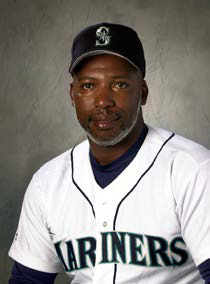
Gerald Perry

Gerald Perry was a line drive-hitting first baseman with excellent speed who played for the Atlanta Braves, Kansas City Royals, and St. Louis Cardinals during his 13 seasons in the big leagues – a career that spanned 1983 to 1995. He hit .300 and stole 42 bases in his All-Star season of 1988 and became one of the game’s premier pinch-hitters late in his career. Perry’s aggressive approach both at the plate and on the bases earned him the respect of his peers. “The way he plays is the only way to play,” teammate Dale Murphy once said.1 After retiring as a player, numerous organizations employed Perry as a hitting coach, including the Seattle Mariners during the team’s 116-win season of 2001.
Gerald June Perry was born on October 30, 1960, in Savannah, Georgia, and grew up in Hilton Head, South Carolina. His father, Clarence, was a self-taught carpenter who worked construction and co-owned a cabinetry business.2 Gerald’s mother, the former Ida Driessen, was the sister of longtime major leaguer Dan Driessen. The Perry family, which included Gerald’s siblings, Clarence Jr. (Chuckie) and Jennifer, lived far from Hilton Head’s resorts and golf courses on a dirt road off Highway 278, where Ida ran a hair salon out back.3
At age 14 – just two years after he first played organized baseball – Gerald dominated a semipro league as a member of the Hilton Head Blue Jays. There was one particular left-handed pitcher named Henry “Big Cheese” Green who routinely struck out 20 batters a game. No one could hit him except for Gerald, who once went 4-for-4 against the flamethrower. “Everybody got the sense that day that Gerald was meant for greatness,” recalled teammate Julius Bryan. “I never saw anybody do that to Henry Green.”4
Perry, who threw right-handed and batted left, continued his success on the baseball diamond at H.E. McCracken High School. During the summer after his sophomore year, Hilton Head’s daily paper, the Island Packet, declared that the All-Conference first baseman, “may be on his way to the big leagues.”5 Two years later, Perry moved one step closer to fulfilling that prediction. Following his graduation in the spring of 1978, the 5-foot-11, 170-pounder was selected in the 11th round of the June amateur draft by the Atlanta Braves, who had heard about him through Driessen.6 He was signed by scout Bill Lucas.
The Braves sent Perry to the organization’s rookie-level team in the Gulf Coast League for the summer and then to the fall instructional league in Sarasota. He returned to Hilton Head during the winter and kept busy hunting and playing basketball in a men’s league.7 Perry spent the 1979 season in his home state with the Greenwood Braves of the Low-A Western Carolinas League, where he led the team with a .333 batting average, hit 9 home runs, stole 35 bases, and captured the team MVP award.8 A year later he was assigned to the Durham Bulls of the High-A Carolina League. Perry struggled early in the season and received instruction from Hall of Famer Luke Appling, who encouraged him to bounce a rubber ball to develop sure hands and quicken his reflexes.9 Perry improved as the season wore on, finishing with a .250 average and 15 home runs while leading the team in runs, doubles, RBIs, and walks. During the offseason, he played winter ball in Colombia and was added to the Braves’ 40-man roster.
Perry continued his steady climb up Atlanta’s minor-league ranks, performing well for the Double-A Savannah Braves in 1981 (.277 average, 19 home runs, 84 RBIs) before his promotion to the Triple-A Richmond Braves of the International League in 1982. Tom Haudricourt of the Richmond Times-Dispatch observed that Perry had “surprising power … especially to the opposite field.”10 Perry posted a .297 average, blasted 15 round-trippers, stole 39 bases, and was voted the Braves’ minor-league player of the year. That offseason he married Carol Ann Wilborn and honed his skills in the Dominican Winter League.
Veteran Chris Chambliss was entrenched at first base for the Braves, so Perry found himself back in Richmond to begin the 1983 season. He responded by posting a .314/.414/.494 slash line in 113 games for the Braves’ top affiliate. When Chambliss pulled a rib-cage muscle in early August, Perry was called up to Atlanta and made his major-league debut on August 11 versus the San Francisco Giants at Atlanta-Fulton County Stadium. Hitting sixth in manager Joe Torre’s lineup, Perry came to bat in the bottom of the first inning following Dale Murphy’s three-run home run and redirected a Bill Laskey pitch to the left-center field gap for a double. Eight days later, the wind was blowing out at Wrigley Field when Perry hit his first career home run against Cubs righty Chuck Rainey.11 A 4-for-10 week and six RBIs earned Perry National League Player of the Week honors on August 22. When Chambliss was reinstated from the disabled list on August 23, the Braves kept Perry on the roster as a bench player. He went 7-for-16 as a pinch-hitter and ended the season with a .359 average in 39 at-bats.
Braves general manager John Mullen created a potential roster spot for Perry early in the offseason by sending outfielder Brett Butler to the Cleveland Indians to complete an earlier trade for pitcher Len Barker.12 The Braves wanted Perry to play left field in the Dominican Winter League, but his manager used him in the outfield sparingly.13 Braves outfielder Terry Harper suffered a shoulder injury during spring training in 1984, creating another vacancy in the outfield for Perry and fellow prospects Albert Hall and Brad Komminsk. Perry started 10 of the Braves’ first 11 games but hit only .188 and was benched as Torre began shuffling players in and out of the lineup in search of production. Perry started eight consecutive games between June 5 and 12, a stretch during which he hit .469. His playing time remained sporadic, however, and Torre gave Komminsk the bulk of the playing time in left field following organizational meetings in July. “I’m very tired of hearing about the future,” a frustrated Perry told the Atlanta Journal at the time. “I’m here to get a position. Right now, there’s nowhere for me to play.”14
Perry’s plight was not lost on Henry Aaron, the Braves’ director of minor-league operations, who told the Associated Press: “[Perry’s] a darned good first baseman. In fact, he is as good a first baseman as anybody in the National League, if he could just get the chance to prove it.”15 Ultimately, Perry did receive regular playing time down the stretch in place of the scuffling Chambliss and finished the 1984 season with a .265 average and .743 OPS in 347 at-bats.
Chambliss remained under contract at a salary of $750,000 and outplayed Perry the following spring, but Perry was nonetheless named the starting first baseman to begin the 1985 season by new manager Eddie Haas. Perry failed to take the reins, however, hitting only .215 in his first 51 games. “I fell on my face,” he later said. “I was trying to hit a homer on every pitch and win the job on one swing, and I didn’t do anything.”16 In early June Haas moved Bob Horner across the diamond to first base and benched Perry, who ended the season with a lackluster .214 average and .556 OPS.
The Braves hired manager Chuck Tanner and added veterans Ted Simmons, Omar Moreno, and Billy Sample during the offseason. Perry hit .425 during the exhibition slate but was one of six young players with big-league experience demoted to Triple A on April 1. That same day the Braves also released veteran hurlers Barker, Pascual Pérez, Terry Forster, and Rick Camp in what was coined the “April Fools’ Day Massacre.”17 Perry hit .326 with a .924 OPS in 107 games for Richmond and played in only 29 games during two call-ups with Atlanta.
Horner departed Atlanta for Japan after the 1986 season, creating a long-awaited opportunity for Perry. “Gerald may have a completely different outlook without Bob Horner looking over his shoulder,” remarked Aaron. “Relaxation and confidence is the name of the game.”18 Tanner viewed Perry as the leading candidate for the first-base job entering spring training but had concerns about his defense.19 Perry, who tended to play flatfooted, did little to earn his skipper’s trust by committing three errors in his first seven exhibition games but showed significant improvement after a defensive crash course with coaches Alex Monchak and Willie Stargell.20
Perry was platooned with Simmons early in the season and carried a lackluster .228 average through the end of May, though he hit .314 with runners in scoring position and contributed a pair of walk-off hits – a three-run home run off Giants reliever Scott Garrelts on April 25 and an RBI single against Ed Lynch and the Cubs on May 31. He also received plaudits from his manager. “He’s one of the smartest baseball players I’ve been around,” said Tanner. “He has great instincts.”21 Perry had a stellar second half while playing regularly, hitting .286 with an .807 OPS and finishing the season with 12 home runs and 42 stolen bases – second most in franchise history.22 He credited Stargell with helping him through his slow start and closer Bruce Sutter with providing advice on what to expect from opposing pitchers.23
The Braves offered the Perry a salary of $375,000 before the 1988 season. Though he and his agent, Jim Turner, asked for only $50,000 more, the case went to arbitration.24 The arbitrator sided with Perry, who earned every penny of his salary. He led the National League in hitting for 70 days during the 1988 season and made his first and only career All-Star Game appearance as a reserve and the Braves’ lone representative. Back in his hometown, those who had watched him evolve from a sandlot star to a big-league regular beamed with pride. “The locals here read the Braves’ box scores every morning to see about Perry, then they check the weather,” wrote Gary Pomerantz in the Atlanta Constitution.25
After hitting .300 or better for nearly four months, Perry carried an average of .2998 after going hitless in his first two at-bats of the Braves’ next to last game of the season. He called the press box to confirm that his official average stood at .300, then asked out of the game and also sat out the season finale in order to preserve the coveted .300 mark.26 Perry responded to criticism he received from his decision by pointing out that he played the last two months of the season with a sore shoulder, the result of diving awkwardly into second base on June 18.
Perry avoided arbitration by agreeing to a $662,500 salary for the 1989 season and got off to a blistering start, hitting .364 in his first 20 games. He then endured a 0-for-35 slump in the first two weeks of May that sank his average to .223 and had a stretch of 165 at-bats without an RBI – the second longest streak in Braves franchise history.27 Though he had spent the previous winter swimming and lifting weights to strengthen his shoulder, Perry still experienced soreness that hindered him at the plate. “He was out there because he’s such a competitor,” said teammate Milt Thompson, “but you could see he wasn’t swinging like the same old Gerald.”28 Perry went on the disabled list on July 10 and three days later underwent a season-ending operation to repair his shoulder.29
The Braves signed first baseman Nick Esasky after the 1989 season and traded Perry and minor-league pitcher Jim Lemasters to the Kansas City Royals for Charlie Liebrandt and Rick Luecken. Perry shared first base and DH duties with George Brett in 1990 and enjoyed an early-season highlight by launching a first-inning grand slam against Nolan Ryan at Arlington Stadium on May 8.30 The Royals underperformed as a team, however, and Perry saw his playing time reduced despite leading the team in batting average and RBIs during the first half. “About the time I was leading the club in RBIs, that’s when they decided to start platooning,” Perry later said. “That was surprising, especially for a club that was getting its butt kicked as often as we were.”31 In addition to the frustration of having a diminished role, the Royals miffed Perry by fining him for a stealing a base.32 He started only 12 of the Royals’ final 30 games, a stretch during which he hit only .137, and finished the season with a .254 average, 8 home runs, and 57 RBIs.
Perry signed a three-year free-agent contract with the Cardinals in December 1990, beginning what would be a five-year stint in St. Louis. Reunited with manager Joe Torre, Perry started 46 games as Pedro Guerrero’s backup in 1991 and hit .240 with six home runs, including a .268 average (11-for-41) as a pinch-hitter. The Cardinals’ acquisition of Andrés Galarraga before the 1992 campaign significantly cut into Perry’s playing time. He started only 22 games and hit .238 with one home run in 143 at-bats for the third-place Cardinals. Perry excelled as a pinch-hitter for St. Louis over the next two seasons. Though he started only 18 games in 1993-94 combined, he contributed a .327 average (36-for-110) as a pinch-hitter. In 1995 Perry became the Cardinals’ all-time pinch-hit leader and finished his Cardinals tenure with 70 pinch hits. Perry struggled overall, however, and the Cards designated him for assignment in late August. “This was a tough decision,” said general manager Walt Jocketty at the time. “He’s a class individual and he’s had a good career with the Cardinals”33
Perry was invited by Torre to try out with the New York Yankees in 1996 but was cut before the end of camp, marking the end of his 18-year professional playing career. In 1,193 big-league games, he posted a slash line of .265/.333/.376, hit 59 home runs, and stole 142 bases. At the time of his retirement, he ranked 14th on the all-time pinch-hit list with 95.34
Perry pivoted to coaching after his playing career, serving as a minor-league hitting coach in the Boston Red Sox organization from 1997 to 1999, a period during which he also managed the Grand Canyon Rafters in the Arizona Fall League.
In 2000 Red Sox manager Jimy Williams recommended Perry to Mariners GM Pat Gillick, who added Perry to Lou Piniella’s staff as hitting coach.35 Perry and Piniella shared a similar hitting philosophy that included using a shorter stroke and protecting the outside corner with two strikes. Perry also preached not trying to hit every strike – something he learned from Aaron – and brought a set of hitting drills designed to help his pupils hit to all fields. In his first year on the job, the Mariners set a franchise record with 775 walks and recorded a .361 on-base percentage. “He keeps everything simple, which is a huge compliment to an instructor or teacher,” said outfielder Raúl Ibañez. “He makes difficult things seem simple, and that’s the highest compliment that I can give anybody.”36
Players appreciated Perry’s positivity and thoroughness. “Major-league hitters know what they are doing,” said Bret Boone, “but you need feedback and support. Gerald is always there when you need him. He doesn’t have the same remedy for everyone; he treats us all as individuals.”37
“Perry has a quiet strength that evokes faith and confidence in him from the players,” wrote Bob Sherwin of the Seattle Times in 2001. “But quiet strength shouldn’t be confused with restraint at times.”38 Indeed, Perry occasionally got ejected for arguing on his hitters’ behalf. “I’ve never seen a hitting coach call an umpire over to the dugout to air him out about balls and strikes like he does,” said outfielder Al Martin. “He does that all the time. I feel like telling him, ‘Hey, Gerald, can you take a nicer approach? You’re making these guys mad at us.’”39
During Perry’s three seasons in Seattle, the Mariners posted a record of 300-186 (.617) while leading the American League in batting average (.278) and runs scored. When Piniella left Seattle to take the Tampa Bay Devil Rays’ managerial post after the 2002 season, Perry took the hitting coach job with the Pittsburgh Pirates where he spent the next three seasons. He held the same position with the Oakland Athletics (2006 and 2011) and Chicago Cubs (2007-09) before returning to the minor-league ranks with the Triple-A Pawtucket Red Sox in 2012 and the Double-A Erie SeaWolves (an affiliate of the Detroit Tigers) from 2013 to 2015.
Perry had two daughters (Portia and Fallon) from his first marriage and a son (Gerald Jr.) with the former Tara Evans, whom he married in 1989. As of 2025, Perry made his home in suburban Atlanta. When the city hosted the 2025 All-Star Game, he was one of 18 Braves alumni who served as an All-Star Ambassador.
SOURCES
In addition to the sources cited in the Notes, the author relied on Baseball-Reference.com.
NOTES
1 Mark Bradley, “Perry Becomes the Player You Always Knew He Would Be,” Atlanta Constitution, June 16, 1988: 103.
2 Clarence Perry, Sr. Obituary, https://www.marshelswrightdonaldson.com/obituary/951664, accessed January 28, 2024.
3 Gary Pomerantz, “Gerald Perry: The Pride of Hilton Head,” Atlanta Constitution, September 25, 1988: 83.
4 Pomerantz.
5 “Bluejays Send Six to All-Star Games,” Island Packet (Hilton Head, South Carolina), July 1, 1976: 10.
6 David Lauderdale, “Atlanta Braves Draft Islander Gerald Perry,” Island Packet, June 13, 1978: 8.
7 David Lauderdale, “Florida Means More Than Fun in the Sun to Perry,” Island Packet, March 20, 1979: 8.
8 “Pitchers’ League in ’79,” Asheville (North Carolina) Citizen-Times, April 9, 1980: 48.
9 Russell Small, “Gerald Perry’s Big-League Chances Improving,” Island Packet, February 26, 1981: 8.
10 Tom Haudricourt, “IL Rookie List Has Virginia Flavor,” Richmond Times-Dispatch, July 4, 1982: 71.
11 Chicago Cubs manager Lee Elia commented after the game that the Cubs did not know how to pitch to Perry because he had never heard of him. Elia’s remarks reflected poorly on the organization and led to his firing days later. Fred Mitchell, “Ex-Manager’s Recent Remark ‘Embarrassing,’” Chicago Tribune, August 23, 1983: 29.
12 Atlanta received Len Barker and $150,000 from Cleveland on August 28, 1983, for players to be named later. Butler and Brook Jacoby were sent to Cleveland on October 21 to complete the deal.
13 Gerry Fraley, “Glove Will Determine if Perry Gets Up to Bat,” Atlanta Journal, February 28, 1984: 59.
14 Gerry Fraley, “Perry Champing at the Bit to Play a Regular Position,” Atlanta Journal, July 27, 1984: 71.
15 Associated Press, “Rookies Misused: Aaron Says Braves Not Using Two Newcomers Properly,” Corpus Christi Times, August 15, 1984: 17.
16 Gerry Fraley, “Perry’s Start Key to Whether Horner Needed,” Atlanta Constitution, April 4, 1987: D7.
17 John O’Connor, “SeaWolves Are Guided by Experienced Hands,” Richmond Times-Dispatch, May 11, 2014: C7.
18 Chris Mortenson, “Aaron: Horner’s Agent Gambled and Lost in Free Agent Game,” Atlanta Constitution, February 19, 1987: 75.
19 “Can Perry Step In to Replace Horner?” Atlanta Journal, February 22, 1987: 63.
20 Gerry Fraley, “Perry Wins Game, Position as Braves End Losing Streak, 5-3,” Atlanta Constitution, April 26, 1987: C9.
21 Chris Mortensen, “Wrigley Rejuvenation Rescued Perry,” Atlanta Constitution, June 1, 1987: 41.
22 Hap Myers stole 57 bases for the 1913 Boston Braves.
23 Stinson, “Perry Power: Braves Hope First Baseman Can Sustain Pre-Injury Pace.”
24 Gerry Fraley, “Braves Lose Arbitration with Perry,” Atlanta Journal, February 3, 1988: 19.
25 Pomerantz.
26 Darryl Maxie, “Braves’ Perry Opts to Sit, Not Hit, to Keep .300,” Atlanta Journal, October 2, 1988: 57.
27 Joe Strauss, “Not All Grades Poor for Braves at Midterm,” Atlanta Journal, July 13, 1989: 75.
28 Dan O’Neill, “He’s a Hit: At 30, Newcomer Perry has Survived Injuries, Inflated Expectations, AL Life,” St. Louis Post-Dispatch, April 3, 1991: 48.
29 Strauss.
30 Perry hit .348 vs. Ryan for his career.
31 O’Neill.
32 O’Neill.
33 Rick Hummel, “Cardinals Give Perry a Push Toward the Door,” St. Louis Post-Dispatch, August 27, 1995: 51.
34 Cecil Harris, “Yanks Sign First Baseman Perry,” Tarrytown (New York) Daily News, January 29, 1996: 28.
35 Blaine Newnham, “Perry, Price Right Coaching Fits for M’s,” Seattle Times, March 31, 2002: 12.
36 Newnham.
37 Newnham.
38 Bob Sherwin, “Gerald Perry Is the Maestro of the Mariners’ Hit Parade – Leader of the Bat,” Seattle Times, August 14, 2001: C1.
39 Sherwin.
Full Name
Gerald June Perry
Born
October 30, 1960 at Savannah, GA (USA)
If you can help us improve this player’s biography, contact us.