

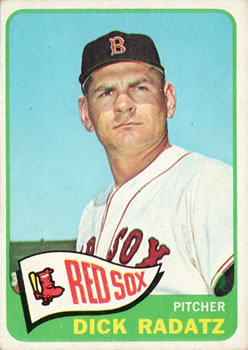
June 5, 1965: Reliever Dick Radatz homers in top of 11th to win game for Red Sox
Despite making all 381 of his major-league appearances in relief, Dick Radatz also got some at-bats. In his seven-season career, Radatz averaged 1.82 innings per appearance on the mound and accumulated 159 plate appearances. He drew four bases on balls but struck out 79 times – almost precisely half the times he came to bat. His career batting average was .131.
Radatz drove in 11 runs in the majors. Six were in 1962, his rookie year with the Boston Red Sox.1 He recorded his next four RBIs in 1964, with one giving Boston a 10-inning walkoff win over the Minnesota Twins.
His final RBI was on his only career home run, on June 5, 1965, in Kansas City. It came in the 11th inning and won the game for the Red Sox.
Standing 6-foot-6 and listed at 230 pounds, Radatz was dubbed “The Monster.” Despite his large size, he fielded well enough, a .920 fielding percentage.
In 1962 Radatz led the American League by appearing in 62 games and closing 53 of them. His 24 retroactively-credited saves also led the AL,2 and he placed third in the league’s Rookie of the Year voting.3 He was named an All-Star in 1963 (he was 15-6, 1.97) and 1964 (16-9, 2.29) and ranked in the top nine in the MVP voting both years. In 1964, he struck out 181 opponents – as of 2026 the most strikeouts ever recorded by a relief pitcher in a single season. The 16 wins as a reliever set an AL record.4
Radatz was having a rough year in 1965, perhaps due to over-use. He squandered leads in four of his first 12 appearances; after giving up a game-tying ninth-inning run and a game-losing 12th-inning run to the New York Yankees on May 18, his ERA sat at 7.18. His performance picked up when he struck out 18 over 10⅔ scoreless innings over five late-May outings, lowering his ERA to 5.26 through 18 appearances. He was 3-3 with eight saves as June began. He blamed his struggles on trying to add a sinker to his repertoire, which previously had consisted of one pitch: the fastball.5
On the morning of June 5, the Athletics (10-30) were in 10th place, last in the American League, 17½ games behind the Minnesota Twins (30-15). The Red Sox were 21-24 and in seventh place, nine games behind the Twins. The teams were scheduled to open their series at Kansas City’s Municipal Stadium a night earlier, but they were rained out.
Starting on Saturday afternoon for Athletics manager Haywood Sullivan was right-hander Diego Seguí (3-5, 4.86), in his fourth year with the team.6 Red Sox manager Billy Herman started Earl Wilson, in his sixth season for Boston. Wilson was 3-4, 5.05.
Neither team scored in the first inning, but Boston first baseman Lee Thomas doubled to kick off the top of the second. He took third when third baseman Ed Charles was charged with a fielding error on Tony Conigliaro’s grounder. Segui set down the next two Red Sox, but 21-year-old rookie shortstop Rico Petrocelli singled to drive in Thomas with the first run of the game.
Boston added a second run in the top of the fourth. Again it was Thomas who ignited the rally. He led off with a walk, and one out later center fielder Gary Geiger doubled him to third. Catcher Bob Tillman singled to left. Thomas scored, but left fielder Bert Campaneris gunned down Geiger trying to score,7 keeping it a two-run Boston lead.
Wilson had held Kansas City scoreless on two hits through five innings. The Athletics’ most serious threat in that span was in the fourth, when Campaneris doubled with one out and stole third, his 13th steal of the season,8 but Wilson stranded him there.
Kansas City finally broke through in the sixth. Wilson walked shortstop Wayne Causey to begin the inning. Campaneris then drove Causey in with a one-out triple to left-center.9 Pitching to the next batter – future Red Sox Ken Harrelson – Wilson threw a wild pitch, and Campaneris scored. The game was tied, 2-2.
The Athletics took the lead in the seventh when second baseman Dick Green, who hit a career-high 15 homers in 1965, led off with his sixth home run of the season over the fence in right-center. Catcher Billy Bryan followed with a double; manager Herman took the ball from Wilson and handed it to reliever Bob Duliba, who got out of the inning without further damage.
John Wyatt took over from Seguí and got through the eighth, despite a single, stolen base, and a walk. Duliba walked Harrelson with one out in the bottom of the inning but induced three groundballs and escaped otherwise unscathed.
The Athletics held the slim 3-2 lead heading into the ninth, and Wyatt got outs from the first two batters. But left fielder Lenny Green doubled to center field, a ball that eluded a diving Jim Landis by an inch or two. He trapped the ball, ruled second base umpire Frank Umont.10
Third baseman Dalton Jones came to the plate. At this point, it became Boston’s turn to benefit from a wild pitch. Green took third base, then scored when Jones lined a single into right-center field. Don Mossi replaced Wyatt, watched Jones steal second, walked Félix Mantilla, but then got Lee Thomas to ground to first base unassisted.
Dick Radatz came in to work the bottom of the ninth. He struck out the first two Athletics. Pinch-hitting for Mossi, Mike Hershberger singled and stole second. Radatz intentionally walked Causey, then struck out Landis.
Right-hander Jesse Hickman pitched the top of the 10th and retired the Red Sox in order in his major-league debut. The 26-year-old Louisiana native had arrived from Triple-A Oklahoma City only half an hour before the game began.11 Radatz answered by striking out the side – Campaneris, Harrelson, and Charles – in the bottom of the inning.
Petrocelli was first up in the 11th, and Hickman struck him out. Radatz was next. He drove the pitch over the left-field fence – “a towering blast down the line in left…the ball soared high over the fence, landing about 380 feet from home plate,” reported the Boston Record-American.12
Boston added an insurance run. Lenny Green walked and stole second. He took third as Jones grounded out, second to first. Mantilla singled, and Green scored. When Mantilla was thrown out trying to steal second, the inning was over, but the Red Sox led, 5-3.
Radatz took the mound again. Dick Green led off with a single. Then Radatz cracked down. He got 20-year-old rookie Rene Lachemann to foul out to the catcher and struck out Nelson Mathews.
Sullivan called on a good-hitting pitcher of his own, Fred Talbot, to bat for Hickman. Talbot, a .263 hitter in the first year of his eight-season career, was batting .333 on the season and had doubled three days earlier, but Radatz made it an eight-strikeout outing by fanningTalbot for the third out.13
The game was over. Radatz had a win and had hit the game-winning homer.14 The Kansas City Star declared that the Athletics had “found themselves overwhelmed, overawed and overmatched by the nearest thing to humans to Mount Everest.”15
The Red Sox dropped in the standings as the year wore on, finishing 62-100. It was the first time they had lost 100 games since 1932. They ended the season 40 games behind the Twins in the standings, in ninth place and just three games ahead of last-place Kansas City.
Radatz finished 9-11 (3.92). His days of glory were largely done after 1965, as he won only three more games – one for the Chicago Cubs and two for the Detroit Tigers.
Acknowledgments
This article was fact-checked by Troy Olszewski and copy-edited by Mike Eisenbath.
Photo credit: Dick Radatz, Trading Card Database.
Sources
In addition to the sources cited in the Notes, the author consulted Baseball-Reference.com and Retrosheet.org.
https://www.baseball-reference.com/boxes/KC1/KC1196506050.shtml
https://www.retrosheet.org/boxesetc/1965/B06050KC11965.htm
Notes
1 Radatz’s six RBIs in 1962 were in three two-RBI games: May 12, May 15, and August 18.
2 Saves did not become an official statistic in major-league baseball until 1969.
3 Tom Tresh of the New York Yankees was the 1962 AL Rookie of the Year.
4 As of 2026, Elroy Face’s 18 relief wins for the Pittsburgh Pirates in 1959 remained the major-league record.
5 He said he had worked on adding another pitch during spring training. “But I began to realize it took something off my fastball. I gave it up. It fouled up my rhythm. I didn’t get enough push off the mound when I threw it.” Paul O’Boynick, “Radatz Doesn’t Need More Than One Pitch,” Kansas City Star, June 6, 1965: 6S.
6 In December 1965, Sullivan became Director of Player Personnel for the Red Sox. The Sporting News, December 11, 1965: 6. In 1977, he was named General Manager, and he served as a general partner in the franchise from 1978 through 1993.
7 Campaneris played 27 games in the outfield as a rookie in 1964 and 39 games in the outfield in 1965 before settling into his regular position of shortstop.
8 Campaneris went on to steal 51 bases in 1965, his first of four consecutive seasons leading the AL in steals.
9 Campaneris’ 12 triples in 1965 tied the Twins’ Zoilo Versalles for the AL lead.
10 Hy Hurwitz, “Radatz Beats A’s with HR in 11th,” Boston Globe, June 6,1965: 57.
11 Hurwitz.
12 Larry Claflin, “Radatz Beats A’s on HR in 11th, Fans 8 Batters,” Boston Record-American, June 6,1965: 48.
13 Radatz had faced the A’s at Fenway Park on May 28 and 30, facing 16 batters and striking out 10 of them. He earned a save in the first of the two games and a win in the second.
14 Hickman’s time in the majors was brief. He worked in 12 games in 1965, with just one decision – this loss – and an ERA of 5.87. He faced three batters in 1966 and retired all three, but it was his only appearance of the year.
15 Ernest Mehl, “Radatz Stars 2 Ways,” Kansas City Star, June 6, 1965: S1. Mehl also dubbed Radatz a “hurling mastodon.”
Additional Stats
Boston Red Sox 5
Kansas City Athletics 3
11 innings
Municipal Stadium
Kansas City, MO
Box Score + PBP:
Corrections? Additions?
If you can help us improve this game story, contact us.