

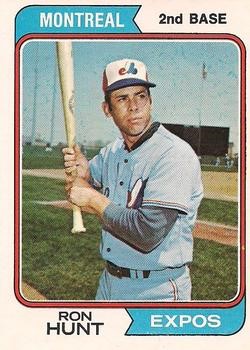
Ron Hunt
“Some folks give their bodies to science. I gave mine to baseball.” 1
It is no surprise that Ron Hunt uttered this classic quote, which is far from bluster. The gritty second baseman is best known for being hit by pitches: 243 times in his 12-year big-league career (1963-74). That total still ranks sixth all-time – fourth among players whose career began after the start of the 20th century. It includes 50 in 1971 – far and away the highest single-season figure since 1900.
The related bumps and bruises have long since healed. However, Hunt’s 15 baseball-related surgeries left much scar tissue and put a noticeable hitch in his step. His baseball-related concussions may have contributed to the onset of Parkinson’s Disease. That reveals a lot about the tough Missourian, who was either one gutsy guy or, possibly, someone who’d had the sense knocked out of him. (Maybe it was both.) What Hunt did know is that every time he got plunked, it was one less time he had to turn right after running to first. That, to his mind, is how he stayed in the league.2
Yet Hunt doesn’t regret his aggressive style. “All complaining does is make your enemies happy,” he said.3
Hunt’s approach – his “impassioned vengeance”4 – was built on solid fundamentals honed as an eager student under the tutelage of a long line of extraordinary instructors. Over the years, many have observed that Hunt “played the game right.” They said he was “old school.” Nicknames like “Scrap Iron”5 and “Pigpen”6 marked the hard-nosed blue-collar qualities ingrained in the man’s genetic code.7
Hunt came to the majors with the New York Mets and became the club’s first player to start an All-Star Game (in 1964). Loyal cuss that he is, he has remained a Met in spirit. And for fans who were there or who’ve heard the stories, the feeling is reciprocated. In addition to the grit and toughness, the loyalty aspect of Hunt’s ethos also harked back to the Gas House Gang of his native city.
***
Ron Kenneth Hunt was born in St. Louis on February 23, 1941, the only child of Floyd and Bernice Hunt. Floyd Hunt, a Navy veteran, worked as a butcher. The marriage didn’t last. Bernice relocated to her parents’ converted attic and continued her career as a secretary.8 Despite the modest lodgings, it was a loving environment. Grandpa Walter Gronemeyer – a gruff, baseball-loving, beer-drinking, beer-making,9 blue collar archetype – stepped willingly into the role of father figure. Walter introduced Ronny to baseball, to the art of the game and the passion for it. Out in the back alley, grandfather and grandson played countless games of catch and baseball offshoots, like bottle caps, cart ball, and Indian ball10 (what Hunt refers to as “alley ball”).11 All the while, Walter peppered the boy with (grand)fatherly wisdom about baseball and life.12 Reflecting in later years, Hunt commented, “I learned so much from him.”13
Hunt didn’t talk much14 but he sure listened – to his Grandpa Gronemeyer and then to Ritenour High Coach Lee Engert, a future Missouri Sports Hall of Fame inductee. Coach Engert, in deep fondness for Hunt, described him as a student of the game (on the flip side, Engert postulated that may have cost him in GPA). Hunt made a habit of waiting at Engert’s door in the morning for the coach’s arrival. Engert would greet the youngster, unlock his door, and invite him in. As the coach prepared for the day, Hunt, often sitting on top of Engert’s desk, would fire one question after another, until Engert finally had to shoo him off.15
Hunt, a member of the 1957 Ritenour state baseball championship team, was a three-sport star at Ritenour. He was heavily recruited to play quarterback by the likes of Northwestern and Southern Illinois University.16 But after the 6-foot, 170-pounder got a good look at the size and speed of the defensive players who’d be chasing him in college, discretion overcame valor – a rare thing for Hunt. He chose baseball, figuring it was the safer sport.17
So, in the summer of 1958, Hunt re-upped to play American Legion ball in St. Louis. Few scouts showed any interest, but one did approach him: Richard Keeley of the Milwaukee Braves. Keeley wanted to sign the youngster, but there was one catch: the size of the bonus. Naturally, Hunt’s number was higher than Keeley’s, so they settled it via an all-or-nothing handshake wager based on the outcome of an upcoming doubleheader. If Hunt fared poorly, he would accept Keeley’s offer; if he did well, Keeley would agree to the bigger figure. In perhaps his most clutch performance to date, Hunt went 7-for-9 and scored a $20,000 signing bonus along with a train ticket to McCook, Nebraska.18
The McCook Braves toiled in a Class D rookie league, with a season of 62 games in July and August. The Nebraska State League was a sort of maiden claiming race for unsigned high school and college graduates. It was the lowest of the low minors, smack in the middle of nowhere.19 The circuit was on the brink of extinction. Its daily routine would have been forever lost but for Hunt’s teammate/roommate Pat Jordan, who – in between bouts of wildness and alienation – was busy taking notes for the classic baseball memoir he eventually wrote: A False Spring (1975)20
The home field, Cibola Stadium, was “rock-hard” and shabby.21 Most of the players wore uniforms handed down from the majors rung by rung to the bottom.22 Long hot bus trips over the flatlands to places like Hastings, Kearney, and Grand Island were in store for young Hunt, whom Jordan described as a “milk ’n’ cookies guy,” a “shy, earnest youth with a very short crew cut that made his large ears look even larger.”23 Playing third base, Hunt fared well at his first stop. Appearing in all 62 games, he hit .284 in 208 at-bats with an .854 OPS, leading McCook to first place in the last year for both the franchise and the league.
Hunt earned promotion to the Cedar Rapids Braves of the Illinois-Indiana-Iowa League (Class B). He continued to listen and learn. The newest mentor was Jimmy Brown, his manager at Cedar Rapids in 1960 and ’61. Brown was also a scrappy infielder, known more for “his hustle and fire than his ability.”24 He urged Hunt to choke up on his bat after a miserable first year (in which he hit .191) and be a contact hitter. Hunt complied. Brown saved the prospect’s career, helping him transition from third to second base, also teaching him how to hit the slider and crowd the plate.25
In addition, in 1961 Hunt renewed his friendship with McCook teammate Barry Morgan. That year another teammate, Paul Snyder, also became a lifetime friend.26 But the most significant relationship of his life was cemented on September 16, when he married Jackie Stewart, whom he’d met in high school. Ron and Jackie have been soulmates through life’s journey ever since. He calls their wedding day “the happiest day of my life,” then follows with “that’s what she told me to say.”
Hunt and his buddies Morgan and Snyder moved up together to Class AA in 1962, as did manager Brown, with the Austin Senators. It was Hunt’s third straight year under Brown, and the skipper’s lessons helped make him a Texas League All Star. That summer, Hunt caught the eye of Solly Hemus, roving scout for the desperate Mets, who persuaded the expansion club’s management to conditionally purchase Hunt from the Braves.27
With his new club, Hunt remained a rapt student. In the fall of 1962, he attended the Florida Instructional League, led by a Who’s Who of scrappers: Eddie Stanky, Cookie Lavagetto, Hemus and Paul “Big Poison” Waner.28They must have seen something they liked in Hunt, for he was sent to big-league spring training in 1963.
There Hunt continued to soak up the vast wisdom of manager Casey Stengel. He also made a point of sitting next to veterans Duke Snider29 and Gil Hodges30 in the Mets dugout, pumping them constantly for advice. Hodges echoed Brown: crowd the plate, taking away the inside pitch while guarding the outside.
The 1962 New York Mets were historically horrible and lovable at the same time. The team’s second year had to be better, though a void of information arose during the offseason. On December 9, 1962, the city’s seven major dailies all shut down amid a citywide newspaper strike that lasted until President Kennedy stepped in. Settlement was announced on March 31, a mere nine days before the start of the 1963 season.31 Barring the coverage in The Sporting News, the fans had little idea who the next gang of pretenders would be, including the cluster of no-names circling around the second-base drain.
The paucity of press contributed to Hunt’s profound anonymity, but he was under the radar anyway, having neither been in the Mets system nor played a day in AAA. There was no hint of him in the Mets yearbook. So, who was this guy? Seemingly from nowhere, he made the roster.
To do so, Hunt had to beat out at least four rivals, not including Charlie Neal and utilityman Rod Kanehl, the Mets’ primary second basemen in 1962, who were shifted to other positions. Against the odds, the rawboned 22-year-old made the cut and signed his first major league contract. He initially served as a backup to recent acquisition Larry Burright.32
The Mets opened the new season by losing six straight, while Burright struggled. Frustrated with his bench-sitting role, the pugnacious rookie approached his legendary manager and said “Coach, Ron Hunt, number 33, second base.” Case said, “What can I do for you?” Hunt declared that he deserved to start, that he could do better than the guy out there. “I’m not a bullpen catcher, I’m a second baseman. Maybe I need a chance, see if I can play here.” Stengel stared at this brash youngster and responded, “Son, you wanna play that bad? OK then. You start tomorrow.”33
Hunt debuted at Crosley Field on April 16, 1963. He made the most of it, reaching base in three of his four plate appearances. Two days later, his walk-off double brought the Mets their first victory of the season (against the Braves, no less). The job was his.34 Hunt started 139 games at second that season.
Sportswriters took to Hunt from the start. In May 1963, Roger Angell called him one of the “sun’s brightest rays,” describing him as “a skinny twenty-two-year-old second baseman up from the Texas League.” Angell praised Hunt’s “quick hands, excellent range to his left, and a terrier-like eagerness for a moving ball…He reminds me of Pee Wee Reese at the plate—an unassuming, intelligent swinger who chokes up on the bat and slaps singles to all fields.” According to Leonard Koppett, Hunt was “[e]xactly the kind of hard-driving, eager young man that Stengel loved most.” George Vecsey also noticed the pluck.35
Fans took to Hunt’s grit and moxie. Looking for a true hero, the so-called New Breed found one.36 Angell described fans holding up signs saying, “WE LUV RON.”37 And Hunt lived up to it. His rookie season was a good one. In 600 plate appearances, Hunt batted .272 with 28 doubles, 10 home runs, 40 walks…and 13 HBPs.38
Hunt didn’t play like a rookie. In Houston, he bunted for a base hit with two strikes and two men on.39 Not a week later, he jarred the ball loose from catcher Doug Camilli on an attempted steal of home in a scoreless game against the Dodgers. In the same game, he tried a “trick play” by intentionally dropping a line drive for a double-play attempt.40 In Milwaukee, he plowed into catcher Ed Bailey at the plate, igniting a game-ending brawl.
Although still relatively unknown during All-Star voting, Hunt’s profile was higher by the end of the season. He narrowly placed second to Pete Rose in Rookie of the Year voting, and New York’s sportswriters voted him Most Valuable Met.41
The latter honors came with a prize: an Amphicar.42 The specialty vehicle was possibly given in response to Hunt’s carping about the George Washington Bridge toll (50 cents each way) that he had to shell out in trips from his apartment in Fort Lee, New Jersey.43 After the award, Hunt drove the car “to the foot of Dyckman Street and…across the Hudson, up the Palisades and to the place where he lived.”44
Hunt’s sophomore season, 1964, may have been his best and happiest. In May, Angell called him the Mets’ “gamecock, their small nova.”45 Hunt’s honor as first Met to be elected an All-Star Game starter carried extra satisfaction because at that time the players did the voting.46 What’s more, that year’s game was held at the Mets’ new home, Shea Stadium. Hunt secured a ticket for his beloved Grandpa Gronemeyer. The night before the game, he snuck his grandfather into the stadium and had the grounds crew turn on the lights. Grandpa always had something to say, but Hunt said that was the first time he ever saw the old man speechless.47
In the Midsummer Classic, Hunt went 1-for-3, slashing a single to left off Dean Chance in his first at-bat on a “3–1 slider, high and inside.”48
Hunt led Met starters with a .303 batting average that year. The club’s won-lost record barely improved but attendance was a different story. The Mets drew 1,732,597, second in the National League.49 The fan base felt that a brighter future lay in store.50
Hunt’s good fortune crashed in 1965. A jammed finger kept him out of the season’s first 15 games; then, in just his 10th game back, on May 11, he sustained an apparent season-ending injury. While charging Lou Brock’s slow roller, Hunt was blindsided by baserunner Phil Gagliano sprinting from first to second. Both players tumbled; only Gagliano got up. Hunt suffered a “complete separation of the [left] shoulder,” was operated on the next day and declared done.51 But he stubbornly worked to come back and on August 5 he did. Even so, after the success of his first two seasons, it was a lost year and the stats showed it.52
Hunt bounced back in 1966 with another All-Star season, and the Mets for the first time climbed out of the cellar. However, Hunt’s relationship with manager Wes Westrum (who’d succeeded Stengel the previous July) turned frosty.53 And so, after the season ended, Hunt was dealt with Jim Hickman to the Dodgers for Tommy Davis and Derrell Griffith.
The trade broke his heart.54 The Hunts loved New York City, the Mets team, and the Mets fans. Ron figured he’d be a Met forever and wanted to be around when the club started to win.55 It did not help that he had to learn of the trade from sportswriter Dick Young.56
Mets fans were similarly stunned. They deluged Hunt with letters professing their disappointment and admiration for their first true star. He responded, “To my friends in New York: I want to thank you for all the happiness you’ve given my family and me. Everything I have or hope to have, I owe to the most wonderful people in the world – the New York fans.”57
The 1967 season would be a difficult one for Hunt. Though he moved from a cellar-dweller to a reigning NL pennant winner, the Dodgers were not the same team without Sandy Koufax (retired) and Maury Wills (traded). The club plummeted from a 95-67 record to 73-89. Hunt started strongly; manager Walter Alston noted that he “performed in spring training like the pennant was on the line.”58 Hunt greatly admired Alston and wanted to play well for him, but a series of injuries limited his playing time and hampered him when he did get on the field.
The Dodgers’ schedule first brought them to Shea on May 22. It was probably then that Hunt’s sense of betrayal prompted him to walk right up to Mets owner Joan Payson’s box and tell her how he felt – although he took his hat off first.59
The stay in L.A. was short. In February 1968, the Dodgers shipped Hunt (along with Nate Oliver) to the Giants in exchange for catcher Tom Haller and a minor leaguer. But before the trade, in late November, he played in the “First [and last] All-Star Annual Celebrity Game,” with announcers Vin Scully and Jerry Lewis, attended by some 28,000 fans.60
Over the next three seasons (1968–1970), Hunt refined his hitting style to take advantage of the lumber behind him in the lineup (Willie Mays, Willie McCovey,61 Jim Ray Hart, Jim Davenport, and later Bobby Bonds).
- He choked up even more – “so much, he looks like a guy hiding a chicken in his coat.”62
- He stood in even closer – “he crowds the plate like Raquel Welch crowds a bikini.”63
- And he got hit a lot – “he gets good flesh on the ball.”64
In his first five seasons he averaged just over 10 HBPs a year. Over the next seven, when he led the National League each year, Hunt’s plunk average exceeded 27 annually.
This was just part of what made Hunt a good table-setter. He scored 221 runs in his three years with the Giants. In 1968, the “Year of the Pitcher,” Hunt reached base 103 times without putting the ball in play. Despite his lack of power, Hunt was third in the NL in bases on balls with 78, while striking out only 41 times in 650 plate appearances. Hunt was sixth in the N.L. and 10th in the majors in OBP that year and scored 79 runs (no major leaguer broke 100). He reached base 235 times, tops on a very good Giants club.
But the hardnosed style took its toll. Hunt continued to rack up injuries with the Giants, collisions at the pivot compounded by the bangs and bruises from his willing role as “a human target in a shooting gallery.”65 In 1969, while coming around to score on a Mays double, Hunt was struck in the temple by a Cookie Rojas relay throw and was hospitalized overnight.66
Less than a month later, on August 31, 1969, in the first game of a doubleheader, Hunt was facing future Hall of Famer and soon-to-be Miracle Met Tom Seaver. Seaver launched a high inside fastball with such force that his follow-through caused him to lose sight of the pitch. He heard a loud crack and looked up to see a soft fly ball he snagged after a short jog for what he thought was the second out. Seaver then noticed the batter had not run but was sprawled in the dirt next to home plate. The crack Seaver heard was not bat on ball but the sound of his fastball smashing into the back of Hunt’s head. Hunt was placed on a stretcher, carried from the stadium, and rushed to the hospital for observation.67 Those back-to-back concussions – plus two other beanings by Bob Gibson and Don Wilson68 – play a suspicious role in the later development of Hunt’s Parkinson’s.
Giants fans booed Seaver for the rest of the game.69 In retaliation, San Francisco hurler Bobby Bolin brushed Seaver back in the seventh. However, the pitch only nicked his jersey.70 It was reminiscent of how Hunt – who crowded the plate and purposely wore a loose, “bloused” uniform – so often reached base.
Getting hit flush in the head by a Seaver fastball would induce most people to reconsider their tactics – but not Hunt. After a single day off, he was back in the lineup and dug in just like before. Jim Bouton hit him on September 6 and Jack Billingham the next day, followed by Ron Reed on September 11, Bill Singer on September 20, and Al Santorini on September 24. Hunt’s HBP frequency actually increased after his beaning.
In 1969, with his old team on the rise, Hunt might have felt like the proverbial bride left at the altar. He felt that he helped build the team that won it all, but it was more about the Mets fans who had embraced him as a young major-leaguer than the team that ended up as World Series champs. As he said in a video posted by sportswriter Ken Davidoff in November 2018, “I’ll never forget you.”
Hunt had once been considered a good fielder with decent range.71 His range declined during his time with the Giants, however, and the installation of Astroturf at Candlestick Park in 1970 exacerbated this shortcoming. By the end of the year, the quicker Tito Fuentes had replaced him.72 In his three years with San Francisco, Hunt’s plate appearances fell from 650 to 569 and then to 442, despite his strong offensive showing that season (.394 OBP). He spent the last month of 1970 at the end of the bench, mad as hell.73
However, there was a noteworthy event off the field that year. Hunt later got credit for possibly saving roomie/double-play partner Hal Lanier’s life during an epileptic attack.74
After the season, following recriminations between club and player, Hunt was virtually given away to the Expos.75 The banged-up veteran looked washed up, an old age 30. He faced two related tasks: to unseat Montreal’s starting second baseman, Gary Sutherland, and avoid being pushed to the margin by crusty manager Gene Mauch, who had no reason to be patient.
Hunt answered the bell, enjoying one of his finest seasons in 1971, reaching base in over 40% of his 638 plate appearances. He continued his knack for wearing down pitchers: working the count and fouling off two-strike deliveries. He also executed the hit and run with distinction. Hunt hit into only one double play the entire season while striking out just 41 times. That was the year he set a modern-era record likely never to be broken: he was hit by a pitched ball 50 times.76
Hunt remained popular with the fans – and Mauch too quickly became an admirer. “In the 30 years that I’ve been connected to baseball,” said Mauch, “I’ve never enjoyed watching a player more. Hunt chops away to every field. He invariably gets wood on the ball and seldom strikes out. He plays all-out in everything he does. The fact that he can endure pain enough to get hit and get on base merely typifies his entire approach. He slides hard, charges balls and does everything he can in efforts to win.”77
Hunt made the most of his three full seasons with the Expos, but the nagging injuries kept piling up. On August 8, 1973, Hunt hurt his knee in a home plate collision and was essentially done for the season.78 Even so, he batted .309 that year with a .418 on base percentage – and led the majors in HPBs for the sixth straight year.
But Hunt’s range continued to decline and his power had all but disappeared. The Expos placed him on waivers in September 1974, and he was claimed by the Cardinals. Hunt came up 28 times for St. Louis and was at the plate when Lou Brock tied and then broke Maury Wills’ single-season stolen base record on September 10. Hunt was hit by pitches twice more, thus leading the NL in that category for the seventh consecutive season.
Hunt was on the Cardinals’ spring roster in 1975, allowing him to teach rookie Keith Hernandez the joys of White Russians.79 However, on March 26, he was cut for good.
Hunt felt he had plenty left in the tank but did not go begging. Oakland A’s owner/GM Charlie Finley offered to sign him to a minor league contract but Hunt had none of it. He hung up his spikes, ending his black-and-blue career. Upon retirement, his 243 HBPs were a major league record for the modern era.80
Hunt returned to his farm in Wentzville, opened up liquor and sporting goods stores, and did some farming. But baseball kept calling. In 1987, he formed Ron Hunt Eagles Baseball Association, a sort of prep school for lads interested in playing college ball.81 No surprise that Coach Hunt was the proverbial stern taskmaster, harping on fundamentals and demanding that teammates police their own. Jackie Hunt offered food and solace as camp mom.82 The Eagles drew players from 20 states and Canada, along with a few from overseas. The team traveled widely, including to Holland and Canada. “Close to 98 percent of those young players [got] into college,” said Hunt, adding that “coaching helped me pay back some of my IOUs in the game.”83
Eventually tiring of the demands, the Hunts ended the Eagles’ run in 2003, but Ron continued to travel the country to give instructional baseball clinics almost anywhere he was asked.84 The price tag for all of these events: gratis.
Another defining Ron Hunt trait is loyalty. He maintains a roster of longtime friends on speed dial85 and regularly rings them up to check in or bark at them. And of course there are Jackie – their long marriage is one for the storybooks – plus daughter Tracie and son Ronnie, true now and forever.
Hunt summed himself up in 2018. “I hope people remember me as a player who played the game right. I hope they remember me as someone who was a decent human being, who respected the game of baseball and gave it his best effort every day for as long as he could.”
Postscript
With his family gathered around, Ron Hunt passed away peacefully at the age of 85 on July 15, 2026, at his beloved farm outside Wentzville, Missouri. Ron never wanted to leave the farm, where he raised cattle for decades, where he faithfully drove his utility tractor around and fed his “mirages” (deer), and where from his home’s front door one could still make out the ball diamond he built for his Eagles teams. With the help of many, he never did.
Last revised: July 19, 2026
Acknowledgments
This article was reviewed by Gregory H. Wolf and Rory Costello and fact-checked by Mark Sternman.
Photo credit: Ron Hunt, Trading Card Database.
Sources
In addition to the sources cited in the Notes, the author accessed Retrosheet.org, Baseball-Reference.com, and SABR.org. The author conducted multiple interviews with Ron and Jackie Hunt, Ronnie Hunt, Bill Wessler, Lee Engert, and Charlie Hinkaty, as well as interviews with Jacques Doucet and Bill Sullivan, and email exchanges with George Vecsey, Ken Davidoff, Jerry Sullivan, and Bill Sullivan.
Notes
1 Paul Dickson, Baseball’s Greatest Quotations, (New York, New York, Harper-Collins Publishers, 2008), 255; The Gigantic Book of Baseball Quotations, Wayne Stewart, editor (New York, New York, Skyhorse Publishing 2007), 66.
2 Bill Sullivan. Long Before the Miracle (Kindle Direct Publishing, 2nd ed., 2016), 397. Hunt authored the foreword to Sullivan’s second edition.
3 Ron Hunt, in-person interview, September 29, 2018, at Hunt’s farm in Wentzville, Missouri.
4 Journalist Arthur Daley stated that, with Hunt, “every game is a holy war.” William J. Ryczek, The Amazing Mets 1962 – 1969, (Jefferson, North Carolina, McFarland & Company, 2008), 59.
5 “Memoirs of Pigpen Hunt,” New York Times, July 1, 1987: Section B, 13.
6 “I Have to Win a Job Again,” Palo Alto Times, April 7, 1970: 4A; “Memoirs of Pigpen Hunt,” note 3.
7 George Vecsey, “Ron Hunt, Loner,” Sport, April 1965, 32.
8 Sullivan, 397.
9 Grandpa worked at the Falstaff Brewery. Sullivan, 397.
10 Dave Hoelstra.com, September 14, 1998; Sport article, 101; Sullivan, 397.
11 “Ron Hunt Just Sneezes at Dirt,” St. Louis Post-Dispatch, March 29, 1964: 76
12 Vecsey, Sport, 101, note 5; Benjamin Pomerance, BaseballSavvy.com, https://baseballsavvy.com/w_hunt.html.
13 Hunt interview.
14 Dick Young described Hunt this way: “He’s a pretty unemotional cuss. He says hello to you. That’s a speech. He keeps his mouth shut and his eyes open. He’s all ballplayer.” “Look, Ma, Mets Have a Real All-Star: Hunt,” New York Daily News, June 13, 1964: 148.
15 Phone interviews with Lee Engert on July 18, 2018, and August 25, 2018. See also, Jerry Reuss, Bring In The Right-Hander (Lincoln, University of Nebraska Press, 2014), 5 – 6.
16 “Mets Liked What They Saw in Look-See at Hunt,” St. Louis Post Dispatch, May 26, 1963: 84.
17 Coach Engert believed that Hunt’s disinterest in academics also played a role. Interview with Engert, July 18, 2018. Hunt interviews.
18 Peter Golenbock. ‘Amazin,’ (New York, New York, St. Martin’s Press, 2002), 146
19 The team did have one future Hall of Famer (Phil Niekro), one future two-time All Star (Hunt), one player who lasted 12 years in the majors (Elrod Hendricks) and 2 others who made the majors (Bruce Brubaker and Luis Alcaraz). The word “nowhere” is not intended to demean McCook, a High Plains prairie town located in southwest Nebraska, but refers to its rural nature far from any population center and over 500 miles from St. Louis.
20 Pat Jordan, A False Spring (Lincoln, Nebraska University of Nebraska Press. 1977).
21 Jordan, 56.
22 Jordan, 63.
23 Jordan, 77.
24 Quoted from the SABR Baseball Biography Project article on Jimmy Brown by Warren Corbett.
25 Phone interview with Hunt, August 16, 2018; “Hunts Can Make the Double Play,” St. Louis Post-Dispatch, March 9, 1965: 33. Brown likely saved Hunt’s career. Jackie, “he was close to quitting.” Benjamin Pomerance, BaseballSavvy.com, https://baseballsavvy.com/w_hunt.html.
26 Wearing many hats, Snyder went on to become an incredible force in the front office of the Atlanta Braves. See SABR Baseball Biography Project article on Paul Snyder by Lee Lowenfish.
27 “Young Ideas,” New York Daily News, April 21, 1963: 154.
28 The Sporting News, August 8, 1964, 3.
29 Sullivan, 398.
30 Sullivan, 400.
31 “114 Day Newspaper Strike Ends,” New York Times, April 1, 1963: 1.
32 The Sporting News, March 9, 1963, 18. Sport, 99.
33 Benjamin Pomerance, BaseballSavvy.com, https://baseballsavvy.com/w_hunt.html, January 14, 2011; Ed Randle Radio, March 25, 2018, wfan.radio.com/media/audio-channel/03-25-ed-randle-former-met-ron-hunt.
34 Tad Myre, “April 19, 1963: Rookie Ron Hunt lifts Mets to season’s first win,” SABR Games Project, accessed May 1, 2026.
35 Roger Angell, The Summer Game (Lincoln, Nebraska, University of Nebraska Press, 2004, originally published in 1972 by Viking Press), 51; George Vecsey, Joy in Mudville, (New York, New York, McCall Publishing Company, 1970), 91.
36 Ryczek, 59.
37 Angell, 67.
38 Hunt stole five bases but didn’t get credit for a stolen base claimed by the main character in a Twilight Zone episode broadcast on October 18, 1963. “The Twilight Zone” A Kind of a Stopwatch (TV Episode 1963) – Trivia – IMDb.
39 The Sporting News, June 1, 1963, 17.
40 “One for the Mets,” New York Daily News, May 20, 1963: 52.
41 Vecsey, Sport, 100.
42 In an article entitled “The 50 Worst Cars of All Time,” Time Magazine declared it as “a vehicle that promised to revolutionize drowning.” Time Magazine Special Edition, “The 50 Worst Cars of All Time,” November 2, 2007, Dan Neil, 1961 Amphicar – The 50 Worst Cars of All Time – TIME
43 Golenbock, 59.
44 The Biographical Encyclopedia of Baseball, David Pietrusza, Matthew Silverman, Michael Gershman, eds. (Kingston, New York, Total/Sports Illustrated), 537.
45 Angell, 64.
46 Vecsey speculated that his personality might hurt Hunt in the player voting, but it didn’t. Sport. 99. Hunt received 172 votes to Mazeroski’s 52.
47 Sullivan, 395; Pomerance.
48 “Starring Role,” New York Daily News, July 7, 2013: 50.
49 The World’s Fair was next door, which may have helped attendance. Hunt said at the time, “People could leave the game, go to the World’s Fair, come back and the game was still going on.” Ryczek, 83.
50 Hunt even had his own fan club. “Giants’ Ron Hunt Ranks High in True Grit,” Sacramento Bee, November 30, 1969: 89.
51 Note 56.
52 .240/.309/.635 vs .303/.357/.763 the year before.
53 “Mets Get a Batting Champ: Hunt, Hick Go For T. Davis,” New York Daily News, November 30: 104.
54 Ryczek, 165; “Ron Hunt in Tears Over Met Trade,” New York Post, November 30, 1966: 1.
55 “New York Loyal Ron Hunt Won’t Sneeze at Mets,” St. Louis Post Dispatch, March 28, 1967: 19.
56 Ryczek, 165.
57 “Young Ideas,” New York Daily News, December 14, 1966: 112.
58 The Sporting News, March 25, 1967, 8.
59 “Starring Role,” New York Daily News, July 7, 2013: 51.
60 (106) 1967 MLB vs Celebrities softball game – YouTube. It’s a fascinating watch. Jim Garner started for the celebs, but after three straight hits to start the game, manager Leo Durocher brought in Eddie Feigner, who proceeded to strike out Willie Mays, Roberto Clemente and Willie McCovey.
61 More than once, Hunt mentioned that Willie McCovey was his favorite player.
62 “Pitchers Use Ron Hunt for Target Practice,” The Miami Herald, April 3, 1973: 167.
63 “Mean Giant Not So Bad,” The Pittsburgh Press, August 11, 1969: 24.
64 “Hunt Won’t Relinquish His Post Without a Fight,” The Montreal Star, February 28, 1972: 47.
65 “Batter Up: Expos Ron Hunt Is Baseball’s Human Target,” Clarion-Ledger, September 28, 1971: 18.
66 “Giants Lose Drop to 3rs, San Franscisco Chronicle, August 7, 1969: 55.
67 Pat Jordan. Tom Seaver and Me (New York, New York: Post Hill Press, 2020),154; “Seaver Phones to Check Up On Hunt,” San Francisco Chronicle, September 1, 1969: 49; “Giants Split with Mets – .002 Behind,” San Francisco Examiner, September 1, 1969: 54.
68 “Expos Follow Hunt Past Reds,” The Cincinnati Inquirer, September 2, 1974: 49.
69 Classic Baseball on Radio” at https://archive.org/details/cbotrarchive/1969+08-31+Mets+at+Giants+Game+1.mp3.
70 “Seaver Assures Hunt Beaning Was Accidental,” Fresno Bee, September 1, 1969: 38.
71 Angell, 64.
72 The Sporting News, May 29, 1971, 28; “Nobody Should Be Ashamed of It,” The Meridian Journal, August 12, 1971: 12; “Ron Hunt Rips Stoneman, Fox,” The Sam Francisco Examiner, January 20, 1971, 55.
73 “Stoneman, Fox Answer Hunt,” The San Francisco Examiner, January 20, 1971: 53.
74 The Sporting News, May 29, 1971, 28; The Meridian Journal, “Nobody Should Be Ashamed of It”, August 12, 1971, 12.
75 “Hunt Traded to Montreal,” The San Francisco Chronicle, January 5, 1971: 37. The Giants received first baseman Dave McDonald, whom the Expos repurchased in March 1971.
76 Hughie Jennings was hit 51 times in 1896.
77 Mel Proctor, The Little General: Gene Mauch – A Baseball Life, (Indianapolis, Indiana, Blue River Press, 2015), 243: The Sporting News, October 16, 1971, 40.
78 “Hunt’s Guts Real Rarity,” The Montreal Star, August 9, 1973: 17.
79 Keith Hernandez, “I’m Keith Hernandez, (New York, New York, Little Brown & Company 2018),165.
80 19th-century players Hughie Jennings and Tommy Tucker had more. Don Baylor surpassed Hunt in 1987; Craig Biggio moved ahead of Baylor in 2005. In 2010, Jason Kendall also passed Hunt.
81 Sullivan, 401.
82 “Ex-Met Hunt Built Field – and Kids Come,” The Abilene Reporter News, July 22, 1991: 20.
83 “Starring Role,” New York Daily News, July 7, 2013: 51.
84 Sullivan, 401.
85 One of those is sportswriter Ken Davidoff, who visited Hunt’s farm in 2018 and wrote an excellent article about Hunt and his struggles with Parkinson’s. The attached video is priceless. “Beloved Met’s hard-nosed play has turned into a hard life: from beanings to Parkinson’s,” New York Post, November 15, 2018. Accessed online at Exclusive | Ron Hunt: Beloved Met known for HBPs reveals Parkinson’s fight.
Full Name
Ronald Kenneth Hunt
Born
February 23, 1941 at St. Louis, MO (USA)
Died
July 15, 2026 at Wentzville, MO (USA)
If you can help us improve this player’s biography, contact us.